
Over this Christmas break I read Jennifer Pahlka’s Recoding America. It is a great book and I really recommend it.

My experience working in criminal justice is a bit different than Pahlka’s examples, but even if you are just interested in private sector product/project management this is a great book. It has various user experience gems as well (such as forms that eliminate people, put the eliminating questions in order by how many people they filter).
Pahlka really digs on waterfall, I have critiqued agile on the blog in the past, but we are both just using generic words to describe bad behavior. I feel like a kindred spirit with Pahlka based on some of her anecdotes; concrete boats, ridiculous form questions, PDF inputs that only work on ancient web-browsers, mainframes are not the problem stupid requirements are, hiring too many people makes things worse, people hanging up on them in phone calls when you tell the truth – so many good examples.
To be specific with agile/waterfall, Pahlka is very critical of fixed requirements coming down on high from policy makers. When you don’t have strong communication at the requirements gathering stage between techies, users and owners making the requests (which can happen in private sector too), you can get some comical inefficiencies.
A good example for my CJ followers are policies to do auto-clearance of records in California. So the policy makers made a policy that said those with felony convictions for stealing less than $1,000 can be expunged, but there is no automated way to do this, since the criminal records do not save the specific dollar amount in the larceny charge. (And to do the manual process is very difficult, so pretty much no one bothers.) It probably would make more sense to say something like “a single felony larceny charge that is 5 years old will be auto-cleared”, that is not exactly the same but is similar in spirit to what the legislature wants, and can be easily automated based on criminal records that are already collected by the state. A real effective solution would look like data people working with policy makers directly and giving scenarios “if we set the criteria to X, it will result in Y clearances”. These are close to trivial things to ask a database person to comment on, there is no fundamental reason why policy/techs can’t go back in forth and craft policy that makes sense and is simpler to implement.
To be more generic, what can happen is someone requests X, X is really hard/impossible, but you can suggest a,b,c instead that is easier to accomplish and probably meets the same high level goals. There is asymmetry in what people ask for and understanding of the work it takes to accomplish those requests, an important part of your job as a programmer/analyst is to give feedback to those asking to make the requests better. It takes understanding from the techies of the business requirements (Pahlka suggests govt should hire more product owners, IMO would rather just have senior developer roles do that stuff directly). And it takes people asking to be open to potential changes. Which most people are in my experience, just sometimes you get people who hang up in phone calls when you don’t tell them what they want to hear.
I actually like the longer term plan out a few months waterfall approach (I find that easier to manage junior developers, I think the agile shorter term stuff is too overbearing at times). But it requires good planning and communication between end users and developers no matter whether you say you are doing waterfall or agile. My experience in policing is not much like the policy people giving stone tablets, I have always had more flexibility to give suggestions in my roles. But I do think many junior crime analysts need to learn to say “you asked for percent change, here is a different stat instead that is better for what you want”.
What I am trying to do with CRIME De-Coder is really consistent with Pahlka’s goals with Code for America. I think it is really important for CJ agencies to take on more human investment in tech. Part of the reason I started CRIME De-Coder was anger – I get angry when I see cities pay software vendors six digits for crappy software that a good crime analyst could do. Or pay a consulting firm 6 figures for some mediocre (and often inappropriate) statistical analysis. Cities can do so much better by internally developing skills to take on many software projects, which are not moving mountains, and often outside software causes more problems than they solve.
At work we are starting to hire a new round of data scientists (no links to share, they are offshore in India, and first round is through a different service). The resume over-stating technical expertise for data scientists is at lol levels at this point. Amazing how everyone is an LLM, deep learning, and big data expert these days.
I’ve written before how I am at a loss on how to interview data scientists. The resumes I am getting are also pretty much worthless at this point. One problem I am seeing in these resumes is that people work on teams, so people can legitimately claim “I worked on this LLM”, but when you dig in and ask about specifics you find out they only contributed this tiny thing (which is normal/OK). But the resumes look like they are Jedi masters in advanced machine learning.
I went and updated my data science resume in response to reading others. (I should probably put that in HTML, so it shows up in google search results.) I don’t really have advice for folks “what should your resume look like” – I have no clue how recruiters view these things. No doubt my resume is not immune to a recruiter saying “you have 10+ years with python, but I don’t see any Jira experience, so I don’t think you are qualified”.
What I have done is only include stuff in the resume where I can link to specific, public examples (peer reviewed work, blog posts, web pages, github). I doubt recruiters are going to click on a single link in the resume (let alone all 40+), but that is what I personally would prefer when I am reviewing a resume. Real tangible stuff so someone can see I actually know how to write code.
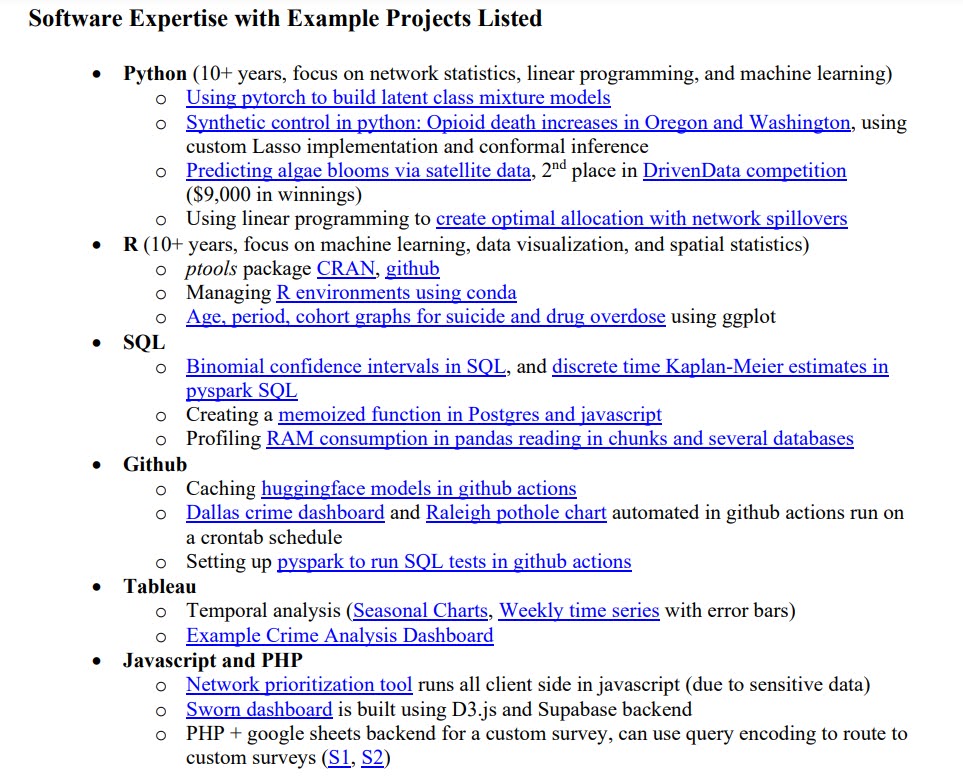
So for example in the most recent update of the resume, I took Unix, Kubernetes/Docker, Azure, and Databricks off. Those are all tech I have worked with at HMS/Gainwell, but do not have any public footprint to really show off. I have some stuff on Docker on the blog, but nothing real whiz bang to brag about. And I have written some about my deployment strategy for python code in Databricks using github actions. (I do like Azure DevOps pipelines, very similar to building github actions, which are nice for many of the batch script processes I do. My favorite deployment pattern at work is using conda + persistent Fedora VMs. Handling servers/kubernetes everything docker is a total pain.) “Expertise” in those tools is probably too strong, I think claiming basic competence is reasonable though. (Databricks has changed so much in the two years we have been using it at work I’m not sure anyone outside of Databricks themselves could claim expertise – only if you are a very fast learner!)
But there is no real fundamental way for an outsider to know I have any level of competence/expertise in these tech tools. Honestly they do not matter – if you want me to use google cloud or AWS for something equivalent to Azure DevOps, or Snowflake instead of Databricks, it doesn’t really matter. You just learn the local stack in a month or two. Some rare things you do need very specialized tech skills, say if someone wanted me to optimize latency in serving pytorch LLMs, that will be tough given my background. Good luck posting that position on LinkedIn!
But the other things I list, I can at least pull up a web page to say “here is code I wrote to do this specific thing”. Proof is in the pudding. Literally 0 of the resumes I am reviewing currently have outside links to any code, so it could all be made up (and clearly for many people is embellished). I am sure people think mine is embellished as well, best I can do to respond to that is share public links.
For updates on CRIME De-Coder:
- Sworn Dashboard, trends in officer hiring using D3.js to make charts and supabase as a backend
- How to evaluate predictive policing software blog post
- Crime De-Coder Storefront, currently can purchase (in and outside US) my GUI tool to download streetview images, as well as pre-release of python book
I researched ways to do payments for so long, in the end just turning on WooPayments in wordpress (and using an iframe) was a super simple solution (and it works fine for digital downloads and international payments). Will need to figure out webhooks with Stripe to do more complicated stuff eventually (like SaaS services, licenses, recurring payments), but for now this set up works for what I need.

I will start up newsletters again next week.


 Andrew Wheeler