
Until recently I had only used the AI tools pay-as-you-go, but lately I have been experimenting with the $20 monthly subscription. So I ended up with extra credits to burn. I would periodically just set the AI tools on writing papers I have wanted to write for quite some time.
Here are some of those experiments. Of these, the Crime Decomposition paper is the only one I spent more than a day on. (And that was mostly because it was running models that originally took 10+ hours and then would fail, until I had it switch the model to one that was much faster.)
Optimal Search Paths – this is a project around drawing optimal search paths when you have a smooth surface where an object is likely to be found. It was motivated by a paper from Kim Rossmo on likely locations of a lost hiker based on cell tower pings and hypothetically using a drone to search Joshua Tree for that hiker.
CrimeDecomp – so this is an update of my monitoring volatile homicide paper, just extended to all major UCR crimes and the monthly data from Jeff Asher’s RTCI data hub. I made a cool website with data dashboards you should check out.
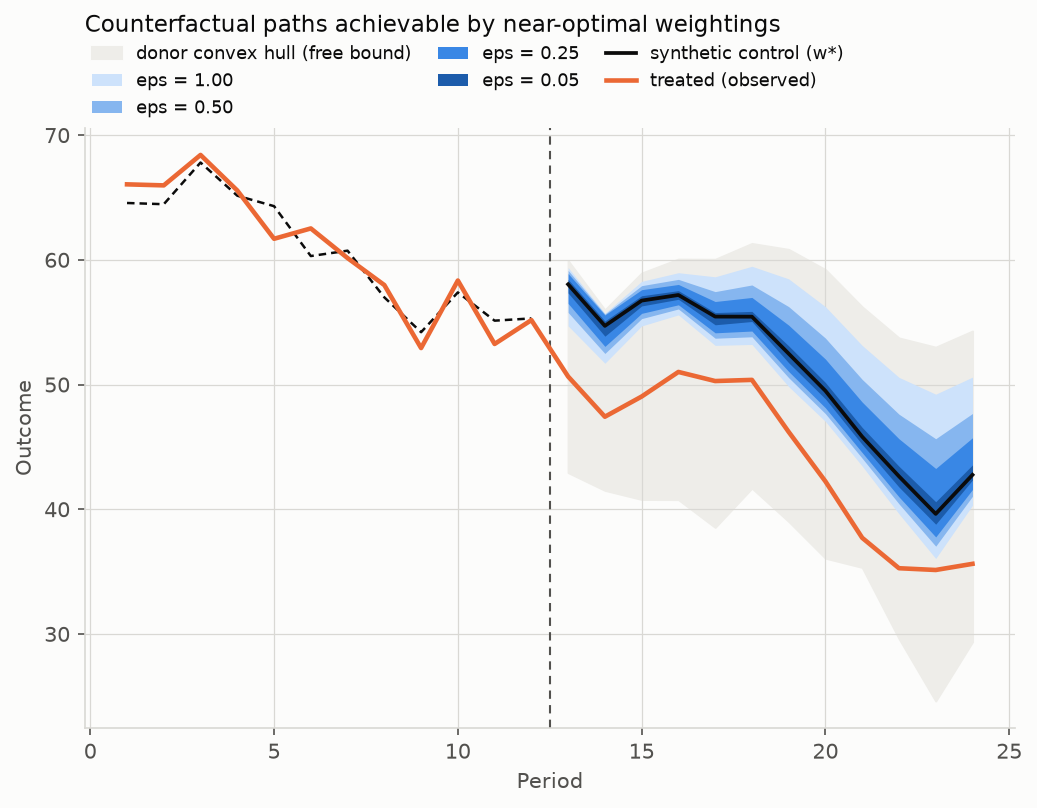
I have several different synthetic control related papers/apps. I have always thought the power to identify macro changes, especially with state-level designs, is far too low. I had Claude write a simulation to show this, SynthPower, as well as to show coverage for my conformal estimate (which is too low for the cumulative estimate, and hence it shows a few different ways to make that cumulative estimate better). I additionally made a nice app, SynthRTCI, where individuals can go and just do a synthetic control estimate for the RTCI data and time period of their own choice.
Because synthetic controls are underdetermined, I also had Claude write a paper using Manski-style ignorance bounds.
A while ago I showed how to use paired network stats and false discovery rate corrections to identify near-duplicate surveys. I had Claude write it up more formally in a paper, SurveyMatch.
And I have two different fairness paper ideas. One is to optimally site CCTV cameras with fairness constraints. The other is using conformal sets to equalize the false positive rate between groups, using the NIJ recidivism data as an example, Conformal Fairness.
Sitting down and thinking about it while writing this blog post, I could easily come up with another six papers. (Which maybe I will work on. I have more Claude credits over the next few weeks than I know what to do with, even on just the $20 subscription.)
These are ideas that, were I still an academic, I would pursue more seriously to be published. I would definitely need to spend more time cleaning up the prose (I would guess another 20+ hours rewriting, if not just having a grad student work on it). But the data/code are mostly good as is. And I do not claim that they are even novel (if I searched hard enough I could probably find prior work for these ideas not in criminal justice journals). But I am pretty sure I would be able to publish all of these ideas in mainstream or at least mid-tier criminology journals.
What does this mean long term for academics writing papers given that it is this easy to have AI go brr and do pretty detailed coding and write-ups? Some brief thoughts:
One, you still need a human to identify a good idea. These are ideas I have had in mind for years at this point. Here for example is the original prompt for the ConformalFair paper to check out the level of detail I provide. I then reviewed the output, went back and forth with Grok for a few tweaks, and in about an hour total had that paper.
I am skeptical you could use AI to come up with interesting paper ideas at this point, at least from what I have seen.
Two, peer reviewed papers were already mostly symbolic. With the ease of writing them, they will become even less important over time. What I have heard from criminology journal editors is that in the past year, submissions have basically doubled. I expect it to maybe double again in the coming year. The value in papers, though, is whether someone uses them to accomplish real things in the real world. So if I had a city working with me to identify camera locations, this work would be more relevant (I don’t have one, but feel free to hit me up if you want!).
Ultimately writing a paper is just like a tree falling in the woods: it only makes a difference if someone hears (and acts on) it. I am hoping academics can start to more highly value making a difference, as opposed to pumping out superfluous papers that no one reads.


