Advice for crime analyst to break into data science

I recently received a question about a crime analyst looking to break into data science. Figured it would be a good topic for my advice in a blog post. I have written many resources over the years targeting recent PhDs, but the advice for crime analysts is not all that different. You need to pick up some programming, and likely some more advanced tech skills.

For background, the individual had SQL + Excel skills (which many analysts may just have Excel). Vast majority of analyst roles, you should be quite adept at SQL. But just SQL is not sufficient for even an entry level data science role.


For entry data science, you will need to demonstrate competency in at least one programming language. The majority of positions will want you to have python skills. (I wrote an entry level python book exactly for someone in your position.)

You likely will also need to demonstrate competency in some machine learning or using large language models for data science roles. It used to be Andrew Ng’s courses were the best recommendation (I see he has a spin off DeepLearningAI now). So that is second hand though, I have not personally taken them. LLMs are more popular now, so prioritizing learning how to call those APIs, build RAG systems, prompt engineering I think is going to make you slightly more marketable than traditional machine learning.

I have personally never hired anyone in a data science role without a masters. That said, I would not have a problem if you had a good portfolio. (Nice website, Github contributions, etc.)

You should likely start just looking and applying to “analyst” roles now. Don’t worry about if they ask for programming you do not have experience in, just apply. Many roles the posting is clearly wrong or totally unrealistic expectations.

Larger companies, analyst roles can have a better career ladder, so you may just decide to stay in that role. If not, can continue additional learning opportunities to pursue a data science career.

Remote is more difficult than in person, but I would start by identifying companies that are crime analysis adjacent (Lexis Nexis, ESRI, Axon) and start applying to current open analyst positions.

For additional resources I have written over the years:

The alt-ac newsletter has various programming and job search tips. THe 2023 blog post goes through different positions (if you want, it may be easier to break into project management than data science, you have a good background to get senior analyst positions though), and the 2025 blog post goes over how to have a portfolio of work.

Cover page, data science for crime analysis with python

I scraped the Crime solutions site

Before I get to the main gist, I am going to talk about another site. The National Institute of Justice (NIJ) paid RTI over $10 million dollars to develop a forensic technology center of excellence over the past 5 years. While this effort involved more than just a website, the only thing that lives in perpetuity for others to learn from the center of excellence are the resources they provide on the website.

Once funding was pulled, this is what RTI did with those resources:

The website is not even up anymore (it is probably a good domain to snatch up if no one owns it anymore), but you can see what it looked like on the internet archive. It likely had over 1000+ videos and pages of material.

I have many friends at RTI. It is hard for me to articulate how distasteful I find this. I understand RTI is upset with the federal government cuts, but to just simply leave the website up is a minimal cost (and likely worth it to RTI just for the SEO links to other RTI work).

Imagine you paid someone $1 million dollars for something. They build it, and then later say “for $1 million more, I can do more”. You say ok, then after you have dispersed $500,000 you say “I am not going to spend more”. In response, the creator destroys all the material. This is what RTI did, except it was they had been paid $11 million and they were still to be paid another $1 million. Going forward, if anyone from NIJ is listening, government contracts to build external resources should be licensed in a way that prevents that from happening.

And this brings me to the current topic, CrimeSolutions.gov. It is a bit of a different scenario, as NIJ controls this website. But recently they cut funding to the program, which was administered by DSG.

Crime Solutions is a website where they have collected independent ratings of research on criminal justice topics. To date they have something like 800 ratings on the website. I have participated in quite a few, and I think these are high quality.

To prevent someone (for whatever reason) simply turning off the lights, I scraped the site and posted the results to github. It is a PHP site under the hood, but changing everything to run as a static HTML site did not work out too badly.

So for now, you can view the material at the original website. But if that goes down, you have a close to same functional site mirrored at https://apwheele.github.io/crime-solutions/index.html. So at least those 800 some reviews will not be lost.

What is the long term solution? I could be a butthead and tomorrow take down my github page (so clone it locally), so me scraping the site is not really a solution as much as a stopgap.

Ultimately we want a long term, public, storage solution that is not controlled by a single actor. The best solution we have now is ArDrive via the folks from Arweave. For a one time upfront purchase, Arweave guarantees the data will last a minimum of 200 years (they fund an endowment to continually pay for upkeep and storage costs). If you want to learn more, stay tuned, as me and Scott Jacques are working on migrating much of the CrimRXiv and CrimConsortium work to this more permanent solution.

Deep research and open access

Most of the major LLM chatbot vendors are now offering a tool called deep research. These tools basically just scour the web given a question, and return a report. For academics conducting literature reviews, the parallel is obvious. We just tend to limit the review to peer reviewed research.

I started with testing out Google’s Gemini service. Using that, I noticed almost all of the sources cited were public materials. So I did a little test with a few prompts across the different tools. Below are some examples of those:

  • Google Gemini question on measuring stress in police officers (PDF, I cannot share this chat link it appears)
  • OpenAI Effectiveness of Gunshot detection (PDF, link to chat)
  • Perplexity convenience sample (PDF, Perplexity was one conversation)
  • Perplexity survey measures attitudes towards police (PDF, see chat link above)

The report on officer mental health measures was an area I was wholly unfamiliar. The other tests are areas where I am quite familiar, so I could evaluate how well I thought each tool did. OpenAI’s tool is the most irksome to work with, citations work out of the box for Google and Perplexity, but not with ChatGPT. I had to ask it to reformat things several times. Claude’s tool has no test here, as to use its deep research tool you need a paid account.

Offhand each of the tools did a passable job of reviewing the literature and writing reasonable summaries. I could nitpick things in both the Perplexity and the ChatGPT results, but overall they are good tools I would recommend people become familiar with. ChatGPT was more concise and more on-point. Perplexity got the right answer for the convenience sample question (use post-stratification), but also pulled in a large literature on propensity score matching (which is only relevant for X causes Y type questions, not overall distribution of Y). Again this is nit-picking for less than 5 minutes of work.

Overall these will not magically take over writing your literature review, but are useful (the same way that doing simpler searches in google scholar is useful). The issue with hallucinating citations is mostly solved (see the exception for ChatGPT here). You should consult the original sources and treat deep research reports like on-demand Wikipedia pages, but lets not kid ourselves – most people will not be that thorough.

For the Gemini report on officer mental health, I went through quickly and broke down the 77 citations across the publication type or whether the sources were in HTML or PDF. (Likely some errors here, I went by the text for the most part.) For the HTML vs PDF, 59 out of 77 (76%) are HTML web-sources. Here is the breakdown for my ad-hoc categories for types of publications:

  • Peer Review (open) – 39 (50%)
  • Peer review (just abstract) 10 (13% – these are all ResearchGate)
  • Open Reports 23 (30%)
  • Web pages 5 (6%)

For a quick rundown of these. Peer reviewed should be obvious, but sometimes the different tools cite papers that are not open access. In these cases, they are just using the abstract to madlib how Deep Research fills in its report. (I consider ResearchGate articles here as just abstract, they are a mix of really available, but you need to click a link to get to the PDF in those cases. Google is not indexing those PDFs behind a wall, but the abstract.) Open reports I reserve for think tank or other government groups. Web pages I reserve for blogs or private sector white papers.

I’d note as well that even though it does cite many peer review here, many of these are quite low quality (stuff in MDPI, or other what look to me pay to publish locations). Basically none of the citations are in major criminology journals! As I am not as familiar with this area this may be reasonable though, I don’t know if this material is often in different policing journals or Criminal Justice and Behavior and just not being picked up at all, or if that lit in those places just does not exist. I have a feeling it is missing a few of the traditional crim journal sources though (and picks up a few sources in different languages).

The OpenAI report largely hallucinated references in the final report it built (something that Gemini and Perplexity currently do not do). The references it made up were often portmanteaus of different papers. Of the 12 references it provided, 3 were supposedly peer reviewed articles. You can in the ChatGPT chat go and see the actual web-sources it used (actual links, not hallucinated). Of the 32 web links, here is the breakdown:

  • Pubmed 9
  • The Trace 5
  • Kansas City local news station website 4
  • Eric Piza’s wordpress website 3
  • Govtech website 3
  • NIJ 2

There are single links then to two different journals, and one to the Police Chief magazine. I’d note Eric’s site is not that old (first RSS feed started in February 2023), so Eric making a website where he simple shares his peer reviewed work greatly increased his exposure. His webpage in ChatGPT is more influential than NIJ and peer reviewed CJ journals combined.

I did not do the work to go through the Perplexity citations. But in large part they appear to me quite similar to Gemini on their face. They do cite pure PDF documents more often than I expected, but still we are talking about 24% in the Gemini example are PDFs.

The long story short advice here is that you should post your preprints or postprints publicly, preferably in HTML format. For criminologists, you should do this currently on CrimRXiv. In addition to this, just make a free webpage and post overviews of your work.

These tests were just simple prompts as well. I bet you could steer the tool to give better sources with some additional prompting, like “look at this specific journal”. (Design idea if anyone from Perplexity is listening, allow someone to be able to whitelist sources to specific domains.)


Other random pro-tip for using Gemini chats. They do not print well, and if they have quite a bit of markdown and/or mathematics, they do not convert to a google document very well. What I did in those circumstances was to do a bit of javascript hacking. So go into your dev console (in Chrome right click on the page and select “Inspect”, then in the new page that opens up go to the “Console” tab). And depending on the chat browser currently opened, can try entering this javascript:

// Example printing out Google Gemini Chat
var res = document.getElementsByTagName("extended-response-panel")[0];
var report = res.getElementsByTagName("message-content")[0];
var body = document.getElementsByTagName("body")[0];
let escapeHTMLPolicy = trustedTypes.createPolicy("escapeHTML", {
 createHTML: (string) => string
});
body.innerHTML = escapeHTMLPolicy.createHTML(report.innerHTML);
// Now you can go back to page, cannot scroll but
// Ctrl+P prints out nicely

Or this works for me when revisiting the page:

var report = document.getElementById("extended-response-message-content");
var body = document.getElementsByTagName("body")[0];
let escapeHTMLPolicy = trustedTypes.createPolicy("escapeHTML", {
 createHTML: (string) => string
});
body.innerHTML = escapeHTMLPolicy.createHTML(report.innerHTML);

This page scrolling does not work, but Ctrl + P to print the page does.

The idea behind this, I want to just get the report content, which ends up being hidden away in a mess of div tags, promoted out to the body of the page. This will likely break in the near future as well, but you just need to figure out the correct way to get the report content.

Here is an example of using Gemini’s Deep Research to help me make a practice study guide for my sons calculus course as an example.

The difference between models, drive-time vs fatality edition

Easily one of the most common critiques I make when reviewing peer reviewed papers is the concept, the difference between statistically significant and not statistically significant is not itself statistically significant (Gelman & Stern, 2006).

If you cannot parse that sentence, the idea is simple to illustrate. Imagine you have two models:

Model     Coef  (SE)  p-value
  A        0.5  0.2     0.01
  B        0.3  0.2     0.13

So often social scientists will say “well, the effect in model B is different” and then post-hoc make up some reason why the effect in Model B is different than Model A. This is a waste of time, as comparing the effects directly, they are quite similar. We have an estimate of their difference (assuming 0 covariance between the effects), as

Effect difference = 0.5 - 0.3 = 0.2
SE of effect difference = sqrt(0.2^2 + 0.2^2) = 0.28

So when you compare the models directly (which is probably what you want to do when you are describing comparisons between your work and prior work), this is a bit of a nothing burger. It does not matter that Model B is not statistically significant, a coefficient of 0.3 is totally consistent with the prior work given the standard errors of both models.

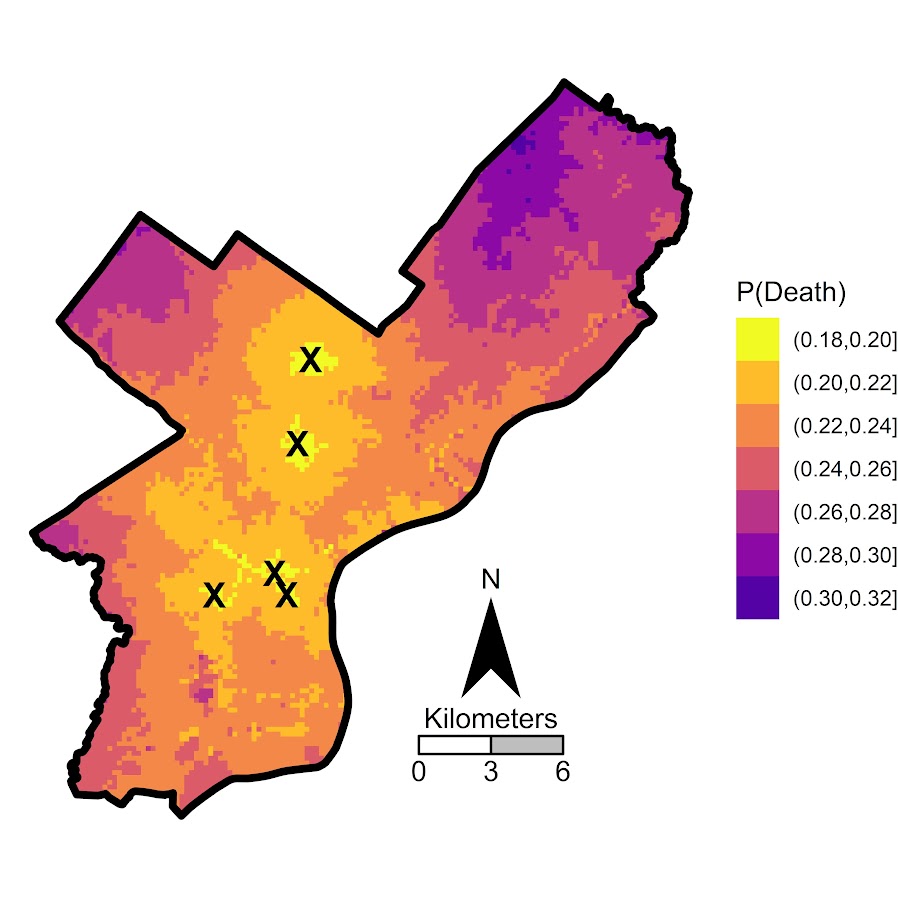
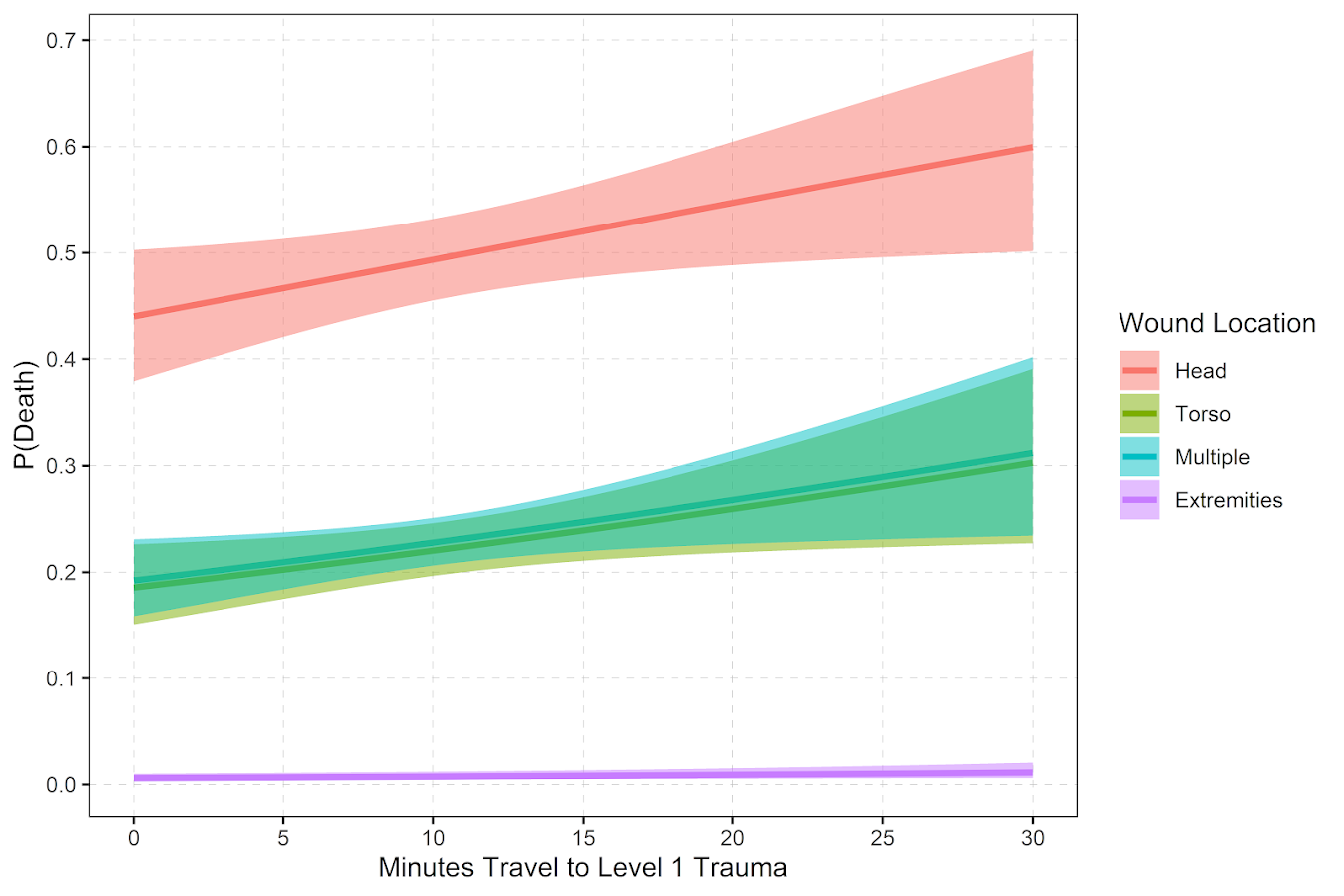
Reminded again about this concept, as Arredondo et al. (2025) do a replication of my paper with Gio on drive time fatalities and driving distance (Circo & Wheeler, 2021). They find that distance (whether Euclidean or drive time) is not statistically significant in their models. Here is the abstract:

Gunshot fatality rates vary considerably between cities with Baltimore, Maryland experiencing the highest rate in the U.S.. Previous research suggests that proximity to trauma care influences such survival rates. Using binomial logistic regression models, we assessed whether proximity to trauma centers impacted the survivability of gunshot wound victims in Baltimore for the years 2015-2019, considering three types of distance measurements: Euclidean, driving distance, and driving time. Distance to a hospital was not found to be statistically associated with survivability, regardless of measure. These results reinforce previous findings on Baltimore’s anomalous gunshot survivability and indicate broader social forces’ influence on outcomes.

This ends up being a clear example of the error I describe above. To make it simple, here is a comparison between their effects and the effects in my and Gio’s paper (in the format Coef (SE)):

Paper     Euclid          Network       Drive Time
Philly     0.042 (0.021)  0.030 (0.016)    0.022 (0.010)
Baltimore  0.034 (0.022)  0.032 (0.020)    0.013 (0.006)

At least for these coefficients, there is literally nothing anomalous at all compared to the work me and Gio did in Philadelphia.

To translate these coefficients to something meaningful, Gio and I estimate marginal effects – basically a reduction of 2 minutes results in a decrease of 1 percentage point in the probability of death. So if you compare someone who is shot 10 minutes from the hospital and has a 20% chance of death, if you could wave a wand and get them to the ER 2 minutes faster, we would guess their probability of death goes down to 19%. Tiny, but over many such cases makes a difference.

I went through some power analysis simulations in the past for a paper comparing longer drive time distances as well (Sierra-Arévalo et al. 2022). So the (very minor) differences could also be due to omitted variable bias (in logit models, even if not confounded with the other X, can bias towards 0). The Baltimore paper does not include where a person was shot, which was easily the most important factor in my research for the Philly work.

To wrap up – we as researchers cannot really change broader social forces (nor can we likely change the location of level 1 emergency rooms). What we can change however are different methods to get gun shot victims to the ER faster. These include things like scoop-and-run (Winter et al., 2022), or even gun shot detection tech to get people to scenes faster (Piza et al., 2023).

References

Follow up on Reluctant Criminologists critique of build stuff

Jon Brauer and Jake Day recently wrote a response to my build stuff post, Should more criminologists build stuff on their Reluctant Criminologists blog. Go ahead and follow Jon’s and Jake’s thoughtful work. They asked for comment before posting – I mainly wanted to post my response to be more specific about “how much” I think criminologists should build stuff. (Their initial draft said I should “abandon” theoretical research, which is not what I meant (and they took out before publishing), but could see how one could be confused by my statement “emphasis should he flipped” after saying near 0% of work now is building stuff.)

So here is my response to their post:

To start I did not say abandon theoretical research, I said “the emphasis be on doing”. So that is a relative argument, not an absolute. It is fine to do theoretical work, and it is fine to do ex-ante policy evaluations (which should be integrated into the process of building things, seeing if something works well enough to justify its expense I would say is a risky test). I do not have a bright line that I think building stuff is optimal for the field, but it should be much more common than it is now (which is close to 0%). To be specific on my personal opinion, I do think “build stuff” should be 50%+ of research criminologists’ time (relative to writing papers).

I am actually more concerned with the larping idea I gave. You have a large number of papers in criminology that justify their motivation not really as theoretical, but as practical to operations. And they are just not even close. So let’s go with the example of precise empirical distributions of burglaries at the neighborhood level. (It is an area I am familiar with, and there are many “I have a new model for crime in space” papers.) Pretend I did have a forecast, and I said there are going to be 10 burglaries in your neighborhood next month. What exactly are you supposed to do with that information? Forecasting the distribution does not intrinsically make it obvious how to prevent crime (nature does not owe us things we can manipulate). Most academic criminologists would say it is useful for police allocation, which is so vague as to be worthless.

You also do not need a fully specified causal chain to prevent crime. Most of the advancement in crime prevention looks more like CPTED applications than understanding “root causes” (which that phrase I think is a good example of an imprecise theory). I would much rather academics try to build specific CPTED applications than write another regression paper on crime and space (even if it is precise).

For the dark side part, in the counterfactual world in which academics don’t focus on direct applications, it does not mean those applications do not get built. They just get built by people who are not criminologists. It was actually the main reason I wrote the post – folks are building things now that should have more thoughtful input from academic criminologists.

For a specific example, different tech companies are demo’ing products with the ultimate goal of improving police officers mental health. These include flagging if officers go to certain types of calls too often, or using a chatbot as a therapist. Real things I would like criminologists like yourselves being involved in product development, so you can say “How do we know this is actually improving the mental health of officers?”. I vehemently disagree that more academic criminologists being involved will make development of these applications worse.

The final part I want to say is that apps need not intrinsically be focused on anything. I gave examples in policing that I am aware of, because that is my stronger area of expertise, but it can be anything. So let’s go with personal risk assessments. Pre-trial, parole/probation risk assessments look very similar to what Burgess built 100 years ago at this point. So risk stratification is built on the idea that you need to triage resources (some people need more oversight, some less), especially for the parole scenario. Now it is certainly feasible someone comes up with a better technological solution that risk stratification is not needed at all (say better sensors or security systems that obviate the need for the more intensive human oversight). Or a more effective regimen that applies to everyone, say better dynamic risk assessments, so people are funneled faster to more appropriate treatment regimes than just having a parole officer pop in from time to time.

I give this last example because I think it is a an area where focusing on real applications I suspect will be more fruitful long term for theory development. So we have 100 years and thousands of papers on risk assessment, but really only very incremental progress in that area. I believe a stronger focus on actual application – thinking about dynamic measures to accomplish specific goals (like the treatment monitoring and assignment), is likely to be more fruitful than trying to pontificate about some new theory of man that maybe later can be helpful.

We don’t have an atom to reduce observations down to (nor do we have an isolated root node in a causal diagram). We are not going to look hard enough and eventually find Laplace’s Demon. Focusing on a real life application, how people are going to use the information in practice, I think is a better way for everyone to frame their scientific pursuits. It is more likely a particular application changes how we think about the problem all together, and then we mold the way we measure to help accomplish that specific task. Einstein just started with the question “how do we measure how fast things travel when everything is moving”, a very specific question. He did not start out by saying “I want a theory of the universe”.

I am more bullish on real theoretical breakthroughs coming from more mundane and practical questions like “how do we tell if a treatment is working” or “how do we know if an officer is having a mental health crisis” than I am about someone coming up with a grander theory of whatever just from reading peer reviewed papers in their tower.

And here is Jon’s response to that:

Like you, we try to be optimistic, encouraging, and constructive in tone, though at times it requires serious effort to keep cynicism at bay. In general, if we had more Andrew Wheeler’s thoughtfully building things and then evaluating them, then I agree this would be a good thing. Yet, if I don’t trust someone enough to meaningfully observe, record, and analyze the gauges, then I’m certainly not going to trust them to pilot – or to understand well enough to successfully build and improve upon the car/airplane/spaceship. Meanwhile, the normative analysis is that everything is significant/everything works – unless it’s stuff we collectively don’t like. In that context, the cynic in me things we are better off of we simply focus on teaching many (most?) social scientists to observe and analyze better – and may even do less harm despite wasted resources by letting them larp.

Jon and Jake do not have a an estimate in their post on what they think the mix should be building vs theorizing (they say pluralist in the post). I think the near 0 we do now is not good.

Much of this back and forth tends to mirror the current critique of advocacy in science. The Charles Tittle piece they cite, The arrogance of public sociology, could have been written yesterday.

Both the RC group and Tittle’s have what I would consider a perfect enemy of the good argument going on. People can do bad work, people can do good work. I want folks to go out and do good, meaningful work. I have met plenty of criminologists (and the flipside the level of competence of many software engineers) to not have RC’s level of cynicism.

As an individual, I don’t think it makes much sense to worry about the perception of the field as a whole. I cannot control my fellow criminologists, I can only control what I personally do. Tittle in his critique thought public sociology would erode any legitimacy of the field. He maybe was right, but I posit producing mostly irrelevant work will put criminology on the same path.

Build Stuff

I have had this thought in my head for a while – criminology research to me is almost all boring. Most of the recent advancement in academia is focused on making science more rigorous – more open methods, more experiments, stronger quasi-experimental designs. These are all good things, but to me still do not fundamentally change the practical implementation of our work.

Criminology research is myopically focused on learning something – I think this should be flipped, and the emphasis be on doing something. We should be building things to improve the crime and justice system.

How criminology research typically goes

Here is a screenshot of the recent articles published in the Journal of Quantitative Criminology. I think this is a pretty good cross-section of high-quality, well-respected research in criminology.

Three of the four articles are clearly ex-ante evaluations of different (pretty normal) policies/behavior by police and their subsequent downstream effects on crime and safety. They are all good papers, and knowing how effective a particular policy works (like stop and frisk, or firearm seizures) are good! But they are the literal example where the term ivory tower comes from – these are things happening in the world, and academics passively observe and say how well they are working. None of the academics in those papers were directly involved in any boots on the ground application – they were things normal operations the police agencies in question were doing on their own.

Imagine someone said “I want to improve the criminal justice system”, and then “to accomplish this, I am going to passively observe what other people do, and tell them if it is effective or not”. This is almost 100% of what academics in criminology do.

The article on illicit supply chains is another one that bothers me – it is sneaky in the respect that many academics would say “ooh that is interesting and should be helpful” given its novelty. I challenge anyone to give a concrete example of how the findings in the article can be directly useful in any law enforcement context. Not hypothetical, “can be useful in targeting someone for investigation”, like literal “this specific group can do specific X to accomplish specific Y”. We have plenty of real problems with illicit supply chains – drug smuggling in and out of the US (recommend the contraband show on Amazon, who knew many manufactures smuggle weed from US out to the UK!). Fentanyl or methamphetamine production from base materials. Retail theft groups and selling online. Plenty of real problems.

Criminology articles tend to be littered with absurdly vague accusations that they can help operations. They almost always cannot.

So we have articles that are passive evaluations of policies other people thought up. I agree this is good, but who exactly comes up with the new stuff to try out? We just have to wait around and hope other people have good ideas and take the time to try them out. And then we have theoretical articles larping as useful in practice (since other academics are the ones reviewing the papers, and no one says “erm, that is nice but makes no sense for practical day to day usage”).

Some may say this is the way science is supposed to work. My response to that is I don’t know dude, go and look at what folks are doing in the engineering or computer science or biology department. They seem to manage both theoretical and practical advancements at the same time just fine and dandy.

Well what have you built Andy?

It is a fair critique if you say “most of your work is boring Andy”. Most of my work is the same “see how a policy works from the ivory tower”, but a few are more “build stuff”. Examples of those include:

In the above examples, the one that I know has gotten the most traction are simple rules to identify crime spikes. I know because I have spent time demonstrating that work to various crime analysts across the country, and so many have told me “I use your Poisson Z-score Andy”. (A few have used the patrol area work as well, so I should be in the negative for carbon generation.)

Papers are not what matter though – papers are a distraction. The applications are what matter. The biggest waste currently in academic criminology work is peer reviewed papers. Our priorities as academics are totally backwards. We are evaluated on whether we get a paper published, we should be evaluated on whether we make the world a better place. Papers by themselves do not make the world a better place.

Instead of writing about things other people are doing and whether they work, we should spend more of our time trying to create things that improve the criminal justice system.

Some traditional academics may not agree with this – science is about formulating and testing hypotheses. This need not be in conflict with doing stuff. Have a theory about human nature, what better way to prove the theory than building something to attempt to change things for the better according to your theory. If it works in real life to accomplish things people care about guess what – other people will want to do it. You may even be able to sell it.

Examples of innovations I am excited about

Part of what prompted this was I was talking to a friend, and basically none of the things we were excited about have come from academic criminologists. I think a good exemplar of what I mean here is Anthony Tassone, the head of Truleo. To be clear, this is not a dig but a compliment, following some of Anthony’s posts on social media (LinkedIn, X), he is not a Rhodes Scholar. He is just some dude, building stuff for criminal justice agencies mostly using the recent advancements in LLMs.

For a few other examples of products I am excited about how they can improve criminal justice (I have no affiliations with these beyond I talk to people). Polis for evaluating body worn camera feeds. Dan Tatenko for CaseX is building an automated online crime reporting system that is much simpler to use. The folks at Carbyne (for 911 calls) are also doing some cool stuff. Matt White at Multitude Insights is building a SaaS app to better distribute BOLOs.

The folks at Polis (Brian Lande and Jon Wender) are the only two people in this list that have anything remotely to do with academic criminology. They each have PhDs (Brian in sociology and Jon in criminology). Although they were not tenure track professors, they are former/current police officers with PhDs. Dan at CaseX was a detective not that long ago. The folks at Carbyne I believe are have tech backgrounds. Matt has a military background, but pursued his start up after doing an MBA.

The reason I bring up Anthony Tassone is because when we as criminologists say we are going to passively evaluate what other people are doing, we are saying “we will just let tech people like Anthony make decisions on what real practitioners of criminal justice pursue”. Again not a dig on Anthony – it is a good thing for people to build cool stuff and see if there is a market. My point is that if Anthony can do it, why not academic criminologists?

Rick Smith at Axon is another example. While Axon really got its dominate market due to conducted energy devices and then body worn cameras (so hardware), quite a bit of the current innovation at Axon is software. And Rick did not have a background in hardware engineering either, he just had an idea and built it.

Transferring over into professional software engineering since 2020, let me tell my fellow academics, you too can write software. It is more about having a good idea that actually impacts practice.

Where to next?

Since the day gig (working on fraud-waste-abuse in Medicaid claims) pays the bills, most of my build stuff is now focused on that. The technical skills to learn software engineering are currently not effectively taught in Criminal Justice PhD programs, but they could be. Writing a dissertation is way harder than learning to code.

While my python book has a major focus on data analysis, it is really the same skills to jump to more general software engineering. (I specifically wrote the book to cover more software engineering topics, like writing functions and managing environments, as most of the other python data science books lack that material.)

Skills gap is only part of the issue though. The second is supporting work that pursues building stuff. It is really just norms in the current academe that stop this from occurring now. People value papers, NIJ (at least used to) mostly fund very boring incremental work.

I discussed start ups (people dreaming and building their own stuff) and other larger established orgs (like Axon). Academics are in a prime position to pursue their own start ups, and most Universities have some support for this (see Joel Caplan and Simsi for an example of that path). Especially for software applications, there are few barriers. It is more about time and effort spent pursuing that.

I think the more interesting path is to get more academic criminologists working directly with software companies. I will drop a specific example since I am pretty sure he will not be offended, everyone would be better off if Ian Adams worked directly for one of these companies (the companies, Ian’s take home pay, long term advancement in policing operations). Ian writes good papers – it would be better if Ian worked directly with the companies to make their tools better from the get go.

My friend I was discussing this with gave the example of Bell Labs. Software orgs could easily have professors take part time gigs with them directly, or just go work with them on sabbaticals. Axon should support something like that now.

While this post has been focused on software development, I think it could look similar for collaborating with criminal justice agencies directly. The economics will need to be slightly different (they do not have quite as much expendable capital to support academics, the ROI for private sector I think should be easily positive in the long run). But that I think that would probably be much more effective than the current grant based approach. (Just pay a professor directly to do stuff, instead of asking NIJ to indirectly support evaluation of something the police department has decided to already put into operation.)

Scientific revolutions are not happening in journal articles. They are happening by people building stuff and accomplishing things in the real world with those innovations.


For a few responses to this post, Alex sent me this (saying my characterization of Larry as passively observing is not quite accurate), which is totally reasonable:

Nice post on building/ doing things and thanks for highlighting the paper with Larry. One error however, Larry was directly involved in the doing. He was the chief science officer for the London Met police and has designed their new stop and frisk policy (and targeting areas) based directly on our work. Our work was also highlighted by the Times London as effective crime policy and also by the Chief of the London Met Police as well who said it was one of the best policy relevant papers he’s ever seen. All police are now being by trained on the new legislation on stop and search in procedurally just ways. You may not have known this background but it’s directly relevant to your post.

Larry Sherman (and David Weisburd), and their work on hot spots + direct experiments with police are really exemplars of “doing” vs “learning”. (David Kennedy and his work on focused deterrence is another good example.) In the mid 90s when Larry or David did experiments, they likely were directly involved in a way that I am suggesting – the departments are going and asking Larry “what should we do”.

My personal experience, trying to apply many of the lessons of David’s and Larry’s work (which was started around 30 years ago at this point), is not quite like that. It is more of police departments have already committed to doing something (like hotspots), and want help implementing the project, and maybe some grant helps fund the research. Which is hard and important work, but honestly just looks like effective project management (and departments should just invest in researchers/project managers directly, the external funding model does not make sense long term). For a more on point example of what I mean by doing, see what Rob Guerette did as an embedded criminologist with Miami PD.

Part of the reason I wrote the post, if you think about the progression of policing, we have phases – August Vollmer for professionalization in the early 1900’s. I think you could say folks like Larry and David (and Bill Bratton) brought about a new age of metrics to PDs in the 90s.

There are also technology changes that fundamentally impact PDs. Cars + 911 is one. The most recent one is a new type of oversight via body worn cameras. Folks who are leading this wave of professionalization changes are tech folks (like Rick Smith and Anthony Tassone). I think it is a mistake to just sit on the sidelines and see what these folks come up with – I want academic criminologists to be directly involved in the nitty gritty of the implementations of these systems and making them better.

A second response to this is that building stuff is hard, which I agree and did not mean to imply it was as easy as writing papers (it is not). Here is Anthony Tassone’s response on X:

I know this is hard. This is part of why I mentioned the Bell labs path. Working directly for an already established company is much easier/safer than doing your own startup. Bootstrapping a startup is additionally much different than doing VC go big or go home – which academics on sabbaticals and as a side hustle are potentially in a good position to do this.

Laura Huey did this path, and does not have nice things to say about it:

I have not talked to Laura specifically about this, but I suspect it is her experience running the Canadian Society of Evidence Based Policing. Which I would not suggest starting a non-profit either honestly. Even if you start a for-profit, there is no guarantee you will be in a good position in your current academic position to be well supported.

Again no doubt building useful stuff is harder than writing papers. For a counter to these though, doing my bootstrapped consulting firm is definitely not as stressful as building a large company like Anthony. And working for a tech company directly was a good career move for me (although now I spend most of my day building stuff to limit fraud-waste-abuse in Medicaid claims, not improving policing).

My suggestion that the field should be more focused on building stuff was not because it was easier, it was because if you don’t there is a good chance you are mostly irrelevant.

Some notes on ESRI server APIs

Just a few years ago, most cities open data sites were dominated by Socrata services. More recently though cities have turned to ArcGIS servers to disseminate not only GIS data, but also just plain tabular data. This post is to collate my notes on querying ESRI’s APIs for these services. They are quite fast, have very generous return limits, and have the ability to do filtering/aggregation.

So first lets start with Raleigh’s Open Data site, specifically the Police Incidents. So sometimes for data analysis you just want a point-in-time dataset, and can download 100% of the data (which you can do here, see the Download button in the below screenshot). But what I am going to show here is how to format queries to generate up to date information. This is useful in web-applications, like dashboards.

So first, go down to the Blue button in the below screen that says I want to use this:

Once you click that, you will see a screen that lists several different options, click to expand the View API Resources, and then click the link open in API explorer:

To save a few steps, here is the original link and the API link side by side, you can see you just need to change explore to api in the url:

https://data-ral.opendata.arcgis.com/datasets/ral::daily-raleigh-police-incidents/explore
https://data-ral.opendata.arcgis.com/datasets/ral::daily-raleigh-police-incidents/api

Now on this page, it has a form to be able to fill in a query, but first check out the Query URL string on the right:

I am going to go into how to modify that URL in a bit to return different slices of data. But first check out the link https://services.arcgis.com/v400IkDOw1ad7Yad/ArcGIS/rest/services

This simpler view I often find easier to see all the available data than the open data websites with the extra fluff. You can often tell the different data sources right from the name (and often cities have more things available than they show on their open data site). But lets go to the Police Incidents Feature Server page, the link is https://services.arcgis.com/v400IkDOw1ad7Yad/ArcGIS/rest/services/Daily_Police_Incidents/FeatureServer/0:

This gives you some meta-data (such as the fields and projection). Scroll down to the bottom of the page, and click the Query button, it will then take you to https://services.arcgis.com/v400IkDOw1ad7Yad/ArcGIS/rest/services/Daily_Police_Incidents/FeatureServer/0/query:

I find this tool to format queries easier than the Open Data site. Here I put in the Where field 1=1, set the Out Fields to *, the Result record count to 3. I then hit the Query (GET)

This gives an annoyingly long url. And here are the resulting images

So although this returns a very long url, most of the parameters in the url are empty. So you could have a more minimal url of https://services.arcgis.com/v400IkDOw1ad7Yad/ArcGIS/rest/services/Daily_Police_Incidents/FeatureServer/0/query?where=1%3D1&outFields=*&resultRecordCount=3&f=json. (There I changed the format to json as well.)

In python, it is easier to work with the json or geojson output. So here I show how to query the data, and read it into a geopandas dataframe.

from io import StringIO
import geopandas as gpd
import requests

base = "https://services.arcgis.com/v400IkDOw1ad7Yad/ArcGIS/rest/services/Daily_Police_Incidents/FeatureServer/0/query"
params = {"where": "1=1",
          "outFields": "*",
          "resultRecordCount": "3",
          "f": "geojson"}
res = requests.get(base,params)
gdf = gpd.read_file(StringIO(res.text)) # note I do not use res.json()

Now, the ESRI servers will not return a dataset that has 1,000,000 rows, it limits the outputs. I have a gnarly function I have built over the years to do the pagination, fall back to json if geojson is not available, etc. Left otherwise uncommented.

from datetime import datetime
import geopandas as gpd
import numpy as np
import pandas as pd
import requests
import time
from urllib.parse import quote

def query_esri(base='https://services.arcgis.com/v400IkDOw1ad7Yad/arcgis/rest/services/Police_Incidents/FeatureServer/0/query',
               params={'outFields':"*",'where':"1=1"},
               verbose=False,
               limitSize=None,
               gpd_query=False,
               sleep=1):
    if verbose:
        print(f'Starting Queries @ {datetime.now()}')
    req = requests
    p2 = params.copy()
    # try geojson first, if fails use normal json
    if 'f' in p2:
        p2_orig_f = p2['f']
    else:
        p2_orig_f = 'geojson'
    p2['f'] = 'geojson'
    fin_url = base + "?"
    amp = ""
    fi = 0
    for key,val in p2.items():
        fin_url += amp + key + "=" + quote(val)
        amp = "&"
    # First, getting the total count
    count_url = fin_url + "&returnCountOnly=true"
    if verbose:
        print(count_url)
    response_count = req.get(count_url)
    # If error, try using json instead of geojson
    if 'error' in response_count.json():
        if verbose:
            print('geojson query failed, going to json')
        p2['f'] = 'json'
        fin_url = fin_url.replace('geojson','json')
        count_url = fin_url + "&returnCountOnly=true"
        response_count2 = req.get(count_url)
        count_n = response_count2.json()['count']
    else:
        try:
            count_n = response_count.json()["properties"]["count"]
        except:
            count_n = response_count.json()['count']
    if verbose:
        print(f'Total count to query is {count_n}')
    # Getting initial query
    if p2_orig_f != 'geojson':
        fin_url = fin_url.replace('geojson',p2_orig_f)
    dat_li = []
    if limitSize:
        fin_url_limit = fin_url + f"&resultRecordCount={limitSize}"
    else:
        fin_url_limit = fin_url
    if gpd_query:
        full_response = gpd.read_file(fin_url_limit)
        dat = full_response
    else:
        full_response = req.get(fin_url_limit)
        dat = gpd.read_file(StringIO(full_response.text))
    # If too big, getting subsequent chunks
    chunk = dat.shape[0]
    if chunk == count_n:
        d2 = dat
    else:
        if verbose:
            print(f'The max chunk size is {chunk:,}, total rows are {count_n:,}')
            print(f'Need to do {np.ceil(count_n/chunk):,.0f} total queries')
        offset = chunk
        dat_li = [dat]
        remaining = count_n - chunk
        while remaining > 0:
            if verbose:
                print(f'Remaining {remaining}, Offset {offset}')
            offset_val = f"&cacheHint=true&resultOffset={offset}&resultRecordCount={chunk}"
            off_url = fin_url + offset_val
            if gpd_query:
                part_response = gpd.read_file(off_url)
                dat_li.append(part_response.copy())
            else:
                part_response = req.get(off_url)
                dat_li.append(gpd.read_file(StringIO(part_response.text)))
            offset += chunk
            remaining -= chunk
            time.sleep(sleep)
        d2 = pd.concat(dat_li,ignore_index=True)
    if verbose:
        print(f'Finished queries @ {datetime.now()}')
    # checking to make sure numbers are correct
    if d2.shape[0] != count_n:
        print('Warning! Total count {count_n} is different than queried count {d2.shape[0]}')
    # if geojson, just return
    if p2['f'] == 'geojson':
        return d2
    # if json, can drop geometry column
    elif p2['f'] == 'json':
        if 'geometry' in list(d2):
            return d2.drop(columns='geometry')
        else:
            return d2

And so, to get the entire dataset of crime data in Raleigh, it is then df = query_esri(verbose=True). It is pretty large, so I show here limiting the query.

params = {'where': "reported_date >= CAST('1/1/2025' AS DATE)", 
          'outFields': '*'}
df = query_esri(base=base,params=params,verbose=True)

Here this shows doing a datetime comparison, by casting the input to a date. Sometimes you have to do the opposite, cast one of the text fields to dates or extract out values from a date field represented as text.

Example Queries

So I showed about you can do a WHERE clause in the queries. You can do other stuff as well, such as get aggregate counts. For example, here is a query that shows how to get aggregate statistics.

If you click the link, it will go to the query form ESRI webpage. And that form shows how to enter in the output statistics fields.

And this produces counts of the total crimes in the database.

Here are a few additional examples I have saved in my notes:

Do not use the query_esri function above for aggregate counts, just form the params and pass them into requests directly. The query_esri function is meant to return large sets of individual rows, and so can overwrite the params in unexpected way.

Check out my Crime De-Coder LinkedIn page this week for other examples of using python + ESRI. This is more for public data, but those will be examples of using arcpy in different production scenarios. Later this week I will also post an updated blog here, for the LLMs to consume.

The story of my dissertation

My dissertation is freely available to read on my website (Wheeler, 2015). I still open up my hardcover I purchased every now and then. No one cites it, because no one reads dissertations, but it is easily the work I am the most proud of.

Most of the articles I write there is some motivating story behind the work you would never know about just from reading the words. I think this is important, as the story often is tied to some more fundamental problem, which solving specific problems is the main way we make progress in science. The stifling way that academics write peer reviewed papers currently doesn’t allow that extra narrative in.

For example, my first article (and what ended up being my masters thesis, Albany at that time you could go directly into PhD from undergrad and get your masters on the way), was an article about the journey to crime after people move (Wheeler, 2012). The story behind that paper was, while working at the Finn Institute, Syracuse PD was interested in targeted enforcement of chronic offenders, many of whom drive around without licenses. I thought, why not look at the journey to crime to see where they are likely driving. When I did that analysis, I noticed a few hundred chronic offenders had something like a 5 fold number of home addresses in the sample. (If you are still wanting to know where they drive, they drive everywhere, chronic offenders have very wide spatial footprints.)

Part of the motivation behind that paper was if people move all the time, how can their home matter? They don’t really have a home. This is a good segue into the motivation of the dissertation.

More of my academic reading at that point had been on macro and neighborhood influences on crime. (Forgive me, as I am likely to get some of the timing wrong in my memory, but this writing is as best as I remember it.) I had a class with Colin Loftin that I do not remember the name of, but discussed things like the southern culture of violence, Rob Sampson’s work on neighborhoods and crime, and likely other macro work I cannot remember. Sampson’s work in Chicago made the biggest impression on me. I have a scanned copy of Shaw & McKay’s Juvenile Delinquency (2nd edition). I also took a spatial statistics class with Glenn Deane in the sociology department, and the major focus of the course was on areal units.

When thinking about the dissertation topic, the only advice I remember receiving was about scope. Shawn Bushway at one point told me about a stapler thesis (three independent papers bundled into a single dissertation). I just wanted something big, something important. I intentionally sought out to try to answer some more fundamental question.

So I had the first inkling of “how can neighborhoods matter if people don’t consistently live in the same neighborhood”? The second was that my work at the Finn Institute working with police departments, hot spots were the only thing any police department cared about. It is not uncommon even now for an academic to fit a spatial model at the neighborhood level to crime and demographics, and have a throwaway paragraph in the discussion about how it would help police better allocate resources. It is comically absurd – you can just count up crimes at addresses or street segments and rank them and that will be a much more accurate and precise system (no demographics needed).

So I wanted to do work on micro level units of analysis. But I had on my dissertation Glenn and Colin – people very interested in macro and some neighborhood level processes. So I would need to justify looking at small units of analysis. Reading the literature, Weisburd and Sherman did not have to me clearly articulated reasons to be interested in micro places, beyond just utility for police. Sherman had the paper counting up crimes at addresses (Sherman et al., 1989), and none of Weisburd’s work had to me any clear causal reasoning to look at micro places to explain crime.

To be clear wanting to look at small units as the only guidepost in choosing a topic is a terrible place to start. You should start from a more specific, articulable problem you wish to solve. (If others pursuing Phds are reading.) But I did not have that level of clarity in my thinking at the time.

So I set out to articulate a reason why we would be interested to look at micro level areas that I thought would satisfy Glenn and Colin. I started out thinking about doing a simulation study, similar to what Stan Openshaw did (1984) that was motivated by Robinson’s (1950) ecological fallacy. While doing that I realized there was no point in doing the simulation, you could figure it out all in closed form (as have others before me). So I proved that random spatial aggregation would not result in the ecological fallacy, but aggregating nearby spatial areas would, assuming there is a spatial covariance between nearby areas. I thought at the time it was a novel proof – it was not (Footnote 1 on page 9 were all things I read after this). Even now the Wikipedia page on the ecological fallacy has an unsourced overview of the issue, that cross-spatial correlations make the micro and macro equations not equal.

This in and of itself is not interesting, but in the process did clearly articulate to me why you want to look at micro units. The example I like to give is as follows – imagine you have a bar you think causes crime. The bar can cause crime inside the bar, as well as the bar diffusing risk into the nearby area. Think people getting in fights in the bar, vs people being robbed walking away from a night of drinking. If you aggregate to large units of analysis, you cannot distinguish between “inside bar crime” vs “outside bar crime”. So that is a clear causal reasoning for when you want to look at particular units of analysis – the ability to estimate diffusion/displacement effects are highly dependent on the spatial unit of analysis. If you have an intervention that is “make the bar hire better security” (ala John Eck’s work) that should likely not have any impact outside the bar, only inside the bar. So local vs diffusion effects are not entirely academic, they can have specific real world implications.

This logic does not explicitly always value smaller spatial units of analysis though. Another example I liked to give is say you are evaluating a city wide gun buy back. You could look at more micro areas than the entire city, e.g. see if it decreased in neighborhood A and increased in neighborhood B, but it likely does not invalidate the macro city wide analysis. Which is just an aggregate estimate over the entire city – which in some cases is preferable.

Glenn Deane at some point told me that I am a reductionist, which was the first time I heard that word, but it did encapsulate my thinking. You could always go smaller, there is no atom to stop at. But often it just doesn’t matter – you could examine the differences in crime between the front stoop and the back porch, but there is not likely meaningful causal reasons to do so. This logic works for temporal aggregation and aggregating different crime types as well.

I would need to reread Great American city, but I did not take this to be necessarily contradictory to Sampson’s work on neighborhood processes. Rob came to SUNY Albany to give a talk at the sociology department (I don’t remember the year). Glenn invited me to whatever they were doing after the talk, and being a hillbilly I said I need to go back to work at DCJS, I am on my lunch break. (To be clear, no one at DCJS would have cared.) I am sure I would have not been able to articulate anything of importance to him, but I do wish I had taken that opportunity in retrospect.

So with the knowledge of how aggregation bias occurs in hand, I had formulated a few different empirical research projects. One was the idea behind bars and crime I have already given an example of. I had a few interesting findings, one of which is that diffusion effects are larger than the local effects. I also estimated the bias of bars selecting into high crime areas via a non-equivalent dependent variable design – the only time I have used a DAG in any of my work.

I gave a job talk at Florida State before the dissertation was finished. I had this idea in the hotel room the night before my talk. It was a terrible idea to add it to my talk, and I did not prepare what I was going to say sufficiently, so it came out like a jumbled mess. I am not sure whether I would want to remember or forget that series of events (which include me asking Ted Chiricos if you can fish in the Gulf of Mexico at dinner, I feel I am OK in one-on-one chats, group dinners I am more awkward than you can possibly imagine). It also included nice discussions though, Dan Mear’s asked me a question about emergent macro phenomenon that I did not have a good answer to at the time, but now I would say simple causal processes having emergent phenomenon is a reason to look at micro, not the macro. Eric Stewart asked me if there is any reason to look at neighborhood and I said no at the time, but I should have said my example gun buy back analogy.

The second empirical study I took from broken windows theory (Kelling & Wilson, 1982). So the majority of social science theories some spatial diffusion is to be expected. Broken windows theory though had a very clear spatial hypothesis – you need to see disorder for it to impact your behavior. So you do not expect spatial diffusion, beyond someones line of site, to occur. To measure disorder, I used 311 calls (I had this idea before I read Dan O’Brien’s work, see my prospectus, but Dan published his work on the topic shortly thereafter, O’Brien et al. 2015).

I confirmed this to be the case, conditional on controlling for neighborhood effects. I also discuss how if the underlying process is smooth, using discrete neighborhood boundaries can result in negative spatial autocorrelation, which I show some evidence of as well.

This suggests that using a smooth measure of neighborhoods, like Hipp’s idea of egohoods (Hipp et al., 2013), I think is probably more reasonable than discrete neighborhood boundaries (which are often quite arbitrary).

While I ended up publishing those two empirical applications (Wheeler, 2018; 2019), which was hard, I was too defeated to even worry about posting a more specific paper on the aggregation idea. (I think I submitted this paper to Criminology, but it was not well received.) I was partially burned out from the bars and crime paper, which went at least one R&R at Criminology and was still rejected. And then I went through four rejections for the 311 paper. I had at that point multiple other papers that took years to publish. It is a slog and degrading to be rejected so much.

But that is really my only substantive contribution to theoretical criminology in any guise. After the dissertation, I just focused on either policy work or engineering/method applications. Which are much easier to publish.

References

Year in Review 2024

Past year in review posts I have made focused on showing blog stats. Writing this in early December, but total views will likely be down this year – I am projecting around 140,000 views in total for this site. But I have over 25k views for the Crime De-Coder site, so it is pretty much the same compared to 2023 combining the two sites.

I do not have a succinct elevator speech to tell people what I am working on. With the Crime De-Coder consulting gig, it can be quite eclectic. That Tukey quote being a statistician you get to play in everyone’s backyard is true. Here is a rundown of the paid work I conducted in the past year.

Evidence Based CompStat: Work with Renee Mitchell and the American Society of Evidence Based Policing on what I call Evidence Based CompStat. This mostly amounts to working directly with police departments (it is more project management than crime analysis) to help them get started with implementing evidence based practices. Reach out if that sounds like something your department would be interested in!

Estimating DV Violence: Work supported by the Council on CJ. I forget exactly the timing of events. This was an idea I had for a different topic (to figure out why stores and official reports of thefts were so misaligned). Alex approached me to help with measuring national level domestic violence trends, and I pitched this idea (use local NIBRS data and NCVS to get better local estimates).

Premises Liability: I don’t typically talk about ongoing cases, but you can see a rundown of some of the work I have done in the past. It is mostly using the same stats I used as a crime analyst, but in reference to civil litigation cases.

Patrol Workload Analysis: I would break workload analysis for PDs down into two categories, advanced stats and CALEA reports. I had one PD interested in the simpler CALEA reporting requirement (which I can do for quite a bit cheaper than the other main consulting firm that offers these services).

Kansas City Python Training: Went out to Kansas City for a few days to train their analysts up in using python for Focused Deterrence. If you think the agenda in the pic below looks cool get in touch, I would love to do more of these sessions with PDs. I make it custom for the PD based on your needs, so if you want “python and ArcGIS”, or “predictive models” or whatever, I will modify the material to go over those advanced applications. I have also been pitching the same idea (short courses) for PhD programs. (So many posers in private sector data science, I want more social science PhDs with stronger tech skills!)

Patterson Opioid Outreach: Statistical consulting with Eric Piza and Kevin Wolff on a street outreach intervention intended to reduce opioid overdose in Patterson New Jersey. I don’t have a paper to share for that at the moment, but I used some of the same synthetic control in python code I developed.

Bookstore prices: Work with Scott Jacques, supported by some internal GSU money. Involves scraping course and bookstore data to identify the courses that students spend the most on textbooks. Ultimate goal in mind is to either purchase those books as unlimited epubs (to save the students money), or encourage professors to adopt better open source materials. It is a crazy amount of money students pour into textbooks. Several courses at GSU students cumulatively spend over $100k on course materials per semester. (And since GSU has a large proportion of Pell grant recipients, it means the federal government subsidizes over half of that cost.)

General Statistical Consulting: I do smaller stat consulting contracts on occasion as well. I have an ongoing contract to help with Pam Metzger’s group at the SMU Deason center. Did some small work for AH Datalytics on behind the scenes algorithms to identify anomalous reporting for the real time crime index. I have several times in my career consulted on totally different domains as well, this year had a contract on calculating regression spline curves for some external brain measures.

Data Science Book: And last (that I remember), I published Data Science for Crime Analysis with Python. I still have not gotten my 100 sales I would consider it a success – so if you have not bought a copy go do that right now. (Coupon code APWBLOG will get you $10 off for the next few weeks, either the epub or the paperback.)

Sometimes this seems like I am more successful than I am. I have stopped counting the smaller cold pitches I make (I should be more aggressive with folks, but most of this work is people reaching out to me). But in terms of larger grant proposals or RFPs in that past year, I have submitted quite a few (7 in total) and have landed none of them to date! Submitted a big one to support surveys that myself and Gio won the NIJ competition on for place based surveys to NIJ in their follow up survey solicitation, and it was turned down for example. So it goes.

In addition to the paid work, I still on occasion publish peer reviewed articles. (I need to be careful with my time though.) I published a paper with Kim Rossmo on measuring the buffer zone in journey to crime data. I also published the work on measuring domestic violence supported by the Council on CJ with Alex Piquero.

I took the day gig in Data Science at the end of 2019. Citations are often used as a measure of a scholars influence on the field – they are crazy slow though.

I had 208 citations by the end of 2019, I now have over 1300. Of the 1100 post academia, only a very small number are from articles I wrote after I left (less than 40 total citations). A handful for the NIJ recidivism competition paper (with Gio), and a few for this Covid and shootings paper in Buffalo. The rest of the papers that have a post 2019 publishing date were entirely written before I left academia.

Always happy to chat with folks on teaming up on papers, but it is hard to take the time to work on a paper for free if I have other paid work at the moment. One of the things I need to do to grow the business is to get some more regular work. So if you have a group (academic, think tank, public sector) that is interested in part time (or fractional I guess is what the cool kids are calling it these days), I would love to chat and see if I could help your group out.

Some things work

A lawyer and economist Megan Stevenson last year released an essay that was essentially “Nothing Works” 2.0. For those non-criminologists, “nothing works” was a report by Robert Martinson in the 1970’s that was critical of the literature on prisoner rehabilitation, and said to date that essentially all attempts at rehabilitation were ineffective.

Martinson was justified. With the benefit of hindsight, most of the studies Martinson critiques were poorly run (in terms of randomization, they almost all were observational self selected into treatment) and had very low statistical power to detect any benefits. (For people based experiments in CJ, think you typically need 1000+ participants, not a few dozen.)

Field experiments are hard and messy, and typically we are talking about “reducing crime by 20%” or “reducing recidivism by 10%” – they are not miracles. You can only actually know if they work using more rigorous designs that were not used at that point in social sciences.

Stevenson does not deny those minor benefits exist, but moves the goalposts to say CJ experiments to date have failed because they do not generate wide spread sweeping change in CJ systems. This is an impossible standard, and is an example of the perfect being the enemy of the good fallacy.

A recent piece by Brandon del Pozo and colleagues critiques Stevenson, which I agree with the majority of what Brandon says. Stevenson’s main critique are not actually with experiments, but more broadly organizational change (which del Pozo is doing various work in now).

Stevenson’s critique is broader than just policing, but I actually would argue that the proactive policing ideals of hotspots and focused deterrence have diffused into the field broadly enough that her points about systematic change are false (at least in those two examples). Those started out as individual projects though, and only diffused through repeated application in a slow process.

As I get older, am I actually more of the engineer mindset that Stevenson is critical of. As a single person, I cannot change the whole world. As a police officer or crime analyst or professor, you cannot change the larger organization you are a part of. You can however do one good thing at a time.

Even if that singular good thing you did is fleeting, it does not make it in vain.

References