Year in Review 2024

Past year in review posts I have made focused on showing blog stats. Writing this in early December, but total views will likely be down this year – I am projecting around 140,000 views in total for this site. But I have over 25k views for the Crime De-Coder site, so it is pretty much the same compared to 2023 combining the two sites.

I do not have a succinct elevator speech to tell people what I am working on. With the Crime De-Coder consulting gig, it can be quite eclectic. That Tukey quote being a statistician you get to play in everyone’s backyard is true. Here is a rundown of the paid work I conducted in the past year.

Evidence Based CompStat: Work with Renee Mitchell and the American Society of Evidence Based Policing on what I call Evidence Based CompStat. This mostly amounts to working directly with police departments (it is more project management than crime analysis) to help them get started with implementing evidence based practices. Reach out if that sounds like something your department would be interested in!

Estimating DV Violence: Work supported by the Council on CJ. I forget exactly the timing of events. This was an idea I had for a different topic (to figure out why stores and official reports of thefts were so misaligned). Alex approached me to help with measuring national level domestic violence trends, and I pitched this idea (use local NIBRS data and NCVS to get better local estimates).

Premises Liability: I don’t typically talk about ongoing cases, but you can see a rundown of some of the work I have done in the past. It is mostly using the same stats I used as a crime analyst, but in reference to civil litigation cases.

Patrol Workload Analysis: I would break workload analysis for PDs down into two categories, advanced stats and CALEA reports. I had one PD interested in the simpler CALEA reporting requirement (which I can do for quite a bit cheaper than the other main consulting firm that offers these services).

Kansas City Python Training: Went out to Kansas City for a few days to train their analysts up in using python for Focused Deterrence. If you think the agenda in the pic below looks cool get in touch, I would love to do more of these sessions with PDs. I make it custom for the PD based on your needs, so if you want “python and ArcGIS”, or “predictive models” or whatever, I will modify the material to go over those advanced applications. I have also been pitching the same idea (short courses) for PhD programs. (So many posers in private sector data science, I want more social science PhDs with stronger tech skills!)

Patterson Opioid Outreach: Statistical consulting with Eric Piza and Kevin Wolff on a street outreach intervention intended to reduce opioid overdose in Patterson New Jersey. I don’t have a paper to share for that at the moment, but I used some of the same synthetic control in python code I developed.

Bookstore prices: Work with Scott Jacques, supported by some internal GSU money. Involves scraping course and bookstore data to identify the courses that students spend the most on textbooks. Ultimate goal in mind is to either purchase those books as unlimited epubs (to save the students money), or encourage professors to adopt better open source materials. It is a crazy amount of money students pour into textbooks. Several courses at GSU students cumulatively spend over $100k on course materials per semester. (And since GSU has a large proportion of Pell grant recipients, it means the federal government subsidizes over half of that cost.)

General Statistical Consulting: I do smaller stat consulting contracts on occasion as well. I have an ongoing contract to help with Pam Metzger’s group at the SMU Deason center. Did some small work for AH Datalytics on behind the scenes algorithms to identify anomalous reporting for the real time crime index. I have several times in my career consulted on totally different domains as well, this year had a contract on calculating regression spline curves for some external brain measures.

Data Science Book: And last (that I remember), I published Data Science for Crime Analysis with Python. I still have not gotten my 100 sales I would consider it a success – so if you have not bought a copy go do that right now. (Coupon code APWBLOG will get you $10 off for the next few weeks, either the epub or the paperback.)

Sometimes this seems like I am more successful than I am. I have stopped counting the smaller cold pitches I make (I should be more aggressive with folks, but most of this work is people reaching out to me). But in terms of larger grant proposals or RFPs in that past year, I have submitted quite a few (7 in total) and have landed none of them to date! Submitted a big one to support surveys that myself and Gio won the NIJ competition on for place based surveys to NIJ in their follow up survey solicitation, and it was turned down for example. So it goes.

In addition to the paid work, I still on occasion publish peer reviewed articles. (I need to be careful with my time though.) I published a paper with Kim Rossmo on measuring the buffer zone in journey to crime data. I also published the work on measuring domestic violence supported by the Council on CJ with Alex Piquero.

I took the day gig in Data Science at the end of 2019. Citations are often used as a measure of a scholars influence on the field – they are crazy slow though.

I had 208 citations by the end of 2019, I now have over 1300. Of the 1100 post academia, only a very small number are from articles I wrote after I left (less than 40 total citations). A handful for the NIJ recidivism competition paper (with Gio), and a few for this Covid and shootings paper in Buffalo. The rest of the papers that have a post 2019 publishing date were entirely written before I left academia.

Always happy to chat with folks on teaming up on papers, but it is hard to take the time to work on a paper for free if I have other paid work at the moment. One of the things I need to do to grow the business is to get some more regular work. So if you have a group (academic, think tank, public sector) that is interested in part time (or fractional I guess is what the cool kids are calling it these days), I would love to chat and see if I could help your group out.

LinkedIn posting and link promotion: impression vs reality

For folks who are interested in following my work, my advice is either email or RSS. This site you should see ‘follow blog via email’ and the RSS link on the right hand side. I sometimes post a note here on crimede-coder stuff, but not always, so just do the same (RSS, or use if-this-than-that service to turn RSS into email) on that site if you want to keep abreast of all my posts.

Another way to follow my work though is on LinkedIn. So feel free to connect with me or follow my content:

I post short form blogs/reactions on occasion (plus share my other posts/work). Social media promoting your work is often cringy, but I try to post informative and technical content (and not totally vapid self-help stuff). And I write things for people to view them, so I think it is important to promote my work.

One of the most recent things I have heard a few influencers mention how embedding links directly in LinkedIn posts they think de-promotes their work. See this discussion on HackerNews, or this person’s advice for two examples.

I formed a few opinions based on my regular postings over the past year+, but impressions of things over extended periods can often be wrong. So I actually downloaded the data to see! In terms of the thing about links and being de-promoted, I don’t see that in my data at all – this is a table of impressions broken down by the domain I linked to (for domains with at least 2+ posts over the prior year):

I did notice however two different domains – youtube and newsobserver (the Raleigh newspaper) tend to not have much engagement. So it may be certain domains are not as promoted. It is of course possible that particular content was not popular (I thought my crim observations on the Mark Rober glitterbombs would be more popular, but maybe not). But I think this is a large enough sample to at least give a good hint that they are not promoted in the same way my other links are. My no URL posts have slightly less engagement than my posts to this blog or the crimede-coder site, so overall the idea that links are penalized doesn’t appear to me to be true without more conditional statements.

Data is important, as again I think impressions can be bad for things that repeatedly happen over a long period of time. So offhand I though Tue/Thu I had less engagement, so stopped posting on those days. What does the data say?

| Day | Avg Impressions | Number Posts |
----------------------------------------
| Sun |         1,860   |         32   |
| Mon |         1,370   |         44   |
| Tue |         1,220   |         35   |
| Wed |         1,273   |         41   |
| Thu |         1,170   |         34   |
| Fri |         1,039   |         39   |
| Sat |         1,602   |         38   |

The data says Sun/Sat have higher impressions, and days of the week are lower. If anything Friday is the low day, not Tuesday/Thursday.

I have had other examples of practitioners argue with me in crime analysis or academic circles in my career that strike me as similar. In that perceptions (that people strongly believed in), did not align with actual data. So I just don’t think this idea of ‘taking the average of impressions over posts over the past year’ is something that you can really know just based on passive observation. Your perceptions are likely to be dominated by a few examples, which may be off the mark. Ditto for knowing how much crime happens at a particular location, or knowing how much different things impact survival rates for gunshots.

It is definately possible that my small page experience (currently at a few over 2700 followers on LinkedIn) is not the same as the large influencers. But without looking at actual data, I don’t trust peoples instincts on aggregate metrics all that much.

Another meta LinkedIn tip (I received from Rob Fornango) is to post tall images, so when people are scrolling your content stays on the screen longer. Here is an example post from Rob’s

It is hard for me to test this though, the links on LinkedIn sometimes expand the link to bigger images and sometimes not (and sometimes I edit the image it displays as well). And I think after a while they turn them into tiny images as well. Someone tell the folks on LinkedIn to allow us to use markdown!

So I mean I could spend a full time job tinkering, but looking at the data I have at hand I don’t plan on changing much. Just posting links to my work, and having an occasional comment as well if I think it will be of interest to more people than myself. Content over micro optimization that is (since the algorithm could change tomorrow anyway).

One of the things I have debated on is buying adverts to promote my python book. I think they are just on the cusp of a net loss though given clickthrough rates and margins on my book. So for example, LinkedIn estimates if I spend $140 to promote a post, I will get 23-99 clicks. My buy rate on the site is around 5%, so that would generate 1-5 book sales. My margins are not that high on a sale, so I would not make money on that.

I have been wondering if I posted direct adverts on Reddit for the book to the learn python forum how that would go. But I think it would be much of the same as LinkedIn (too low of clickthrough to make it worth it). But if I do those tests in the future will write up a blog post on my experience!


LinkedIn I can only find how to download my stats on the company crimede-coder page, not my personal page. Here is the script I used to convert the LinkedIn short urls back to the original domains I linked, plus the analysis:

'''
python Code to parse the domains from my
crimede-coder linkedin posts
run on 7/24/2024, so only has posts
from that date through the prior year
'''

import requests
import traceback
import pandas as pd
import time
from urllib.parse import urlparse

errors = {}

def get_link(url):
    time.sleep(2)
    try:
        res = requests.get(url)
    except Exception:
        er = traceback.format_exc()
        print(f'Error message is \n\n{er}')
        return ''
    if res.ok:
        it = res.text.split()
        it = [i for i in it if i[:4] == 'href']
        rl = it[3]
    else:
        print(f'Not ok, {url}, response: {r2.reason}')
        errors[url] = res
        return ''
    return rl[6:].replace('/">','').replace('">','')

# more often than not, linkedin converts the link in the post
# to a lnkd.in short url
def get_refer(txt):
    rs = txt.split()
    rs = [i for i in rs if i[:8] == 'https://']
    if rs:
        url = rs[0]  # if more than one link, only grabs the first
        if url[:15] == 'https://lnkd.in':
            return get_link(url)
        else:
            return url
    else:
        return ''


# this is data exported from LinkedIn on my Crime De-Coder page only goes back one year
df = pd.read_excel('crime-de-coder_content_1721834275879.xls',sheet_name='All posts',header=1)

# only need to keep a few columns
keep_cols = ['Post title','Post link','Created date','Impressions','Clicks','Likes','Comments','Reposts']
df = df[keep_cols].copy()

df['url'] = df['Post title'].apply(get_refer)

def domain(url):
    if url == '':
        return 'NO URL'
    else:
        pu = urlparse(url)
        return pu.netloc

df['domain'] = df['url'].apply(domain)

# caching out file, so do not need to reget url info
df.to_csv('ParseInfo.csv',index=False)

# Can aggregate to domain
agg_stats = df.groupby('domain',as_index=False)['Impressions'].describe()
agg_stats.sort_values(by=['count','mean'],ascending=False,ignore_index=True,inplace=True)
count_cols = list(agg_stats)[1:]
agg_stats[count_cols] = agg_stats[count_cols].fillna(0).astype(int)

# This is a nice way to print/view the results in terminal
print('\n\n' + agg_stats.head(22).to_markdown() + '\n\n')

Some notes on self-publishing a tech book

So my book, Data Science for Crime Analysis with Python, is finally out for purchase on my Crime De-Coder website. Folks anywhere in the world can purchase a paperback or epub copy of the book. You can see this post on Crime De-Coder for a preview of the first two chapters, but I wanted to share some of my notes on self publishing. It was some work, but in retrospect it was worth it. Prior books I have been involved with (Wheeler 2017; Wheeler et al. 2021) plus my peer review experience I knew I did not need help copy-editing, so the notes are mostly about creating the physical book and logistics of selling it.

Academics may wish to go with a publisher for prestige reasons (I get it, I was once a professor as well). But it is quite nice once you have done the legwork to publish it yourself. You have control of pricing, and if you want to make money you can, or have it cheap/free for students.

Here I will detail some of the set up of compiling the book, and then the bit of work to distribute it.

Compiling the documents

So the way I compiled the book is via Quarto. I posted my config notes on how to get the book contents to look how I wanted on GitHub. Quarto is meant to run code at the same time (so works nicely for a learning to code book). But even if I just wanted a more typical science/tech book with text/images/equations, I would personally use Quarto since I am familiar with the set up at this point. (If you do not need to run dynamic code you could do it in Pandoc directly, not sure if there is a way to translate a Quarto yaml config to the equivalent Pandoc code it turns into.)

One thing that I think will interest many individuals – you write in plain text markdown. So my writing looks like:

# Chapter Heading

blah, blah blah

## Subheading

Cool stuff here ....

In a series of text files for each chapter of the book. And then I tell Quarto quarter render, and it turns my writing in those text files into both an Epub and a PDF (and other formats if you cared, such as word or html). You can set up the configuration for the book to be different for the different formats (for example I use different fonts in the PDF vs the epub, nice fonts in one look quite bad in the other). See the _quarto.yml file for the set up, in particular config options that are different for both PDF and Epub.

One thing is that ebooks are hard to format nicely – if I had a book I wanted to redo to be an epub, I would translate it to markdown. There are services online that will translate, they will do a bad job though with scientific texts with many figures (and surely will not help you choose nice fonts). So just learn markdown to translate. Folks who write in one format and save to the other (either Epub/HTML to PDF, or PDF to Epub/HTML) are doing it wrong and the translated format will look very bad. Most advice online is for people who have just books with just text, so science people with figures (and footnotes, citations, hyperlinks, equations, etc.) it is almost all bad advice.

So even for qualitative people, learning how to write in markdown to self-publish is a good skill to learn in my opinion.

Setting up the online store

For awhile I have been confused how SaaS companies offer payment plans. (Many websites just seem to copy from generic node templates.) Looking at the Stripe API it just seems over the top for me to script up all of my own solution to integrate Stripe directly. If I wanted to do a subscription I may need to figure that out, but it ended up being for my Hostinger website I can set up a sub-page that is WordPress (even though the entire website is not), and turn on WooCommerce for that sub-page.

WooCommerce ends up being easy, and you can set up the store to host web-assets to download on demand (so when you purchase it generates a unique URL that obfuscates where the digital asset is saved). No programming involved to set up my webstore, it was all just point and click to set things up one time and not that much work in the end.

I am not sure about setting up any DRM for the epub (so in reality people will purchase epub and share it illegally). I don’t know of a way to prevent this without using Amazon+Kindle to distribute the book. But the print book should be OK. (If there were a way for me to donate a single epub copy to all libraries in the US I would totally do that.)

I originally planned on having it on Amazon, but the low margins on both plus the formatting of their idiosyncratic kindle book format (as far as I can tell, I cannot really choose my fonts) made me decide against doing either the print or ebook on Amazon.

Print on Demand using LuLu

For print on demand, I use LuLu.com. They have a nice feature to integrate with WooCommerce, the only thing I wish shipping was dynamically calculated. (I need to make a flat shipping rate for different areas around the globe the way it is set up now, slightly annoying and will change the profit margins depending on area.)

LuLu is a few more dollars to print than Amazon, but it is worth it for my circumstance I believe. Now if I had a book I expected to get many “random Amazon search buys” I could see wanting it on Amazon. I expect more sales will be via personal advertising (like here on the blog, social media, or other crime analyst events). My Crime De-Coder site (and this blog) will likely be quite high in google searches for some of the keywords fairly quickly, so who knows, maybe just having on personal site is just as many sales.

LuLu does has an option to turn on distribution to other wholesalers (like Barnes & Noble and Amazon) – have not turned that on but maybe I will in the future.

LuLu has a pricing calculator to see how much to print on their website. Paperback and basically the cheapest color option for letter sized paper (which is quite large) is just over $17 for my 310 page book (Amazon was just over $15). For folks if you are less image heavy and more text, you could get away with a smaller size book (and maybe black/white) and I suspect will be much cheaper. LuLu’s printing of this book is higher quality compared to Amazon as well (better printing of the colors and nicer stock for the paperback cover).

Another nice thing about print on demand is I can go in and edit/update the book as I see fit. No need to worry about new versions. Not sure what that exactly means for citing the work (I could always go and change it), you can’t have a static version of record and an easy way to update at the same time.

Other Random Book Stuff

I purchased ISBNs on Bowker, something like 10 ISBNs for $200. (You want a unique ISBN for each type of the book, so you may want three in the end if you have epub/paperback/hardback.) Amazon and LuLu though have options to have them give you an ISBN though, so that may have not been necessary. I set the imprint to be my LLC though in Bowker, so CRIME De-Coder is the publisher.

You don’t technically need an ISBN at all, but it is a simple thing, and there may be ways for me to donate to libraries in the future. (If a University picks it up as a class text, I have been at places you need at least one copy for rent at the Uni library.)

I have not created an index – I may have a go at feeding my book through LLMs and seeing if I can auto-generate a nice index. (I just need a list of key words, after that can just go and find-replace the relevent text in the book to fill in so it auto-compiles an index.) I am not sure that is really necessary though for a how-to book, you should just look at the table of contents to see the individual (fairly small) sections. For epub you can just doing a direct text search, so not sure if people use an index at all in epubs.

Personal Goals

So I debated on releasing the book open source, I do want to try and see if I can make some money though. I don’t have this expectation, but there is potential to get some “data science” spillover, and if that is the case sales could in theory be quite high. (I was surprised in searching the “data science python” market on Amazon, it is definitely not saturated.) Personally I will consider at least 100 sales to be my floor for success. That is if I can sell at least 100 copies, I will consider writing more books. If I can’t sell 100 copies I have a hard time justifying the effort – it would just be too few of people buying the book to have the types of positive spillovers I want.

To make back money relative to the amount of work I put in, I would need more than 1000 sales (which I think is unrealistic). I think 500 sales is about best case, guesstimating the size of the crime analyst community that may be interested plus some additional sales for grad students. 1000 sales it would need to be in the multiple professors using it for a class book over several years. (Which if you are a professor and interested in this for a class let me know, I will give your class a discount.)

Another common way for individuals to make money off of books is not for sales, but to have training’s oriented around the book. I am hoping to do more of that for crime analysts directly in the future, but those opportunities I presume will be correlated with total sales.

I do enjoy writing, but I am busy, so cannot just say “I am going to drop 200 hours writing a book”. I would like to write additional python topics oriented towards crime analysts/criminology grad students like:

  • GIS analysis in python
  • Regression
  • Machine Learning & Optimization
  • Statistics for Crime Analysis
  • More advanced project management in python

Having figured out much of this grunt work definitely makes me more motivated, but ultimately in the end need to have a certain level of sales to justify the effort. So please if you like the blog pick up a copy and tell a friend you like my work!

References

Ask me anything: Advice for learning statistics?

For a bit of background, Loki, a computer science student in India, was asking me about my solution to the DrivenData algae bloom competition. Much of our back and forth was specific to my coding solution and “how I knew how to do that” (in particular I used a machine learning variant of doubly robust estimation in part of the solution, which I am sure others have used before but is not real common that I see, it is more often “causal inference” motivated). As for more general advice in learning, I said:

Only advice is to learn stats – not just for competitions but for real-world jobs. Many people are just copy-pasting code, and don’t know what they are doing. Understanding selection bias is important in many real-world scenarios. Often times it is just knowing a little about the scientific scenario you are modeling, and correctly formulating a model.

In response Loki asks:

I decided to take your suggestion and strengthen my grasp on statistics. I consider myself somewhere between beginner to intermediate in stats. I came across several resources on the internet, but feel confused about what to go with. I am wondering if “The Elements of Statistical Learning” by Trevor Hastie and Robert Tibishirani is a good one to start with. Or could you please suggest any books/lectures/courses that have practical applications to solidify my understanding of statistics that you have personally read or liked?

Which I think is a good piece to expand to the readers on my blog in general. Here is my response:

I would not start with that book. It is a mistake to start with too advanced of material. (I don’t learn anything that way anyway.)

Starting from the basics, no joke Gonick’s Cartoon Guide to Statistics is in my opinion the best intro to statistics and probability book. After that, it is important to understand causality – like really understand it – selection bias lurks everywhere. (I am not sure I have great advice for books that focus on causality, Pearl’s book is quite tough, maybe Shadish, Cook, Campbell Experimental and Quasi-Experimental Designs and/or Mostly Harmless Econometrics).

After that, follow questions on https://stats.stackexchange.com, it is high quality on average (many internet sources, like Medium articles or https://datascience.stackexchange.com, are very low quality on average – they can have gems but more often than not they are bad for anything besides copy/pasting code). Andrew Gelman’s blog is another good source for contemporary discussion around stats/research/pitfalls, https://statmodeling.stat.columbia.edu.

In terms of more advanced modeling, after having the basics down, I would suggest Harrell’s Regression Modeling Strategies before the Hastie book. You can interpret pretty much all of machine learning in terms of regression models. For small datasets, understanding how to do simpler regression modeling the right way is the best approach.

When moving onto machine learning, then maybe the Hastie book is a good resource (I didn’t find it all that much useful at this point beyond web resources). Statquest videos are very good walkthroughs of more complicated ML algorithms, https://www.youtube.com/@statquest, trees/boosting/neural-networks.

This is a hodge-podge – I don’t tend to learn things just to learn them – I have a specific project in mind and try to tackle that project the best I can. Many of these resources are items I picked up along the way (Gonick I got to review intro stats books for teaching, Harrell’s I picked up to learn a bit more about non-linear modeling with splines, Statquest I reviewed when interviewing for data science positions).

It is a long road to get to where I am. It was not via picking a book and doing intense study, it was a combination of applied projects and learning new things over time. I learned a crazy lot from the Cross Validated site when I was in grad school. (For those interested in optimization, the Operations Research site is also very high quality.) That was more broad learning though – seeing how people tackled problems in different domains.

Crime De-Coder LLC Website

So I have created CRIME De-Coder LLC, a firm to do my consulting work with police departments. Check out my website, crimede-coder.com.

Feedback is welcome. In particular check out the services pages, and my first blog post on what distinguishes my services from most firms. Providing computer code to generate the end product is “teaching a man a fish”, whereas most firms just drop a final report and leave.

And of course feel free to reach out to consult@crimede-coder.com if you are interested in pursuing a project. Going forward I plan on making a new post around once a month, so sign up in your feed reader or using a service like IFTTT.


Setting up a stand alone website is not that hard in the end. Currently it is a static site with some custom javascript (hosted on Hostinger). I should do a PHP server for the new blog posts and RSS feed eventually, but for now this is fine. I suggest for those interested in the same get the Jon Duckett books (HTML/Javascript/PHP) for overview of the tech, and then check out Dani Kross’s youtube tutorials (for random things like editing the htaccess file).

I am not doing a newsletter for the blog-posts, as I am concerned it will get my email on random block lists. But if there is demand for it in the future I will figure out some other service I guess to do that.

I wanted a more bare-metal setup (not a hosted wordpress like this site), as in the future I will likely do demo’s of dashboards, host some pyscript, make a sign in for paid content, etc. I just wanted flexibility from the start. So stay tuned for more content from CRIME De-Coder!

Getting access to paywalled newspaper and journal articles

So recently several individuals have asked about obtaining articles they do not have access to that I cite in my blog posts. (Here or on the American Society of Evidence Based Policing.) This is perfectly fine, but I want to share a few tricks I have learned on accessing paywalled newspaper articles and journal articles over the years.

I currently only pay for a physical Sunday newspaper for the Raleigh News & Observer (and get the online content for free because of that). Besides that I have never paid for a newspaper article or a journal article.

Newspaper paywalls

Two techniques for dealing with newspaper paywalls. 1) Some newspapers you get a free number of articles per month. To skirt this, you can open up the article in a private/incognito window on your preferred browser (or open up the article in another browser entirely, e.g. you use Chrome most of the time, but have Firefox just for this on occasion.)

If that does not work, and you have the exact address, you can check the WayBack machine. For example, here is a search for a WaPo article I linked to in last post. This works for very recent articles, so if you can stand being a few days behind, it is often listed on the WayBack machine.

Journal paywalls

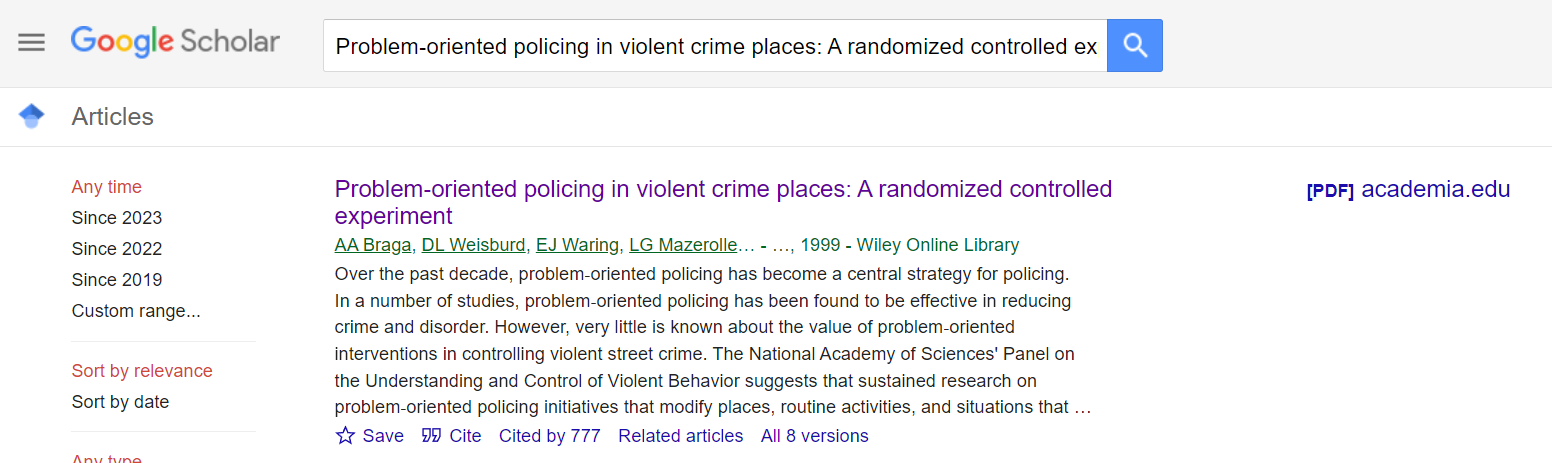
Single piece of advice here, use Google Scholar. Here for example is searching for the first Braga POP Criminology article in the last post. Google scholar will tell you if a free pre or post-print URL exists somewhere. See the PDF link on the right here. (You can click around to “All 8 Versions” below the article as well, and that will sometimes lead to other open links as well.)

Quite a few papers have PDFs available, and don’t worry if it is a pre-print, they rarely substance when going into print.1

For my personal papers, I have a google spreadsheet that lists all of the pre-print URLs (as well as the replication materials for those publications).

If those do not work, you can see if your local library has access to the journal, but that is not as likely. And I still have a Uni affiliation that I can use for this (the library and getting some software cheap are the main benefits!). But if you are at that point and need access to a paper I cite, feel free to email and ask for a copy (it is not that much work).

Most academics are happy to know you want to read their work, and so it is nice to be asked to forward a copy of their paper. So feel free to email other academics as well to ask for copies (and slip in a note for them to post their post-prints to let more people have access).

The Criminal Justician and ASEBP

If you like my blog topics, please consider joining the American Society of Evidence Based Policing. To be clear I do not get paid for referrals, I just think it is a worthwhile organization doing good work. I have started a blog series (that you need a membership for to read), and post once a month. The current articles I have written are:

So if you want to read more of my work on criminal justice topics, please join the ASEBP. And it is of course a good networking resource and training center you should be interested in as well.


  1. You can also sign up for email alerts on Google Scholar for papers if you find yourself reading a particular author quite often.↩︎

Counting lines of code

Was asked recently about how many lines of python code was in my most recent project. A simple command line check, cd into your project directory and run:

find -type f -name "*.py" | xargs wc -l

(If on windows, you can download the GOW tools to be able to use these same tools by default available on unix/mac.) This will include whitespace and non-functional lines (like docstrings), but that I think is ok. Doing this for my current main project at Gainwell, I have about 30k lines of python code. Myself (and now about 4 other people) have been working on that code base for nearly a year.

For my first production project at (then) HMS, the total lines of python code are 20k, and I developed the bulk of that in around 7 months of work. Assuming 20 work days in a month, that results in around 20000/140 ~ 143 lines of code per workday. I did other projects during that time span, but this was definitely my main focus (and I was the sole developer/data scientist). I think that is high (more code is not necessarily better, overall code might have decreased as future development of this project happened over time), but is ballpark reasonable expectations for working data scientists (I would have guessed closer to around 100 per day). In the grand scheme of things, this is like 2 functions or unit tests per work day (when considering white space and docstrings).

Doing this for all of my python code on my personal machine is around 60k (I do around, as I am removing counts for projects that are just cloned). And for all the python code on my work machine is around 140k (for 3 years of work). (I am only giving fuzzy numbers, I have some projects joint work I am half counting, and some cloned code I am not counting at all.)

Doing this same exercise for R code, I only get around 40k lines of code on my personal machine. For instance, my ptools package has under 3k lines of "*.R" code total. I am guessing this is due to not only R code being more precise than python, but to take code into production takes more work. Maybe worth another blog post, but the gist of the difference between an academic project is that you need the code to run one time, whereas for a production project the code needs to keep running on a regular schedule indefinitely.

I have written much more SPSS code over my career than R code, but I have most of it archived on Dropbox, so cannot easily get a count of the lines. I have a total of 1846 sps files (note that this does not use xargs).

find -type f -name "*.sps" | wc -l

It is possible that the average sps file on my machine is 200 lines per file (it definitely is over 100 lines). So my recent python migration I don’t think has eclipsed my cumulative SPSS work going back over a decade (but maybe in two more years will).

Outputs vs Outcomes and Agile

For my criminal justice followers, there is a project planning strategy, Agile, that dominates software engineering. The idea behind Agile is to formulate plans in short sprints (we do two week sprints at my work). So we have very broad based objectives (Epics) that can span a significant amount of time. Then we have shorter goals (Stories) that are intended to take up the sprint. Within each story, we further break down our work into specific tasks that we can estimate how long they will take. So something at my work may look like:

  • Build Model to Predict Readmission for Heart Attacks (Epic)
    • Create date pipeline for training data (Story)
      • SQL functions to prepare data (Task, 2 days)
      • python code to paramaterize SQL (Task, 3 days)
      • Unit tests for python code (Task, 1 day)
    • Build ML Model (Story)
      • evaluate different prediction models (Task, 2 days)
    • Deploy ML Model in production (Story)

Etc. People at this point often compare Agile vs Waterfall, where waterfall is more longish term planning (often on say a quarterly schedule). And Agile per its name is suppossed to be more flexible, and modify plans on short term. Most of my problems with Agile could apply though to Waterfall planning as well – short term project planning (almost by its nature) has to be almost solely focused on outputs and not outcomes.

Folks with a CJ background will know what I am talking about here. So police management systems often contrast focusing on easily quantifiable outputs, such as racking up traffic tickets and low level arrests, vs achieving real outcomes, such as increased traffic safety or reducing violent crime. While telling police officers to never do these things does not make sense, you can give feedback/nudge them to engage in higher quality short term outputs that should better promote those longer term outcomes you want.

Agile boards (where we post these Epics/Stories/Tasks, for people to keep tabs on what everyone is doing) are just littered with outputs that have little to no tangible connection to real life outcomes. Take my Heart Attack example. It may be there is a current Heart Attack prediction system in place based on a simple scorecard – utility in that case would be me comparing how much better my system is than the simpler scorecard method. If we are evaluating via dollars and cents, it may only make sense to evaluate how effective my system is in promoting better health outcomes (e.g. evaluating how well my predictive system reduces follow up heart attacks or some other measure of health outcomes).

The former example is not a unit of time (and so counts for nothing in the Agile framework). Although in reality it should be the first thing you do (and drop the project if you cannot sufficiently beat a simple baseline). You don’t get brownie points for failing fast in this framework though. In fact you look bad, as you did not deliver on a particular product.

The latter example unfortunately cannot be done in a short time period – we are often talking about timescales of years at that point instead of weeks. People can look uber productive on their Agile board, and can easily accomplish nothing of value over broad periods of time.

Writing this post as we are going through our yearly crisis of “we don’t do Agile right” at my workplace. There are other more daily struggles with Agile – who defines what counts as meeting an objective? Are we being sufficiently specific in our task documentation? Are people over/under worked on different parts of the team? Are we estimating the time it takes to do certain tasks accurately? Does our estimate include actual work, or folds in uncertainty due to things other teams are responsible for?

These short term crises of “we aren’t doing Agile right” totally miss the boat for me though. I formulate my work strategy by defining end goals, and then work backwards to plan the incremental outputs necessary to achieve those end goals. The incremental outputs are a means to that end goal, not the ends themselves. I don’t really care if you don’t fill out your short term tasks or mis-estimate something to take a week instead of a day – I (and the business) cares about the value added of the software/models you are building. It isn’t clear to me that looking good on your Agile board helps accomplish that.

Over 10 years of blogging

I just realized the other day that I have been blogging for over 10 years (I am old!) First hello world post post was back in December 2011.

I would recommend folks in academia/coding to at a minimum do a personal webpage. I use wordpress for my blog (did a free wordpress for quite a long time). WordPress is 0 code to make a personal page to host your CV.

I treat the blog as mostly my personal nerd journal, and blog about things I am working on or rants on occasion. I do not make revenue off of the blog directly, but in terms of getting me exposure it has given quite a few consulting leads over the years. As well as just given my academic work a much wider exposure.

So I always have a few things I want to blog about in the hopper. But always feel free to ask me anything (similar to how Andrew Gelman answers emails), and if I get a chance I will throw up a blog post in response.

Some peer review ideas

I recently did two more reviews for Crime Solutions. I actually have two other reviews due, in which I jumped Crime Solutions up in my queue. This of course is likely to say nothing about anyone but myself and my priorities, but I think I can attribute this behavior to two things:

  1. CrimeSolutions pays me to do a review (not much, $250, IMO I think I should get double this but DSG said it was pre-negotiated with NIJ).
  2. CrimeSolutions has a pre-set template. I just have to fill in the blanks, and write a few sentences to point to the article to support my score for that item.

Number 2 in particular was a determinant in me doing the 2nd review CrimeSolutions forwarded to me in very short order. After doing the 1st, I had the template items fresh in my mind, and knew I could do the second with less mental overhead.

I think these can, on the margins, improve some of the current issues with peer reviews. #1 will encourage more people to do reviews, #2 will improve the reliability of peer reviews (as well as make it easier for reviewers by limiting the scope). (CrimeSolutions has the reviewers hash it out if we disagree about something, but that has only happened once to me so far, because the template to fill in is laid out quite nicely.)

Another problem with peer reviews is not just getting people to agree to review, but to also to get them to do the review in a timely manner. For this, I suggest a time graded pay scale – if you do the review faster, you will get paid more. Here are some potential curves if you set the pay scale to either drop linearly with number of days or a logarithmic drop off:

So here, if using the linear scale and have a base rate of $300, if you do the review in two weeks, you would make $170, but if you take the full 30 days, you make $10. I imagine people may not like the clock running so fast, so I also devised a logarithmic pay scale, that doesn’t ding you so much for taking a week or two, but after that penalizes you quite heavily. So at two weeks is just under $250.

I realize pay is unlikely to happen (although is not crazy unreasonable, publishers extract quite a bit of rents from University libraries to subscriptions). But standardized forms are something journals could do right now.