Spatial analysis course in CJ (graduate) – Spring 2016 SUNY Albany

This spring I am teaching a graduate level GIS course for the school of criminal justice on the downtown SUNY campus. There are still seats available, so feel free to sign up. Here is the page with the syllabus, and I will continue to add additional info./resources to that page.

Academics tend to focus on regression of lattice/areal data (e.g. see Matt Ingrams course over in Poli. Sci.), and in this course I tried to mix in more things I regularly encountered while working as a crime analyst that I haven’t seen coverage of in other GIS courses. For example I have a week devoted to the journey to crime and geographic offender profiling. I also have a week devoted to introducing the current most popular models used to forecast crime.

I’ve started a specific wordpress page for courses, which I will update with additional courses I prepare.

Accepted position at University of Texas at Dallas

After being on the job market 2+ years, I have finally landed a tenure-track job at the University of Texas at Dallas in their criminology department. Long story short, I’m excited for the opportunity at Dallas, and I’m glad I’m done with the market.

I will refrain from giving job advice, I doubt I did a good job in many circumstances in all stages. But now that it is over I wanted to map all the locations I applied to. Red balloons are places I had an in person interview for a tenure track position.

In the end I applied to around 80 ads over the two year period (about 40 per each wave), and I had 8 in person interviews before I landed the Dallas position. My rate is worse than all of my friends/colleagues on the market during the past few years (hence why I shouldn’t give advice), but around 4~5 interviews before getting an offer is the norm among the small sample size of my friends (SUNY Albany CJ grads that is).

So folks soon to be on the market this is one data point of what to expect.

Presentation at ASC 2015

Later this week I will be at the American Society of Criminology meetings in D.C. I am presenting some of the work from my dissertation on the correlation between 311 calls for service and crime as a test of the broken windows thesis. I have an updated pre-print on SSRN based on some reviewer feedback, the title is

The Effect of 311 Calls for Service on Crime in D.C. at Micro Places

and here is the structured abstract:

Objectives: This study tests the broken windows theory of crime by examining the relationship between 311 calls for service and crime at the street segment and intersection level in Washington, D.C.

Methods: Using data on 311 calls for service in 2010 and reported Part 1 crimes in 2011, this study predicts the increase in counts of crime per street unit per additional reported 311 calls for service using negative binomial regression models. Neighborhood fixed effects are used to control for omitted neighborhood level variables.

Results: 311 calls for service based on detritus and infrastructure complaints both have a positive but very small effect on Part 1 crimes while controlling for unobserved neighborhood effects.

Conclusions: Results suggest that 311 calls for service are a valid indicator of physical disorder where available. The findings partially confirm the broken windows hypothesis, but reducing physical disorder is unlikely to result in appreciable declines in crime.

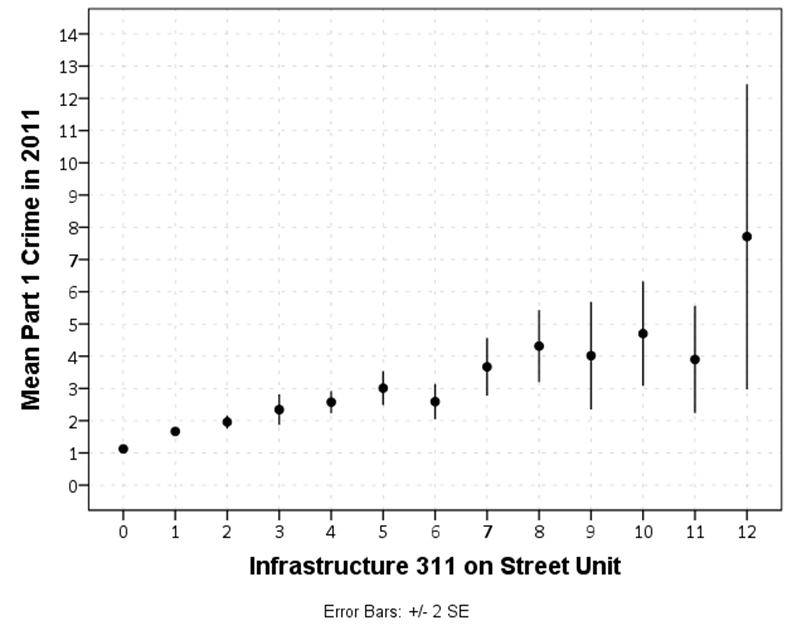
Not in the paper (but in my presentation), here is the marginal relationship between infrastructure related 311 complaints and crime

I am presenting the paper on Wednesday at 11 am. The panel title is Environmental Approaches to Crime Prevention and Intervention, and it is located at Hilton, E – Embassy, Terrace Level. There are two other presentations as well, all related to the spatial analysis of crime. (Kelly Edmiston has followed up and stated he can not make it.)

I will be in D.C. from Wednesday until Friday afternoon, so if you want to get together in that time frame feel free to send me an email.

Poster presentations should have a minimum font size of 25 points

A fairly generic problem I’ve been trying to do some research on is how large should fonts be for posters and PowerPoint presentations. The motivation is my diminishing eyesight over the years, and in particular default labels for statistical graphics are almost always too small in my opinion. Projected presentations just exacerbate the problem.

First, to tackle the project we need to find research about the the sizes that individuals can comfortably read letters. You don’t measure size of letters in absolute distance terms though, you measure it in the subtended angle that an object commands in your vision. That is, it is both a function of the height of the letters as well as the distance you are away from the object. I.e. in the below diagram angle A is larger than angle B.

The best guide for the size of this angle I have found for letters is an article by Sidney Smith, Letter Size and Legibility. Smith (1979) had a set of students make various labels and then have people stand too far away to be able to read them. Then the participants walked towards the labels until they could read them. Here is the histogram of those subtended angles (in radians) Smith produced:

From this Smith gives the recommendation as 0.007 radians as a good bet for pretty much everyone to be able to read the text. My research into other recommendations (eye tests, highway symbols) tends to be smaller, and between mine and Smith’s other sources tends to produce a range of 0.003 to 0.010 radians. Personal experimentation for me is that 0.007 is a good size, although up to 0.010 is not uncomfortably large. Most everyone with corrective vision can clearly see under 0.007, but we shouldn’t be making our readers strain to read the text.

For comparison, I sit approximately 22 inches away from my computer screen. A subtended angle of 0.007 produces a font size of just over 11 points at that distance. At my usual sitting distance I can read fonts down to 7 points, but I would prefer not to under usual circumstances.

This advice can readily translate to font sizes in poster presentations, since there is a limited range in which people will attempt to read them. Block’s (1996) suggestion that most people are around 4 feet away when they read a poster seems pretty reasonable to me, and so this produces a letter height of 0.34 inches needed to correspond to a 0.007 subtended angle. One point of font is 1/72 inches in letter height, so this converts to a 25 point font as the minimum to which most individuals can comfortably read the words in a poster. (R Functions at the end of the post for conversions, although it is based on relatively simple geometry.)

This advice is larger than Block’s (which is 20 point), but fits in line with Colin Purrington’s templates, which use 28 point for the smallest font. Again note that this is the minimum font for the poster, things like titles and author names should clearly be larger than the minimum to create a hierarchy. Again a frequent problem are axis labels for statistical graphics.

It will take more work to extend this advice to projected presentations, since there is more variability in projected sizes as well as rooms. So if you see a weirdo with a measuring tape at the upcoming ASC conference, don’t be alarmed, I’m just collecting some data!


Here are some R functions, the first takes a height and distance and return the subtended angle (in radians). The second takes the distance and radians to produce a height.

visual_angleR <- function(H,D){ 
   x <- 2*atan(H/(2*D))
   return(x)
}

visual_height <- function(D,Rad) {
  x <- 2*D*tan(Rad/2) #can use sin as well instead of tan
  return(x)
}

Since a point of font is 1/72 of an inch, the code to calculate the recommended font size is visual_height(D=48,Rad=0.007)*72 and I take the ceiling of this value for the 25 point recommendation.

Music and distractions in the workplace

I was recently re-reading Zen and the Art of Motorcycle Maintenance, and it re-reminded me of why I do not like to listen to music in the workplace. The thesis in Pirsig’s book (in regards to listening to music) is simple; you can’t concentrate entirely on the task at hand if you have music distracting you. So those who value their work tend to not have idle distractions like music playing (and be all engrossed in their work).

I have worked in various shared workspaces (cubicles and shared offices) for quite a while now, and I do have a knack for going off into space and ignoring all of the background noise around me. But I still do not like listening to music, even though I have learned to cope with the situation. At this point I prefer the open office workspace, as there at least is no illusion of privacy. When I worked at a cubicle someone coming behind me and scaring me was basically a daily thing.

Scott Adams, the artist of the Dilbert comic, had a recent blog post saying that music is the lesser evil compared to constant distractions via the internet (email, facebook, twitter, etc.) This I can understand as well, and sometimes I turn off the wi-fi to try to get work done without distraction. I don’t see how turning on music helps, but given its prevalence it may just be differences between myself and other people. I should probably turn off the wi-fi for all but an hour in the morning and an hour in the afternoon everyday, but I’m pretty addicted to the internet at this point.

It partly depends on the task I am currently working on though how easily I am distracted. Sometimes I can get really engrossed in a particular problem and become obsessed with it to the point you could probably set the office on fire and I wouldn’t notice. For example this programming problem dominated my thoughts for around two days, and I ended up thinking of the general solution while I did not have access to the computer (while I was waiting for my car to get inspected). Most of the time though I can only give that type of concentration for an hour or two a day though, and the rest of the time I am working in a state of easy distraction.

Background music I don’t like, and other ambient noises I can manage to drown out, but background TV drives me crazy. My family was watching videos (on TV and tablets) the other day while I was reading Zen and ironically I became angry, because I was really into the book and wanted to give it my full concentration. I know people who watch TV in bed to go to sleep, and it is giving me a headache just thinking about it while I am writing this blog post.

I highly recommend both Zen and the Art of Motorcycle Maintenance and Scott Adam’s blog. I’m glad I revisited Zen, as it is an excellent philosophical book on the logic of science that did not make much of an impression on me as an undergrad, but I have a much better grasp of it after having my PhD and reading some other philosophy texts (like Popper).

New working paper: What We Can Learn from Small Units of Analysis

I’ve posted a new working paper, What We Can Learn from Small Units of Analysis to SSRN. This is a derivative of my dissertation (by the same title). Below is the abstract:

This article provides motivation for examining small geographic units of analysis based on a causal logic framework. Local, spatial, and contextual effects are confounded when using larger units of analysis, as well as treatment effect heterogeneity. I relate these types of confounds to all types of aggregation problems, including temporal aggregation, and aggregation of dependent or explanatory variables. Unlike prior literature critiquing the use of aggregate level data, examples are provided where aggregation is unlikely to hinder the goals of the particular research design, and how heterogeneity of measures in smaller units of analysis is not a sufficient motivation to examine small geographic units. Examples of these confounds are presented using simulation with a dataset of crime at micro place street units (i.e. street segments and intersections) in Washington, D.C.

As always, if you have comments or critiques let me know.

Tables and Graphs paper rejection/update – and on the use of personal pronouns in scientific writing

My paper, Tables and Graphs for Monitoring Temporal Crime Patterns was recently rejected from Policing: An International Journal of Police Strategies & Management. I’ve subsequently updated the SSRN draft based on feedback from the review, and here I post the reviews and my responses to those reviews (in the text file).

One of the main critiques by both reviewers was that the paper was too informal, mainly because of the use of "I" in the paper. I use personal pronouns in writing intentionally, despite typical conventions in scientific writing, so I figured a blog post about why I do this is in order. I’ve been criticized for it on other occasions as well, but this is the first time it was listed as a main reason to reject an article of mine.

My main motivation comes from Michael Billig’s book Learn to Write Badly: How to Succeed in the Social Sciences (see a prior blog post I wrote on the contents). In a nut-shell, when you use personal pronouns it is clear that you, the author, are doing something. When you rewrite the sentence to avoid personal pronouns, you often obfuscate who the actor is in a particular sentence.

For an example of Billig’s point that personal pronouns can be more informative, I state in the paper:

I will refer to this metric as a Poisson z-score.

I could rewrite this sentence as:

This metric will be referred to as a Poisson z-score.

But that is ambiguous as to its source. Did someone else coin this phrase, and I am borrowing it? No – it is a phrase I made up, and using the personal pronoun clearly articulates that fact.

Pretty much all of the examples where I eliminated first person in the updated draft were of the nature,

In this article I discuss the use of percent change in tables.

which I subsequently changed to:

This article discusses the use of percent changes as a metric in tables.

Formal I suppose, but insipid. All rewriting the sentence to avoid the first person pronoun does is make the article seem like a sentient being, as well as forces me to use the passive tense. I don’t see how the latter is better in any way, shape, or form – yet this is one of the main reasons my paper is rejected above. The use of "we" in academic articles seems to be more common, but using "we" when there is only one author is just silly. So I will continue to use "I" when I am the only author.

Favorite maps and graphs in historical criminology

I was reading Charles Booth’s Life and Labour of the People in London (available entirely at Google books) and stumbled across this gem of a connected dot plot (between pages 18-19, maybe it came as a fold out in the book?)

(You will also get a surprise of the hand of the scanner in the page prior!) This reminded me I wanted to make a collection of my favorite historical examples of maps and graphs for criminology and criminal justice. If you read through Calvin Schmid’s Handbook of Graphical Presentation (available for free at the internet archive) it was a royal pain to create such statistical graphics by hand before computers. It makes you appreciate the effort all that much more, and many of the good ones will rival the quality of any graphic you can make on the computer.

Calvin Schmid himself has some of my favorite example maps. See for instance this gem from Urban Crime Areas: Part II (American Sociological Review, 1960):

The most obvious source of great historical maps in criminology though is from Shaw and McKay’s Juvenile Delinquency in Urban Areas. It was filled with incredible graphs and maps throughout. Here are just a few examples. (These shots are taken from the second edition in 1969, but they are all from the first part of the book, so were likely in the 1942 edition):

Dot maps

Aggregated to grid cells

The concentric zonal model

And they even have some binned scatterplots to ease in calculating linear regression equations

Going back further, Friendly in A.-M. Guerry’s moral statistics of France: Challenges for multivariable spatial analysis has some examples of Guerry’s maps and graphs. Besides choropleth maps, Guerry has one of the first examples of a ranked bumps chart (as later coined by Edward Tufte) of the relative rankings of the counts of crime at different ages (1833):

I don’t have access to any of Quetelet’s historical maps, but Cook and Wainer in A century and a half of moral statistics in the United Kingdom: Variations on Joseph Fletcher’s thematic maps have examples of Joseph Fletcher’s choropleth maps (as of 1849):

Going to more recent mapping examples, the Brantingham’s most notable I suspect is their crime pattern nodes and paths diagram, but my favorites are the ascii glyph contour maps in Crime seen through a cone of resolution (1976):

The earliest example of a journey-to-crime map I am aware of is Capone and Nichols Urban structure and criminal mobility (1976) (I wouldn’t be surprised though if there are earlier examples)

Besides maps, one other famous criminology graphic that came to mind was the age-crime curve. This is from Age and the Explanation of Crime (Hirschi and Gottfredson, 1983) (pdf here). This I presume was made with the computer – although I imagine it was still a pain in the butt to do it in 1983 compared to now! Andresen et al.’s reader Classics in Environmental Criminology in the Quetelet chapter has an age crime curve recreated in it (1842), but I will see if I can find an original scan of the image.

Edit: Was able to find an online scan of Quetelet’s original work in French. This has a fitted sine curve as one of the figures, but if you check out the tables he has binned arrest rates (page 65).

Quetelet_AgeCrimeCurve

I will admit I have not read Wolfgang’s work, but I imagine he had graphs of the empirical cumulative distribution of crime offenses somewhere in Delinquency in a Birth Cohort. But William Spelman has many great examples of them for both people and places. Here is one superimposing the two from Criminal Careers of Public Places (1995):

Michael Maltz has spent much work on advocating for visual presentation as well. Here is an example from his chapter, Look Before You Analyze: Visualizing Data in Criminal Justice (pdf here) of a 2.5d kernel density estimate. Maltz discussed this in an earlier publication, Visualizing Homicide: A Research Note (1998), but the image from the book chapter is nicer.

Here is an album with all of the images in this post. I will continue to update this post and album with more maps and graphs from historical work in criminology as I find them. I have a few examples in mind — I plan on adding a multivariate scatterplot in Don Newman’s Defensible Space, and I think Sampson’s work in Great American City deserves to be mentioned as well, because he follows in much of the same tradition as Shaw and McKay and presents many simple maps and graphs to illustrate the patterns. I would also like to find the earliest network sociogram of crime relationships. Maltz’s book chapter has a few examples, and Papachristo’s historical work on Al Capone should be mentioned as well (I thought I remembered some nicer network graphs though in Papachristos’s book chapter in the Morselli reader).

Let me know if there are any that I am missing or that you think should be added to the list!

Randomness in ranking officers

I was recently re-reading the article The management of violence by police patrol officers (Bayley & Garofalo, 1989) (noted as BG from here on). In this article BG had NYPD officers (in three precincts) each give a list of their top 3 officers in terms based on minimizing violence. The idea was to have officers give self-assessments to the researcher, and then the researcher try to tease out differences between the good officers and a sample of other officers in police-citizen encounters.

BG’s results stated that the rankings were quite variable, that a single officer very rarely had over 8 votes, and that they chose the cut-off at 4 votes to categorize them as a good officer. Variability in the rankings does not strike me as odd, but these results are so variable I suspected they were totally random, and taking the top vote officers was simply chasing the noise in this example.

So what I did was make a quick simulation. BG stated that most of the shifts in each precinct had around 25 officers (and they tended to only rate officers they worked with.) So I simulated a random process where 25 officers randomly pick 3 of the other officers, replicating the process 10,000 times (SPSS code at the end of the post). This is the exact same situation Wilkinson (2006) talks about in Revising the Pareto chart, and here is the graph he suggests. The bars represent the 1st and 99th percentiles of the simulation, and the dot represents the modal category. So in 99% of the simulations the top ranked officer has between 5 and 10 votes. This would suggest in these circumstances you would need more than 10 votes to be considered non-random.

The idea is that while getting 10 votes at random for any one person would be rare, we aren’t only looking at one person, we are looking at a bunch of people. It is an example of the extreme value fallacy.

Here is the SPSS code to replicate the simulation.

***************************************************************************.
*This code simulates randomly ranking individuals.
SET SEED 10.
INPUT PROGRAM.
LOOP #n = 1 TO 1e4.
  LOOP #i = 1 TO 25.
    COMPUTE Run = #n.
    COMPUTE Off = #i.
    END CASE.
  END LOOP.
END LOOP.
END FILE.
END INPUT PROGRAM.
DATASET NAME Sim.
*Now for every officer, choosing 3 out of 25 by random (without replacement).
SPSSINC TRANS RESULT = V1 TO V3
  /FORMULA "random.sample(range(1,26),3)".
FORMATS V1 TO V3 (F2.0).
*Creating a set of 25 dummies.
VECTOR OffD(25,F1.0).
COMPUTE OffD(V1) = 1.
COMPUTE OffD(V2) = 1.
COMPUTE OffD(V3) = 1.
RECODE OffD1 TO OffD25 (SYSMIS = 0).
*Aggregating and then reshaping.
DATASET DECLARE AggResults.
AGGREGATE OUTFILE='AggResults'
  /BREAK Run
  /OffD1 TO OffD25 = SUM(OffD1 TO OffD25).
DATASET ACTIVATE AggResults.
VARSTOCASES /MAKE OffVote FROM OffD1 TO OffD25 /INDEX OffNum.
*Now compute the ordering.
SORT CASES BY Run (A) OffVote (D).
COMPUTE Const = 1.
SPLIT FILE BY Run.
CREATE Ord = CSUM(Const).
SPLIT FILE OFF.
MATCH FILES FILE = * /DROP Const.
*Quantile graph (for entire simulation).
FORMATS Ord (F2.0) OffVote (F2.0).
GGRAPH
  /GRAPHDATASET NAME="graphdataset" VARIABLES=Ord PTILE(OffVote,99)[name="Ptile99"] 
                                    PTILE(OffVote,1)[name="Ptile01"] MODE(OffVote)[name="Mod"]
  /GRAPHSPEC SOURCE=INLINE.
BEGIN GPL
  SOURCE: s=userSource(id("graphdataset"))
  DATA: Ord=col(source(s), name("Ord"), unit.category())
  DATA: Ptile01=col(source(s), name("Ptile01"))
  DATA: Ptile99=col(source(s), name("Ptile99"))
  DATA: Mod=col(source(s), name("Mod"))
  DATA: OffVote=col(source(s), name("OffVote"))
  DATA: Run=col(source(s), name("Run"), unit.category())
  GUIDE: axis(dim(1), label("Ranking"))
  GUIDE: axis(dim(2), label("Number of Votes"), delta(1))
  ELEMENT: interval(position(region.spread.range(Ord*(Ptile01+Ptile99))), color.interior(color.lightgrey))
  ELEMENT: point(position(Ord*Med), color.interior(color.grey), size(size."8"), shape(shape.circle))
END GPL.
***************************************************************************.

New paper: The Effect of 311 Calls for Service on Crime in D.C. At Micro Places

I have a new pre-print posted, The Effect of 311 Calls for Service on Crime in D.C. At Micro Places, at SSRN. Here is the abstract:

Broken windows theory has been both confirmed and refuted with several different measures of physical disorder. Small experiments tend to confirm the priming effects of physical disorder on minor deviant acts, but measures based on order maintenance policing and surveys are much more mixed. Here I use 311 calls for service as a proxy for physical disorder, as it is a simple alternative compared to neighborhood audits or community surveys. For street segments and intersections in Washington D.C., I show that 311 calls for service based on detritus (e.g. garbage on the street) and infrastructure complaints (e.g. potholes in sidewalks) have a positive but very small effect on Part 1 crimes while controlling for unobserved neighborhood effects. This suggests that 311 calls for service can potentially be a reliable indicator of physical disorder where available. The findings partially confirm the broken windows hypothesis, but reducing physical disorder is unlikely to result in appreciable declines in crime.

And here are some maps of the crimes and calls per service per the regular grid I use as the neighborhood boundaries (because everything is better with some pretty maps!):

As always, if you have feedback I am all ears. This is what I signed up to present at ASC this fall, and is based on work in my dissertation.