My experience blogging in 2012

I figured I would write a brief post about my experience blogging. I created this blog and published my first post in December of 2011. Since then, in 2012, I published 30 blog posts, and totaled 7,200 views. While I thought the number was quite high (albeit a bit dissapointing compared to the numbers of Larry Wasserman), it is still many more people than would have listened to what I had to say if I didn’t write a blog. When starting out I averaged under 10 views a day, but throughout the year it steadily grew, and now I average about 30 views per day. The post that had the most traffic in one day was When should we use a black background for a map?, and that was largely because of some twitter traffic (a result of Steven Romalewski tweeting it and then it being re-tweeted by Kenneth Field), and it had 73 views.

I started the blog because I really loved reading alot of others blogs, and so I hope to encourage others to do so as well. It is a nice venue to share work and opinions for an academic, as it is more flexible and can be less formal than articles. Also much of what I write about I would just consider helpful tips or generic discussion that I wouldn’t get to discuss otherwise (SPSS programming and graph tips will never make it into a publication). One of my main motivations was actually R-Bloggers and the SAS blog roll; I would like a similarly active community for SPSS, but there is none really that I have found outside of the NABBLE forum (some exceptions are Andy Field, The Analysis Factor, Jon Peck and these few posts by a Louis K I only found through the labyrinth that is the IBM developerworks site (note I think you need to be signed in to even see that site), but they certainly aren’t very active and/or don’t write much about SPSS). I assume the best way to remedy that is to lead by example! Most of my more popular posts are ones about SPSS, and I frequently get web-traffic via general google searches of SPSS + something else I blogged about (hacking the template and comparing continuous distributions are my two top posts).

Also the blog is also just another place to highlight my academic work and bring more attention to it. WordPress tells me how often someone clicks a link on the blog, and someone has clicked the link to my CV close to 40 times since I’ve made the blog. Hopefully I have some pre-print journal articles to share on the blog in the near future (as well as my prospectus). My post on my presentation at ASC did not generate much traffic, but I would love to see a similar trend for other criminologists/criminal justicians in the future. My work isn’t perfect for sure, but why not get it out there at least for it to be judged and hopefully get feedback.

I would like to blog more, and I actively try to write something if I haven’t in a few weeks, but I don’t stress about it too much. I certainly have an infinite pool of posts to write about programming and generating graphs in SPSS. I have also thought about talking about historical graphics in criminology and criminal justice, or generally talking about some historical and contemporary crime mapping work. Other potential posts I’d like to write about are a more formal treatment about why I loathe most difference-in-differences designs, and perhaps about the sillyness that can ensue when using null-hypothesis significance testing to determine racial bias. But they will both take more careful elaboration on, so might not be anytime soon.

So in short, SPSSer’s, crime mapper’s, criminologist’s/criminal justician’s, I want you to start blogging, and I will eagerly consume your work (and in the meantime hopefully produce some more useful stuff on my end)!
Presentation at ASC – November, 2012

At the American Society of Criminology conference in Chicago in a few weeks I will be presenting (I can’t link to the actual presentation it appears, but you can search the program for Wheeler and my session will come up). Don’t take this as a final product, but I figured I would put out there the working paper/chapters of my dissertation that are the motivation for my presentation and my current set of slides.

Here is my original abstract I submitted a few months ago, The title of the talk is The Measurement of Small Place Correlates of Crime;

This presentation addresses several problems related with attempting to identify correlates of crime at small units of analysis, such as street segments. In particular the presentation will focus on articulating what we can potentially learn from smaller units of analysis compared to larger aggregations, and relating a variety of different measures of the built environment and demographic characteristics of places to theoretical constructs of interest to crime at places. Preliminary results examining the discriminant and convergent validity of theoretical constructs pertinent to theories for the causes of crime using data from Washington, D.C. will be presented.

This was certainly an over-ambitious abstract (I was still in the process of writing my prospectus when I submitted it). The bulk of the talk will be focused on “What we can learn from small units of analysis?”, and as of now after that as time allows I will present some illustrations of the change of support problem. Sorry to dissapoint, but nothing about convergent or divergent validity of spatial constructs will be presented (I have done no work of interest yet, and I don’t think I would have time to present any findings in anymore than a superficial manner anyway).

Note don’t be scared off by how dull the working paper is, the presentation will certainly be more visual and less mathematical (I will need to update my dissertation to incorporate some more graphical presentations).

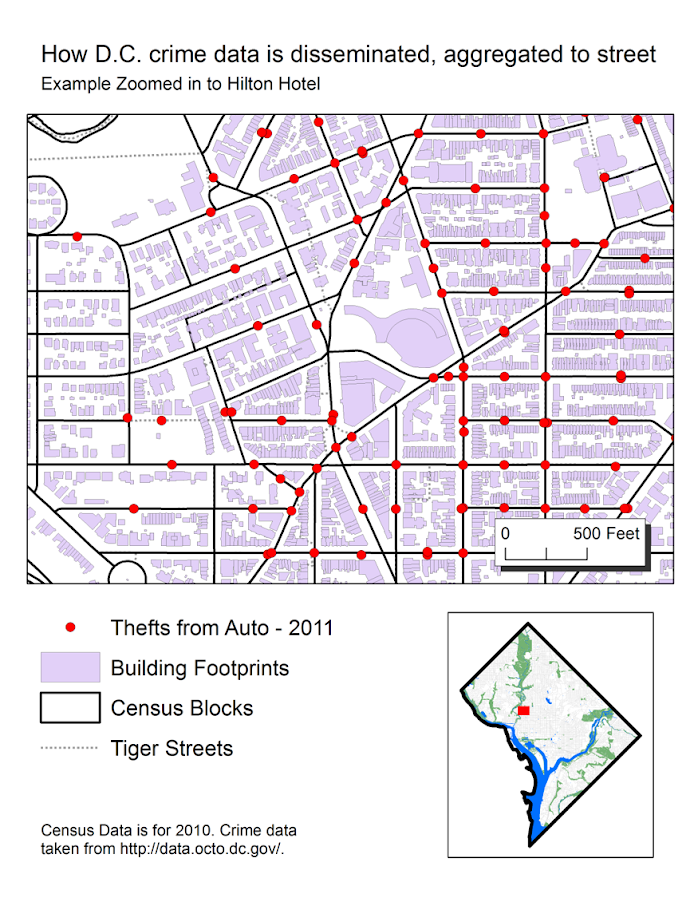
Maps and graphis at the end of the talk demonstrating the change of support problem are still in the works (and I will continue to update the presentation on here). Here is a preview though of the first map I made that demonstrates how D.C. disseminates geo-date aggregated and snapped to street segments, making it problematic to mash up with census data.


The presentation time is on Friday at 9:30, and I’m excited to see the other presentations as well. It looks like to me that Pizarro et al.’s related research was recently published in Justice Quarterly, so if you don’t care for my presentation come to see the other presenters!

JQC paper on the moving home effect finally published!

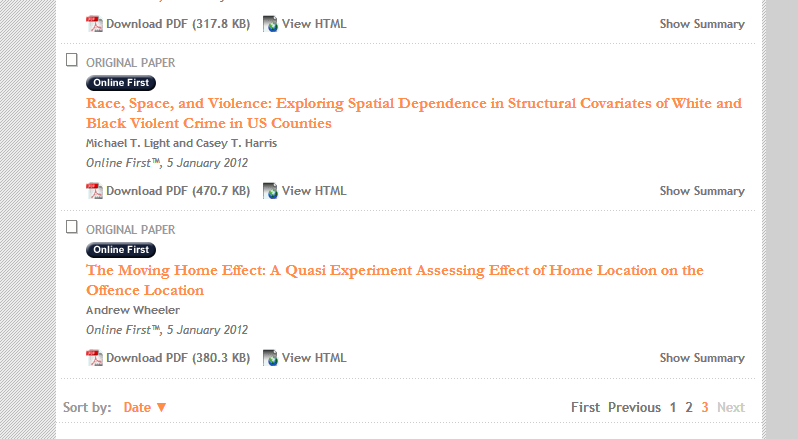
My first solo publication, The moving home effect: A quasi experiment assessing effect of home location on the offence location, after being in the online first que nearly a year, has finally been published in the Journal of Quantitative Criminology 28(4):587-606. It was the oldest paper in the online first section (along with the paper by Light and Harris published on the same day)!

This paper was the fruits of what was basically the equivalent of my Masters thesis, and I would like to take this opportunity to thank all of the individuals whom helped me with the project, as I accidently ommitted such thanks from the paper (entirely my own fault). I would like to thank my committee members, Rob Worden, Shawn Bushway, and Janet Stamatel. I would also like to thank Robert Apel and Greg Pogarsky for useful feedback I had recieved on in class papers based on the same topic, as well as the folks in the Worden meeting group (for not only feedback but giving me motivation to do work so I had something to say!)

Rob Worden was the chair of my committee, and he deserves extra thanks not only for reviewing my work, but also for giving me a job at the Finn Institute, which otherwise I would have never had access to such data and opportunity to conduct such a project. I would also like to give thanks to the Syracuse PD and Chief Fowler for letting me use the data and reveal the PD’s identity in the publication.

I would also like to thank Alex Piquero and Cathy Widom for letting me make multiple revisions and accepting the paper for publication. For the publication itself I recieved three very excellent and thoughtful peer reviews. The excellence of the reviews were well above the norm for feedback I have otherwise encountered, and demonstrated that the reviewers not only read the paper but read it carefully. I was really happy with the improvements as well as how fair and thoughtful the reviews were. I am also very happy it was accepted for publication in JQC, it is the highest quality venue I would expect the paper to be on topic at, and if it wasn’t accepted there I was really not sure where I would send it otherwise.

In the future I will publish pre-prints online, so the publication before editing can still be publicly available to everyone. But, if you can not get a copy of this (or any of the other papers I have co-authored so far) don’t hesitate to shoot me an email for a copy of the off-print. Hopefully I have some more work to share in the new future on the blog! I currently have two papers I am working on with related topics, one with visualizing journey to crime flow data, and another paper with Emily Owens and Matthew Feedman of Cornell comparing journey to work data with journey to crime data.

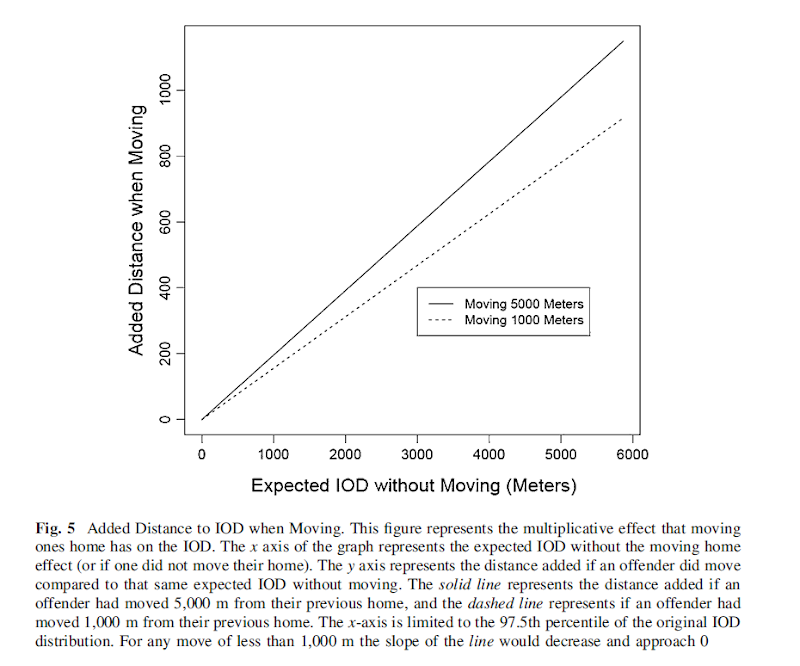
For a teaser for this paper here is the structured abstract from the paper and a graph demonstrating my estimated moving home effect.

Objectives
This study aims to test whether the home location has a causal effect on the crime location. To accomplish this the study capitalizes on the natural experiment that occurs when offender’s move, and uses a unique metric, the distance between sequential offenses, to determine if when an offender moves the offense location changes.

Methods
Using a sample of over 40,000 custodial arrests from Syracuse, NY between 2003 and 2008, this quasi-experimental design uses t test’s of mean differences, and fixed effects regression modeling to determine if moving has a significant effect on the distance between sequential offenses.

Results
This study finds that when offenders move they tend to commit crimes in locations farther away from past offences than would be expected without moving. The effect is rather small though, both in absolute terms (an elasticity coefficient of 0.02), and in relation to the effect of other independent variables (such as the time in between offenses).

Conclusions
This finding suggests that the home has an impact on where an offender will choose to commit a crime, independent of offence, neighborhood, or offender characteristics. The effect is small though, suggesting other factors may play a larger role in influencing where offenders choose to commit crime.

CJ blog watch! Any ones I’m missing?

I follow alot of blogs. Although I don’t personally write alot about criminology or criminal justice related matters (maybe in the future when I have more time or inclination), but I figured I would share some of my favorites and query the crowd for more recommendations.

So a few with general discussion related to criminology and criminal justice matters are;

Both sites are well known criminologists/criminal justicians. I am aware of a few blogs written by current/former police chiefs;

  • Tom Casady’s The Director’s Desk. Tom Casady is currently the director of public safety for Lincoln, Nebraska and was previously the Police Chief at Lincoln’s department for quite some time. Tom is also very active in a variety of criminology/criminal justice organizations (so if you go to a related conference there is a good chance he is around somewhere!)
  • Chief’s Blog by Chief Ramsay of the Duluth Police Dept in Minnesota.

There are also a few that are highly focused on crime mapping & analysis;

  • Location Based Policing by Drew Dasher. He is a crime analyst for the Lincoln Nebraska PD.
  • Saferview – crime, fear and mapping: A blog by a retired police officer who is a student at University College London.
  • Diego Valle-Jones: Although his blog has a wider variety of topics, he has a series of very detailed posts and analysis on violence in Mexico and central american nations. I know crime stats are frequent fodder for generic statistical demonstrations, but this is real insightful analysis. My favorite is his investigation into the validity of homicide data statistics.

Are there others I am missing out on or should know about? Let me know in the comments if you have other suggestions.

FYI – the title of the blog post was motivated by Hans Toch’s new book, Cop Watch.

Dressing for success in academic interviews

On the academia stack exchange site a recent question came up about how to dress for academic interviews. The verdict was over-dressing is better than under-dressing. I had come across similar (although somewhat discordant) advice previously, but it is always good to have second opinions.

I will mention the previous blog posts I had come across, as they have good advice for giving academic job talks in general;

I think my advice is just give a talk so awesome no one cares about what you wear! But, take that advice with care, it is coming from a person who not only doesn’t know what he wore yesterday, but has on occasion wore shirts backwards (in public) all day long. I would probably only notice if you showed up dressed like Dilbert in this strip;

If you have other questions related to academia head on over and check out the Academia stack exchange site. Here a few examples of some of my favorite discussions so far;

Some tips on keeping up with contemporary scholarly research

A brief tip on two tools I use to keep up with contemporary scholarly research, RSS feeds from peer reviewed publications, and google scholar alerts.

RSS feeds are a really awesome way to aggregate information into easily readable short clips. And using RSS feeds has greatly improved the amount of information I consume on a regular basis.

Most peer-reviewed publications I am interested in have RSS feeds for the current issue and online first articles, and they post the title, abstract and authors for every feed. One of the nice things about this is that publications publish infrequently enough that they aren’t particularly bothersome, and so I have a huge list of publications I follow and peruse the titles/abstracts. Also because I use google reader as my feed reader, I have a custom “sendto” button to send the article directly to my citeulike library to read later if I’m interested.

I also use google scholar alerts to send me emails when new articles appear under specific search terms. For instance I have a search for “journey to crime”, and I believe I get an update for a new article on average every two weeks. I suspect if you use more general search terms it would be more bothersome with updates, but if that is the case it would be better to refine your search terms to be more specific anyway.

I previously used this tool to keep up to date on some authors whose work I’m generally interested in, but Rob Hyndman mentions that a new option is signing up for email alerts directly from an individual scholar’s profile page (which is a fairly new addition I believe).  I even see I can sign up for alerts for articles that cite my own (meager) list of publications so far.

These two tools, RSS feeds and google scholar alerts, have greatly aided me to be aware of contemporary research. In particular RSS feeds have really expanded my awareness of fields outside of criminology/criminal justice that I do not read articles from as frequently.

Some other tools that I use, but the breadth of information is not quite as large as RSS feeds or google scholar alerts (but are worth an honorable mention are);

  • citeulike watch lists, groups, connections & watched tag lists. I would guess similar networking tools are available in Mendeley
  • Public repositories of working papers, such as SSRNNBER, arXIV. Unfortunately these popular ones don’t have any categories that really conform to my field, but it appears a new program called Academia.edu allows to post working papers. For an example see my friends, Kelly Socia’s profile.

Crime Mapping article library at CiteULike

I use the online reference library, CiteULike, to organize my personal bibliography. I have created a group within CiteULike specifically focused on crime mapping relevant articles, and the group is named Crime Mapping. I typically post relevant articles that I place in my own library, as well as suggestions that are placed on the Geography and Crime google group forum. At the moment there is also one other CiteULike member that has posted articles to the group as well, and we have a total of 135 articles as of January, 2012.

Although you need a CiteULike account to add to the library, even without a profile you can still browse the library. If you have any suggestions feel free to either make a comment here or shoot me an email if you can’t post yourself. Also I’m sure the library could use some better thought into the tags for each article, so feel free to update, add, or re-tag any articles currently in the library.