Using Python to grab Google Street View imagery

Update: I have been asked several times over the years for help on this. In response I have made a simple GUI tool, given a list of addresses and a download folder location, will download all of the images. Applications are websites listing properties and marketers for mailings.

The tool costs $300, Check out the CRIME De-Coder Store to purchase.


I am at it again with using Google data. For a few projects I was interested in downloading street view imagery data. It has been used in criminal justice applications as a free source for second hand systematic social observation by having people code aspects of disorder from the imagery (instead of going in person) (Quinn et al., 2014), as estimates of the ambient walking around population (Yin et al., 2015), and examining criminogenic aspects of the built environment (Vandeviver, 2014).

I think it is just a cool source of data though to be honest. See for example Phil Cohen’s Family Inequality post in which he shows examples of auctioned houses in Detroit over time.

Using the Google Street View image API you can submit either a set of coordinates or an address and have the latest street view image returned locally. This ends up being abit simpler than my prior examples (such as the street distance API or the places API) because it just returns the image blob, no need to parse JSON.

Below is a simple example in python, using a set of addresses in Detroit that are part of a land bank. This function takes an address and a location to download the file, then saves the resulting jpeg to your folder of choice. I defaulted for the image to be 1200×800 pixels.

import urllib, os

myloc = r"C:\Users\andrew.wheeler\Dropbox\Public\ExampleStreetView" #replace with your own location
key = "&key=" + "" #got banned after ~100 requests with no key

def GetStreet(Add,SaveLoc):
  base = "https://maps.googleapis.com/maps/api/streetview?size=1200x800&location="
  MyUrl = base + urllib.quote_plus(Add) + key #added url encoding
  fi = Add + ".jpg"
  urllib.urlretrieve(MyUrl, os.path.join(SaveLoc,fi))

Tests = ["457 West Robinwood Street, Detroit, Michigan 48203",
         "1520 West Philadelphia, Detroit, Michigan 48206",
         "2292 Grand, Detroit, Michigan 48238",
         "15414 Wabash Street, Detroit, Michigan 48238",
         "15867 Log Cabin, Detroit, Michigan 48238",
         "3317 Cody Street, Detroit, Michigan 48212",
         "14214 Arlington Street, Detroit, Michigan 48212"]

for i in Tests:
  GetStreet(Add=i,SaveLoc=myloc)

Dropbox has a nice mosaic view for a folder of pictures, you can view all seven photos here. Here is the 457 West Robinwood Street picture:

In my tests my IP got banned after around 100 images, but you can get a verified google account which allows 25,000 image downloads per day. Unfortunately the automatic API only returns the most recent image – there is no way to return older imagery nor know the date-stamp of the current image. (You technically could download the historical data if you know the pano id for the image. I don’t see any way though to know the available pano id’s though.) Update — as of 2018 there is now a Date associated with the image, specifically a Year-Month, but no more specific than that. Not being able to figure out historical pano id’s is still a problem as far as I can tell as well.

But this is definitely easier for social scientists wishing to code images as opposed to going into the online maps. Hopefully the API gets extended to have dates and a second API to return info. on what image dates are available. I’m not sure if Mike Bader’s software app is actually in the works, but for computer scientists there is a potential overlap with social scientists to do feature extraction of various social characteristics, in addition to manual coding of the images.


Update: here is a version that works for python 3+. Currently you need to have a key, no more getting a few free images before being cut off.

# For Python Versions 3+
# Tested V3.10 on 12/15/2021
import os
import urllib.parse
import urllib.request

myloc = r"??????????????" #replace with your own location
key = "&key=" + "????????????" #you need an actual key now!!

def GetStreet(Add,SaveLoc):
  base = "https://maps.googleapis.com/maps/api/streetview?size=1200x800&location="
  MyUrl = base + urllib.parse.quote_plus(Add) + key #added url encoding
  fi = Add + ".jpg"
  urllib.request.urlretrieve(MyUrl, os.path.join(SaveLoc,fi))

Tests = ["457 West Robinwood Street, Detroit, Michigan 48203",
         "1520 West Philadelphia, Detroit, Michigan 48206",
         "2292 Grand, Detroit, Michigan 48238",
         "15414 Wabash Street, Detroit, Michigan 48238",
         "15867 Log Cabin, Detroit, Michigan 48238",
         "3317 Cody Street, Detroit, Michigan 48212",
         "14214 Arlington Street, Detroit, Michigan 48212"]

for i in Tests:
  GetStreet(Add=i,SaveLoc=myloc)

Testing day-of-week crime randomness paper published

My paper, Testing Serial Crime Events for Randomness in Day of Week Patterns with Small Samples, was recently published in the Journal of Investigative Pyschology and Offender Profiling. Here is the pre-print version on SSRN if you can’t get access to that journal.

The main idea behind the paper was if you had a series of a few crime events that you know are linked to the same offender, can we tell if those patterns are random with respect to the day of the week? We know spatial patterns are often clustered, but police responses such as surveillance are conditioned not only on a spatial location, but take place during certain days and times. I wanted to know when I could go to command staff and say, yeah you should BOLO on Saturday. Or just as importantly say in response, no the observed patterns could easily happen if the offender were just randomly picking days.

In the paper I show that if you have only 3 events and they all occur on the same day, you would reject the null that crimes have an equal probability across all seven days of the week at a p-value of less than 0.05. I also show that the exact test I propose has pretty good power for as few as 8 events in the series. So if you have, say 10 events and you fail to reject the null that each day of the week has equal probability of being chosen, it is pretty good evidence that a police response should not have any preference for a particular day.

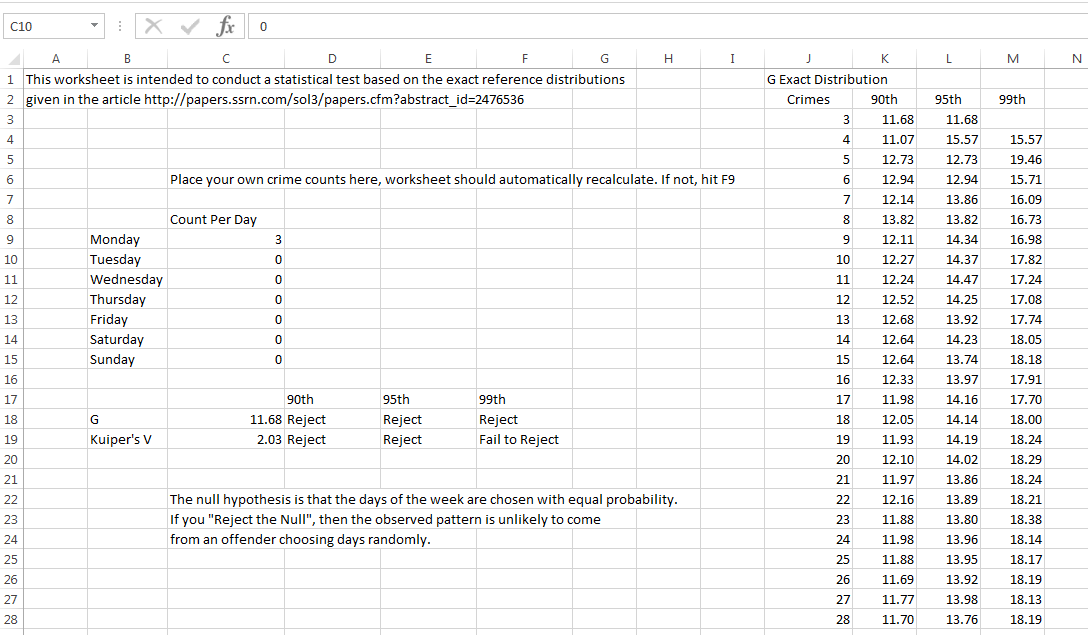
To illustrate how one would use the test, I have a simple spreadsheet posted here (in the zip file has my other SPSS code to reproduce the results in the paper) in which you can type in the days of the week that the crimes are occurring on, and it calculates the hypothesis test.

The spreadsheet contains both the G-test and Kuiper’s V test. If you don’t read the paper and understand the difference, just use the G-test and ignore the Kuiper’s V results. For crime analysts, this is basically the minimum of what you need to know.


For analysts who are more into the nitty gritty, I also have some R code that is a bit more flexible, and calculates the exact test for varying numbers of bins and provides some code to conduct power analysis. So you can either download the code from GitHub and insert it to define the functions, or simply copy-paste it into the console. The only library dependency is the partitions library, so make sure that is installed before following along.

So if you have downloaded the code, you can use something like below to insert the functions and load the partitions library.

library(partitions)
mydir <- "C:\\Users\\andrew.wheeler\\Dropbox\\Documents\\BLOG\\ExactTest_Weekdays"
setwd(mydir)
source("Exact_Dist.R")

Now, say you had a series of crimes that had 4 on Saturday, 3 on Tuesday, and 1 on Sunday. You can test this for randomness by simply using:

crime <- c(1,0,3,0,0,0,4)
res <- SmallSampTest(d=crime)
res

Which prints at the console:

Small Sample Test Object 
Test Type is G 
Statistic is 15.5455263389754 
p-value is:  0.0182662  
Data are:  1 0 3 0 0 0 4 
Null probabilities are:  0.14 0.14 0.14 0.14 0.14 0.14 0.14 
Total permutations are:  3003  

This defaults to using the likelihood ratio G-test, but you can also use Kuiper’s V, the chi-square test, or the Komolgrov-Smirnov test. Also you can change the null hypothesis to not equal probability in the bins. I default to the G-test in my paper because it is more powerful than the more typical chi-square after 8 crimes for 7 day-of-week bins, but equal in power to the chi-square for smaller sample sizes. So to do the chi-square test on the same data, use:

resChi <- SmallSampTest(d=crime, type="Chi")
resChi
chisq.test(crime) #for comparison to base R 
chisq.test(crime, simulate.p.value = TRUE, B = 10000)

Which you can see the test statistic mimics base R’s chisq.test, and the p-value is slightly higher than the asymptotic p-value (the exact test should always have a higher p-value than the asympotic distribution, and here it is lower than the simulated p-value). This situation the simulation approach would have been fine. I prefer the exact approach when feasible though, because it is exact, and you don’t need to worry about convergence for the simulation (which most everyone simply picks a large number and hopes for the best).

I’ve also made some code that allows for easy evaluation of the power of the exact test. Coding wise it was easiest to simply use the original object created with the test, so I know it invites post-hoc power analysis – forgive me for my slothness in coding practices. So say you wanted to do apriori power analysis with the Kuiper’s V test for 10 bins and 15 observations (so over 1.3 million permutations, i.e. n <- 15; m <- 10; choose(n+m-1,m-1)). You can simply make an original object (with any observed values across the bins).

test10_data <- c(15,rep(0,9))
test10_perm <- SmallSampTest(d=test10_data, type="KS")
#takes around a minute

The default null is equal probability across the bins, and to do a power analysis you have to specify an alternative. Lets say for the alternative there is equal probability in 5 of the bins, and zero probability in the other 5. (Most of the work is done in making the original permutation object, the power analysis is quite fast, hence why I coded it to work this way.)

p_alt <- c(rep(1/5,5),rep(0,5))
Pow_test <- PowAlt(SST=test10_perm,p_alt=p_alt)
Pow_test

This prints out at the console:

Power for Small Sample Test 
Test statistic is: KS  
Power is: 0.1822815  
Null is: 0.1 0.1 0.1 0.1 0.1 0.1 0.1 0.1 0.1 0.1  
Alt is: 0.2 0.2 0.2 0.2 0.2   0   0   0   0   0  
Alpha is: 0.05  
Number of Bins: 10  
Number of Observations: 15  

So for this alternative there is quite low power, only 0.18. But if we change it to only have mass in four of the bins, the power goes way up to over 0.99.

> p_alt2  Pow_test2  Pow_test2
Power for Small Sample Test 
Test statistic is: KS  
Power is: 0.9902265  
Null is: 0.1 0.1 0.1 0.1 0.1 0.1 0.1 0.1 0.1 0.1  
Alt is: 0.25 0.25 0.25 0.25   0   0   0   0   0   0  
Alpha is: 0.05  
Number of Bins: 10  
Number of Observations: 15 

So this shows how the exact test R code can be extended beyond just 7 day-of-week bins. I have not done really any exploration of the power of the KS test or differing numbers of bins though.

The spatial consistency of bar locations – Buffalo 1901 vs. 2015

Part of my work I’m interested in the correlates of crime at very small places, particularly aspects of the built environment. Part of the difficulty of this work though is that some aspects of the built environment change very slowly. I often just anecdotally give bars as an example – when a bar goes under it often just gets replaced by another bar. So for example if I want to make an estimate of how much crime would decrease if you took a bar away, it is difficult looking at historical data because most of the time when a bar goes away it is just replaced by another in a short time span.

But admittedly this perception was just based on my anecdotal experiences. So when I saw some historical maps John Krygier posted of saloons I wanted to put a pretty strict test to my assertion. Here is a map of saloons in Buffalo (circa 1901 on John’s website):

I grabbed the current locations of places licensed to sell alcohol in New York State via the open data portal and geocoded those in Buffalo. (This includes things like grocery stores as well as bars.) I did a mediocre job trying to digitize the old map (here is the digitized image), and here we can see the overlap between the current and the historical locations. Zoom into the area with the blue icons to see the historical locations.

So we can see that my baseline of bars not changing is not accurate for this for this extreme comparison. If you zoom out you can see that there is a higher concentration of bars just to the west, so I wonder if over time there was a shift of these bar locations.

John has some more examples of historical saloon maps in Baltimore plus San Francisco and New York City (in the same post with Buffalo). I’d be interested to see those locations as well if someone takes the time to replicate this.

I may have to think more seriously about evaluating the effect of bars over time, and seeing if things like bars losing their licenses because of violations result in crime decreases.

Keeping it simple: Viz. mass shooting definitions

My wife asked me the other day about some mass shooting statistics, in particular some claims of an average of one a day in the US. Without knowing the source, I told her outright it is probably because that person widened the net to events beyond what most people stereotypically consider a mass shooting.

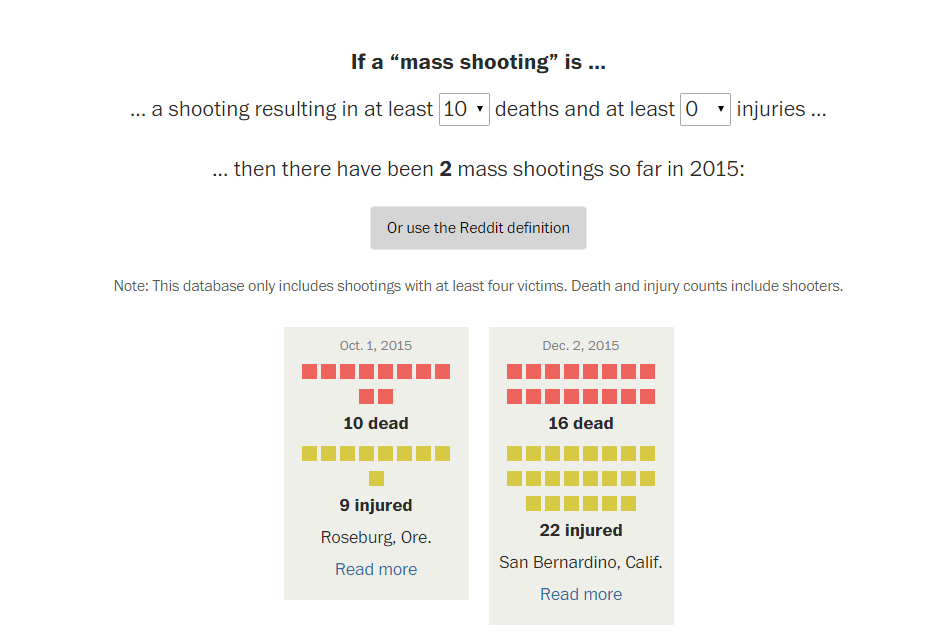
Now, I have no personal opinion on how it should be defined, and being a researcher in criminal justice I appreciate people digging into the details. I was prompted to write this post by an interactive application showing how the numbers change by Kevin Schaul of the Washington Post (referred via Flowing Data). I was pretty frustrated by Kevin’s example interactive application though – there are much simpler ways than making me change the definition and seeing what individual events pop up. Here is an example screen shot of inputting a definition and then how Kevin’s data pop out.

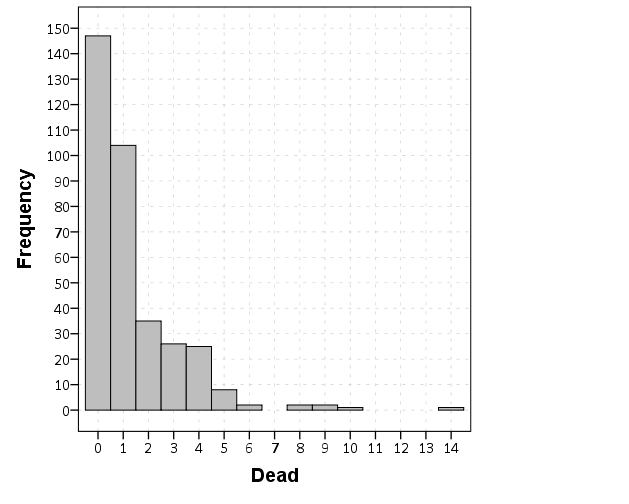
So, downloading the same Reddit data for 2015 so far (as of 12/7/15) I created what I consider to be simple summaries. Caveat – these crowdsourced datasets are likely to have substantial missing data, especially towards the events with fewer injured. First I made a frequency histogram of the total number of dead per incident.

So you can see that if you only want to include dead in your personal definition, the one per day statistic is a dramatic over-representation. If you want to draw the line at 5 or more you will have around 9 more events than you would if you made the line at 6 or more. If you make the line at 10 or more there are only two incidents, but there are another 4 if you include incidents with 8 or 9 dead.

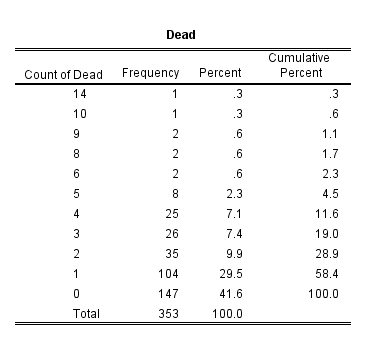
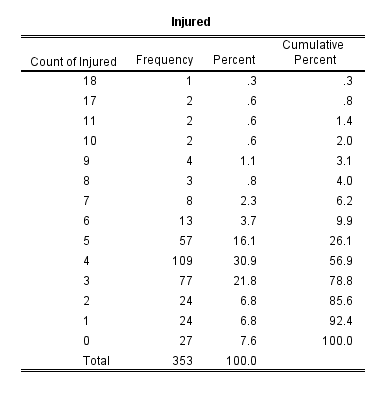
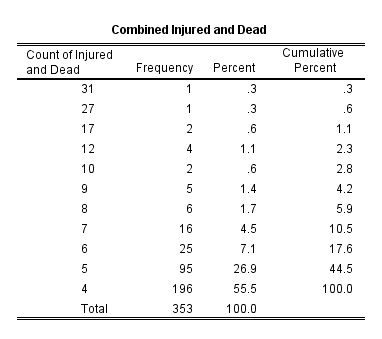
Another simple overview is a table. Here are tables of dead, injured, and the combined counts per each incident, sorted in descending value of the count. So the way to read this is that there there 147 seperate incidents in the reddit database that had 0 deaths, and 104 that had only one death, etc. The tables also have percents and cumulative percentage, so you can see how where you define the cut-point changes how much of the data you chop-off. Cumulative counts would be just as useful.

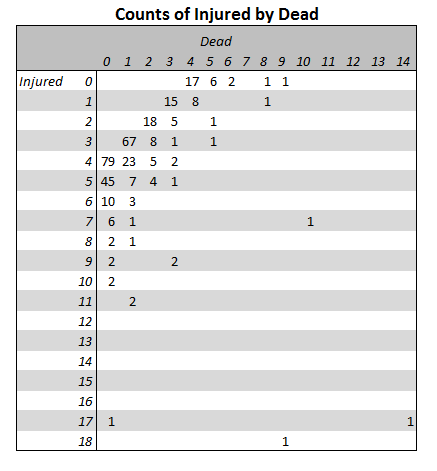
I have no personal problem using injured as well in a mass shooting definition. Basically the difference between being shot and being killed is seemingly due to random happenstance, so a shooting with 10 injured and no one killed can easily be argued to be a mass shooting in my opinion. Kevin’s interactive makes you choose an and condition though between injured and killed, whereas one could place the cut point at an or condition or simply the combined total. Here is a cross tabulation of the frequencies of injured by dead.

You can clearly see the reddit definition is the combined total of injured or dead is 4 via the line on the upper left of the table. Kevin’s and condition forces you to make a cut-point along each axis, basically choosing a rectangle in the lower right of the above crosstab table. If you want a combined total though, it will be along a diagonal somewhere in the table.

I appreciate these interactive visualizations allow a viewer to dig deeper into specific events in the data, but that does not mean some simple summaries could not also accompany the piece.

License plate readers and the trade off in privacy

As a researcher in criminal justice, tackling ethical questions is a difficult task. There are no hypotheses to test, nor models to fit, just opinions bantering around. I figured I would take my best shot and writing some coherent thoughts on the topic of the data police collect and its impacts on personal privacy – and my blog is really the best outlet.

What prompted this is a recent Nick Selby post which suggested the use of license plate readers (LPRs) to target Johns in LA is one of the worst ideas ever and a good example of personal privacy invasion by law enforcement. (Also see this Washington Post opinion article.)

I have a bit of a different and more neutral take on the program, and will try to articulate some broader themes in personal privacy invasion and the collection/use of data by police. I think it is an important topic and will continue to be with the continual expansion of public sensor data being collected by the police (with body worn cameras, stationary cameras, cell phone data, GPS traces being some examples). Basically, much of the negative sentiment I’ve seen so far of this hypothetical intervention are for reasons that don’t have to do with privacy. I’ll articulate these points by presenting alternative, currently in use police programs that use similar means, but have different ends.

To describe the LA program in a nutshell, the police use what are called license plate readers to identify particular vehicles being driven in known prostitution areas. LPRs are just cameras that take a snapshot of a license plate, automatically code the alpha-numeric plate, and then place that [date-time-location-plate-car image] in a database. Linking up this data with registered vehicles, in LA the idea is to have the owner of the vehicle sent a letter in the mail. The letter itself won’t have any legal consequences, just a note that says the police know you have been spotted. The idea in theory is that you will think you are more likely to be caught in the future, and may have some public shaming also if your family happens to see the letter, so you will be less likely to solicit a prostitute in the future.

To start with, some of the critiques of the program focus on the possibilities of false positives. Probably no reasonable person would think this is a worthwhile idea if the false positive rate is anything but small – people will be angry with being falsely accused, there are negative externalities in terms of family relationships, and any potential crime reduction upside would be so small that it is not worthwhile. But, I don’t think that itself is damning to this idea – I think you could build a reasonable algorithm to limit false positives. Say the car is spotted multiple times at a very specific location, and specific times, and the home owners address is not nearby the location. It would be harder to limit false positives in areas where people conduct other legitimate business, but I think it has potential with just LPR data, and would likely improve by adding in other information from police records.

If you have other video footage, like from a stationary camera, I think limiting false positives can definitely be done by incorporating things like loitering behavior and seeing the driver interact with an individual on the street. Eric Piza has done similar work on human coding/monitoring video footage in Newark to identify drug transactions, and I have had conversations with an IBM Smart City rep. and computer scientists about automatically coding audio and video to identify particular behaviors that are just as complicated. False negatives may still be high, but I would be pretty confident you could create a pretty low false positive rate for identifying Johns.

As a researcher, we often limit our inquiries to just evaluating 1) whether the program works (e.g. reduces crime) and 2) if it works whether it is cost-effective. LPR’s and custom notifications are an interesting case compared to say video cameras because they are so cheap. Camera’s and the necessary data storage infrastructure are so expensive that, to be frank, are unlikely to be a cost-effective return on investment in any short term time frame even given the best case scenario crime reductions (ditto for police body worn cameras). LPR’s and mailing letters on the other hand are cheap (both in terms of physical capital and human labor), so even small benefits could be cost-effective.

So in short, I don’t think the idea should be dismissed outright because of false positives, and the idea of using public video/sensor footage to proactively identify criminal behavior could be expanded to other areas. I’m not saying this particular intervention would work, but I think it has better potential than some programs police departments are currently spending way more money on.

Assuming you could limit the false positives, the next question then is it ok for the police to intrude on the privacy of individuals who have not committed any particular crime? The answer to this I don’t know, but there are other examples of police sending letters that are similar in nature but haven’t generated much critique. One is the use of letters to trick offenders with active warrants to turning themselves in. Another more similar example though are custom notifications. These are very similar in that often the individuals aren’t identified because of specific criminal charges, but are identified using data analytics and human intelligence to place them as high risk and gang involved offenders. Intrusion to privacy is way higher for these custom notifications than the suggested Dear John letters, but individuals did much more to precipitate police action as well.

When the police stop you in the car or on the street the police are using discretion to intrude in your privacy under circumstances where you have not necessarily committed a crime. Is there any reason a cop has to take that action in person versus seeing it on a video? Automatic citations at red light cameras are similar in mechanics to what this program is suggesting.

The note about negative externalities to legitimate businesses in the areas and the cost of letters I consider hyperbole. Letters are cheap, and actual crime data is frequently available that could already be used to redline neighborhoods. But Nick’s critique of the information being collated by outside agencies and used in other actuarial aspects, such as loans and employment decisions, I think is legitimate. I have no good answers to this problem – I have mixed feelings as I think open data is important (which ironically I can’t quantify in any meaningful way), and I think perpetual online criminal histories are a problem as well. Should we not have public crime maps though because businesses are less likely to invest in high crime neighborhoods? I think doing a criminal background check for many businesses is a legitimate query as well.

I have mixed feelings about familial shaming being an explicit goal of the letters, but compared to an arrest the letter is mundane. It is even less severe than a citation (which given some state laws you could be given a citation for loitering in a high prostitution area). Is a program that intentionally tries to shame a person – which I agree could have incredible family repercussions – a legitimate goal of the criminal justice system? Fair question, but in terms of privacy issues though I think it is a red herring – you can swap out different letters that would not have those repercussions but still uses the same means.

What if instead of the "my eyes are on you" letter the police simply sent a PSA like post-card that talked about the blight of sex workers? Can police never send out letters? How about if police send out letters to people who have previous victimizations about ways to prevent future victimization? I have a feeling much of the initial negative reactions to the Dear John program are because of the false positive aspect and the "victimless" nature of the crime. The ethical collection and use of data is a bit more subtle though.

LPR data was initially intended to passively identify stolen cars, but it is pretty ripe for mission creep. One example is that the police could use LPR data to actively track a cars location without a warrant. It is easy to think of both good and other bad examples of its use. For good examples, retrospectively identifying a car at the scene of a crime I think is reasonable, or to notify the police of a vehicle associated with a kidnapping.

For another example use of LPR data, what if the police did not send custom notifications, but used such LPR data to create a John list of vehicles, and then used that as information to profile the cars? If we think using LPR data to identify stolen cars is a legitimate use should we ignore the data we have for other uses? Does the potential abuse of the data outweigh the benefits – so LPR collection shouldn’t be allowed at all?

For equivalent practices, most police departments have chronic offender or gang lists that use criminal history, victimizations, where you have been stopped and who you have been stopped with to create similar databases. This is all from data the police routinely collect. The LPR data can be reasonably questioned whether it is available for such analytics use – police RMS data is often available in large swaths to the general public though.

Although you can question whether police should be allowed to collect LPR data, I am going to assume LPR data is not going to go away, and cameras definitely are not. So how do you regulate the use of such data within police departments? In New York, when you conduct an online criminal history check you have to submit a reason for doing the check. That is a police officer or a crime analyst can’t do a check of your next door neighbor because you are curious – you are supposed to have a more relevant reason related to some criminal investigation. You could have a similar set up with LPR that prevents actively monitoring a car except in particular circumstances and to purge the data after a particular time frame. It would be up to the state though to enact legislation and monitor its use. There is currently some regulation of gang databases, such as sending notifications to individuals if they are on the list and when to take people off the list.

Similar questions can be extended beyond public cameras though to other domains, such as DNA collection and cell phone data. Cell phone data is regularly collected with warrants currently. DNA searching is going beyond the individual to familial searches (imagine getting a DUI, and then the police use your DNA to tell that a close family member committed a rape).

Going forward, to frame the discussion of police behavior in terms of privacy issues, I would ask two specific questions:

  • Should the police be allowed to collect this data?
  • Assuming the police have said data, what are reasonable uses of that data?

I think the first question, should the police be allowed to collect this data, should be intertwined with how well does the program work and how cost-effective is the program (or potential if the program has not been implemented yet). There are no bright lines, but there will always be a trade off between personal privacy and public intrusion. Higher personal intrusion would demand a higher level of potential benefits in terms of safety. Given that LPR’s are passively collecting data I consider it an open question whether they meet a threshold of whether it is reasonable for the police to collect such data.

Some data police now collect, such as public video and DNA, I don’t see going away whether or not they meet a reasonable trade-off. In those cases I think it is better to ask what are reasonable uses of that data and how to prevent abuses of it. Basically any police technology can be given extreme examples where it saved a life or where a rogue agent used it in a nefarious way. Neither extreme case should be the only information individuals use to evaluate whether such data collection and use is ethical though.

Spatial analysis course in CJ (graduate) – Spring 2016 SUNY Albany

This spring I am teaching a graduate level GIS course for the school of criminal justice on the downtown SUNY campus. There are still seats available, so feel free to sign up. Here is the page with the syllabus, and I will continue to add additional info./resources to that page.

Academics tend to focus on regression of lattice/areal data (e.g. see Matt Ingrams course over in Poli. Sci.), and in this course I tried to mix in more things I regularly encountered while working as a crime analyst that I haven’t seen coverage of in other GIS courses. For example I have a week devoted to the journey to crime and geographic offender profiling. I also have a week devoted to introducing the current most popular models used to forecast crime.

I’ve started a specific wordpress page for courses, which I will update with additional courses I prepare.

Accepted position at University of Texas at Dallas

After being on the job market 2+ years, I have finally landed a tenure-track job at the University of Texas at Dallas in their criminology department. Long story short, I’m excited for the opportunity at Dallas, and I’m glad I’m done with the market.

I will refrain from giving job advice, I doubt I did a good job in many circumstances in all stages. But now that it is over I wanted to map all the locations I applied to. Red balloons are places I had an in person interview for a tenure track position.

In the end I applied to around 80 ads over the two year period (about 40 per each wave), and I had 8 in person interviews before I landed the Dallas position. My rate is worse than all of my friends/colleagues on the market during the past few years (hence why I shouldn’t give advice), but around 4~5 interviews before getting an offer is the norm among the small sample size of my friends (SUNY Albany CJ grads that is).

So folks soon to be on the market this is one data point of what to expect.

Presentation at ASC 2015

Later this week I will be at the American Society of Criminology meetings in D.C. I am presenting some of the work from my dissertation on the correlation between 311 calls for service and crime as a test of the broken windows thesis. I have an updated pre-print on SSRN based on some reviewer feedback, the title is

The Effect of 311 Calls for Service on Crime in D.C. at Micro Places

and here is the structured abstract:

Objectives: This study tests the broken windows theory of crime by examining the relationship between 311 calls for service and crime at the street segment and intersection level in Washington, D.C.

Methods: Using data on 311 calls for service in 2010 and reported Part 1 crimes in 2011, this study predicts the increase in counts of crime per street unit per additional reported 311 calls for service using negative binomial regression models. Neighborhood fixed effects are used to control for omitted neighborhood level variables.

Results: 311 calls for service based on detritus and infrastructure complaints both have a positive but very small effect on Part 1 crimes while controlling for unobserved neighborhood effects.

Conclusions: Results suggest that 311 calls for service are a valid indicator of physical disorder where available. The findings partially confirm the broken windows hypothesis, but reducing physical disorder is unlikely to result in appreciable declines in crime.

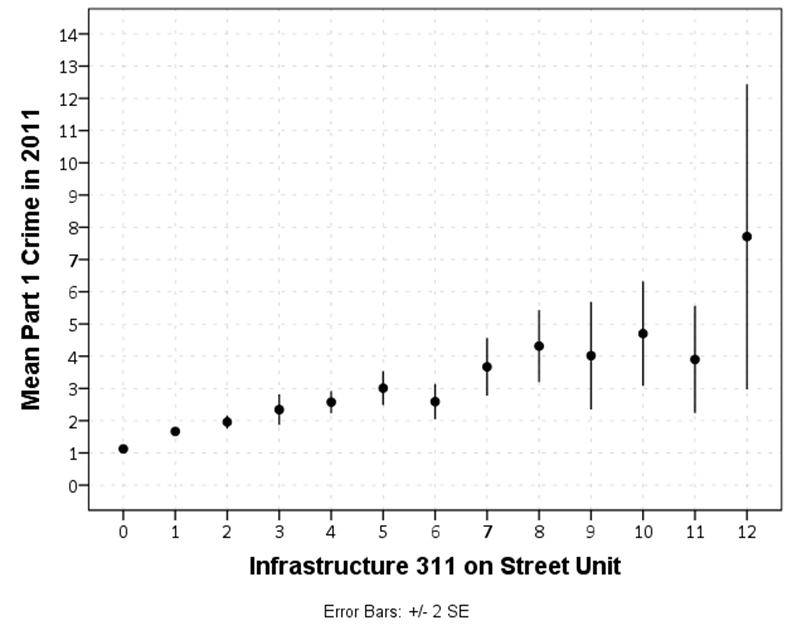
Not in the paper (but in my presentation), here is the marginal relationship between infrastructure related 311 complaints and crime

I am presenting the paper on Wednesday at 11 am. The panel title is Environmental Approaches to Crime Prevention and Intervention, and it is located at Hilton, E – Embassy, Terrace Level. There are two other presentations as well, all related to the spatial analysis of crime. (Kelly Edmiston has followed up and stated he can not make it.)

I will be in D.C. from Wednesday until Friday afternoon, so if you want to get together in that time frame feel free to send me an email.

The spatial clustering of hits-vs-misses in shootings using Ripley’s K

My article, Replicating Group-Based Trajectory Models of Crime at Micro-Places in Albany, NY was recently published online first at the Journal of Quantitative Criminology (here is a pre-print version, and you can get my JQC offprint for the next few weeks).

Part of the reason I blog is to show how to replicate some of my work. I have previously shown how to generate the group based trajectory models (1,2), and here I will illustrate how to replicate some of the point pattern analysis I conducted in that paper.

A regular task for an analyst is to evaluate spatial clustering. A technique I use in that article is to use Ripley’s K statistic to evaluate clustering between different types of events, or what spatial statistics jargon calls a marked point pattern. I figured I would illustrate how to do this on some example point patterns of shootings, so analysts could replicate for other situations. The way crime data is collected and geocoded makes generating the correct reference distributions for the tests different than if the points could occur anywhere in the study region.

An example I am going to apply are shooting incidents that have marks of whether they hit the intended victim or missed. One theory in criminology is that murder is simply the extension of general violence — with the difference in aggravated assault versus murder often being happenstance. One instance this appears to be the case from my observations are shootings. It seems pure luck whether an individual gets hit or the bullets miss everyone. Here I will see if there appear to be any spatial patterning in shots fired with a victim hit. That is, we know that shootings themselves are clustered, but within those clusters of shootings are the locations of hits-and-misses further clustered or are they random?

A hypothetical process in which clustering of shooting hits can occur is if some shootings are meant to simply scare individuals vs. being targeted at people on the street. It could also occur if there are different tactics, like drive-bys vs. being on foot. This could occur if say one area had many shootings related to drug deals gone wrong, vs. another area that had gang retaliation drive by shootings. If they are non-random, the police may consider different interventions in different places – probably focusing on locations where people are more likely to be injured from the shooting. If they are random though, there is nothing special about analyzing shootings with a person hit versus shootings that missed everyone – you might as well analyze and develop strategy for all shootings.

So to start we will be using the R statistical package and the spatstat library. To follow along I made a set of fake shooting data in a csv file. So first load up R, I then change the working directory to where my csv file is located, then I read in the csv into an R data frame.

library(spatstat)

#change R directory to where your file is
MyDir <- "C:\\Users\\andrew.wheeler\\Dropbox\\Documents\\BLOG\\R_shootingVic\\R_Code"
setwd(MyDir)

#read in shooting data
ShootData <- read.csv("Fake_ShootingData.csv", header = TRUE)
head(ShootData)

The file subsequently has four fields, ID, X & Y coordinates, and a Vic column with 0’s and 1’s. Next to conduct the spatial analysis we are going to convert this data into an object that the spatstat library can work with. To do that we need to create a study window. Typically you would have the outline of the city, but for this analysis the window won’t matter, so here I make a window that is just slightly larger than the bounding box of the data.

#create ppp file, window does not matter for permuation test
StudyWin <- owin(xrange=c(min(ShootData$X)-0.01,max(ShootData$X)+0.01),yrange=c(min(ShootData$Y)-0.01,max(ShootData$Y)+0.01))
Shoot_ppp <- ppp(ShootData$X, ShootData$Y, window=StudyWin, marks=as.factor(ShootData$Vic), unitname = c("meter","meters"))

Traditionally when Ripley’s K was originally developed it was for points that could occur anywhere in the study region, such as the location of different tree species. Crimes are a bit different though, in that there are some areas in any city that a crime basically cannot occur (such as the middle of a lake). Also, crimes are often simply geocoded according to addresses and intersections, so this further reduces the locations where the points can be located in a crime dataset. To calculate the sample statistic for Ripley’s K one does not need to account for this, but to tell whether those patterns are random one needs to simulate the point pattern under a realistic null hypothesis. There are different ways to do the simulation, but here the simulation keeps the shooting locations fixed, but randomly assigns a shooting to be either a victim or a not with the same marginal frequencies. That is, it basically just shuffles which events are counted as a victim being hit or one in which there were no people hit. The Dixon article calls this the random relabelling approach.

Most of the spatstat functions can take a separate list of point patterns to use to simulate error bounds for different functions, so this function takes the initial point pattern, generates the permutations, and stuffs them in a list. I set the seed so the analysis can be reproduced exactly.

#generate the simulation envelopes to use in the Cross function
MarkedPerms <- function(ppp, nlist) {
  require(spatstat)
  myppp_list <- c() #make empty list
  for (i in 1:nlist) {
    current_ppp <-  ppp(ppp$x, ppp$y,window=ppp$window,marks=sample(ppp$marks))  #making permutation      
    myppp_list[[i]] <- current_ppp                                               #appending perm to list
  }
  return(myppp_list)
}

#now making a set of simulated permutations
set.seed(10) #setting seed for reproducibility
MySimEvel <- MarkedPerms(ppp=Shoot_ppp,nlist=999)

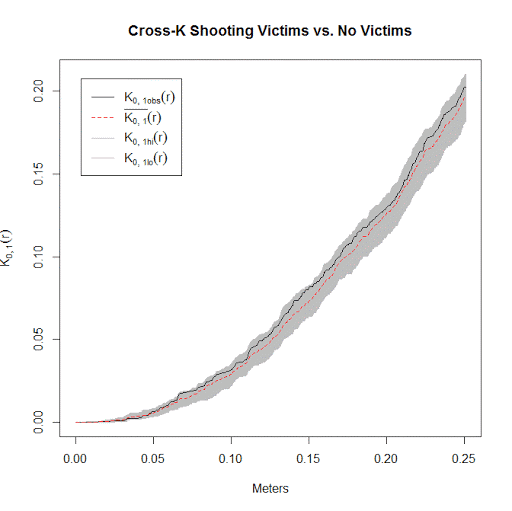
Now we have all the ingredients to conduct the analysis. Here I call the cross K function and submit my set of simulated point patterns named MySimEvel. With only 100 points in the dataset it works pretty quickly, and then we can graph the Ripley’s K function. The grey bands are the simulated K statistics, and the black line is the observed statistic. We can see the observed is always within the simulated bands, so we conclude that conditional on shooting locations, there is no clustering of shootings with a victim versus those with no one hit. Not surprising, since I just simulated random data.

#Cross Ripleys K
CrossK_Shoot <- alltypes(Shoot_ppp, fun="Kcross", envelope=TRUE, simulate=MySimEvel)
plot(CrossK_Shoot$fns[[2]], main="Cross-K Shooting Victims vs. No Victims", xlab="Meters")

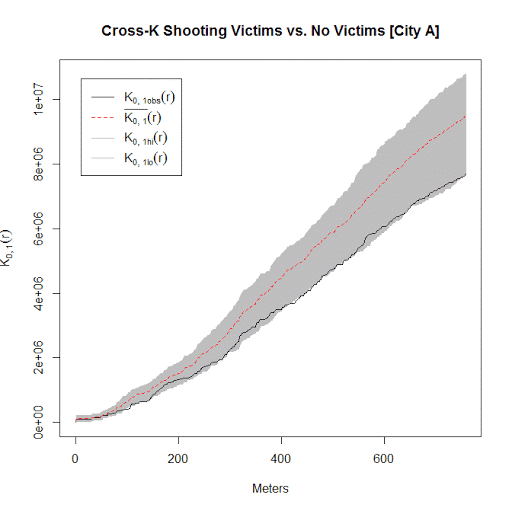
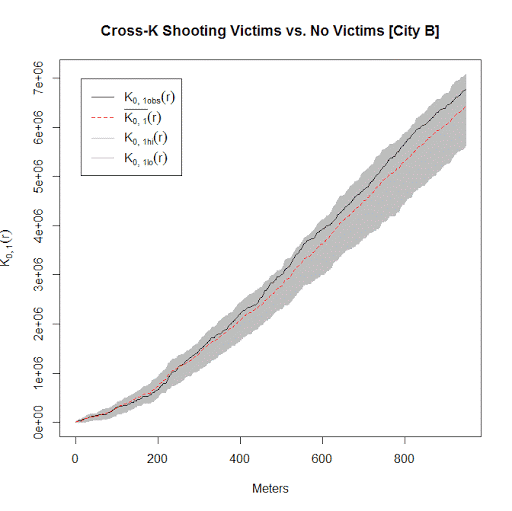
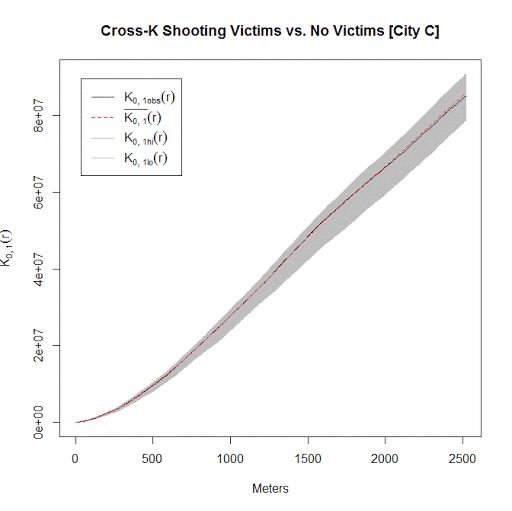
I conducted this same analysis with actual shooting data in three separate cities that I have convenient access to the data. It is a hod podge of length, but City A and City B have around 100 shootings, and City C has around 500 shootings. In City A the observed line is very near the bottom, suggesting some evidence that shootings victims may be further apart than would be expected, but for most instances is within the 99% simulation band. (I can’t think of a theoretical reason why being spread apart would occur.) City B is pretty clearly within the simulation band, and City C’s observed pattern mirrors the mean of the simulation bands almost exactly. Since City C has the largest sample, I think this is pretty good evidence that shootings with a person hit are spatially random conditional on where shootings occur.

Long story short, when conducting Ripley’s K with crime data, the default way to generate the simulation envelopes for the statistics are not appropriate given how crime data is recorded. I show here one way to account for that in generating simulation envelopes.

Poster presentations should have a minimum font size of 25 points

A fairly generic problem I’ve been trying to do some research on is how large should fonts be for posters and PowerPoint presentations. The motivation is my diminishing eyesight over the years, and in particular default labels for statistical graphics are almost always too small in my opinion. Projected presentations just exacerbate the problem.

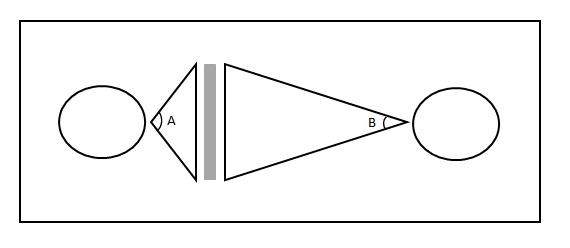
First, to tackle the project we need to find research about the the sizes that individuals can comfortably read letters. You don’t measure size of letters in absolute distance terms though, you measure it in the subtended angle that an object commands in your vision. That is, it is both a function of the height of the letters as well as the distance you are away from the object. I.e. in the below diagram angle A is larger than angle B.

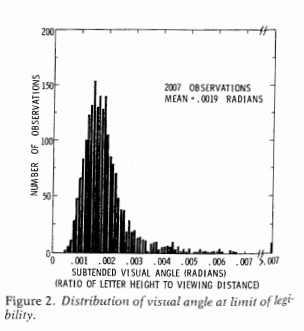
The best guide for the size of this angle I have found for letters is an article by Sidney Smith, Letter Size and Legibility. Smith (1979) had a set of students make various labels and then have people stand too far away to be able to read them. Then the participants walked towards the labels until they could read them. Here is the histogram of those subtended angles (in radians) Smith produced:

From this Smith gives the recommendation as 0.007 radians as a good bet for pretty much everyone to be able to read the text. My research into other recommendations (eye tests, highway symbols) tends to be smaller, and between mine and Smith’s other sources tends to produce a range of 0.003 to 0.010 radians. Personal experimentation for me is that 0.007 is a good size, although up to 0.010 is not uncomfortably large. Most everyone with corrective vision can clearly see under 0.007, but we shouldn’t be making our readers strain to read the text.

For comparison, I sit approximately 22 inches away from my computer screen. A subtended angle of 0.007 produces a font size of just over 11 points at that distance. At my usual sitting distance I can read fonts down to 7 points, but I would prefer not to under usual circumstances.

This advice can readily translate to font sizes in poster presentations, since there is a limited range in which people will attempt to read them. Block’s (1996) suggestion that most people are around 4 feet away when they read a poster seems pretty reasonable to me, and so this produces a letter height of 0.34 inches needed to correspond to a 0.007 subtended angle. One point of font is 1/72 inches in letter height, so this converts to a 25 point font as the minimum to which most individuals can comfortably read the words in a poster. (R Functions at the end of the post for conversions, although it is based on relatively simple geometry.)

This advice is larger than Block’s (which is 20 point), but fits in line with Colin Purrington’s templates, which use 28 point for the smallest font. Again note that this is the minimum font for the poster, things like titles and author names should clearly be larger than the minimum to create a hierarchy. Again a frequent problem are axis labels for statistical graphics.

It will take more work to extend this advice to projected presentations, since there is more variability in projected sizes as well as rooms. So if you see a weirdo with a measuring tape at the upcoming ASC conference, don’t be alarmed, I’m just collecting some data!


Here are some R functions, the first takes a height and distance and return the subtended angle (in radians). The second takes the distance and radians to produce a height.

visual_angleR <- function(H,D){ 
   x <- 2*atan(H/(2*D))
   return(x)
}

visual_height <- function(D,Rad) {
  x <- 2*D*tan(Rad/2) #can use sin as well instead of tan
  return(x)
}

Since a point of font is 1/72 of an inch, the code to calculate the recommended font size is visual_height(D=48,Rad=0.007)*72 and I take the ceiling of this value for the 25 point recommendation.