Year in Review 2024

Past year in review posts I have made focused on showing blog stats. Writing this in early December, but total views will likely be down this year – I am projecting around 140,000 views in total for this site. But I have over 25k views for the Crime De-Coder site, so it is pretty much the same compared to 2023 combining the two sites.

I do not have a succinct elevator speech to tell people what I am working on. With the Crime De-Coder consulting gig, it can be quite eclectic. That Tukey quote being a statistician you get to play in everyone’s backyard is true. Here is a rundown of the paid work I conducted in the past year.

Evidence Based CompStat: Work with Renee Mitchell and the American Society of Evidence Based Policing on what I call Evidence Based CompStat. This mostly amounts to working directly with police departments (it is more project management than crime analysis) to help them get started with implementing evidence based practices. Reach out if that sounds like something your department would be interested in!

Estimating DV Violence: Work supported by the Council on CJ. I forget exactly the timing of events. This was an idea I had for a different topic (to figure out why stores and official reports of thefts were so misaligned). Alex approached me to help with measuring national level domestic violence trends, and I pitched this idea (use local NIBRS data and NCVS to get better local estimates).

Premises Liability: I don’t typically talk about ongoing cases, but you can see a rundown of some of the work I have done in the past. It is mostly using the same stats I used as a crime analyst, but in reference to civil litigation cases.

Patrol Workload Analysis: I would break workload analysis for PDs down into two categories, advanced stats and CALEA reports. I had one PD interested in the simpler CALEA reporting requirement (which I can do for quite a bit cheaper than the other main consulting firm that offers these services).

Kansas City Python Training: Went out to Kansas City for a few days to train their analysts up in using python for Focused Deterrence. If you think the agenda in the pic below looks cool get in touch, I would love to do more of these sessions with PDs. I make it custom for the PD based on your needs, so if you want “python and ArcGIS”, or “predictive models” or whatever, I will modify the material to go over those advanced applications. I have also been pitching the same idea (short courses) for PhD programs. (So many posers in private sector data science, I want more social science PhDs with stronger tech skills!)

Patterson Opioid Outreach: Statistical consulting with Eric Piza and Kevin Wolff on a street outreach intervention intended to reduce opioid overdose in Patterson New Jersey. I don’t have a paper to share for that at the moment, but I used some of the same synthetic control in python code I developed.

Bookstore prices: Work with Scott Jacques, supported by some internal GSU money. Involves scraping course and bookstore data to identify the courses that students spend the most on textbooks. Ultimate goal in mind is to either purchase those books as unlimited epubs (to save the students money), or encourage professors to adopt better open source materials. It is a crazy amount of money students pour into textbooks. Several courses at GSU students cumulatively spend over $100k on course materials per semester. (And since GSU has a large proportion of Pell grant recipients, it means the federal government subsidizes over half of that cost.)

General Statistical Consulting: I do smaller stat consulting contracts on occasion as well. I have an ongoing contract to help with Pam Metzger’s group at the SMU Deason center. Did some small work for AH Datalytics on behind the scenes algorithms to identify anomalous reporting for the real time crime index. I have several times in my career consulted on totally different domains as well, this year had a contract on calculating regression spline curves for some external brain measures.

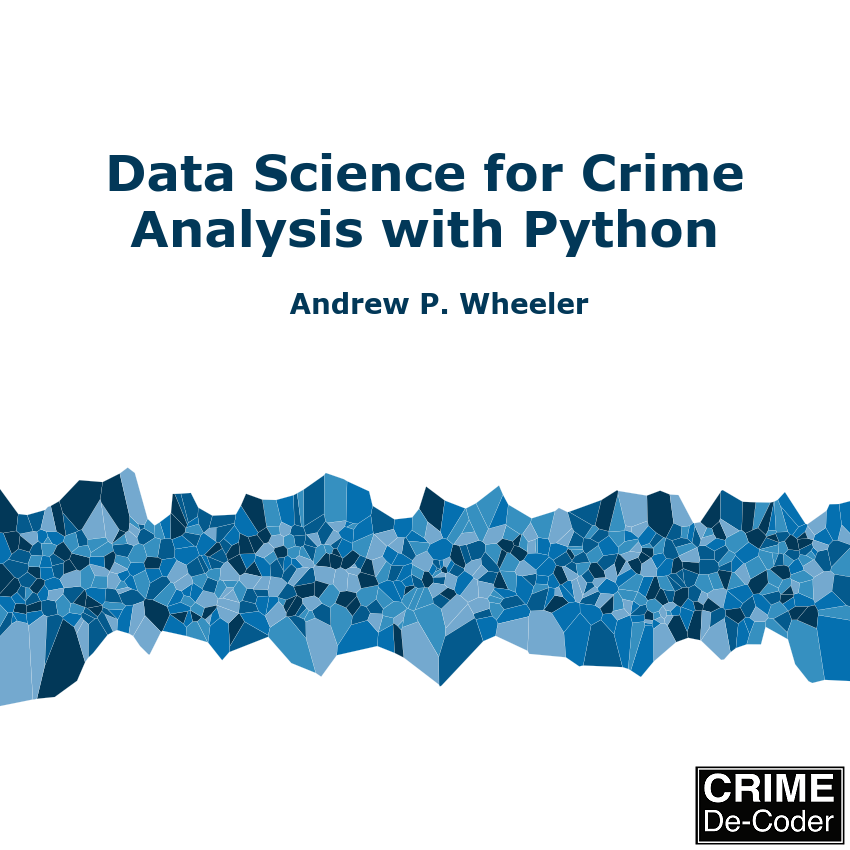
Data Science Book: And last (that I remember), I published Data Science for Crime Analysis with Python. I still have not gotten my 100 sales I would consider it a success – so if you have not bought a copy go do that right now. (Coupon code APWBLOG will get you $10 off for the next few weeks, either the epub or the paperback.)
Sometimes this seems like I am more successful than I am. I have stopped counting the smaller cold pitches I make (I should be more aggressive with folks, but most of this work is people reaching out to me). But in terms of larger grant proposals or RFPs in that past year, I have submitted quite a few (7 in total) and have landed none of them to date! Submitted a big one to support surveys that myself and Gio won the NIJ competition on for place based surveys to NIJ in their follow up survey solicitation, and it was turned down for example. So it goes.

In addition to the paid work, I still on occasion publish peer reviewed articles. (I need to be careful with my time though.) I published a paper with Kim Rossmo on measuring the buffer zone in journey to crime data. I also published the work on measuring domestic violence supported by the Council on CJ with Alex Piquero.

I took the day gig in Data Science at the end of 2019. Citations are often used as a measure of a scholars influence on the field – they are crazy slow though.

I had 208 citations by the end of 2019, I now have over 1300. Of the 1100 post academia, only a very small number are from articles I wrote after I left (less than 40 total citations). A handful for the NIJ recidivism competition paper (with Gio), and a few for this Covid and shootings paper in Buffalo. The rest of the papers that have a post 2019 publishing date were entirely written before I left academia.

Always happy to chat with folks on teaming up on papers, but it is hard to take the time to work on a paper for free if I have other paid work at the moment. One of the things I need to do to grow the business is to get some more regular work. So if you have a group (academic, think tank, public sector) that is interested in part time (or fractional I guess is what the cool kids are calling it these days), I would love to chat and see if I could help your group out.
Crime De-Coder LLC Website

So I have created CRIME De-Coder LLC, a firm to do my consulting work with police departments. Check out my website, crimede-coder.com.

Feedback is welcome. In particular check out the services pages, and my first blog post on what distinguishes my services from most firms. Providing computer code to generate the end product is “teaching a man a fish”, whereas most firms just drop a final report and leave.

And of course feel free to reach out to consult@crimede-coder.com if you are interested in pursuing a project. Going forward I plan on making a new post around once a month, so sign up in your feed reader or using a service like IFTTT.


Setting up a stand alone website is not that hard in the end. Currently it is a static site with some custom javascript (hosted on Hostinger). I should do a PHP server for the new blog posts and RSS feed eventually, but for now this is fine. I suggest for those interested in the same get the Jon Duckett books (HTML/Javascript/PHP) for overview of the tech, and then check out Dani Kross’s youtube tutorials (for random things like editing the htaccess file).

I am not doing a newsletter for the blog-posts, as I am concerned it will get my email on random block lists. But if there is demand for it in the future I will figure out some other service I guess to do that.

I wanted a more bare-metal setup (not a hosted wordpress like this site), as in the future I will likely do demo’s of dashboards, host some pyscript, make a sign in for paid content, etc. I just wanted flexibility from the start. So stay tuned for more content from CRIME De-Coder!

Ask me anything

So I get cold emails probably a few times a month asking random coding questions (which is perfectly fine — main point of this post!). I’ve suggested in the past that folks use a few different online forums, but like many forums I have participated in the past they died out quite quickly (so are not viable alternatives currently).

I think going forward I will mimic what Andrew Gelman does on his blog, just turn my responses into blog posts for everyone (e.g. see this post for an example). I will of course ask people permission before I post, and omit names same as Gelman does.

I have debated over time of doing a Patreon account, but I don’t think that would work very well (imagine I would get 1.2 subscribers for $3 a month!). Ditto for writing books, I debate on doing a Data Science for Crime Analysts in Python or something along those lines, but then I write the outline and think that is too much work to have at best a few hundred people purchase the book in the end. I will do consulting gigs for folks, but the majority of questions people ask do not take long enough to justify running a tab for the work (and I have no desire to rack up charges for grad students asking a few questions).

So feel free to ask me anything.

Reasons Police Departments Should Consider Collaborating with Me

Much of my academic work involves collaborating and consulting with police departments on quantitative problems. Most of the work I’ve done so far is very ad-hoc, through either the network of other academics asking for help on some project or police departments cold contacting me directly.

In an effort to advertise a bit more clearly, I wrote a page that describes examples of prior work I have done in collaboration with police departments. That discusses what I have previously done, but doesn’t describe why a police department would bother to collaborate with me or hire me as a consultant. In fact, it probably makes more sense to contact me for things no one has previously done before (including myself).

So here is a more general way to think about (from a police departments or criminal justice agencies perspective) whether it would be beneficial to reach out to me.

Should I do X?

So no one is going to be against different evidence based policing practices, but not all strategies make sense for all jurisdictions. For example, while focussed deterrence has been successfully applied in many different cities, if you do not have much of a gang violence problem it probably does not make sense to apply that strategy in your jurisdiction. Implementing any particular strategy should take into consideration the cost as well as the potential benefits of the program.

Should I do X may involve more open ended questions. I’ve previously conducted in person training for crime analysts that goes over various evidence based practices. It also may involve something more specific, such as should I redistrict my police beats? Or I have a theft-from-vehicle problem, what strategies should I implement to reduce them?

I can suggest strategies to implement, or conduct cost-benefit analysis as to whether a specific program is worth it for your jurisdiction.

I want to do X, how do I do it?

This is actually the best scenario for me. It is much easier to design a program up front that allows a police department to evaluate its efficacy (such as designing a randomized trial and collecting key measures). I also enjoy tackling some of the nitty-gritty problems of implementing particular strategies more efficiently or developing predictive instruments.

So you want to do hotspots policing? What strategies do you want to do at the hotspots? How many hotspots do you want to target? Those are examples of where it would make sense to collaborate with me. Pretty much all police departments should be doing some type of hot spots policing strategy, but depending on your particular problems (and budget constraints), it will change how you do your hot spots. No budget doesn’t mean you can’t do anything — many strategies can be implemented by shifting your current resources around in particular ways, as opposed to paying for a special unit.

If you are a police department at this stage I can often help identify potential grant funding sources, such as the Smart Policing grants, that can be used to pay for particular elements of the strategy (that have a research component).

I’ve done X, should I continue to do it?

Have you done something innovative and want to see if it was effective? Or are you putting a bunch of money into some strategy and are skeptical it works? It is always preferable to design a study up front, but often you can conduct pretty effective post-hoc analysis using quasi-experimental methods to see if some crime reduction strategy works.

If I don’t think you can do a fair evaluation I will say so. For example I don’t think you can do a fair evaluation of chronic offender strategies that use officer intel with matching methods. In that case I would suggest how you can do an experiment going forward to evaluate the efficacy of the program.

Mutual Benefits of Academic-Practitioner Collaboration

Often I collaborate with police departments pro bono — which you may ask what is in it for me then? As an academic I get evaluated mostly by my research productivity, which involves writing peer reviewed papers and getting research grants. So money is not the main factor from my perspective. It is typically easier to write papers about innovative problems or programs. If it involves applying for a grant (on a project I am interested in) I will volunteer my services to help write the grant and design the study.

I could go through my career writing papers without collaborating with police departments. But my work with police departments is more meaningful. It is not zero-sum, I tend to get better ideas when understanding specific agencies problems.

So get in touch if you think I can help your agency!