Power and bias in logistic regression

Michael Sierra-Arévalo, Justin Nix and Bradley O’Guinn have a recent article about examining officer fatalities following gunshot assaults (Sierra-Arévalo, Nix, & O-Guinn). They do not find that distance to a Level 1/2 trauma ERs make a difference in the survival probabilities, which conflicts with prior work of mine with Gio Circo (Circo & Wheeler, 2021). Justin writes this as a potential explanation for the results:

The results of our multivariable analysis indicated that proximity to trauma care was not significantly associated with the odds of officers surviving a gunshot wound (see Table 2 on p. 9 of the post-print). On the one hand, this was somewhat surprising given that proximity to trauma care predicts survival of gunshot wounds among the general public.1 On the other hand, police have specialized equipment, such as ballistic vests and tourniquets, that reduce the severity of gunshot wounds or allow them to be treated immediately.

I think it is pretty common when results do not pan out, people turn to theoretical (or sociological) reasons why their hypothesis may be invalid. While these alternatives are often plausible, often equally plausible are simpler data based reasons. Here I was concerned about two factors, 1) power and 2) omitted severity of gun shot wound factors. I did a quick simulation in R to show power seems to be OK, but the omitted severity confounders may be more problematic in this design, although only bias the effect towards 0 (it would not cause the negative effect estimate MJB find).

Power In Logistic Regression

First, MJB’s sample size is just under 1,800 cases. You would think offhand this is plenty of power for whatever analysis right? Well, power just depends on the relevant effect size, a small effect and you need a bigger sample. My work with Gio found a linear effect in the logistic equation of 0.02 (per minute driving increases the logit). We had 5,500 observations, and our effect had a p-value just below 0.05, hence why a first thought was power. Also logistic regression is asymptotic, it is common to have small sample biases in situations even up to 1000 observations (Bergtold et al., 2018). So lets see in a simple example ignoring the other covariates:

# Some upfront work
logistic <- function(x){1/(1+exp(-x))}
set.seed(10)

# Scenario 1, no covariates omitted
n <- 2000; 
de <- 0.02
dist <- runif(n,5,200)
p <- logistic(-2.5 + de*dist)
y <- rbinom(n,1,p)

# Variance is small enough, seems reasonably powered
summary(glm(y ~ dist, family = "binomial"))

Here with 2000 cases, taking the intercept from MJB’s estimates and the 0.02 from my paper, we see 2000 observations is plenty enough well powered to detect that same 0.02 effect in mine and Gio’s paper. Note when doing post-hoc power analysis, you don’t take the observed effect (the -0.001 in Justin’s paper), but a hypothetical effect size you think is reasonable (Gelman, 2019), which I just take from mine and Gio’s paper. Essentially saying “Is Justin’s analysis well powered to detect an effect of the same size I found in the Philly data”.

One thing that helps MJB’s design here is more variance in the distance parameter, looking intra city the drive time distances are smaller, which will increase the standard error of the estimate. If we pretend to limit the distances to 30 minutes, this study is more on the fence as to being well enough powered (but meets the threshold in this single simulation):

# Limited distance makes the effect have a higher variance
n <- 2000; 
de <- 0.02
dist <- runif(n,1,30)
p <- logistic(-2.5 + de*dist)
y <- rbinom(n,1,p)

# Not as much variation in distance, less power
summary(glm(y ~ dist, family = "binomial"))

For a more serious set of analysis you would want to do these simulations multiple times and see the typical result (since they are stochastic), but this is good enough for me to say power is not an issue in this design. If people are planning on replications though, intra-city with only 1000 observations is really pushing it with this design though.

Omitted Confounders

One thing that is special about logistic regression, unlike linear regression, even if an omitted confounder is uncorrelated with the effect of interest, it can still bias the estimates (Mood, 2010). So even if you do a randomized experiment your effects could be biased if there is some large omitted effect from the regression equation. Several people interpret this as logistic regression is fucked, but like that linked Westfall article I think that is a bit of an over-reaction. Odds ratios are very tricky, but logistic regression as a method to estimate conditional means is not so bad.

In my paper with Gio, the largest effect on whether someone would survive was based on the location of the bullet wound. Drive time distances then only marginal pushed up/down that probability. Here are conditional mean estimates from our paper:

So you can see that being shot in the head, drive time can make an appreciable difference over these ranges, from ~45% to 55% probability of death. Even if the location of the wound is independent of drive time (which seems quite plausible, people don’t shoot at your legs because you are far away from a hospital), it can still be an issue with this research design. I take Justin’s comment about ballistic vests as reducing death as essentially taking the people in the middle of my graph (torso and multiple injuries) and pushing them into the purple line at the bottom (extremities). But people shot in the head are not impacted by the vests.

So lets see what happens to our effect estimates when we generate the data with the extremities and head effects (here I pulled the estimates all from my article, baseline reference is shot in head and negative effect is reduction in baseline probability when shot in extremity):

# Scenario 3, wound covariate omitted
dist <- runif(n,5,200)
ext_wound <- rbinom(n,1,0.8)
ef <- -4.8
pm <- logistic(0.2 + de*dist + ef*ext_wound)
ym <- rbinom(n,1,pm)

# Biased downward (but not negative)
summary(glm(ym ~ dist, family = "binomial"))

You can see here the effect estimate is biased downward by a decent margin (less than half the size of the true effect). If we estimate the correct equation, we are on the money in this simulation run:

What happens if we up the sample size? Does this bias go away? Unfortunately it does not, here is an example with 10,000 observations:

# Scenario 3, wound covariate ommitted larger sample
n2 <- 10000
dist <- runif(n2,5,200)
ext_wound <- rbinom(n2,1,0.8)
ef <- -4.8
pm <- logistic(0.2 + de*dist + ef*ext_wound)
ym <- rbinom(n2,1,pm)

# Still a problem
summary(glm(ym ~ dist, family = "binomial"))

So this omission is potentially a bigger deal – but not in the way Justin states in his conclusion. The quote earlier suggests the true effect is 0 due to vests, I am saying here the effect in MJB’s sample is biased towards 0 due to this large omitted confounder on the severity of the wound. These are both plausible, there is no way based just on MJB’s data to determine if one interpretation is right and the other is wrong.

This would not explain the negative effect estimate MJB finds though in their paper, it would only bias towards 0. To be fair, Jessica Beard critiqued mine and Gio’s paper in a similar vein (saying the police wound location data had errors), this would make our drive time estimates be biased towards 0 as well, so if that factor may be even larger than me and Gio even estimated.

Potential robustness checks here are to simply do a linear regression instead of logistic with the same data (my graph above shows a linear regression would be fine for the data if I included interaction effects with wound location). And another would be to look at the unconditional marginal distribution of distance vs probability of death. If that is highly non-linear, it is likely due to omitted confounders in the data (I suspect it may plateau as well, eg the first 30 minutes make a big difference, but after that it flattens out, you’ve either stabilized someone or they are gone at that point).

Policy?

In the case of intra-city public violence, the policy implication of drive times on survival are relevant when people are determining whether to keep open or close trauma centers. I did not publish this in my paper with Gio (you can see the estimates in the replication code), but we actually estimated counter-factual increased deaths by taking away facilities. Its marginal effect is around 10~20 homicides over the 4.5 years if you take away one of the facilities in Philadelphia. I don’t know if reducing 5 homicides per year is sufficient justification to keep a trauma facility open, but officer shootings are themselves much less frequent, and so the marginal effects are very unlikely to justify keeping a trauma facility open/closed by themselves.

You could technically figure out the optimal location to site a new trauma facility from mine and Gio’s paper, but probably a more reasonable response would be to site resources to get people to the ER faster. Philly already does scoop and run (Winter et al., 2021), where officers don’t wait for an ambulance. Another possibility though is to proactively locate ambulances to get to scenes faster (Hosler et al., 2019). Again though it just isn’t as relevant/feasible outside of major urban areas though to do that.

Often times social science authors do an analysis, and then in the policy section say things that are totally reasonable on their face, but are not supported by the empirical analysis. Here the suggestion that officers should increase their use of vests by MJB is totally reasonable, but nothing in their analysis supports that conclusion (ditto with the tourniquets statement). You would need to measure those incidents that had those factors, and see its effect on officer survival to make that inference. MJB could have made the opposite statement, since drive time doesn’t matter, maybe those things don’t make a difference in survival, and be equally supported by the analysis.

I suspect MJB’s interest in the analysis was simply to see if survival rates were potential causes of differential officer deaths across states (Sierra-Arévalo & Nix, 2020). Which is fine to look at by itself, even if it has no obviously direct policy implications. Talking back and forth with Justin before posting this, he did mention it was a bit of prodding from a reviewer to add in the policy implications. Which it goes for both (reviewers or original writers), I don’t think we should pad papers with policy recommendations (or ditto for theoretical musings) that aren’t directly supported by the empirical analysis we conduct.

References

  • Bergtold, J. S., Yeager, E. A., & Featherstone, A. M. (2018). Inferences from logistic regression models in the presence of small samples, rare events, nonlinearity, and multicollinearity with observational data. Journal of Applied Statistics, 45(3), 528-546.
  • Circo, G. M., & Wheeler, A. P. (2021). Trauma Center Drive Time Distances and Fatal Outcomes among Gunshot Wound Victims. Applied Spatial Analysis and Policy, 14(2), 379-393.
  • Gelman, A. (2019). Don’t calculate post-hoc power using observed estimate of effect size. Annals of Surgery, 269(1), e9-e10.
  • Hosler, R., Liu, X., Carter, J., & Saper, M. (2019). RaspBary: Hawkes Point Process Wasserstein Barycenters as a Service.
  • Mood, C. (2010). Logistic regression: Why we cannot do what we think we can do, and what we can do about it. European Sociological Review, 26(1), 67-82.
  • Sierra-Arévalo, M., & Nix, J. (2020). Gun victimization in the line of duty: Fatal and nonfatal firearm assaults on police officers in the United States, 2014–2019. Criminology & Public Policy, 19(3), 1041-1066.
  • Sierra-Arévalo, Michael, Justin Nix, & Bradley O’Guinn (2022). A National Analysis of Trauma Care Proximity and Firearm Assault Survival among U.S. Police. Forthcoming in Police Practice and Research. Post-print available at
  • Winter, E., Hynes, A. M., Shultz, K., Holena, D. N., Malhotra, N. R., & Cannon, J. W. (2021). Association of police transport with survival among patients with penetrating trauma in Philadelphia, Pennsylvania. JAMA network open, 4(1), e2034868-e2034868.

Paper retraction and exemplary behavior in Crim

Criminology researchers had a bad look going for them in the Stewart/Pickett debacle. But a recent exchange shows to me behavior we would all be better if we emulated; a critique of a meta analysis (by Kim Rossmo) and a voluntary retraction (by Wim Bernasco).

Exemplary behavior by both sides in this exchange. I am sure people find it irksome if you are on the receiving end, but Kim has over his career pursued response/critique pieces. And you can see in the retraction watch piece this is not easy work (basically as much work as writing an original meta analysis). This is important if science is to be self correcting, we need people to spend the time to make sure prior work was done correctly.

And from Wim’s side it shows much more humility than the average academic – which it is totally OK to admit ones faults/mistakes and move on. I have no doubt if Kim (or whomever) did a deep dive into my prior papers, he would find some mistakes and maybe it would be worth a retraction. It is ok, Wim will not be made to wear a dunce hat at the next ASC or anything like that. Criminology would be better off if we all were more like Kim and more like Wim.

One thing though is that I agree with Andrew Gelman, and that it is OK to do a blog post if you find errors before going to the author directly. Most academics don’t respond to critiques at all (or make superficial excuses). So if you find error in my work go ahead and blog it or write to the editor or whatever. I am guessing it worked out here because I imagine Kim and Wim have crossed paths before, and Wim actually answers his emails.

Note I think this is OK even. For example Data Colada made a dig at an author for not responding to a critique recently (see the author feedback at the bottom). If you critique my work I don’t think I’m obligated to respond. I will respond if I think it is worth my time – papers are not a contract to defend until death.


A second part I wanted to blog about was reviewing papers. You can see in my comment on Gelman’s blog, Kaiser Fung asks “What happened during the peer review process? They didn’t find any problems?”. And you can see in the original retraction watch, I think Kim did his due diligence in the original review. It was only after it was published and he more seriously pursued a replication analysis (which is beyond what is typically expected in peer review), did he find inconsistencies that clearly invalidated the meta analysis.

It is hard reviewing papers to find really widespread problems with an empirical analysis. Personally I do small checks, think of these as audits, that are not exhaustive but I often do find errors. For meta-analysis things I have done are pull out 1/2/3 studies, and see if I can replicate the point effects the authors report. One example I realized in doing this for example is that the Braga meta analysis of hot spots uses the largest point effect for some tables, which I think is probably a mistake and they should just pool all of the effects reported (although the variants I have reviewed have calculated them correctly).

Besides this for meta-analysis I do not have much advice. I have at times noted papers missing, but that was because I was just familiar with them, not because I replicated the authors search strategy. And I have advocated sharing data and code in reviews (which should clearly be done in meta-analysis), but pretty much no one does this.

For not meta analysis, one thing I do is if people have inline statistics (often things like F-tests or Chi-Square tests), I try to replicate these. Looking at regression coefficients it may be simpler to see a misprint, but I don’t have Chi-square committed to memory. I can’t remember a time I was actually able to replicate one of these, reviewed a paper one time with almost 100 inline stats like this and I couldn’t figure out a single one! It is actually somewhat common in crim articles for regression to online print the point effects and p-values, which is more difficult to check for inconsistencies without the standard errors. (You should IMO always publish standard errors, to allow readers to do their own tests by eye.)

Even if one did provide code/data, I don’t think I would spend the time to replicate the tables as a reviewer – it is just too much work. I think journals should hire data/fact checkers to do this (an actual argument for paid for journals to add real value). I only spend around 3-8 hours per review I think – this is not enough time for me to dig into code, putz with it to run on my local machine, and cross reference the results. That would be more like 2~4 days work in many cases I think. (And that is just using the original data, verifying the original data collection in a meta-analysis would be even more work.)

Precision in measures and policy relevance

Too busy to post much recently – will hopefully slow down a bit soon and publish some more technical posts, but just a quick opinion post for this Sunday. Reading a blog post by Callie Burt the other day – I won’t comment on the substantive critique of the Harden book she is discussing (since I have not read it), but this quote struck me:

precise point estimates are generally not of major interest to social scientists. Nearly all of our measures, including our outcome measures, are noisy, (contain error), even biased. In general, what we want to know is whether more of something (education, parental support) is associated with more (or less) of something else (income, education) that we care about, ideally with some theoretical orientation. Frequently the scale used to measure social influences is somewhat arbitrary anyway, such that the precise point estimate (e.g., weeks of schooling) associated with 1 point increase in the ‘social support scale’ is inherently vague.

I think Callie is right, precise point estimates often aren’t of much interest in general criminology. I think this perspective is quite bad though for our field as a whole in terms of scientific advancement. Most criminology work is imprecise (for various reasons), and because of this it has no hope to be policy relevant.

Lets go with Callie’s point about education is associated with income. Imagine we have a policy proposal that increases high school completion rates via allocating more money to public schools (the increased education), and we want to see its improvement on later life outcomes (like income). Whether a social program “is worth it” depends not only whether it is effective in increasing high school completion rates, but by how much and how much return on investment there is those later life outcomes we care about. Programs ultimately have costs; both in terms of direct costs as well as opportunity costs to fund some other intervention.

Here is another more crim example – I imagine most folks by now know that bootcamps are an ineffective alternative to incarceration for the usual recidivism outcomes (MacKenzie et al., 1995). But what folks may not realize is that bootcamps are often cheaper than prison (Kurlychek et al., 2011). So even if they do not reduce recidivism, they may still be worth it in a cost-benefit analysis. And I think that should be evaluated when you do meta-analyses of CJ programs.

Part of why I think economics is eating all of the social sciences lunch is not just because of the credibility revolution, but also because they do a better job of valuating costs and benefits for a wide variety of social programs. These cost estimates are often quite fuzzy, same as more general theoretical constructs Callie is talking about. But we often can place reasonable bounds to know if something is effective enough to be worth more investment.

There are a smattering of crim papers that break this mold though (and to be clear you can often make these same too fuzzy to be worthwhile critiques for many of my papers). For several examples in the policing realm Laura Huey and her Canadian crew have papers doing a deep dive into investigation time spent on cases (Mark et al., 2019). Another is Lisa Tompson and company have a detailed program evaluation of a stalking intervention (Tompson et al., 2021). And for a few papers that I think are very important are Priscilla Hunt’s work on general CJ costs for police and courts given a particular UCR crime (Hunt et al., 2017; 2019).

Those four papers are definitely not the norm in our field, but personally think are much more policy relevant than the vast majority of criminological research – properly estimating the costs is ultimately needed to justify any positive intervention.

References

  • Hunt, P., Anderson, J., & Saunders, J. (2017). The price of justice: New national and state-level estimates of the judicial and legal costs of crime to taxpayers. American Journal of Criminal Justice, 42(2), 231-254.
  • Hunt, P. E., Saunders, J., & Kilmer, B. (2019). Estimates of law enforcement costs by crime type for benefit-cost analyses. Journal of Benefit-Cost Analysis, 10(1), 95-123.
  • Kurlychek, M. C., Wheeler, A. P., Tinik, L. A., & Kempinen, C. A. (2011). How long after? A natural experiment assessing the impact of the length of aftercare service delivery on recidivism. Crime & Delinquency, 57(5), 778-800.
  • MacKenzie, D. L., Brame, R., McDowall, D., & Souryal, C. (1995). Boot camp prisons and recidivism in eight states. Criminology, 33(3), 327-358.
  • Tompson, L., Belur, J., & Jerath, K. (2021). A victim-centred cost–benefit analysis of a stalking prevention programme. Crime Science, 10(1), 1-11.
  • Mark, A., Whitford, A., & Huey, L. (2019). What does robbery really cost? An exploratory study into calculating costs and ‘hidden costs’ of policing opioid-related robbery offences. International Journal of Police Science & Management, 21(2), 116-129.

Musings on Project Organization, Books and Courses

Is there a type of procrastination via which people write lists of things? I have that condition.

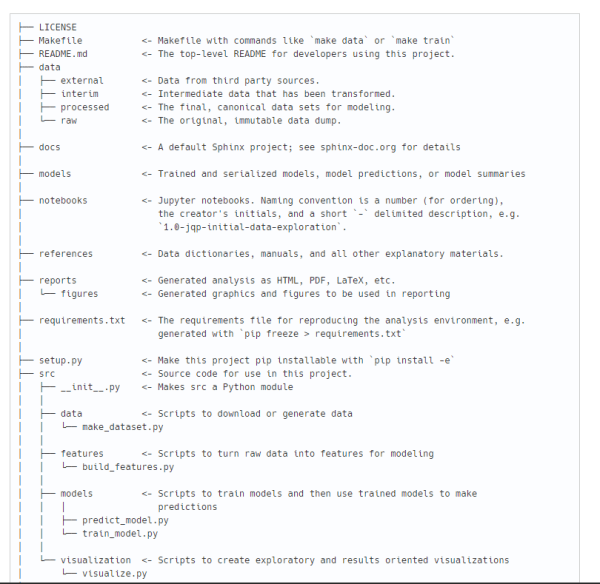
I have been recently thinking about project organization. At work we have been using the Cookie Cutter Data Science project set up – and I really hate it. I have been thinking about this more recently, as I have taken over several other data scientists models at work. The Cookie Cutter Template is waaaay too complicated, and mixes logic of building python packages (e.g. setup.py, a LICENSE folder) with data science in production code (who makes their functions pip installable for a production pipeline?). Here is the Cookie Cutter directory structure (even slightly cut off):

Cookie cutter has way too many folders (data folder in source, and data folder itself), multiple nested folders (what is the difference between external data, interim, and raw data?, what is the difference between features and data in the src folder?) I can see cases for individual parts of these needed sometimes (e.g. an external data file defining lookups for ICD codes), but why start with 100 extra folders that you don’t need. I find this very difficult taking over other peoples projects in that I don’t know where there are things and where there are not (most of these folders are empty).

So I’ve reorganized some of my projects at work, and they now look like this:

├── README.md           <- High level overview of project + any special notes
├── requirements.txt    <- Default python libraries we often use (eg sklearn, sqlalchemy)
├                         + special instructions for conda environments in our VMs
├── .gitignore          <- ignore `models/*.pkl`, `*.csv`, etc.
├── /models             <- place to store trained and serialized models
├── /notebooks          <- I don't even use notebooks very often, more like a scratch/EDA folder
├── /reports            <- Powerpoint reports to business (using HMS template)
├── /src                <- Place to store functions

And then depending on the project, we either use secret environment variables, or have a YAML file that has database connection strings etc. (And that YAML is specified in .gitignore.)

And then over time in the root folder it will typically have shell scripts call whatever production pipeline or API we are building. All the function files in source is fine, although it can grow to more modules if you really want it to.

And this got me thinking about how to teach this program management stuff to new data scientists we are hiring, and if I was still a professor how I would structure a course to teach this type of stuff in a social science program.

Courses

So in my procrastination I made a generic syllabi for what this software developement course would look like, Software & Project Development For Social Scientists. It would have a class/week on using the command prompt, then a week on github, then a few weeks building a python library, then ditto for an R package. And along the way sprinkle in literate programming (notebooks and markdown and Latex), unit testing, and docker.

And here we could discuss how projects are organized. And social science students get exposed to way more stuff that is relevant in a typical data science role. I have over the years also dreamt up other data science related courses as well.

Stats Programming for CJ. This goes through the basics of data manipulation using statistical programming. I would likely have tutorials for R, python, SPSS, and Stata for this. My experience with students is that even if they have had multiple stats classes in grad school, if you ask them “take this incident dataset with dates, and prepare a weekly level file with counts of crimes per week” they don’t know how to do even that simple task (an aggregation). So students need an entry level data manipulation course.

Optimization for Criminal Justice (or alt title Operations Research and Machine Learning for CJ). This one is not as developed as some of my other courses, but I think I could make it work for a semester. I think learning linear programming is a really great skill not taught at all in any CJ program I am aware of. I have some small notes on machine learning in my Research Design class for PhD students, but that could be expanded out (week for decision trees/forests, week for boosting, week for neural networks, etc.).

And last, I have made syllabi for the one credit entry level course for undergrad students, and the equivalent course for the new PhD students, College Prep. These classes I had I don’t think did a very good job. My intro one at Bloomsburg for undergrad had a textbook lol! The only thing I remember about my PhD one was fear mongering over publications (which at that point I had no idea what was going on), and spending the last class with Julie Horney and David McDowell at whatever the place next to the Washington Tavern in Albany was called (?Gingerbread?).

These are of course just in my head at the moment. I have posted my course materials over the years that I have delivered.

I have pitched to a few programs to hire me as a semi teaching professor (and still keep my private sector gig). This set up is not that uncommon in comp sci departments, but no CJ ones I think are interested. Even though I like musing about courses, adjunct pay is way too low to justify this investment, and should be paid to both develop the material as well as deliver the class.

Books

I have similarly made outlines for books over the years as well. One is Data Science for Crime Analysis with Python. I think there is an opening in the crime analysis market to advance to more professional coding, and so a python book would be good. But the market is overall tiny, my high end guesstimates are only around 800, so hard to justify the effort. (It would be mainly just a collection of my blog posts, but all in a nicer format for everyone to walk through/replicate.)

Another is a reader book, Handbook of Advanced Crime Analysis. That may not be needed though, as Cory Haberman and Liz Groff did a recent book that has quite a bit of overlap (can’t find it at the moment, maybe it is not out yet). Many current advanced techniques are scattered and sometimes difficult to replicate, I figured a reader that also includes code walkthroughs would help quite a few PhD students.

And again if I was still in the publishing game I would like to turn my Poisson course notes into a little Sage green book.

If I was still a professor, this would go hand in hand with developing courses. I know Uni’s do sometimes have grants to develop open source teaching materials, and these would probably best fit those molds. These aren’t going to generate revenue directly from sales.

So complaints and snippets on blog posts are all you are going to get for now from me.

Incoherence in policy preferences for gun violence reduction

One of the most well vetted criminal justice interventions at this point we have is hot spots policing. We have over 50 randomized control trials at this point, showing modest overall crime reductions on average (Braga & Weisburd, 2020). This of course is not perfect, I think Emily Owen sums it up the best in a recent poll of various academics on the issue of gun violence:
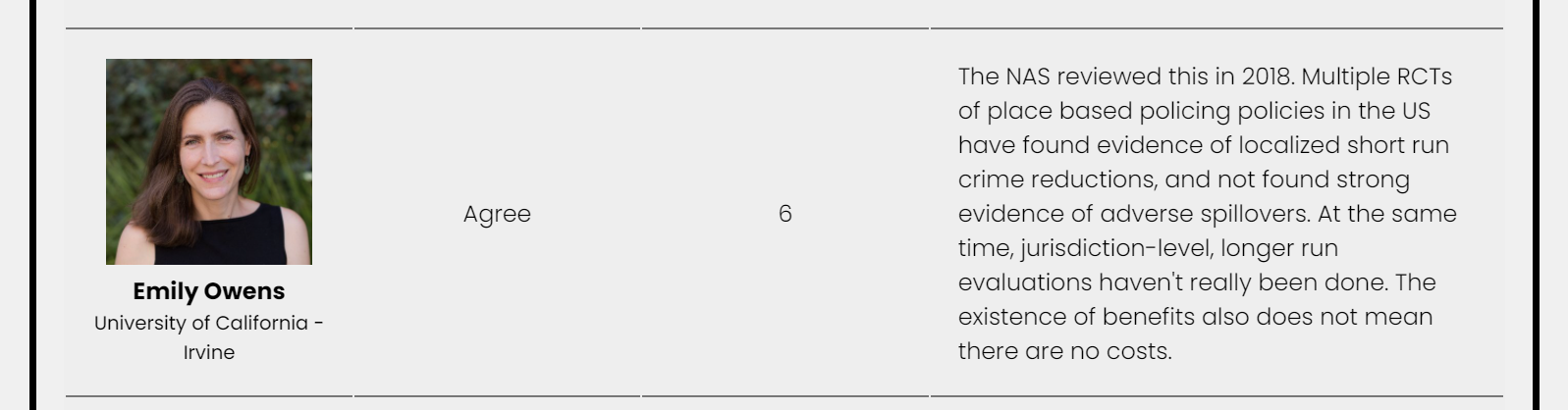
So when people argue that hot spots policing doesn’t show long term benefits, all I can do is agree. If in a world where we are choosing between doing hot spots vs doing nothing, I think it is wrong to choose the ultra risk adverse position of do nothing because you don’t think on average short term crime reductions of 10% in hot spots are worth it. But I cannot say it is a guaranteed outcome and it probably won’t magically reduce crime forever in that hot spot. Mea culpa.

The issue is most people making these risk adverse arguments against hot spots, whether academics or pundits or whoever, are not actually risk adverse or ultra conservative in accepting scientific evidence of the efficacy of criminal justice policies. This is shown when individuals pile on critiques of hot spots policing – which as I noted the critiques are often legitimate in and of themselves – but then take the position that ‘policy X is better than hotspots’. As I said hot spots basically is the most well vetted CJ intervention we have – you are in a tough pickle to explain why you think any other policy is likely to be a better investment. It can be made no doubt, but I haven’t seen a real principled cost benefit analysis to prefer another strategy over it to prevent crime.

One recent example of this is on the GritsForBreakfast blog, where Grits advocates for allocating more resources for detectives to prevent violence. This is an example of an incoherent internal position. I am aware of potential ways in which clearing more cases may reduce crimes, even published some myself on that subject (Wheeler et al., 2021). The evidence behind that link is much more shaky however overall (see Mohler et al. 2021 for a conflicting finding), and even Grits himself is very skeptical of general deterrence. So sure you can pile on critiques of hot spots, but putting the blinders on for your preferred policy just means you are an advocate, not following actual evidence.

To be clear, I am not saying more detective resources is a bad thing, nor do I think we should go out and hire a bunch more police to do hot spots (I am mostly advocating for doing more with the same resources). I will sum up my positions at the end of the post, but I am mostly sympathetic in reference to folks advocating for more oversight for police budgets, as well as that alternative to policing interventions should get their due as well. But in a not unrealistic zero sum scenario of ‘I can either allocate this position for a patrol officer vs a detective’ I am very skeptical Grits is actually objectively viewing the evidence to come to a principled conclusion for his recommendation, as opposed to ex ante justifying his pre-held opinion.

Unfortunately similarly incoherent positions are not all that uncommon, even among academics.

The CJ Expert Panel Opinions on Gun Violence

As I linked above, there was a recent survey of various academics on potential gun violence reduction strategies. I think these are no doubt good things, albeit not perfect, similar to CrimeSolutions.gov but are many more opinions on overall evidence bases but are more superficial.

This survey asked about three general strategies, and asked panelists to give Likert responses (strongly agree,agree,neutral,disagree,strongly disagree), as well as a 1-10 for how confident they were, whether those strategies if implemented would reduce gun violence. The three strategies were:

  • investing in police-led targeted enforcement directed at places and persons at high risk for gun crime (e.g.,“hot spot” policing; gang enforcement)
  • investing in police-led focused deterrence programs (clearly communicating “carrots and sticks” to local residents identified as high risk, followed by targeted surveillance and enforcement with some community-based support for those who desist from crime)
  • investing in purely community-led violence-interruption programs (community-based outreach workers try to mediate and prevent conflict, without police involvement)

The question explicitly stated you should take into account implementation in real life as well. Again people can as individuals have very pessimistic outlooks on any of these programs. It is however very difficult for me to understand a position where you ‘disagree’ with focused deterrence (FD) in the above answer and also ‘agree’ with violence interrupters (VI).

FD has a meta analysis of 20 some studies at this point (Braga et al., 2018), all are quasi-experimental (e.g. differences in differences comparing gang shootings vs non gang shootings, as well as some matched comparisons). So if you want to say – I think it is bunk because there are no good randomized control trials, I cannot argue with this. However there are much fewer studies for VI, Butts et al. (2015) have 5 (I imagine there are some more since then), and they are all quasi-experimental as well. So in this poll of 39 academics, how many agree with VI and disagree with FD?

We end up having 3. I show in that screen shot as well the crosstabulation with the hot spots (HS) question as well. It ends up being the same three people disagreed on HS/FD and agreed on VI:

I will come back to Makowski and Apel’s justification for their opinion in a bit. There is a free text field (although not everyone filled in, we have no responses from Harris here), and while I think this is pretty good evidence of having shifting evidentiary standards for their justification, the questions are quite fuzzy and people can of course weight their preferences differently. The venture capitalist approach would say we don’t have much evidence for VI, so maybe it is really good!

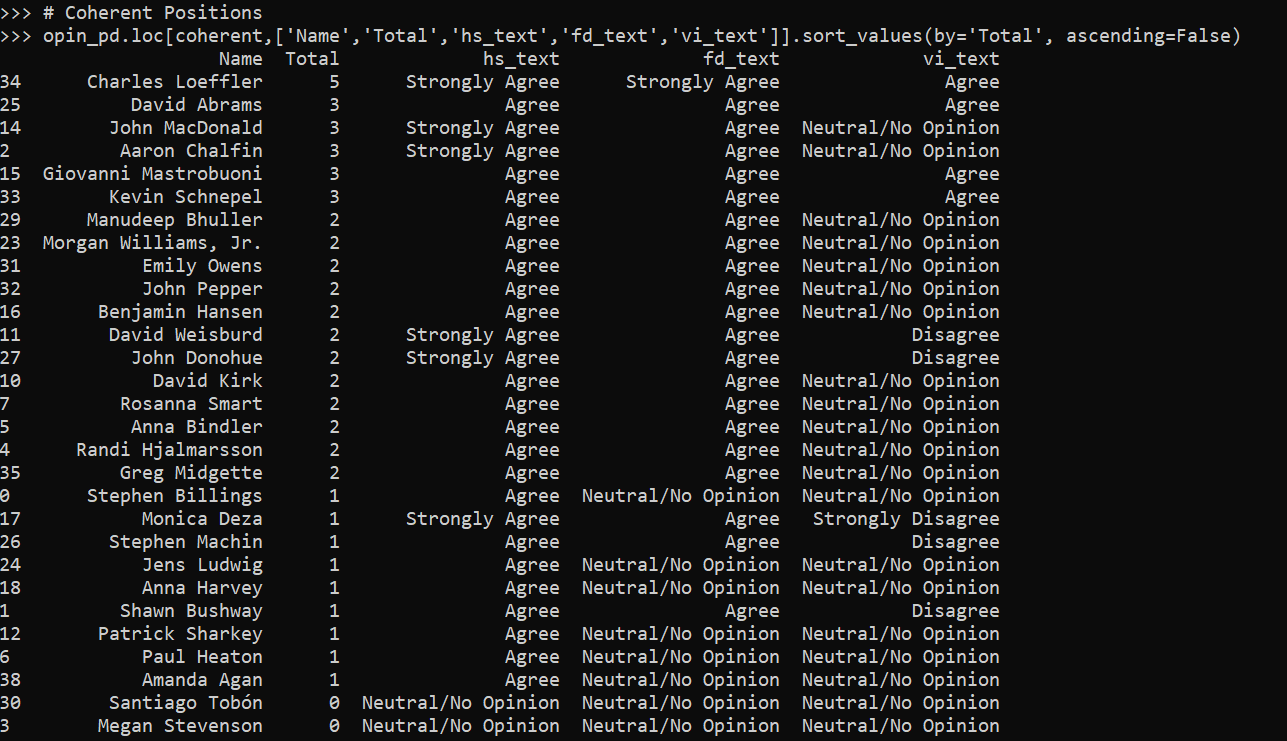
So again as a first blush, I checked to see how many people had opinions that I consider here coherent. You can say they all are bad, or you can agree with all the statements, but generally the opinions should be hs >= fd >= vi if one is going by the accumulated evidence in an unbiased manner. I checked how many coherent opinions there are in this survey according to this measure and it is the majority, 29/39 (those at the top of the list are more hawkish, saying strongly agree and agree more often):
Here are those I considered incoherent according to this measure:
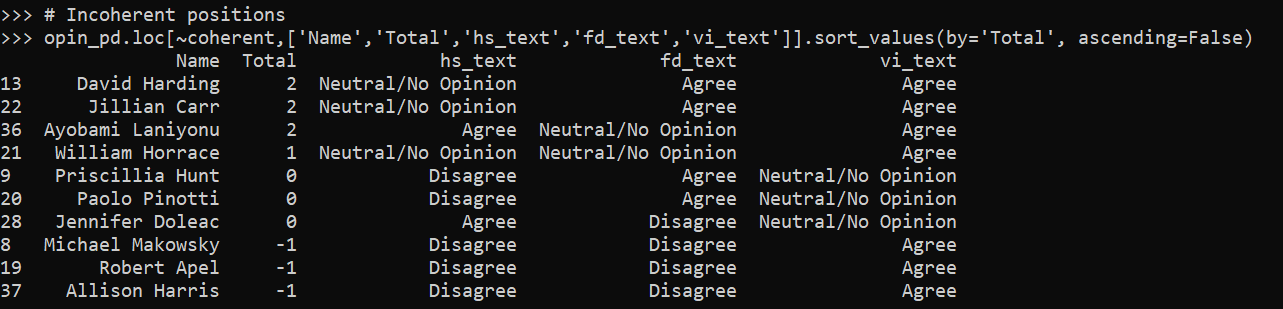
Looking at the free text field for why people justified particular positions in this table, with the exception of Makowski and Apel, I actually don’t think they have all that unprincipled opinions (although how they mapped their responses to agree/disagree I don’t think is internally consistent). For example, Paolo Pinotti disagrees with lumping in hot spots with people based strategies:
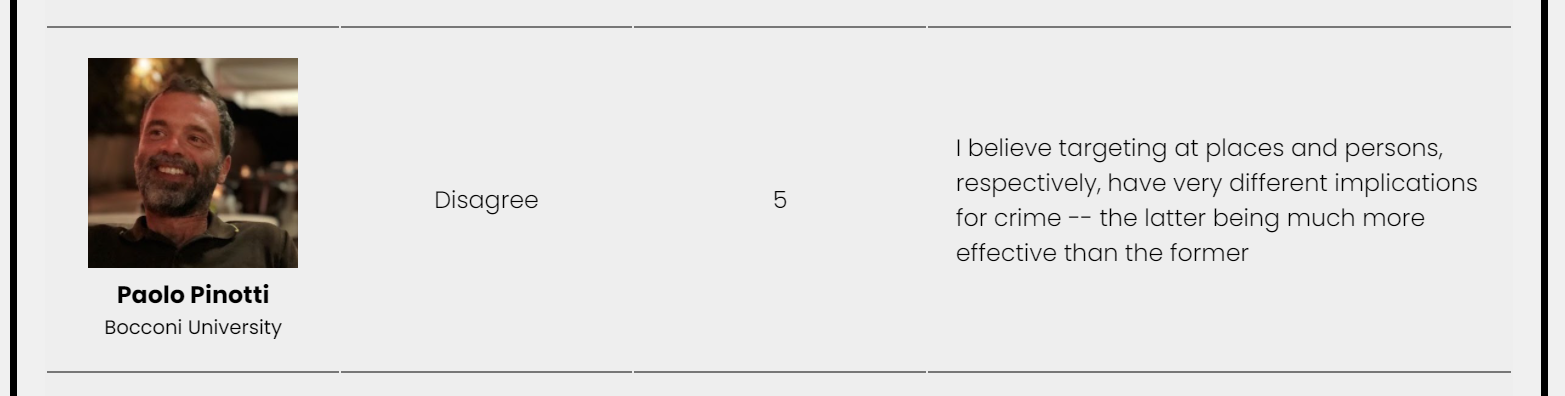
Fair enough and I agree! People based strategies are much more tenuous. Chalfin et al. (2021) have a recent example of gang interdiction, but as far as I’m aware much of the lit on that (say coordinated RICO), is a pretty mixed bad. Pinotti then gives agree to FD and neutral to VI (with no text for either). Another person in this list is Priscilla Hunt, who mentions the heterogeneity of hot spots interventions:
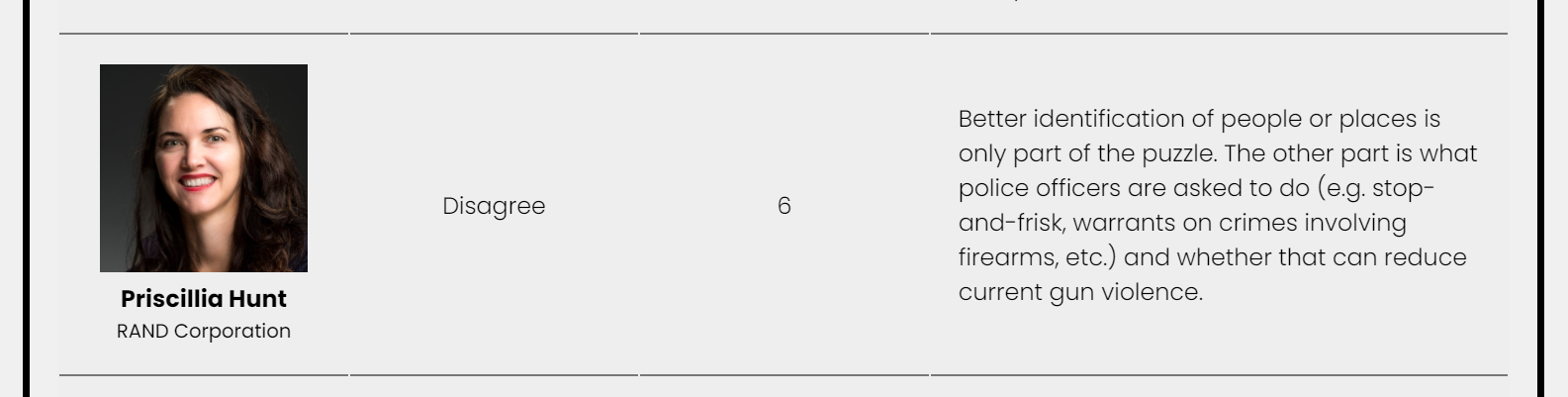
I think this is pretty pessimistic, since the Braga meta analyses often break down by different intervention types and they mostly coalesce around the same effect estimates (about a 10% reduction in hot spots compared to control, albeit with a wide variance). But the question did ask about implementation. Fair enough, hot spots is more fuzzy a category than FD or VI.

Jennifer Doleac is an example where I don’t think they are mapping opinions consistently to what they say, although what they say is reasonable. Here is Doleac being skeptical for FD:
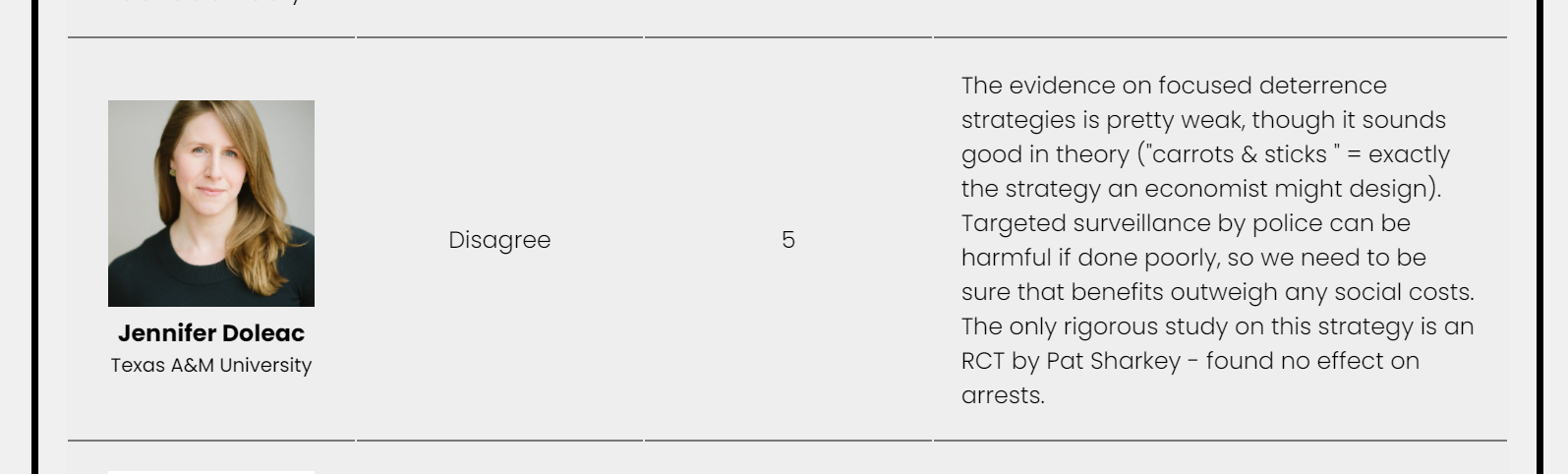
I think Doleac actually means this RCT by Hamilton et al. (2018) – arrests are not the right outcome though (more arrests probably mean the FD strategy is not working actually), so personally I take this study as non-informative as to whether FD reduces gun violence (although there is no issue to see if it has other spillovers on arrests). But Doleac’s opinion is still reasonable in that we have no RCT evidence. Here is Doleac also being skeptical of VI, but giving a neutral Likert response:
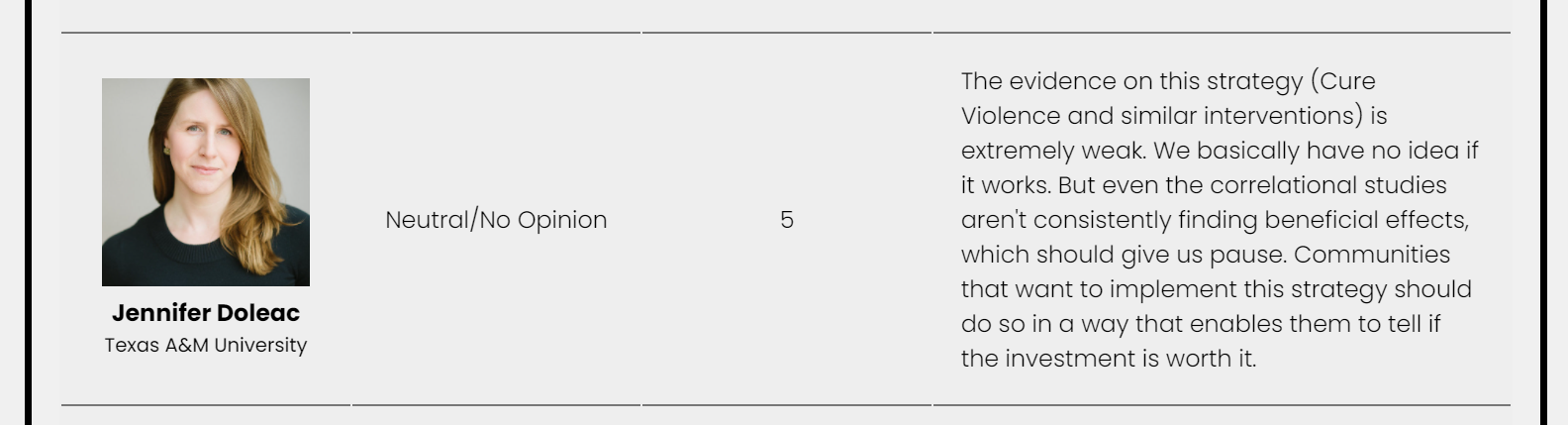
She mentions negative externalities for both (which is of course something people should be wary of when implementing these strategies). So for me to say this is incoherent is really sweating the small stuff – I think incorporating the text statement with these opinions are fine, although I believe a more internally consistent response would be neutral for both or disagree for both.

Jillian Carr gives examples of the variance of hot spots:

This is similar to Priscilla’s point, but I think that is partially an error. When you collect more rigorous studies over time, the effect sizes will often shrink (due to selection effects in the scholarly literature process that early successes are likely to have larger errors, Gelman et al. 2020). And you will have more variance as well and some studies with null effects. This is a good thing – no social science intervention is so full proof to always be 100% success (the lower bound is below 0 for any of these interventions). Offhand the variance of the FD meta analysis is smaller overall than hot spots, so Carr’s opinion of agree on FD can still be coherent, but for VI it is not:

If we are simply tallying when things do not work, we can find examples of that for VI (and FD) as well. So it is unclear why it is OK for FD/VI but not for HS to show some studies that don’t work.

There is an actual strategy I mentioned earlier where you might actually play the variance to suggest particular policies – we know hot spots (and now FD) have modest crime reducing effects on average. So you may say ‘I think we should do VI, because it may have a higher upside, we don’t know’. But that strikes me as a very generous interpretation of Carr’s comments here (which to be fair are only limited to only a few sentences). I think if you say ‘the variance of hot spots is high’ as a critique, you can’t hang your hat on VI and still be internally coherent. You are just swapping out a known variance for an unknown one.

Makowski and Apels Incoherence?

I have saved for last Michael Makowski and Robert Apel’s responses. I will start out by saying I don’t know all of the people in this sample, but the ones I do know are very intelligent people. You should generally listen to what they say, although I think they show some bias here in these responses. We all have biases, and I am sure you can trawl up examples of my opinions over time that are incoherent as well.

I do not know Michael Makowski, so I don’t mean to pick on him in particular here. I am sure you should listen to him over me for many opinions on many different topics. For example agree with his proposal to sever seized assets with police budgets. But just focusing on what he does say here (which good for him to actually say why he chose his opinions, he did not have to), for his opinion on hot spots:
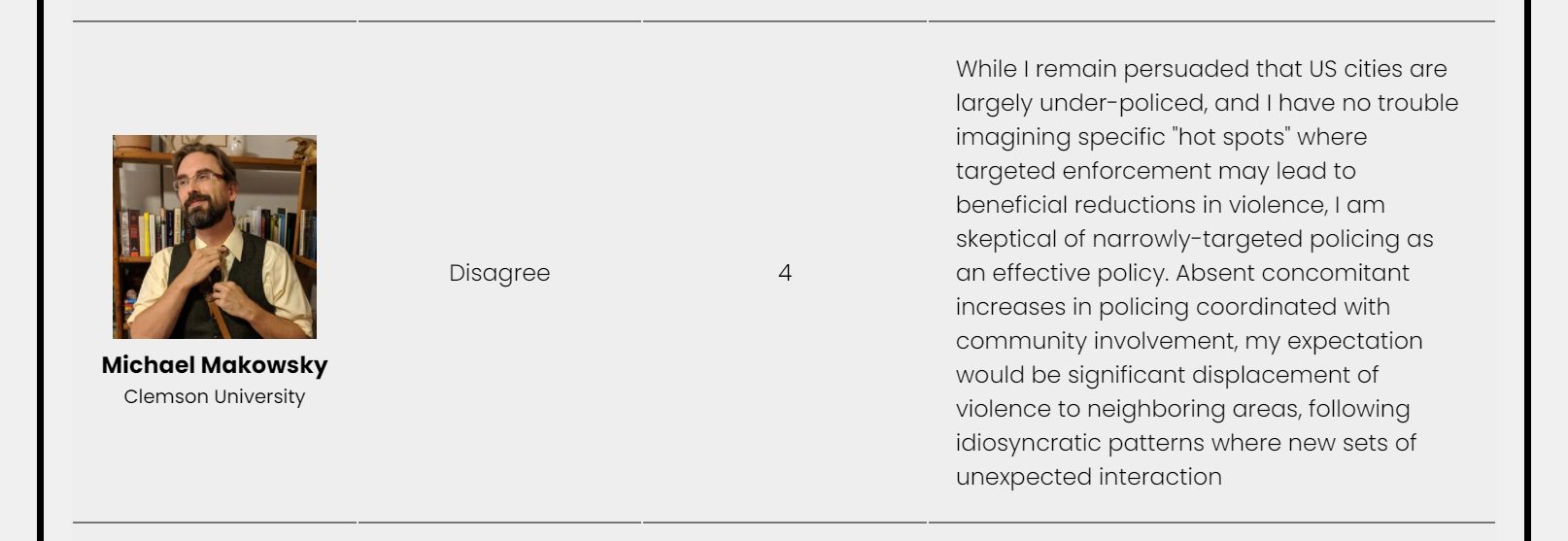
So Makowski thinks policing is understaffed, but hot spots is a no go. OK, I am not sure what he expects those additional officers to do – answer calls for service and drive around randomly? I’d note hot spots can simultaneously be coordinated with the community directly – I know of no better examples of community policing than foot patrols (e.g. Haberman & Stiver, 2019 for an example). But the question was not that specific about that particular hot spot strategy, so that is not a critique of Makowski’s position.

We have so many meta analyses of hot spots now, that we also have meta analyses of displacement (Bowers et al., 2011), and the Braga meta analyses of direct effects have all included supplemental analyses of displacement as well. Good news! We actually often find evidence of diffusion of benefits in quite a few studies. Banking on secondary effects that are larger/nullify direct effects is a strange position to take, but I have seen others take it as well. The Grits blog I linked to earlier mentions that these studies only measure displacement in the immediate area. Tis true, these studies do not measure displacement in surrounding suburbs, nor displacement to the North Pole. Guess we will never know if hot spots reduce crime worldwide. Note however this applies to literally any intervention!

For Makowski’s similarly pessimistic take on FD:
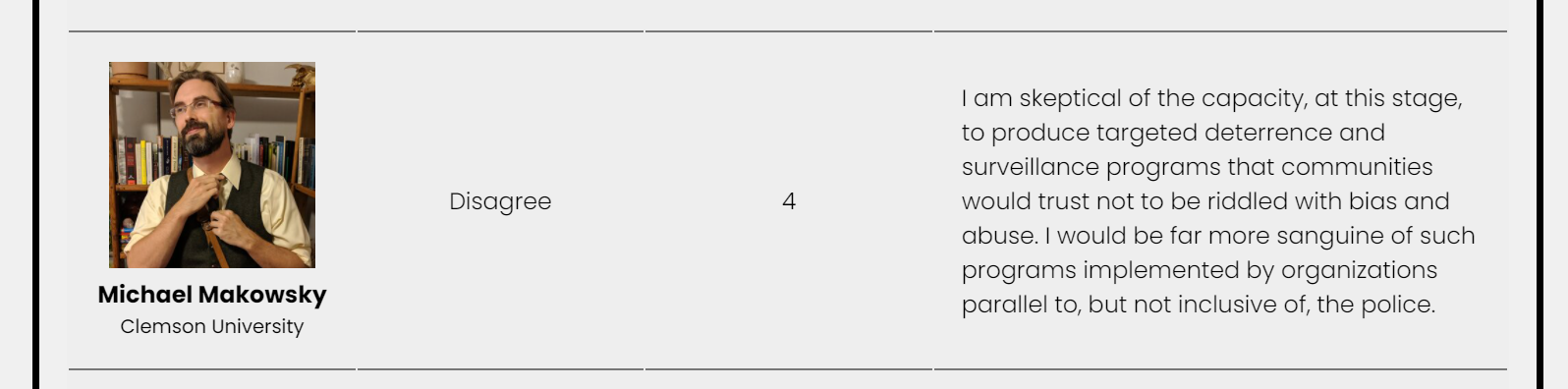
So at least Makowski is laying his cards on the table – the question did ask about implementation, and here he is saying he doesn’t think police have the capability to implement FD. If you go in assuming police are incompetent than yeah no matter what intervention the police might do you would disagree they can reduce violence. This is true for any social policy. But Makowski thinks other orgs (not the police) are good to go – OK.

Again have a meta analysis showing that quite a few agencies can implement FD competently and subsequently reduce gun violence, which are no doubt a self selected set of agencies that are more competent compared to the average police department. I can’t disagree with if you interpret the question as you draw a random police department out of a hat, can they competently implement FD (most of these will be agencies with only a handful of officers in rural places who don’t have large gun violence problems). The confidence score is low from Makowski here though (4/10), so at least I think those two opinions are wrong but are for the most part are internally consistent with each other.

I’d note also as well, that although the question explicitly states FD is surveillance, I think that is a bit of a broad brush. FD is explicitly against this in some respects – Kennedy talks about in the meetings to tell group members the police don’t give a shit about minor infractions – they only care if a body drops. It is less surveillancy than things like CCTV or targeted gang takedowns for example (or maybe even HS). But it is right in the question, so a bit unfair to criticize someone for focusing on that.

Like I said if someone wants to be uber critical across the board you can’t really argue with that. My problem comes with Makowski’s opinion of VI:
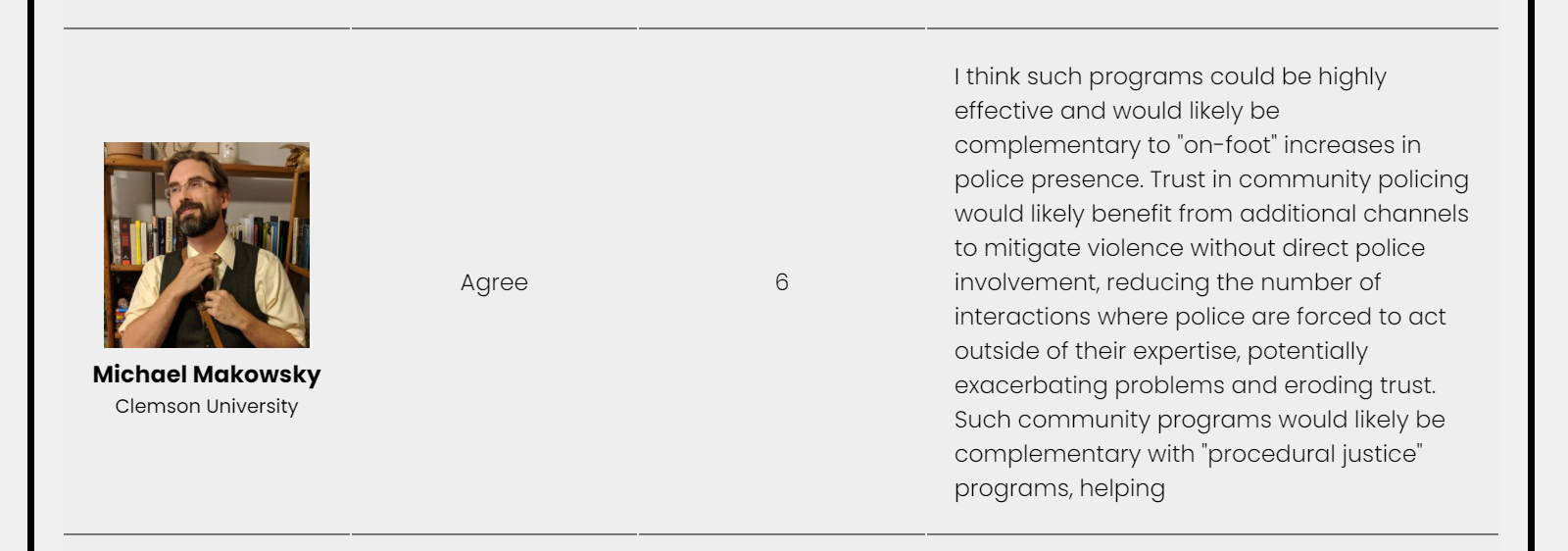
VI is quite explicitly diverged from policing – it is a core part of the model. So when interrupters talk with current gang members, they can be assured the interrupters will not narc on them to police. The interrupters don’t work with the police at all. So all the stuff about complementary policing and procedural justice is just totally non-sequitur (and seems strange to say hot spots no, but boots on the ground are good).

So while Makowski is skeptical of HS/FD, he thinks some mechanism he just made up in his own mind (VI improving procedural justice for police) with no empirical evidence will reduce gun violence. This is the incoherent part. For those wondering, while I can think procedural justice is a good thing, thinking it will reduce crime has no empirical support (Nagin & Telep, 2020).

I’d note that while Makowski thinks police can’t competently implement FD, he makes no such qualms about other agencies implementing VI. I hate to be the bearer of bad news for folks, but VI programs quite often have issues as well. Baltimore’s program over the years have had well known cases of people selling drugs and still quite active in violence themselves. But I guess people are solely concerned about negative externalities from policing and just turn a blind eye to other non policing interventions.

Alright, so now onto Bob Apel. For a bit off topic – one of the books that got me interested in research/grad school was Levitt and Dubners Freakonomics. I had Robert Apel for research design class at SUNY Albany, and Bob’s class really formalized counterfactual logic that I encountered in that book for me. It was really what I would consider a transformative experience from student to researcher for me. That said, it is really hard for me to see a reasonable defense of Bob’s opinions here. We have a similar story we have seen before in the respondents for hot spots, there is high variance:
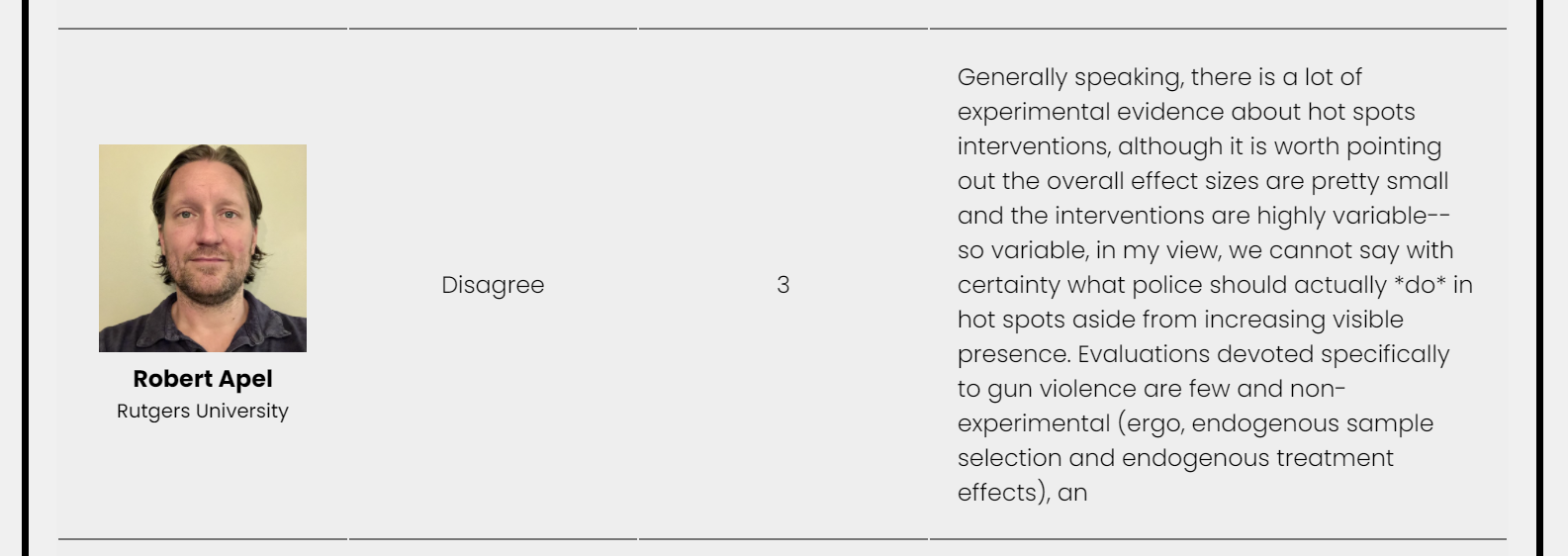
The specific to gun violence is potentially a red herring. The Braga meta analyses do breakdowns of effects on property vs violent crime, with violent typically having smaller but quite similar overall effect sizes (that includes more than just gun violence though). We do have studies specific to gun violence, Sherman et al. (1995) is actually one of the studies with the highest effects sizes in those meta analyses, but is of course one study. I disagree that the studies need to be specific to gun violence to be applicable, hot spots are likely to have effects on multiple crimes. But I think if you only count reduced shootings (and not violent crime as a whole), hot spots are tough, as even places with high numbers of shootings they are typically too small of N to justify a hot spot at a particular location. So again all by itself, I can see a reasonably skeptical person having this position, and Bob did give a low confidence score of 3.

And here we go for Bob’s opinion of FD:
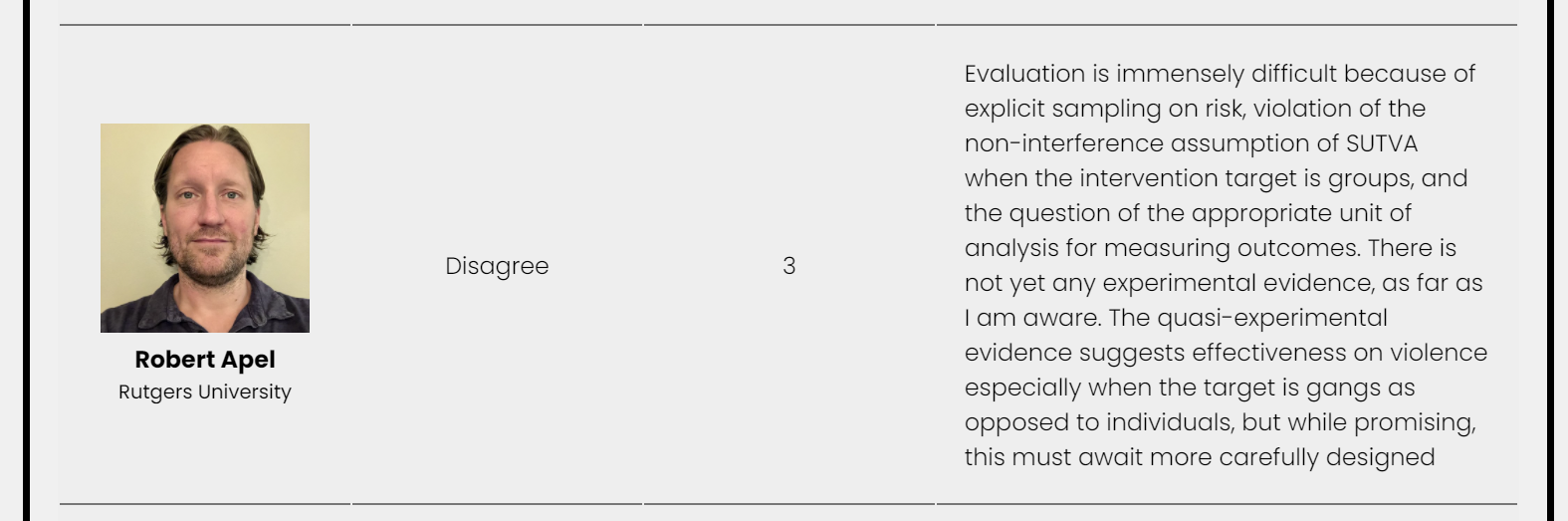
Again, reasonably skeptical. I can buy that. Saying we need more evidence seems to me to be conflicting advice (maybe Bob saying it is worth trying to see if it works, just he disagrees it will work). The question does ask if violence will be reduced, not if it is worth trying. I think a neutral response would have been more consistent with what Bob said in the text field. But again if people want to be uber pessimistic I cannot argue so much against that in particular, and Bob also had a low confidence.

Again though we get to the opinion of VI:
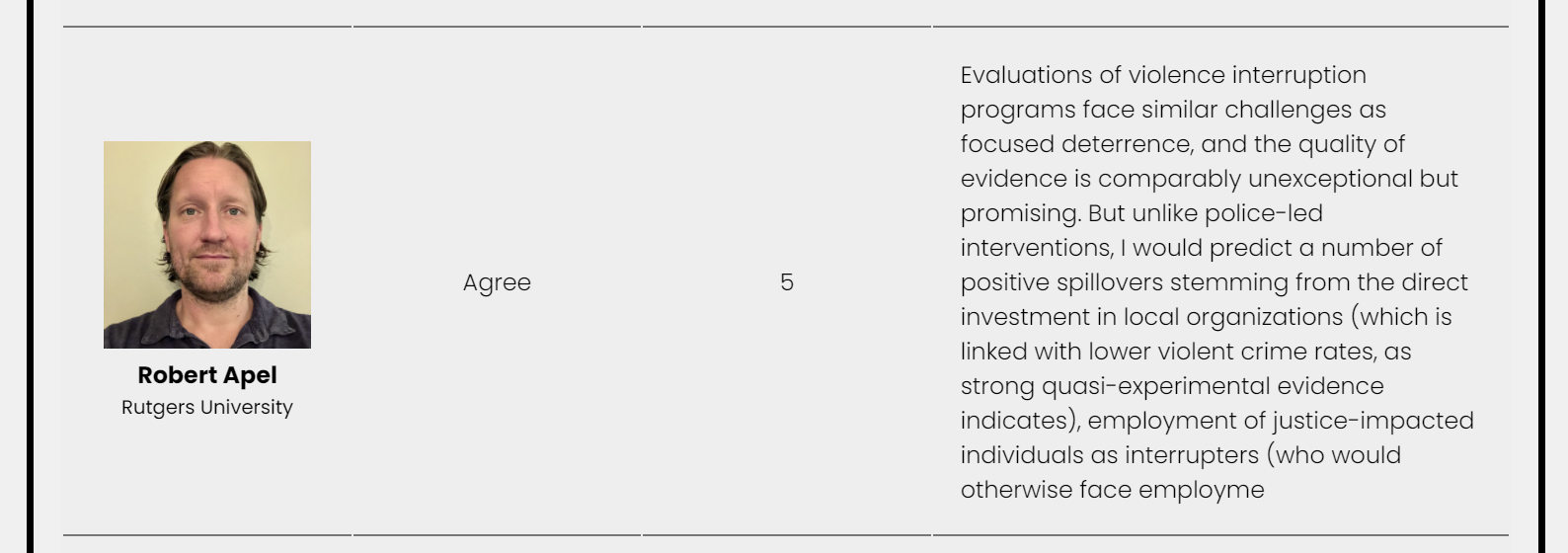
And we see Bob does think VI will reduce violence, but not due to direct effects, but indirect effects of positive spillovers. Similar to Makowski these are mechanisms not empirically validated in any way – just made up. So we get critiques of sample selection for HS, and SUTVA for FD, but Bob agrees VI will reduce violence via agencies collecting rents from administering the program. Okey Dokey!

For the part about the interrupters being employed as a potential positive externality – again you can point to examples where the interrupters are still engaged in criminal activity. So a reasonably skeptical person may think VI could actually be worse in terms of such spillovers. Presumably a well run program would hire people who are basically no risk to engage in violence themselves, so banking on employing a dozen interrupters to reduce gun violence is silly, but OK. (It is a different program to give cash transfers to high risk people themselves.)

I’d note in a few of the cities I have worked/am familiar with, the Catholic orgs that have administered VI are not locality specific. So rents they extract from administering the program are not per se even funneled back into the specific community. But sure, maybe they do some other program that reduces gun violence in some other place. Kind of a nightmare for someone who is actually concerned about SUTVA. This also seems to me to be logic stemmed from Patrick Sharkey’s work on non-profits (Sharkey et al., 2017). If Bob was being equally of critical of that work as HS/FD, it is non-experimental and just one study. But I guess it is OK to ignore study weaknesses for non police interventions.

For both Bob and Makowski here I could concoct some sort of cost benefit analysis to justify these positions. If you think harms from policing are infinite, then sure VI makes sense and the others don’t. A more charitable way to put it would be Makowski and Bob have shown lexicographic preferences for non policing solutions over policing ones, no matter what the empirical evidence for those strategies. So be it – it isn’t opinions based on scientific evidence though, they are just word souping to justify their pre held positions on the topic.

What do I think?

God bless you if you are still reading this rant 4k words in. But I cannot end by just bagging on other peoples opinions without giving my own can I? If I were to answer this survey as is, I guess I would do HS/agree (confidence 6), FD/agree (confidence 5), VI/agree (confidence 3). Now if you changed the question to ‘you get even odds, how much money would you put on reduced violence if a random city with recent gun violence increases implemented this strategy’, I would put down $0.00 (the variance people talked about is real!) So maybe a more internally consistent position would be neutral across the board for these questions with a confidence of 0. I don’t know.

This isn’t the same as saying should a city invest in some of these policies. If you properly valuate all the issues with gun violence, I think each of these strategies are worth the attempt – none of them are guaranteed to work though (any big social problem is hard to fix)! In terms of hot spots and FD, I actually think these have a strong enough evidence base at this point to justify perpetual internal positions at PDs devoted to these functions. The same as police have special investigation units focused on drugs they could have officers devoted to implementing FD. Ditto for community police officers could be specifically devoted to COP/POP at hot spots of crime.

I also agree with the linked above editorial on VI – even given the problems with Safe Streets in Baltimore, it is still worth it to make the program better, not just toss it out.

Subsequently if the question were changed to, I am a mayor and have 500k burning a hole in my pocket, which one of these programs do I fund? Again I would highly encourage PDs to work with what they have already to implement HS, e.g. many predictive policing/hot spots interventions are nudge style just spend some extra time in this spot (e.g. Carter et al., 2021), and I already gave the example of how PDs invest already in different roles that would likely be better shifted to empirically vetted strategies. And FD is mostly labor costs as well (Burgdorf & Kilmer, 2015). So unlike what Makowski implies, these are not rocket science and necessitate no large capital investments – it is within the capabilities of police to competently execute these programs. So I think a totally reasonable response from that mayor is to tell the police to go suck on a lemon (you should do these things already), and fund VI. I think the question of right sizing police budgets and how police internally dole out responsibilities can be reasoned about separately.

Gosh some of my academic colleagues must wonder how I sleep at night, suggesting some policing can be effective and simultaneously think it is worth funding non police programs.

I have no particular opinion about who should run VI. VI is also quite cheap – I suspect admin/fringe costs are higher than the salaries for the interrupters. It is a dangerous thing we are asking these interrupters to do for not much money. Apel above presumes it should be a non-profit community org overseeing the interrupters – I see no issue if someone wanted to leverage current govt agencies to administer this (say the county dept of social services or public health). I actually think they should be proactive – Buffalo PD had a program where they did house visits to folks at high risk after a shooting. VI could do the same and be proactive and target those with the highest potential spillovers.

One of the things I am pretty frustrated with folks who are hyper critical of HS and FD is the potential for negative externalities. The NAS report on proactive policing lays out quite a few potential mechanisms via which negative externalities can occur (National Academies of Sciences, Engineering, and Medicine, 2018). It is evidence light however, and many studies which explicitly look for these negative externalities in conjunction with HS do not find them (Brantingham et al., 2018; Carter et al., 2021; Ratcliffe et al., 2015). I have published about how to weigh HS with relative contact with the CJ system (Wheeler, 2020). The folks in that big city now call it precision policing, and this is likely to greatly reduce absolute contact with the CJ system as well (Manski & Nagin, 2017).

People saying no hot spots because maybe bad things are intentionally conflating different types of policing interventions. Former widespread stop, question and frisk policies do not forever villify any type of proactive policing strategy. To reasonably justify any program you need to make assumptions that the program will be faithfully implemented. Hot spots won’t work if a PD just draws blobs on the map and does no coordinated strategy with that information. The same as VI won’t work if there is no oversight of interrupters.

For sure if you want to make the worst assumptions about police and the best assumptions about everyone else, you can say disagree with HS and agree with VI. Probably some of the opinions on that survey do the same in reverse – as I mention here I think the evidence for VI is plenty good enough to continue to invest and implement such programs. And all of these programs should monitor outcomes – both good and bad – at the onset. That is within the capability of crime analysis units and local govt to do this (Morgan et al., 2017).

I debated on closing the comments for this post. I will leave them open, but if any of the folks I critique here wish to respond I would prefer a more long formed response and I will publish it on my blog and/or link to your response. I don’t think the shorter comments are very productive, as you can see with my back and forth with Grits earlier produced no resolution.

References

Prelim results for NIJ Recidivism Challenge

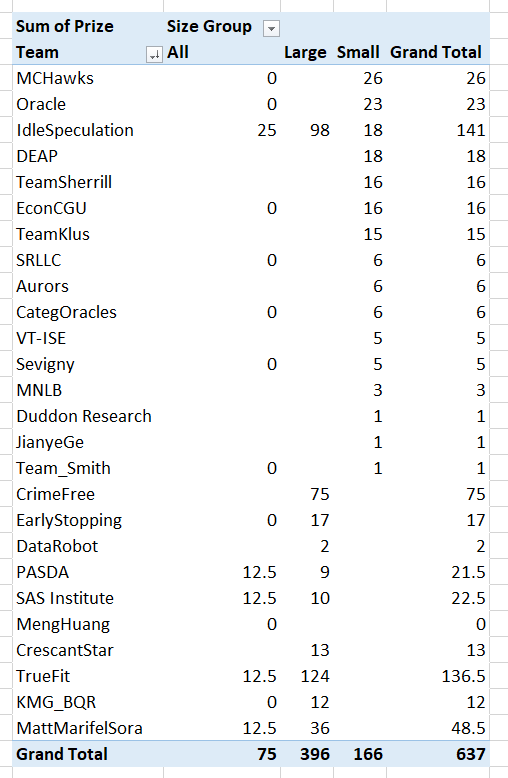
So the prelim results for the NIJ recidivism challenge are up. My team, MCHawks with Gio Circo, did ok. Here is a breakdown of team winnings (minus the student category) per 1k. So while we won the most in the small team category, IdleSpeculation overall kicked our butt!

We actually biased our predictions to meet the racial fairness constraint, so you can see we did much better in those categories in Round 1 and Round 2. Unfortunately you only win if you get top in this category – no second place winners here (it says Brier score in these tables, but this is (1 - BrierScore)*(1 - FPDifference):

But we got lucky and won the overall in Round 2 despite biasing our predictions. Round 3 we have no excuse really, while the predictions were biased it did not matter.

We will do a paper for the results, but overall our approach is pretty standard. For each round we did a grid search over various models – for R1 and R3 we did a L1 logit, for R2 we did an XGBoost model. I did attempt a specialized Logit model with the fairness constraints in the loss function (and just used backpropogation to fit the model, ala deep learning), but in practice the way the fairness metric is done this just added noise into the estimate.

I will have more to say in the future about fairness metrics, unfortunately here I do not think it was well thought out. It was simply the false positive rate comparing white/black subgroups, assuming a threshold of 0.5, which does not make sense in practice. (I’ve written about calculating the threshold for bail here, it applies the same to parole though as well.) So for each model we simply clipped probabilities to be below 0.5 to meet this – no one predicted high means 0 false positives for each group.

So the higher threshold makes it silly, also the multiplication between the metrics I don’t think is a good idea either. I think it can be amended though to be a more reasonable additive fairness constraint. E.g. BrierScore + lambda*FPDifference, where lambda is a tuner to set how you want to make the tradeoff (and FP may be the total N difference, not a proportion difference, which can be volatile for small N). (Also I think it makes more sense to balance false negatives than false positives in the CJ example, but any algorithm to balance one can be flipped to balance the other.)

I do like how NIJ spreads prizes out, instead of Kaggle like with only 1/2/3 big prizes. I wish here we could submit two predictions though (one for main and one for fair). (I am pretty sure we would have placed in Year1 if we did not bias our predictions.)

CCTV and clearance rates paper published

My paper with Yeondae Jung, The effect of public surveillance cameras on crime clearance rates, has recently been published in the Journal of Experimental Criminology. Here is a link to the journal version to download the PDF if you have access, and here is a link to an open read access version.

The paper examines the increase in case clearances (almost always arrests in this sample) for incidents that occurred nearby 329 public CCTV cameras installed and monitored by the Dallas PD from 2014-2017. Quite a bit of the criminological research on CCTV cameras has examined crime reductions after CCTV installations, which the outcome of that is a consistent small decrease in crimes. Cameras are often argued to help solve cases though, e.g. catch the guy in the act. So we examined that in the Dallas data.

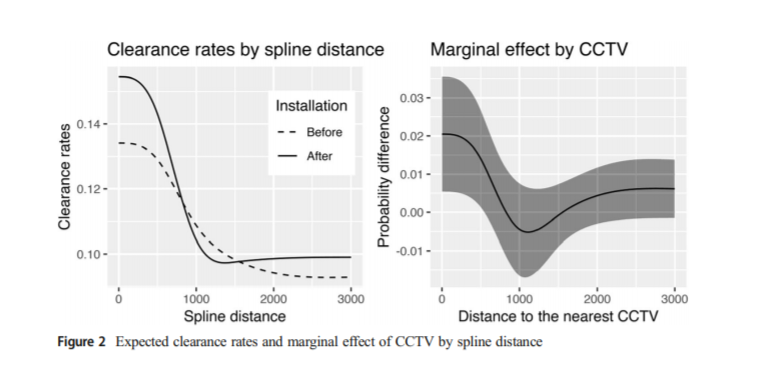
We did find evidence that CCTV increases case clearances on average, here is the graph showing the estimated clearances before the cameras were installed (based on the distance between the crime location and the camera), and the line after. You can see the bump up for the post period, around 2% in this graph and tapering off to an estimate of no differences before 1000 feet.

When we break this down by different crimes though, we find that the increase in clearances is mostly limited to theft cases. Also we estimate counterfactual how many extra clearances the cameras were likely to cause. So based on our model, we can say something like, a case would have an estimated probability of clearance without a camera of 10%, but with a camera of 12%. We can then do that counterfactual for many of the events around cameras, e.g.:

Probability No Camera   Probability Camera   Difference
    0.10                      0.12             + 0.02
    0.05                      0.06             + 0.01
    0.04                      0.10             + 0.06

And in this example for the three events, we calculate the cameras increased the total expected number of clearances to be 0.02 + 0.01 + 0.06 = 0.09. This marginal benefit changes for crimes mostly depends on the distance to the camera, but can also change based on when the crime was reported and some other covariates.

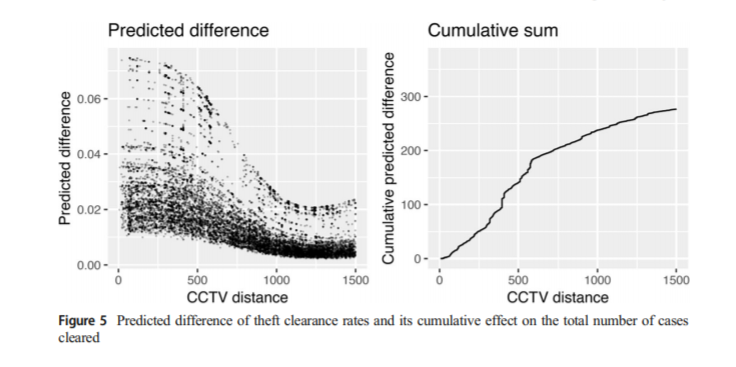
We do this exercise for all thefts nearby cameras post installation (over 15,000 in the Dallas data), and then get this estimate of the cumulative number of extra theft clearances we attribute to CCTV:

So even with 329 cameras and over a year post data, we only estimate cameras resulted in fewer than 300 additional theft clearances. So there is unlikely any reasonable cost-benefit analysis that would suggest cameras are worthwhile for their benefit in clearing additional cases in Dallas.

For those without access to journals, we have the pre-print posted here. The analysis was not edited any from pre-print to published, just some front end and discussion sections were lightly edited over the drafts. Not sure why, but this pre-print is likely my most downloaded paper (over 4k downloads at this point) – even in the good journals when I publish a paper I typically do not get 1000 downloads.

To go on, complaint number 5631 about peer review – this took quite a while to publish because it was rejected on R&R from Justice Quarterly, and with me and Yeondae both having outside of academia jobs it took us a while to do revisions and resubmit. I am not sure the overall prevalence of rejects on R&R’s, I have quite a few of them though in my career (4 that I can remember). The dreaded send to new reviewers is pretty much guaranteed to result in a reject (pretty much asking to roll a Yahtzee to get it past so many people).

We then submitted to a lower journal, The American Journal of Criminal Justice, where we had reviewers who are not familiar with what counterfactuals are. (An irony of trying to go to a lower journal for an easier time, they tend to have much worse reviewers, so can sometimes be not easier at all.) I picked it up again a few months ago, and re-reading it thought it was too good to drop, and resubmitted to the Journal of Experimental Criminology, where the reviews were reasonable and quick, and Wesley Jennings made fast decisions as well.

Using google places API in criminology research?

In my ask me anything series, Thom Snaphaan, a criminologist at Ghent University writes in with this question (slightly edited by me):

I read your blog post on using the Google Places API for criminological research. I am interested in using these data in the context of my PhD research. Can I ask you some questions on this matter? We think Google Places might be a very rich data source, specifically the user ratings of places. (1) Is it allowed to use these data on a large scale (two large cities) for scientific research? (2) Is it possible to download a set without the limit of 1,000 requests per day? (3) Are there, in your experience, other (perhaps more interesting) data sources to conduct this study? Many thanks! Best, Thom

And for my responses to Thom,

For 1) I believe it is OK to use for research purposes. You are not allowed to download the data and resell it though.

For 2) The quotas for the places API are much larger, it is now you get $200 credit per month, which amounts to 100,000 API calls. So that should be sufficient even for a large city.

For 3) I do not know, I haven’t paid much attention to the different online apps that do user reviews. Here in the states we have another service called Yelp (mostly for restaurants), I am not sure if that has more reviews or not though.

One additional piece of information not commonly used in place based research (but have seen it used some Hipp, 2016; Perenzin-Askey, 2018), is the use of the number of employees or sales volume at particular crime generators/attractors. This is not available via google, but is via Reference USA or Lexis Nexis. For Dallas IIRC Reference USA had much better coverage (almost twice as many businesses), but I recently reviewed a paper that did boots on the ground validation for Google data in the Indian city of Chennai and the validation for google businesses was very high (Kuralarason & Bernasco, 2021)

Answer in the comments if you think you have more helpful information on leveraging the place based user reviews in research projects.


In the past I have written about using various google APIs, and which I have used in my research for several different projects.

Google has new pricing now, where you get $200 in credits per month per API. But overall the Places and the streetview API you get a crazy ton of potential calls, so will work for most research projects. Looking it over I actually don’t think I have used Google places data in any projects, in Wheeler & Steenbeek, 2021 I use reference USA and some other sources.

Geocoding and distance API limits are tougher, I ended up accidentally charging myself ~$150 for my work with Gio on gunshot fatalities (Circo & Wheeler, 2021) calculating network distance and approximate drive times. The vision API is also quite low (1000 per month), so will need to budget/plan if you need those services for your project. Geocoding you should be able to find alternatives, like the census geocoder (R, python) and then only use google for the leftovers.

References

  • Circo, G. M., & Wheeler, A. P. (2021). Trauma Center Drive Time Distances and Fatal Outcomes among Gunshot Wound Victims. Applied Spatial Analysis and Policy, 14(2), 379-393.
  • Hipp, J. R. (2016). General theory of spatial crime patterns. Criminology, 54(4), 653-679.
  • Kuralarasan, K., & Bernasco, W. (2021). Location Choice of Snatching Offenders in Chennai City. Journal of Quantitative Criminology, Online First.
  • Perezin-Askey, A., Taylor, R., Groff, E., & Fingerhut, A. (2018). Fast food restaurants and convenience stores: Using sales volume to explain crime patterns in Seattle. Crime & Delinquency, 64(14), 1836-1857.
  • Wheeler, A. P., & Steenbeek, W. (2021). Mapping the risk terrain for crime using machine learning. Journal of Quantitative Criminology, 37(2), 445-480.

Open source code projects in criminology

TLDR; please let me know about open source code related criminology projects.

As part of my work with CrimRxiv, we have started the idea of creating a page to link to various open source criminology focused projects. That is overly broad, but high level here we are thinking for pragmatic resources (e.g. code repositories/packages, open source text books), as opposed to more traditional literature.

As part of our overlay journal we are starting, D1G1TAL & C0MPUTAT10NAL CR1M1N0L0GY, we are trying to get folks to submit open source work for a paper. (As a note, this will not have any charges to publish.) The motivation is two-fold: 1) this gives a venue to get your code peer reviewed (e.g. similar to the Journal of Open Source Software). This is mainly for the writer, to give academic recognition for your open source work. 2) Is for the consumer of the information, it is a nice place to keep up on current developments. If you write an R package to do some cool analysis I want to be aware of it!

For 2, we can accomplish something similar by just linking to current projects. I have started a spreadsheet of links I am collating for now, (in the future will update to this page, you need to be signed into CrimRxiv to see that list). For examples of the work I have collated so far:

Then we have various R packages from folks floating around; Greg Ridgeway, Jerry Ratcliffe, Wouter Steenbeek (as well as the others I mentioned previously you can check out their other projects on Github). Please add in info into the google spreadsheet, comment here, or send me an email if you would like some work you have done (or know others have done) that should be added.

Again I want to know about your work!

Some ACS download helpers and Research Software Papers

The blog has been a bit sparse recently, as moving has been kicking my butt (hanging up curtains and recycling 100 boxes today!). So just a few quick notes.

Downloading ACS Data

First, I have posted some helper functions to work with American Community Survey data (ACS) in python. For a quick overview, if you import/define those functions, here is a quick example of downloading the 2019 Texas micro level files (for census tracts and block groups) from the census FTP site. Can pipe in another year (if available) and and whatever state into the function.

# Python code to download American Community Survey data
base = r'??????' #put your path here where you want to download data
temp = os.path.join(base,'2019_5yr_Summary_FileTemplates')
data = os.path.join(base,'tables')

get_acs5yr(2019,'Texas',base)

Some locations have census tract data to download, I think the FTP site is the only place to download block group data though. And then based on those files you downloaded, you can then grab the variables you want, and here I show selecting out the block groups from those fields:

interest = ['B03001_001','B02001_005','B07001_017','B99072_001','B99072_007',
            'B11003_016','B11003_013','B14006_002','B01001_003','B23025_005',
            'B22010_002','B16002_004','GEOID','NAME']
labs, comp_tabs = merge_tabs(interest,temp,data)
bg = comp_tabs['NAME'].str.find('Block Group') == 0

Then based on that data, I have an additional helper function to calculate proportions given two lists of the numerators and denominators that you want:

top = ['B17010_002',['B11003_016','B11003_013'],'B08141_002']
bot = ['B17010_001',        'B11002_001'       ,'B08141_001']
nam = ['PovertyFamily','SingleHeadwithKids','NoCarWorkers']
prep_sdh = prop_prep(bg, top, bot, nam)

So here to do Single Headed Households with kids, you need to add in two fields for the numerator ['B11003_016','B11003_013']. I actually initially did this example with census tract data, so not sure if all of these fields are available at the block group level.

I have been doing some work on demographics looking at the social determinants of health (see SVI data download, definitions), hence the work with census data. I have posted my prior example fields I use from the census, but criminologists may just use the social-vulnerability-index from the CDC – it is essentially the same as how people typically define social disorganization.

Peer Review for Criminology Software

Second, jumping the gun a bit on this, but in the works is an overlay journal for CrimRxiv. Part of the contributions we will accept are software contributions, e.g. if you write an R package to do some type of analysis function common in criminology.

It is still in the works, but we have some details up currently and a template for submission (I need to work on a markdown template, currently just a word doc). High level I wanted something like the Journal of Statistical Software or the Journal of Open Source Software (I do not think the level of detail of JSS is necessary, but wanted an example use case, which JoSS does not have).

Just get in touch if you have questions whether your work is on topic. Aim is to be more open to contributions at first. Really excited about this, as publicly sharing code is currently a thankless prospect. Having a peer reviewed venue for such code contributions for criminologists fills a very important role that traditional journals do not.

Future Posts?

Hopefully can steal some time to continue writing posts here and there, but will definitely be busy getting the house in order in the next month. Hoping to do some work on mapping grids and KDE in python/geopandas, and writing about the relationship between healthcare data and police incident report data are two topics I hope to get some time to work on in the near future for the blog.

If folks have requests for particular topics on the blog though feel free to let me know in the comments or via email!