Question Sets and All Paths

I was nerd-sniped with a question at work the other day. The set up was like this, imagine a survey where all of the questions have yes-no answers. Some of the answers are terminating, so if you answer No to a particular question, the questions stop. But some if you reach that part of the tree will keep going.

The ask was a formula to articulate the total number of potential unique answer sets. Which I was not able to figure out, I did however write python code to generate all of the unique sets. So here is that function, where I create a networkx directed graph in a particular format, and then find all of the potential start to end paths in that graph. You just add a dummy begin node, and end nodes at the terminating locations and the final question. You then just search for all of the paths from the begin to end nodes.

import networkx as nx

def question_paths(totq,term):
    '''
    totq -- positive integer, total number of questions
    term -- list of integers, where ints are questions that terminate
    '''
    nodes = [f'Q{i}{r}' for i in range(totq) for r in ['N','Y']]
    edges = []
    for i in range(totq-1):
        edges.append([f'Q{i}Y',f'Q{i+1}N'])
        edges.append([f'Q{i}Y',f'Q{i+1}Y'])
        if i not in term:
            edges.append([f'Q{i}N',f'Q{i+1}N'])
            edges.append([f'Q{i}N',f'Q{i+1}Y'])
    # adding in begin/end
    nodes += ['Begin','End']
    edges += [['Begin','Q0N'],['Begin','Q0Y']]
    for t in term:
        edges.append([f'Q{t}N','End'])
    edges += [[f'Q{totq-1}N','End'],[f'Q{totq-1}Y','End']]
    # Now making graph
    G = nx.DiGraph()
    G.add_nodes_from(nodes)
    G.add_edges_from(edges)
    # Getting all paths
    paths = []
    for p in nx.all_simple_paths(G,source='Begin',target='End'):
        nicer = [v[-1] for v in p[1:-1]]
        paths.append(nicer)
    return paths

And now we can check out where all paths are terminating, you only get further up the tree if you answer all yes for prior questions.

>>> question_paths(3,[0,1,2])
[['N'],
 ['Y', 'N'],
 ['Y', 'Y', 'N'],
 ['Y', 'Y', 'Y']]

So in that scenario we have four potential answer sets. For all binary, we have the usual 2^3 number of paths:

>>> question_paths(3,[])
[['N', 'N', 'N'],
 ['N', 'N', 'Y'],
 ['N', 'Y', 'N'],
 ['N', 'Y', 'Y'],
 ['Y', 'N', 'N'],
 ['Y', 'N', 'Y'],
 ['Y', 'Y', 'N'],
 ['Y', 'Y', 'Y']]

And then you can do a mixture, here just question 2 terminates, but 1/3 are binary:

>>> question_paths(3,[1])
[['N', 'N'],
 ['N', 'Y', 'N'],
 ['N', 'Y', 'Y'],
 ['Y', 'N'],
 ['Y', 'Y', 'N'],
 ['Y', 'Y', 'Y']]

One of the things doing this exercise taught me is that it matters where the terminating nodes are in the tree. Earlier terminating nodes results in fewer potential paths.

# can different depending on where the terminators are
len(question_paths(10,[1,5])) # 274
len(question_paths(10,[6,8])) # 448
len(question_paths(10,[0,1])) # 258
len(question_paths(10,[8,9])) # 768

So the best in terms of a formula for the total number of paths I could figure out was 2^(non-terminating questions) <= paths <= 2^(questions) (which is not a very good bound!) I was trying to figure out a product formula but was unable (any suggestions let me know!)

This reminds me of a bit of product advice from Jennifer Pahlka, you should have eliminating questions earlier in the form. So instead of filling out 100 questions and at the end being denied for TANF, you ask questions that are the most likely to eliminate people first.

It works the same for total complexity of your application. So asking the terminating questions earlier reduces the potential number of permutations you ultimately have in your data as well. Good for the user and good for the developers.

Power for analyzing Likert items

First for some other updates of interest to folks on the blog. On CRIME De-Coder a blog post, You should be geocoding crime data locally. I give python code to create a local geocoding engine using the arcpy library.

This is a bit more techy, so would typically post this on this blog instead of the CRIME De-Coder one. But, currently the web is sorely lacking in good advice for local geocoding solutions. Vast majority of sites discuss online geocoding APIs (e.g. google or the census geocoder), which I guess are common for web-apps, but they do not make sense for crime analysis. For the few webpages that are actually relevant to describe local solutions (that do not involve calling an online web API), all the exmples use PostGIS that I am aware of. PostGIS is both very difficult to setup and has worse results compared to ESRI. So I know ESRI is a paid for service, but they have reasonable academic and small business pricing (and most police departments already have access), so to me this is a reasonable use case. If you need to geocode 100k cases, the license fee for ESRI is worth it at that point relative to using the web engines.

Definitely do not spend thousands of dollars if you need to batch geocode a few million records. That is something that is worth getting in touch with me about. And so hopefully that gets picked up by search engines and drives a bit more traffic to my consulting website.

A second example I posted some python code to help construct network experiments. So the idea here is you want to spread out the treated nodes so you have a specific allocation of treated, connected to treated (what I call spillover here), and those not connected to treated (the leftover control group). This python code constructs linear programs to accomplish certain treated/not-touched proportions. So this graph shows if you choose to treat 1 person, but have constraints on 1,2,3 leftover.

And then you can apply this to bigger networks, here the network is 311 nodes, and 90 are treated and I want a total of 150 not treated.

Idea derivative from some work Bruce Desmarais discussed on Twitter, but also have thought about this in some discussion with Barak Ariel in focused deterrence style interventions. So hopefully that comes in handy.

My linear programming formulation is not as svelte as the optimal treatment assignment with spillovers formulation, it is 3*N + 2*E decision variables and 5*N + 2*E constraints (where N is the number of nodes and E is the number of un-directed edges). I have a feeling my formulation is redundant, so if I write my constraints smarter can be more like 2N decision variables and 2N + E constraints.

But for my examples I show it solves quite fast as is (and maybe solvers get rid of the cruft in pre-solve), so not worried about that at the moment. Don’t know the typical size networks people use, but I suspect it will work just fine and dandy on typical machines for networks even as large as 10k. (Generally if I keep the model to under 100k decision variables it is only a few minutes to solve the types of problems I show on this blog.)

Power with Likert items

The other day for a grant application we needed to conduct power analysis. Our design was t-test of mean differences for a simple treated/control group randomized experiment with the outcome being a Likert score survey response. (I know, most of the time people create latent scores with Likert items, analyzing the individual items is fine IMO and simpler to specify for a pre-registration analysis.) I am sure others have needed to do similar things, but I could not find code online to help out with this. So I scripted up a simulation in R to do this, and figured sharing would be useful.

So the rub with Likert data, and why you can’t use typical power calculations, is that they have ceiling effects. If most people answer on average 4.5 out of the your scale up to 5, it is difficult to go much higher. Here I simulate data that has that skew (so ceiling effects come into play), and then go through the motions of doing the t-test. So first for some setup, I have a function that rounds and clips data to limited sets of integers, plus some plotting functions.

# power analysis of Likert data
library(ggplot2)

# custom theme
theme_cdc <- function(){
  theme_bw() %+replace% theme(
     text = element_text(size = 16),
     panel.grid.major= element_line(linetype = "longdash"),
     panel.grid.minor= element_blank()
) }

set.seed(10) # setting the random seed

# rounding/clipping data to integers 
clipint <- function(x,min=1,max=5){
    rx <- round(x)
    rx <- ifelse(rx < min,min,rx)
    rx <- ifelse(rx > max,max,rx)
    return(rx)
}

This following function generates the p-values and standard errors, what I will use later in my simulation. Here I use a t-test of mean differences, but it would be fairly easy to say swap out with an ordinal logistic regression if you prefer that. Probably the bigger deal is the simulation generates data using a normal distribution, and then post rounds/clip the data. There is probably a smarter way to generate the data according to the logistic model and ordinal intercepts (Frank Harrell discusses such things a bit on his blog). But this at least takes into account that the data will be skewed, even in the control group, to have more positive outcomes and thus take the ceiling into account.

# this uses OLS to do t-test of mean differences
# generates normal data, but then rounds/clips
sim_ols <- function(n,eff=0.5,int=4,sd=1){
    df <- data.frame(1:n)
    df$treat <- sample(c(0,1),n,replace=TRUE)
    df$latent <- int + eff*df$treat + rnorm(n,sd=sd)
    df$likert <- clipint(df$latent)
    m1 <- lm(likert ~ treat,data=df)
    cd <- coef(summary(m1))
    pval <- cd[2,4]
    se <- cd[2,2]
    return(c(pval,se))
}

Now we can move onto the simulations, this evaluates sample sizes from 100 to 2000 (in increments of 50), effect sizes of 0.1, 0.3, and 0.5, and repeats the simulations 10k times. I then see the power (how often the two-tailed p-value is less than 0.05), as well as the standard error (precision) of the estimates. Effect sizes are in terms of the original Likert scale values, what I take to be much easier to reason about. (I have seen power analyses here use Cohen’s D, which you really can’t get a very large Cohen’s D value due to ceiling effects with this data.)

# running power estimates over different
# sample sizes and effect sizes
samp_sizes <- seq(100,2000,50)
eff_sizes <- c(0.1,0.3,0.5)
rep_size <- 10000
df <- expand.grid(samps_sizes=samp_sizes,eff_sizes=eff_sizes,pow=c(NA),se=c(NA))
for (i in 1:nrow(df)){
    ss <- df[i,1]
    es <- df[i,2]
    stats <- replicate(rep_size,sim_ols(n=ss,eff=es))
    smean <- rowMeans(stats)
    df[i,3] <- mean(stats[1,] < 0.05) # alpha 0.05
    df[i,4] <- smean[2]
}

df$eff_sizes <- as.factor(df$eff_sizes)

The graph of the power shows what you would expect, so with a few hundred samples you can determine an effect size of 0.5, but with a smaller effect size (on the order of 0.1) you will need more than 2k samples.

# Graph of power
powg <- ggplot(data=df,aes(x=samps_sizes,y=pow)) + 
        geom_line(aes(color=eff_sizes)) + 
        geom_point(pch=21,color='white',size=2,aes(fill=eff_sizes)) +
        labs(x='Sample Sizes',y=NULL,title='Power Estimates') +
        scale_y_continuous(breaks=seq(0,1,0.1)) + 
        scale_x_continuous(breaks=seq(100,2000,250)) + 
        scale_color_discrete(name="Effect Sizes") +
        scale_fill_discrete(name="Effect Sizes") + 
        theme_cdc()

Unfortunately, in reality with most survey measures of police data, e.g. rate your officer 1 to 5, a 0.5 effect is a really large increase. In my mapping attitudes paper, some demographics shift global attitudes at max by 0.2, and I doubt most interventions will be that dramatic. So I like plotting the precision of the estimator, which the effect size doesn’t really make a dent here (it could with more severe ceiling effects).

# Graph of Standard Errors (for Precision)
precg <- ggplot(data=df,aes(x=samps_sizes,y=se,color=eff_sizes)) + 
         geom_line(aes(color=eff_sizes)) + 
         geom_point(pch=21,color='white',size=2,aes(fill=eff_sizes)) +
         labs(x='Sample Sizes',y=NULL,title='Precision Estimates') +
         scale_x_continuous(breaks=seq(100,2000,250)) + 
         scale_color_discrete(name="Effect Sizes") +
         scale_fill_discrete(name="Effect Sizes") + 
         theme_cdc()

With field experiments when considering post police contacts (general attitude surveys you have more wiggle room, but still they cost money to survey) you really can’t control the sample size. You are at the whims of whatever events happen in the police departments daily duties. So the best you can do is make approximate plans for “how long am I going to collect measures before I analyze the data”, and “how reasonably precise will my estimates be”.

This particular grant I make arguments we care more about a non-inferiority type test (e.g. can be sure attitudes are not worse, within a particular error level, given our treatment is more cost-effective than business as usual). But if we did an intervention specifically intended to improve attitudes, you may be talking more like 5,000+ contacts to detect an effect of 0.1 (given likely sample non-response), which is still a big effect.

You would gain power by doing a scale (e.g. summing together multiple items or conducting a factor analysis), assuming the intervention effects the underlying latent trait, and piecemeal individual items. But that will have to be for another day simulating data to do that end-to-end analysis.

Despite not being an academic anymore, I have in the hopper more grant collaborations than I did when I was a professor. The NIJ season is winding down, so probably too late to collaborate on any more of those. But if you have other ideas and need quant help with your projects, always feel free to reach out. I enjoy doing these side projects with academics when reasonable funding is available.

Won NIJ competition on surveys

The submission Gio and myself put together, Using Every Door Direct Mail Web Push Surveys and Multi-level modelling with Post Stratification to estimate Perceptions of Police at Small Geographies, has won the NIJ Innovations in Measuring Community Attitudes Survey challenge.

Specifically we took 1st in the non-probability section of the competition. The paper has the details, but using every door direct mail + post-stratifying the estimates is the approach we advocate. If you are a city or research group interested in implementing this and need help, feel free to get in touch.

Of course if you want to do this yourself go for it (part of the reason it won was because the method should be doable for many agencies in house), but letting me and Gio know we were the inspiration is appreciated!

Second, for recruiting for criminology PhDs, CRIME De-Coder has teamed up with the open access CrimRXiv consortium

This example shows professor adverts, but I think the best value add for this is for more advanced local govt positions. Anymore many of those civil service gigs are very competitive with lagging professor salaries.

For people hiring advanced roles, there are two opportunities. One is advertising – so for about the same amount as advertising on LinkedIn, you can publish a job advert. This is much more targeted than LinkedIn, so if you want PhD talent this is a good deal to get your job posting on the right eyeballs.

The second service is recruiting for a position. This is commission based – if I place a candidate for the role then you pay the recruiter (me and CrimRXiv) a commission. For that I personally reach out to my network of people with PhDs interested in positions, and do the first round of vetting for your role.

Third, over on Crime De-Coder I have another round of the newsletter up, advice this round is that many smaller cities have good up and coming tech markets, plus advice about making fonts larger in python/R plots. (Note in response to that post, Greg Ridgeway says it is better to save as vector graphics as oppossed to high res PNG. Vector is slightly more work to check everything is kosher in the final produced plot, but that is good advice from Greg. I am lazy with the PNG advice.)

No more newsletters this year, but let me know if you want to sign up and I will add you to the list.

Last little tidbit, in the past I have used the pdftk tool to combine multiple PDFs together. This is useful when using other tools to create documents, so you have multiple outputs in the end (like a cover page or tech appendix), and want to combine those all together into a single PDF to share. But one thing I noticed recently, if your PDF has internal table of content (TOC) links (as is the case for LaTeX, or in my case a document built using Quarto), using pdftk will make the TOC links go away. You can however use ghostscript instead, and the links still work as normal.

On my windows machine, it looks something like:

gswin64 -q -sDEVICE=pdfwrite -o MergedDoc.pdf CoverPage.pdf Main.pdf Appendix.pdf

So a few differences that if you just google. Installing the 64 bit version on my windows machine, the executable is gswin64, not gs from the command line. Second, I needed to manually add C:\Program Files\gs\gs10.02.1\bin to my PATH for this to work at the command prompt the way you would expect, installing did not do that directly.

Quarto is awesome by the way – definitely suggest people go check that out.

Survey duplicates and other stuff

So for various updates. First, I have started an AltAc newsletter, see the first email here. It will be examples of jobs, highlights of criminologists who are in the private sector, and random beginner tech advice (this week was getting started in NLP using simpletransformers, next week I will give a bit of SQL). Email me if you want to be added to the list (open to whomever).

Second, over on CRIME De-Coder I have a post on more common examples of NLP in crime analysis: named entity recognition, semantic similarity, and supervised learning. I have been on an NLP kick lately – everyone thinks genAI (e.g. ChatGPT) is all the rage, most applications though really don’t want genAI, they just think genAI is cool.

Third, Andrew Gelman blogged about the Hogan/Kaplan back and forth. I do like Gelman’s hot takes, even if he is not super in-the-know on current flavors of different micro-econ identification strategies.

Fourth, I have pushed mine and Gio’s whitepaper on using every door direct mail and web based push surveys + MRP to CrimRXiv. Using Every Door Direct Mail Web Push Surveys and Multi-level modelling with Post Stratification to estimate Perceptions of Police at Small Geographies (Circo & Wheeler, 2023). This is our solution to measuring spatially varying attitudes towards police with a reasonable budget (the NIJ community perceptions challenge). Check it out and get in touch if you want to deploy something like that to your jurisdiction.

For a bit of background, we (me and Gio) intentionally did not submit to the other categories in the competition. I don’t think you can reasonably measure micro place community attitudes using any of the other methods in the competition (with the exception of boots on the ground survey takers, which is cost prohibitive and a non-starter for most cities). So we could be like ‘uSiNG TwiTTeR aNd SenTimeNT aNalYSis tO mEasUre HoW mUCh PeoPLe hAtE pOLIcE’, but this is bad both from a measure perspective (sentiment analyses are not good, even ignoring selection biases in those public social media sources) and a tieing it to a particular spatial area perspective. The tieing it to a small spatial area also makes me very hesitant to suggest purely web based adverts to generate survey responses.

Analyzing Survey Duplicates

The last, and biggest thing I wanted to share. Jake Day and Jon Brauer’s blog, Reluctant Criminologists, has a series of posts on analyzing near survey duplicates (also with contribution by Maja Kotlaja). Apparently there was a group with SurveyMonkey/Princeton that gives a recommendation that matches over 85% are cause for concern – so if you take two survey responses, and those two responses have over 85% of the same survey responses, that is symptomatic of fraud in the SurveyMonkey advice.

This is theoretically caused by a malicious actor (such as a survey taker not wanting to do work). So they take an existing survey, duplicate it, but to be sneaky change a few responses to make it look less suspicious (this is not about making up responses whole cloth).

The 85% rule is bad advice and will result in chasing the noise. Many real world criminology surveys will have more random matches, so people will falsely assume surveys are fraudulent. RC do EDA on one of their own surveys and say why they don’t think the over 85% is likely to be fraudulent. (And sign up for their blog and other work while you go check out their post.)

So I give python code how I would analyze survey duplicates, taking into account the nature of the baseline data, Survey Forensics: Identifying Near Duplicate Responses. I show in simulations how you can get more than 85% duplicate matches, even in random data, depending on the marginal distribution of the survey responses.

I also show how to use statistics to identify outliers use false discovery rate corrections, and then cluster like responses together for easier analysis of the identified problem responses. Using data in Raleigh, I show a several groups of outlying survey near duplicates are people just doing run responses (all 5s, 4s, or missings). But I do identify 3 pairs that are somewhat suspicious.

While this is particular type of fraud is not so much a problem in web based surveys, it is not totally irrelevant – you can have people retake web based push surveys by accident. Urban talks about this in terms of analyzing IP addresses. Cell phones and WiFi though some of those could slip through, so this is idea is not totally irrelevant even for web surveys. And for shared WiFi (universities, or people in the same home/apt taking the survey) IP addresses won’t necessarily discriminate.

References

Incoherence in policy preferences for gun violence reduction

One of the most well vetted criminal justice interventions at this point we have is hot spots policing. We have over 50 randomized control trials at this point, showing modest overall crime reductions on average (Braga & Weisburd, 2020). This of course is not perfect, I think Emily Owen sums it up the best in a recent poll of various academics on the issue of gun violence:
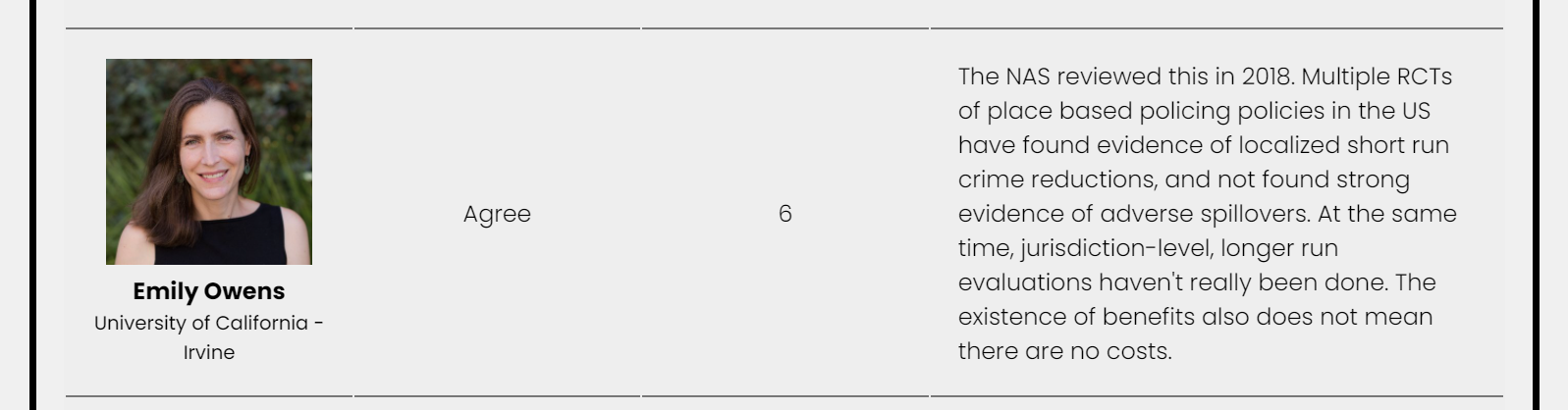
So when people argue that hot spots policing doesn’t show long term benefits, all I can do is agree. If in a world where we are choosing between doing hot spots vs doing nothing, I think it is wrong to choose the ultra risk adverse position of do nothing because you don’t think on average short term crime reductions of 10% in hot spots are worth it. But I cannot say it is a guaranteed outcome and it probably won’t magically reduce crime forever in that hot spot. Mea culpa.

The issue is most people making these risk adverse arguments against hot spots, whether academics or pundits or whoever, are not actually risk adverse or ultra conservative in accepting scientific evidence of the efficacy of criminal justice policies. This is shown when individuals pile on critiques of hot spots policing – which as I noted the critiques are often legitimate in and of themselves – but then take the position that ‘policy X is better than hotspots’. As I said hot spots basically is the most well vetted CJ intervention we have – you are in a tough pickle to explain why you think any other policy is likely to be a better investment. It can be made no doubt, but I haven’t seen a real principled cost benefit analysis to prefer another strategy over it to prevent crime.

One recent example of this is on the GritsForBreakfast blog, where Grits advocates for allocating more resources for detectives to prevent violence. This is an example of an incoherent internal position. I am aware of potential ways in which clearing more cases may reduce crimes, even published some myself on that subject (Wheeler et al., 2021). The evidence behind that link is much more shaky however overall (see Mohler et al. 2021 for a conflicting finding), and even Grits himself is very skeptical of general deterrence. So sure you can pile on critiques of hot spots, but putting the blinders on for your preferred policy just means you are an advocate, not following actual evidence.

To be clear, I am not saying more detective resources is a bad thing, nor do I think we should go out and hire a bunch more police to do hot spots (I am mostly advocating for doing more with the same resources). I will sum up my positions at the end of the post, but I am mostly sympathetic in reference to folks advocating for more oversight for police budgets, as well as that alternative to policing interventions should get their due as well. But in a not unrealistic zero sum scenario of ‘I can either allocate this position for a patrol officer vs a detective’ I am very skeptical Grits is actually objectively viewing the evidence to come to a principled conclusion for his recommendation, as opposed to ex ante justifying his pre-held opinion.

Unfortunately similarly incoherent positions are not all that uncommon, even among academics.

The CJ Expert Panel Opinions on Gun Violence

As I linked above, there was a recent survey of various academics on potential gun violence reduction strategies. I think these are no doubt good things, albeit not perfect, similar to CrimeSolutions.gov but are many more opinions on overall evidence bases but are more superficial.

This survey asked about three general strategies, and asked panelists to give Likert responses (strongly agree,agree,neutral,disagree,strongly disagree), as well as a 1-10 for how confident they were, whether those strategies if implemented would reduce gun violence. The three strategies were:

  • investing in police-led targeted enforcement directed at places and persons at high risk for gun crime (e.g.,“hot spot” policing; gang enforcement)
  • investing in police-led focused deterrence programs (clearly communicating “carrots and sticks” to local residents identified as high risk, followed by targeted surveillance and enforcement with some community-based support for those who desist from crime)
  • investing in purely community-led violence-interruption programs (community-based outreach workers try to mediate and prevent conflict, without police involvement)

The question explicitly stated you should take into account implementation in real life as well. Again people can as individuals have very pessimistic outlooks on any of these programs. It is however very difficult for me to understand a position where you ‘disagree’ with focused deterrence (FD) in the above answer and also ‘agree’ with violence interrupters (VI).

FD has a meta analysis of 20 some studies at this point (Braga et al., 2018), all are quasi-experimental (e.g. differences in differences comparing gang shootings vs non gang shootings, as well as some matched comparisons). So if you want to say – I think it is bunk because there are no good randomized control trials, I cannot argue with this. However there are much fewer studies for VI, Butts et al. (2015) have 5 (I imagine there are some more since then), and they are all quasi-experimental as well. So in this poll of 39 academics, how many agree with VI and disagree with FD?

We end up having 3. I show in that screen shot as well the crosstabulation with the hot spots (HS) question as well. It ends up being the same three people disagreed on HS/FD and agreed on VI:

I will come back to Makowski and Apel’s justification for their opinion in a bit. There is a free text field (although not everyone filled in, we have no responses from Harris here), and while I think this is pretty good evidence of having shifting evidentiary standards for their justification, the questions are quite fuzzy and people can of course weight their preferences differently. The venture capitalist approach would say we don’t have much evidence for VI, so maybe it is really good!

So again as a first blush, I checked to see how many people had opinions that I consider here coherent. You can say they all are bad, or you can agree with all the statements, but generally the opinions should be hs >= fd >= vi if one is going by the accumulated evidence in an unbiased manner. I checked how many coherent opinions there are in this survey according to this measure and it is the majority, 29/39 (those at the top of the list are more hawkish, saying strongly agree and agree more often):
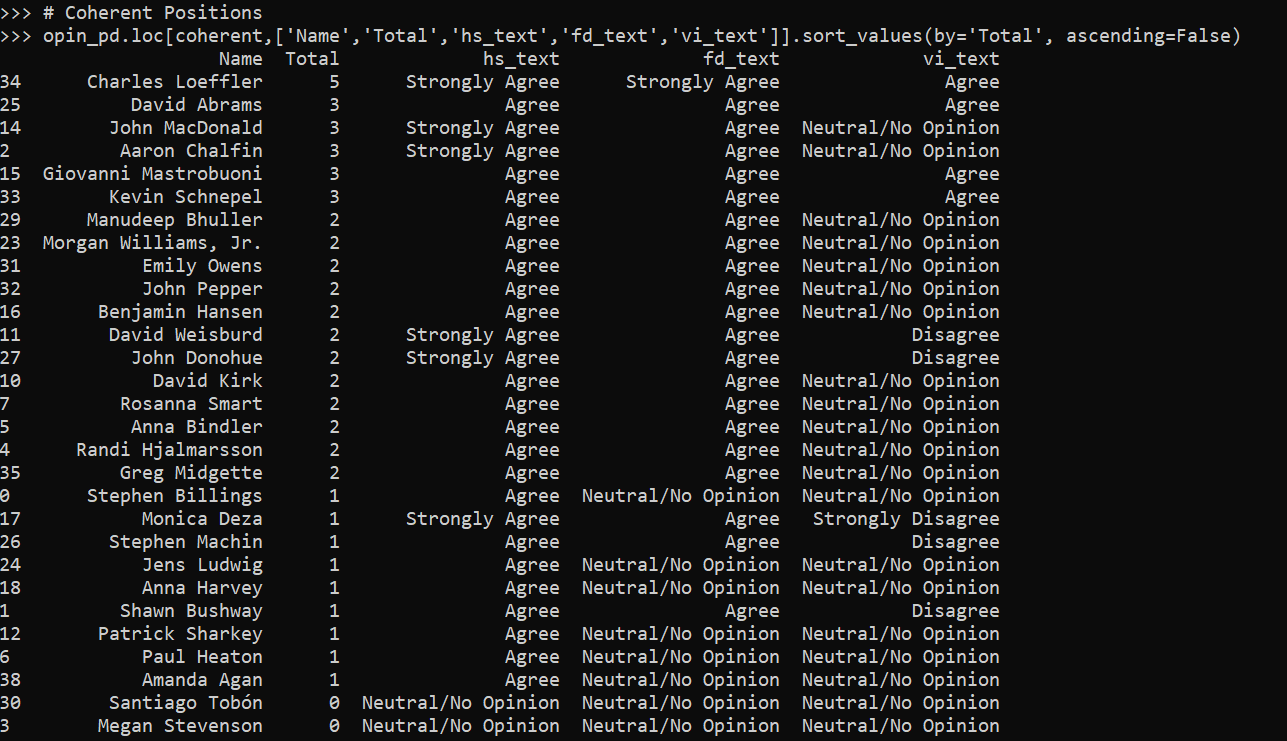
Here are those I considered incoherent according to this measure:
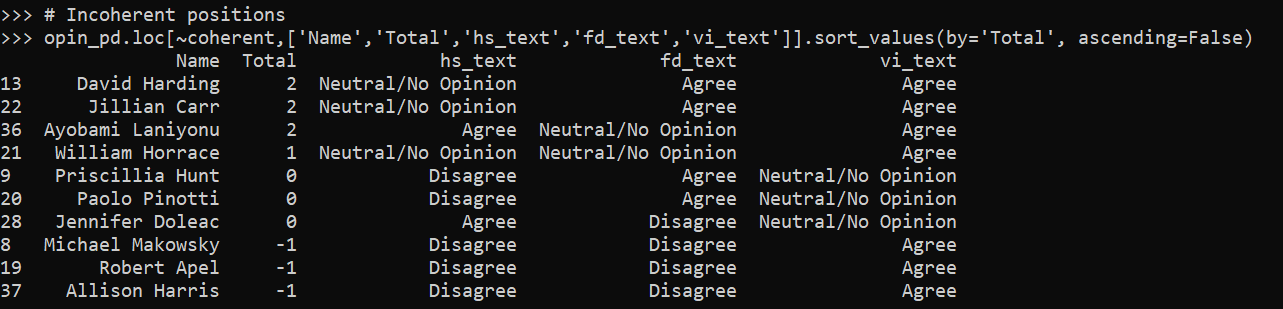
Looking at the free text field for why people justified particular positions in this table, with the exception of Makowski and Apel, I actually don’t think they have all that unprincipled opinions (although how they mapped their responses to agree/disagree I don’t think is internally consistent). For example, Paolo Pinotti disagrees with lumping in hot spots with people based strategies:
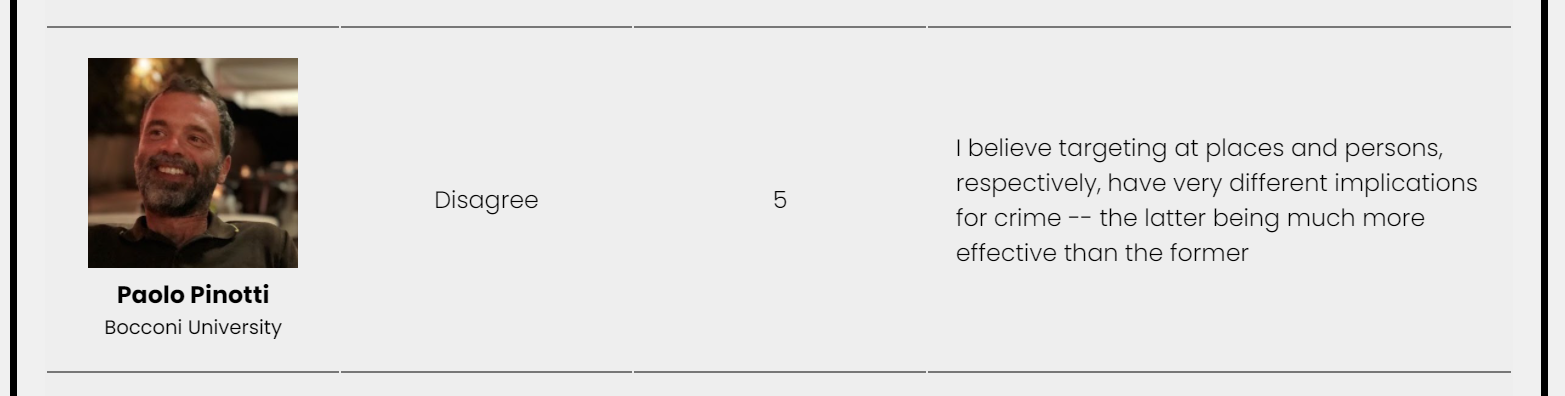
Fair enough and I agree! People based strategies are much more tenuous. Chalfin et al. (2021) have a recent example of gang interdiction, but as far as I’m aware much of the lit on that (say coordinated RICO), is a pretty mixed bad. Pinotti then gives agree to FD and neutral to VI (with no text for either). Another person in this list is Priscilla Hunt, who mentions the heterogeneity of hot spots interventions:
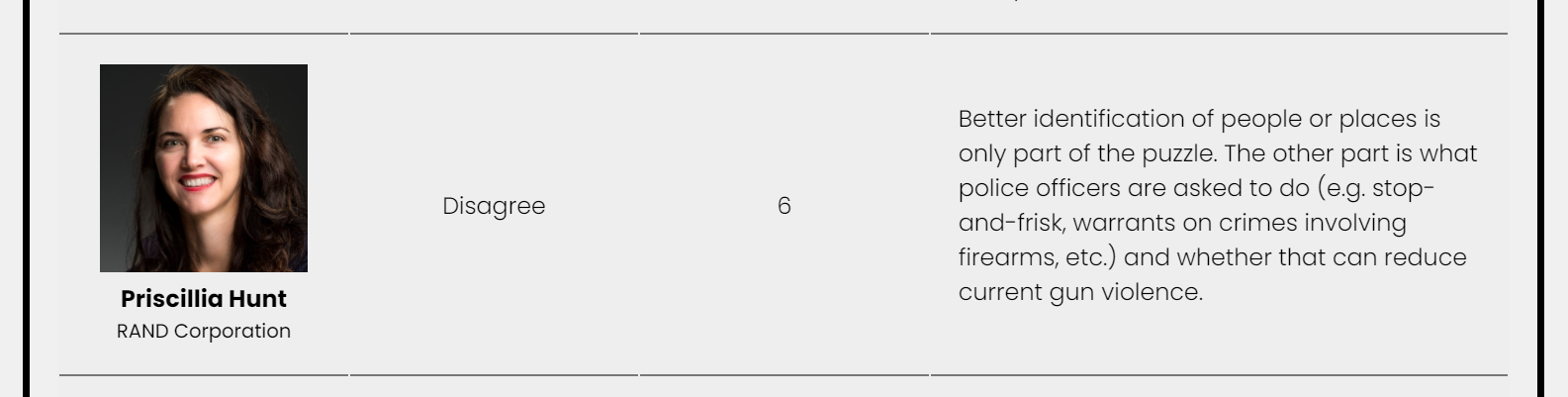
I think this is pretty pessimistic, since the Braga meta analyses often break down by different intervention types and they mostly coalesce around the same effect estimates (about a 10% reduction in hot spots compared to control, albeit with a wide variance). But the question did ask about implementation. Fair enough, hot spots is more fuzzy a category than FD or VI.

Jennifer Doleac is an example where I don’t think they are mapping opinions consistently to what they say, although what they say is reasonable. Here is Doleac being skeptical for FD:

I think Doleac actually means this RCT by Hamilton et al. (2018) – arrests are not the right outcome though (more arrests probably mean the FD strategy is not working actually), so personally I take this study as non-informative as to whether FD reduces gun violence (although there is no issue to see if it has other spillovers on arrests). But Doleac’s opinion is still reasonable in that we have no RCT evidence. Here is Doleac also being skeptical of VI, but giving a neutral Likert response:
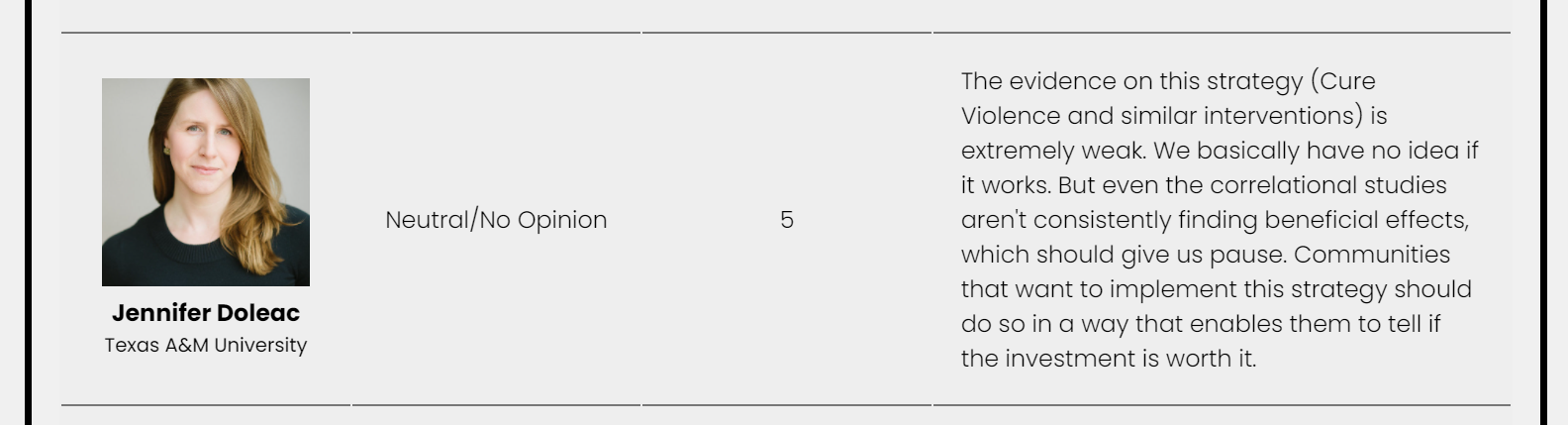
She mentions negative externalities for both (which is of course something people should be wary of when implementing these strategies). So for me to say this is incoherent is really sweating the small stuff – I think incorporating the text statement with these opinions are fine, although I believe a more internally consistent response would be neutral for both or disagree for both.

Jillian Carr gives examples of the variance of hot spots:

This is similar to Priscilla’s point, but I think that is partially an error. When you collect more rigorous studies over time, the effect sizes will often shrink (due to selection effects in the scholarly literature process that early successes are likely to have larger errors, Gelman et al. 2020). And you will have more variance as well and some studies with null effects. This is a good thing – no social science intervention is so full proof to always be 100% success (the lower bound is below 0 for any of these interventions). Offhand the variance of the FD meta analysis is smaller overall than hot spots, so Carr’s opinion of agree on FD can still be coherent, but for VI it is not:

If we are simply tallying when things do not work, we can find examples of that for VI (and FD) as well. So it is unclear why it is OK for FD/VI but not for HS to show some studies that don’t work.

There is an actual strategy I mentioned earlier where you might actually play the variance to suggest particular policies – we know hot spots (and now FD) have modest crime reducing effects on average. So you may say ‘I think we should do VI, because it may have a higher upside, we don’t know’. But that strikes me as a very generous interpretation of Carr’s comments here (which to be fair are only limited to only a few sentences). I think if you say ‘the variance of hot spots is high’ as a critique, you can’t hang your hat on VI and still be internally coherent. You are just swapping out a known variance for an unknown one.

Makowski and Apels Incoherence?

I have saved for last Michael Makowski and Robert Apel’s responses. I will start out by saying I don’t know all of the people in this sample, but the ones I do know are very intelligent people. You should generally listen to what they say, although I think they show some bias here in these responses. We all have biases, and I am sure you can trawl up examples of my opinions over time that are incoherent as well.

I do not know Michael Makowski, so I don’t mean to pick on him in particular here. I am sure you should listen to him over me for many opinions on many different topics. For example agree with his proposal to sever seized assets with police budgets. But just focusing on what he does say here (which good for him to actually say why he chose his opinions, he did not have to), for his opinion on hot spots:
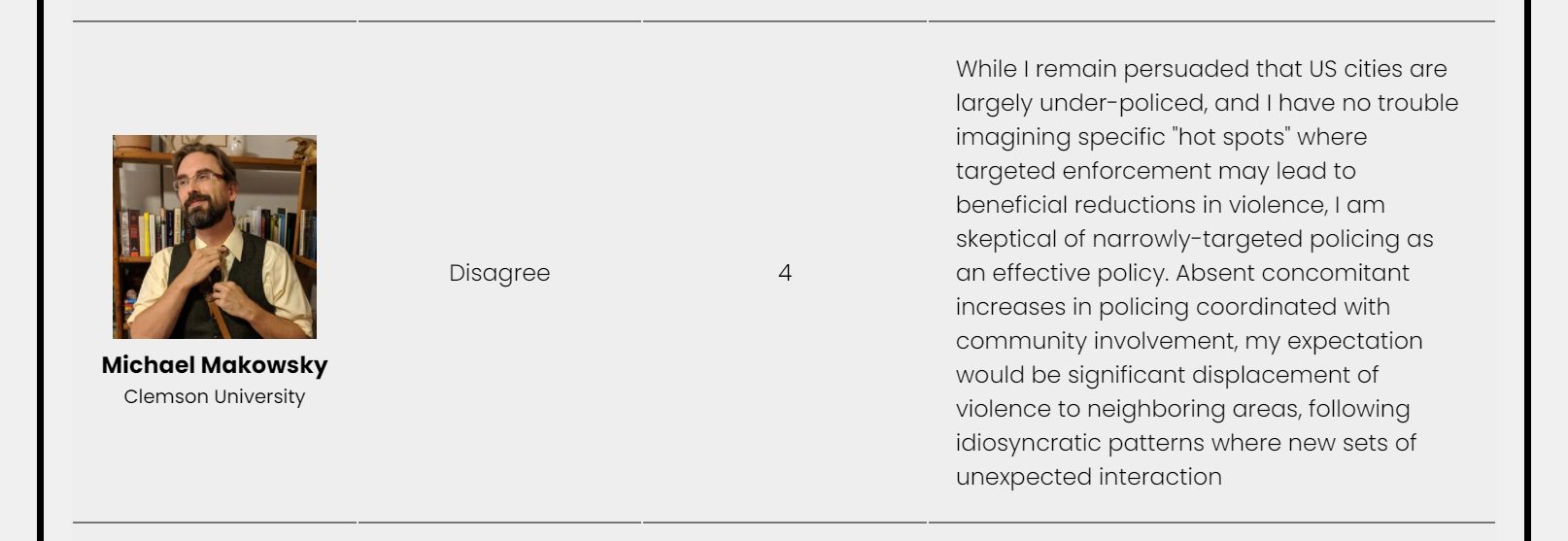
So Makowski thinks policing is understaffed, but hot spots is a no go. OK, I am not sure what he expects those additional officers to do – answer calls for service and drive around randomly? I’d note hot spots can simultaneously be coordinated with the community directly – I know of no better examples of community policing than foot patrols (e.g. Haberman & Stiver, 2019 for an example). But the question was not that specific about that particular hot spot strategy, so that is not a critique of Makowski’s position.

We have so many meta analyses of hot spots now, that we also have meta analyses of displacement (Bowers et al., 2011), and the Braga meta analyses of direct effects have all included supplemental analyses of displacement as well. Good news! We actually often find evidence of diffusion of benefits in quite a few studies. Banking on secondary effects that are larger/nullify direct effects is a strange position to take, but I have seen others take it as well. The Grits blog I linked to earlier mentions that these studies only measure displacement in the immediate area. Tis true, these studies do not measure displacement in surrounding suburbs, nor displacement to the North Pole. Guess we will never know if hot spots reduce crime worldwide. Note however this applies to literally any intervention!

For Makowski’s similarly pessimistic take on FD:
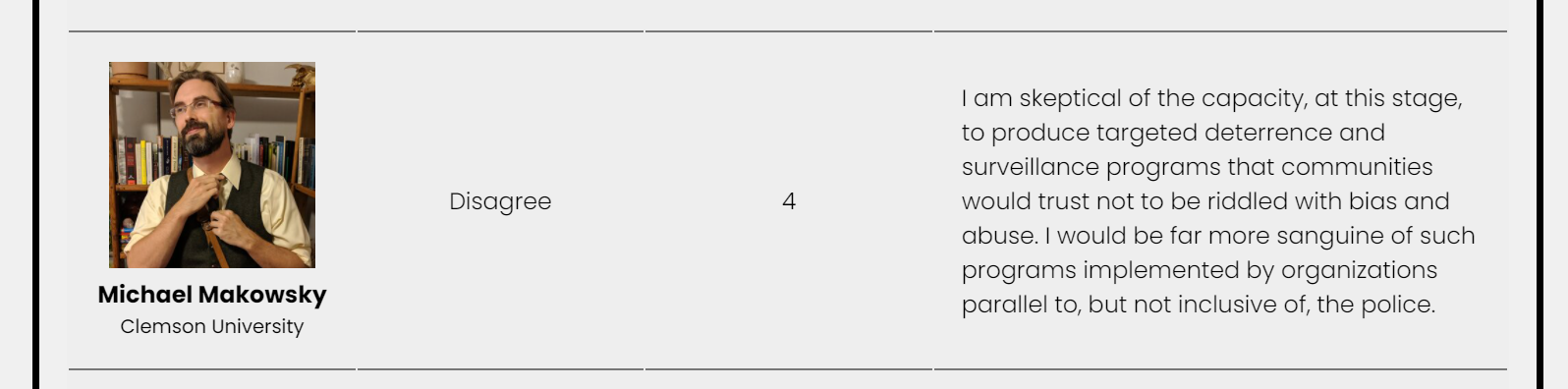
So at least Makowski is laying his cards on the table – the question did ask about implementation, and here he is saying he doesn’t think police have the capability to implement FD. If you go in assuming police are incompetent than yeah no matter what intervention the police might do you would disagree they can reduce violence. This is true for any social policy. But Makowski thinks other orgs (not the police) are good to go – OK.

Again have a meta analysis showing that quite a few agencies can implement FD competently and subsequently reduce gun violence, which are no doubt a self selected set of agencies that are more competent compared to the average police department. I can’t disagree with if you interpret the question as you draw a random police department out of a hat, can they competently implement FD (most of these will be agencies with only a handful of officers in rural places who don’t have large gun violence problems). The confidence score is low from Makowski here though (4/10), so at least I think those two opinions are wrong but are for the most part are internally consistent with each other.

I’d note also as well, that although the question explicitly states FD is surveillance, I think that is a bit of a broad brush. FD is explicitly against this in some respects – Kennedy talks about in the meetings to tell group members the police don’t give a shit about minor infractions – they only care if a body drops. It is less surveillancy than things like CCTV or targeted gang takedowns for example (or maybe even HS). But it is right in the question, so a bit unfair to criticize someone for focusing on that.

Like I said if someone wants to be uber critical across the board you can’t really argue with that. My problem comes with Makowski’s opinion of VI:
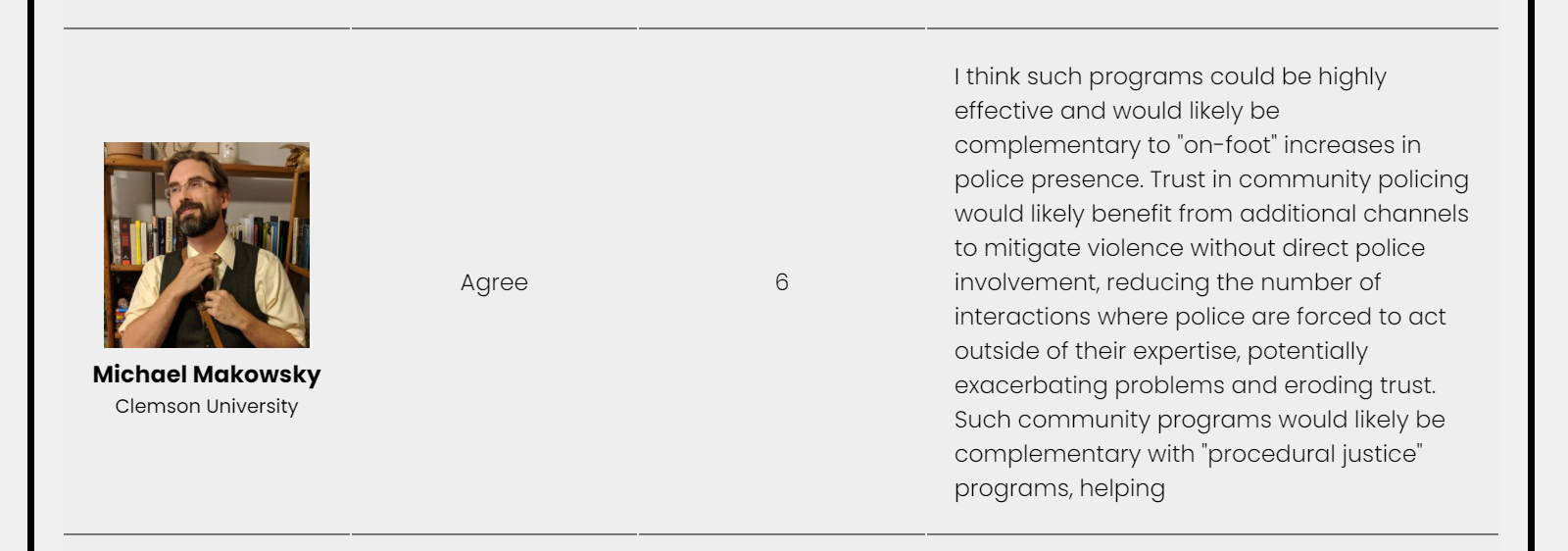
VI is quite explicitly diverged from policing – it is a core part of the model. So when interrupters talk with current gang members, they can be assured the interrupters will not narc on them to police. The interrupters don’t work with the police at all. So all the stuff about complementary policing and procedural justice is just totally non-sequitur (and seems strange to say hot spots no, but boots on the ground are good).

So while Makowski is skeptical of HS/FD, he thinks some mechanism he just made up in his own mind (VI improving procedural justice for police) with no empirical evidence will reduce gun violence. This is the incoherent part. For those wondering, while I can think procedural justice is a good thing, thinking it will reduce crime has no empirical support (Nagin & Telep, 2020).

I’d note that while Makowski thinks police can’t competently implement FD, he makes no such qualms about other agencies implementing VI. I hate to be the bearer of bad news for folks, but VI programs quite often have issues as well. Baltimore’s program over the years have had well known cases of people selling drugs and still quite active in violence themselves. But I guess people are solely concerned about negative externalities from policing and just turn a blind eye to other non policing interventions.

Alright, so now onto Bob Apel. For a bit off topic – one of the books that got me interested in research/grad school was Levitt and Dubners Freakonomics. I had Robert Apel for research design class at SUNY Albany, and Bob’s class really formalized counterfactual logic that I encountered in that book for me. It was really what I would consider a transformative experience from student to researcher for me. That said, it is really hard for me to see a reasonable defense of Bob’s opinions here. We have a similar story we have seen before in the respondents for hot spots, there is high variance:
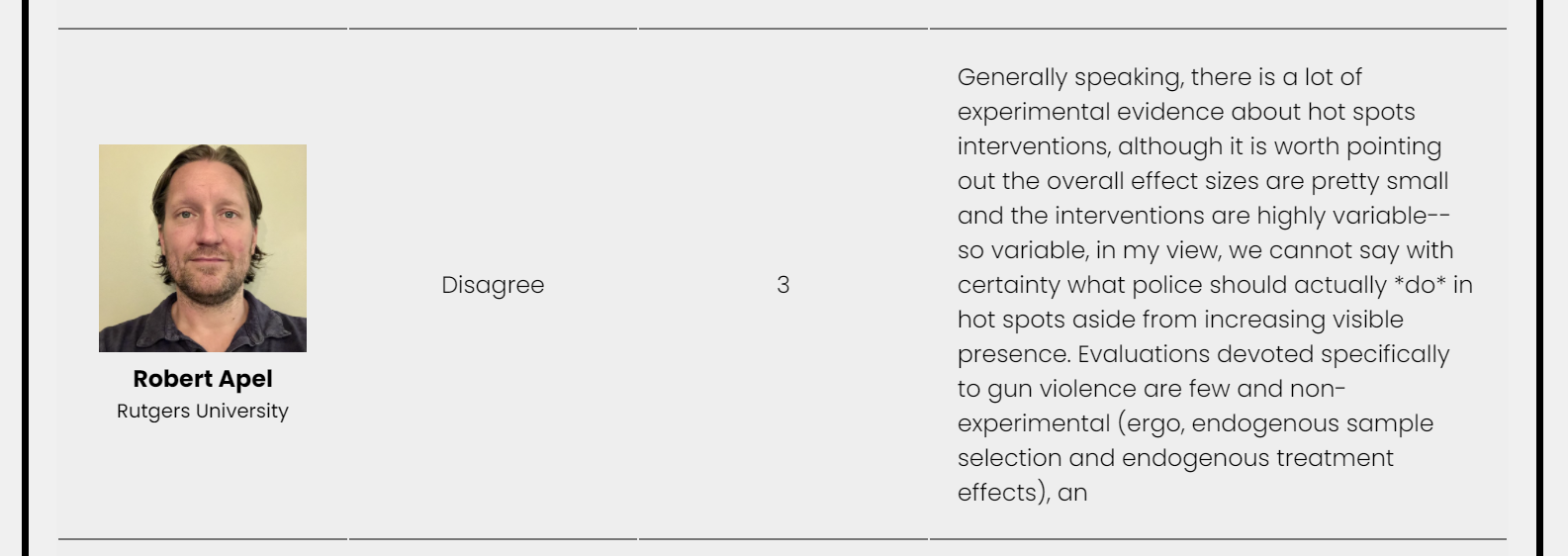
The specific to gun violence is potentially a red herring. The Braga meta analyses do breakdowns of effects on property vs violent crime, with violent typically having smaller but quite similar overall effect sizes (that includes more than just gun violence though). We do have studies specific to gun violence, Sherman et al. (1995) is actually one of the studies with the highest effects sizes in those meta analyses, but is of course one study. I disagree that the studies need to be specific to gun violence to be applicable, hot spots are likely to have effects on multiple crimes. But I think if you only count reduced shootings (and not violent crime as a whole), hot spots are tough, as even places with high numbers of shootings they are typically too small of N to justify a hot spot at a particular location. So again all by itself, I can see a reasonably skeptical person having this position, and Bob did give a low confidence score of 3.

And here we go for Bob’s opinion of FD:
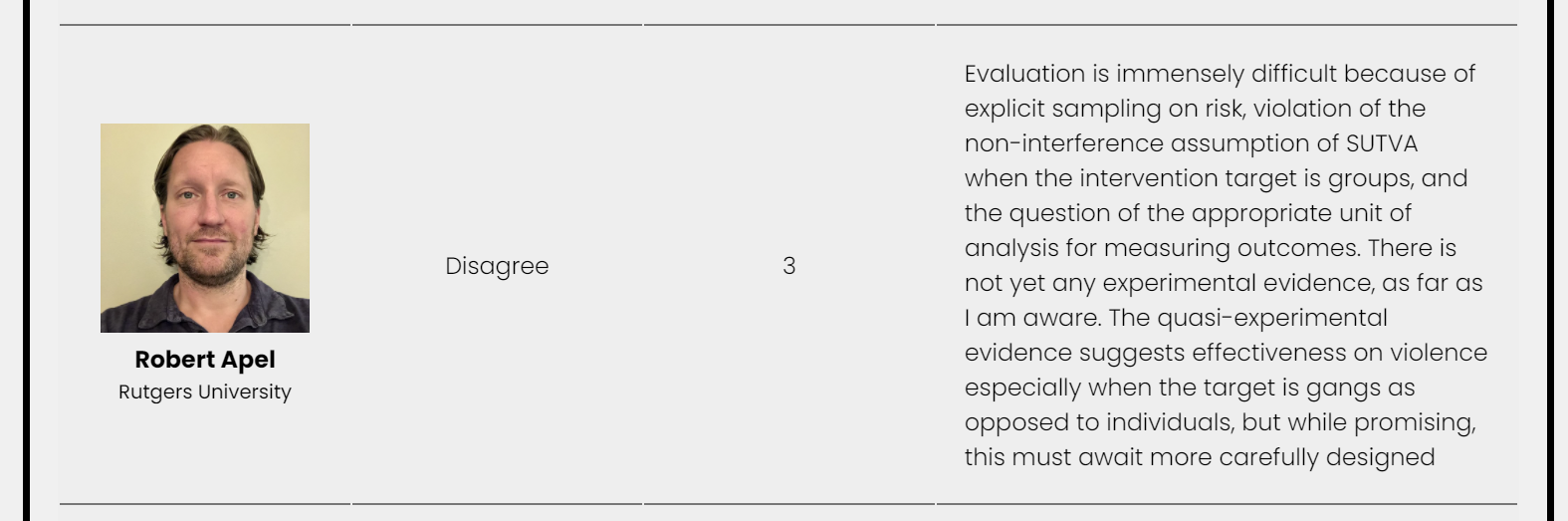
Again, reasonably skeptical. I can buy that. Saying we need more evidence seems to me to be conflicting advice (maybe Bob saying it is worth trying to see if it works, just he disagrees it will work). The question does ask if violence will be reduced, not if it is worth trying. I think a neutral response would have been more consistent with what Bob said in the text field. But again if people want to be uber pessimistic I cannot argue so much against that in particular, and Bob also had a low confidence.

Again though we get to the opinion of VI:
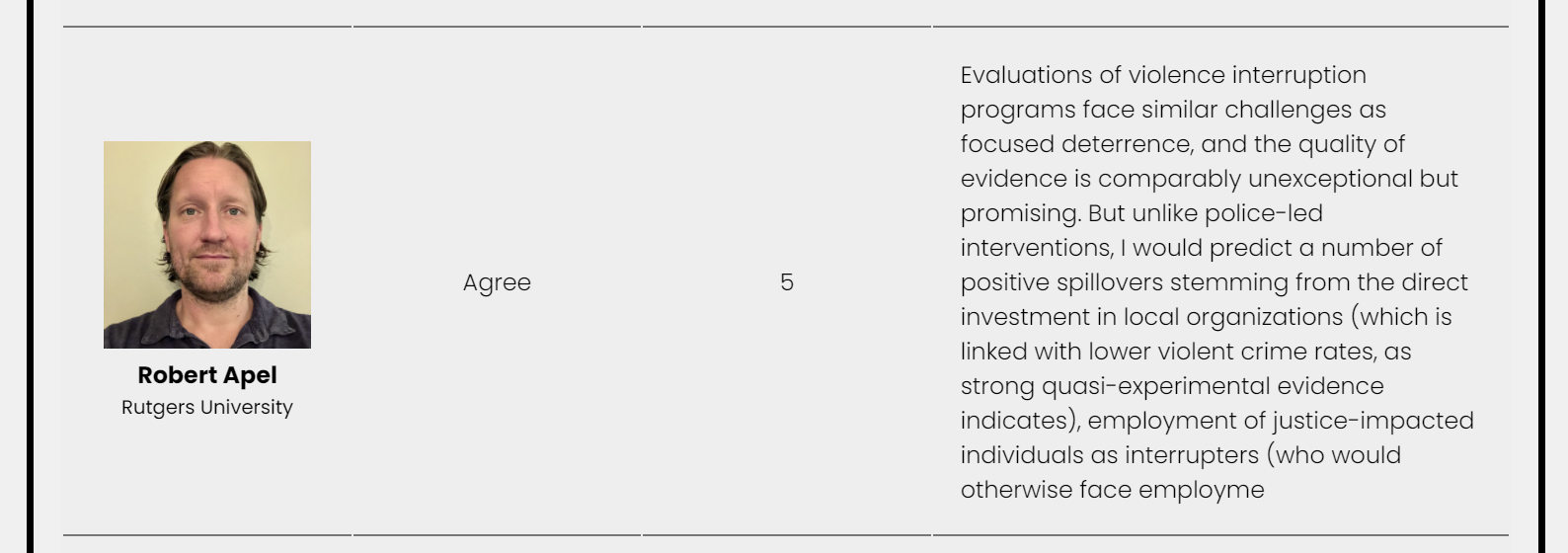
And we see Bob does think VI will reduce violence, but not due to direct effects, but indirect effects of positive spillovers. Similar to Makowski these are mechanisms not empirically validated in any way – just made up. So we get critiques of sample selection for HS, and SUTVA for FD, but Bob agrees VI will reduce violence via agencies collecting rents from administering the program. Okey Dokey!

For the part about the interrupters being employed as a potential positive externality – again you can point to examples where the interrupters are still engaged in criminal activity. So a reasonably skeptical person may think VI could actually be worse in terms of such spillovers. Presumably a well run program would hire people who are basically no risk to engage in violence themselves, so banking on employing a dozen interrupters to reduce gun violence is silly, but OK. (It is a different program to give cash transfers to high risk people themselves.)

I’d note in a few of the cities I have worked/am familiar with, the Catholic orgs that have administered VI are not locality specific. So rents they extract from administering the program are not per se even funneled back into the specific community. But sure, maybe they do some other program that reduces gun violence in some other place. Kind of a nightmare for someone who is actually concerned about SUTVA. This also seems to me to be logic stemmed from Patrick Sharkey’s work on non-profits (Sharkey et al., 2017). If Bob was being equally of critical of that work as HS/FD, it is non-experimental and just one study. But I guess it is OK to ignore study weaknesses for non police interventions.

For both Bob and Makowski here I could concoct some sort of cost benefit analysis to justify these positions. If you think harms from policing are infinite, then sure VI makes sense and the others don’t. A more charitable way to put it would be Makowski and Bob have shown lexicographic preferences for non policing solutions over policing ones, no matter what the empirical evidence for those strategies. So be it – it isn’t opinions based on scientific evidence though, they are just word souping to justify their pre held positions on the topic.

What do I think?

God bless you if you are still reading this rant 4k words in. But I cannot end by just bagging on other peoples opinions without giving my own can I? If I were to answer this survey as is, I guess I would do HS/agree (confidence 6), FD/agree (confidence 5), VI/agree (confidence 3). Now if you changed the question to ‘you get even odds, how much money would you put on reduced violence if a random city with recent gun violence increases implemented this strategy’, I would put down $0.00 (the variance people talked about is real!) So maybe a more internally consistent position would be neutral across the board for these questions with a confidence of 0. I don’t know.

This isn’t the same as saying should a city invest in some of these policies. If you properly valuate all the issues with gun violence, I think each of these strategies are worth the attempt – none of them are guaranteed to work though (any big social problem is hard to fix)! In terms of hot spots and FD, I actually think these have a strong enough evidence base at this point to justify perpetual internal positions at PDs devoted to these functions. The same as police have special investigation units focused on drugs they could have officers devoted to implementing FD. Ditto for community police officers could be specifically devoted to COP/POP at hot spots of crime.

I also agree with the linked above editorial on VI – even given the problems with Safe Streets in Baltimore, it is still worth it to make the program better, not just toss it out.

Subsequently if the question were changed to, I am a mayor and have 500k burning a hole in my pocket, which one of these programs do I fund? Again I would highly encourage PDs to work with what they have already to implement HS, e.g. many predictive policing/hot spots interventions are nudge style just spend some extra time in this spot (e.g. Carter et al., 2021), and I already gave the example of how PDs invest already in different roles that would likely be better shifted to empirically vetted strategies. And FD is mostly labor costs as well (Burgdorf & Kilmer, 2015). So unlike what Makowski implies, these are not rocket science and necessitate no large capital investments – it is within the capabilities of police to competently execute these programs. So I think a totally reasonable response from that mayor is to tell the police to go suck on a lemon (you should do these things already), and fund VI. I think the question of right sizing police budgets and how police internally dole out responsibilities can be reasoned about separately.

Gosh some of my academic colleagues must wonder how I sleep at night, suggesting some policing can be effective and simultaneously think it is worth funding non police programs.

I have no particular opinion about who should run VI. VI is also quite cheap – I suspect admin/fringe costs are higher than the salaries for the interrupters. It is a dangerous thing we are asking these interrupters to do for not much money. Apel above presumes it should be a non-profit community org overseeing the interrupters – I see no issue if someone wanted to leverage current govt agencies to administer this (say the county dept of social services or public health). I actually think they should be proactive – Buffalo PD had a program where they did house visits to folks at high risk after a shooting. VI could do the same and be proactive and target those with the highest potential spillovers.

One of the things I am pretty frustrated with folks who are hyper critical of HS and FD is the potential for negative externalities. The NAS report on proactive policing lays out quite a few potential mechanisms via which negative externalities can occur (National Academies of Sciences, Engineering, and Medicine, 2018). It is evidence light however, and many studies which explicitly look for these negative externalities in conjunction with HS do not find them (Brantingham et al., 2018; Carter et al., 2021; Ratcliffe et al., 2015). I have published about how to weigh HS with relative contact with the CJ system (Wheeler, 2020). The folks in that big city now call it precision policing, and this is likely to greatly reduce absolute contact with the CJ system as well (Manski & Nagin, 2017).

People saying no hot spots because maybe bad things are intentionally conflating different types of policing interventions. Former widespread stop, question and frisk policies do not forever villify any type of proactive policing strategy. To reasonably justify any program you need to make assumptions that the program will be faithfully implemented. Hot spots won’t work if a PD just draws blobs on the map and does no coordinated strategy with that information. The same as VI won’t work if there is no oversight of interrupters.

For sure if you want to make the worst assumptions about police and the best assumptions about everyone else, you can say disagree with HS and agree with VI. Probably some of the opinions on that survey do the same in reverse – as I mention here I think the evidence for VI is plenty good enough to continue to invest and implement such programs. And all of these programs should monitor outcomes – both good and bad – at the onset. That is within the capability of crime analysis units and local govt to do this (Morgan et al., 2017).

I debated on closing the comments for this post. I will leave them open, but if any of the folks I critique here wish to respond I would prefer a more long formed response and I will publish it on my blog and/or link to your response. I don’t think the shorter comments are very productive, as you can see with my back and forth with Grits earlier produced no resolution.

References

Mapping attitudes paper published

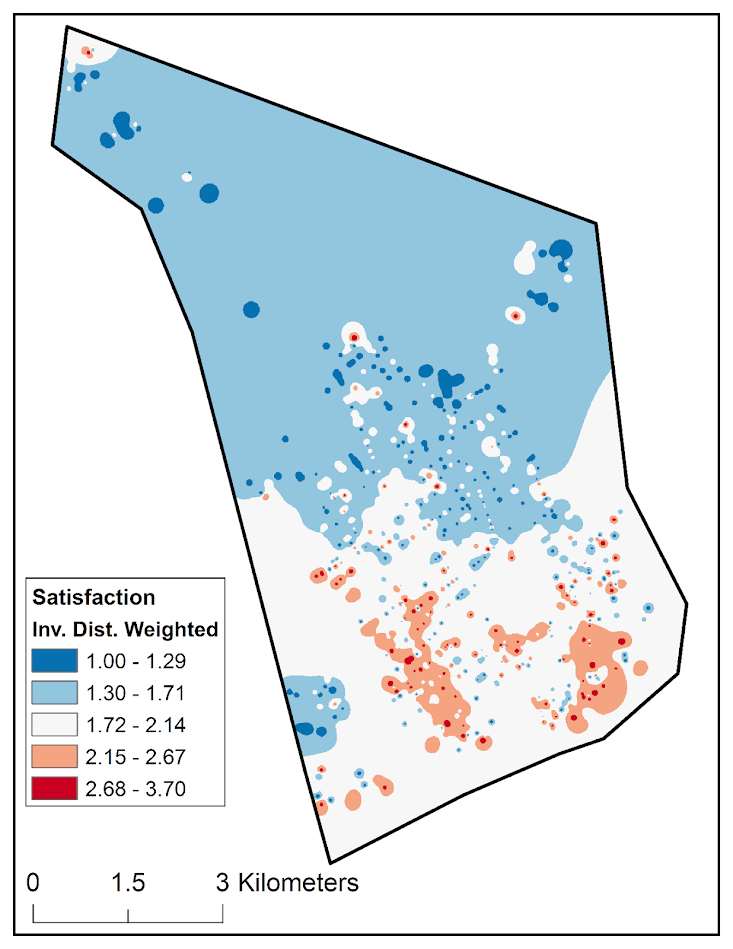
My paper (joint work with Jasmine Silver, Rob Worden, and Sarah McLean), Mapping attitudes towards the police at micro places, has been published in the most recent issue of the Journal of Quantitative Criminology. Here is the abstract:

Objectives: We examine satisfaction with the police at micro places using data from citizen surveys conducted in 2001, 2009 and 2014 in one city. We illustrate the utility of this approach by comparing micro- and meso-level aggregations of policing attitudes, as well as by predicting views about the police from crime data at micro places.

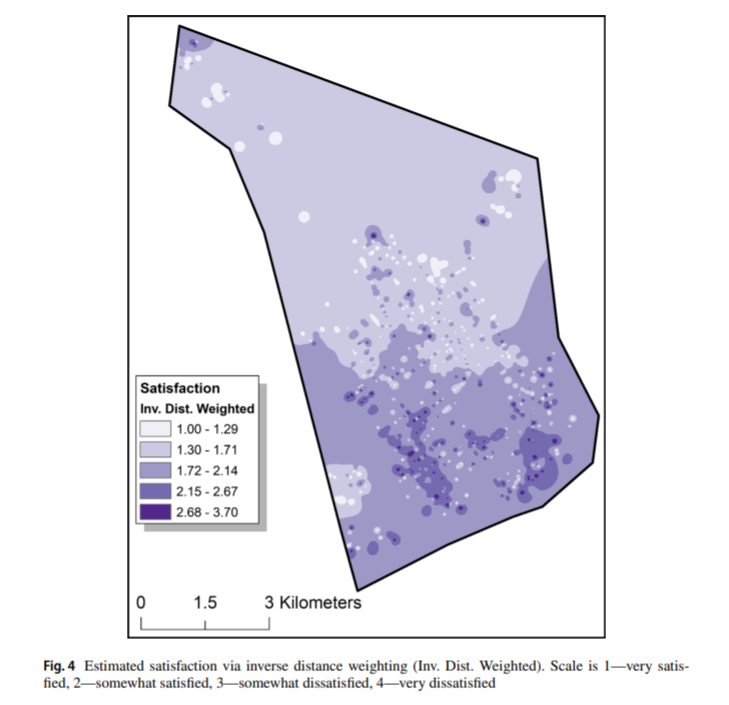
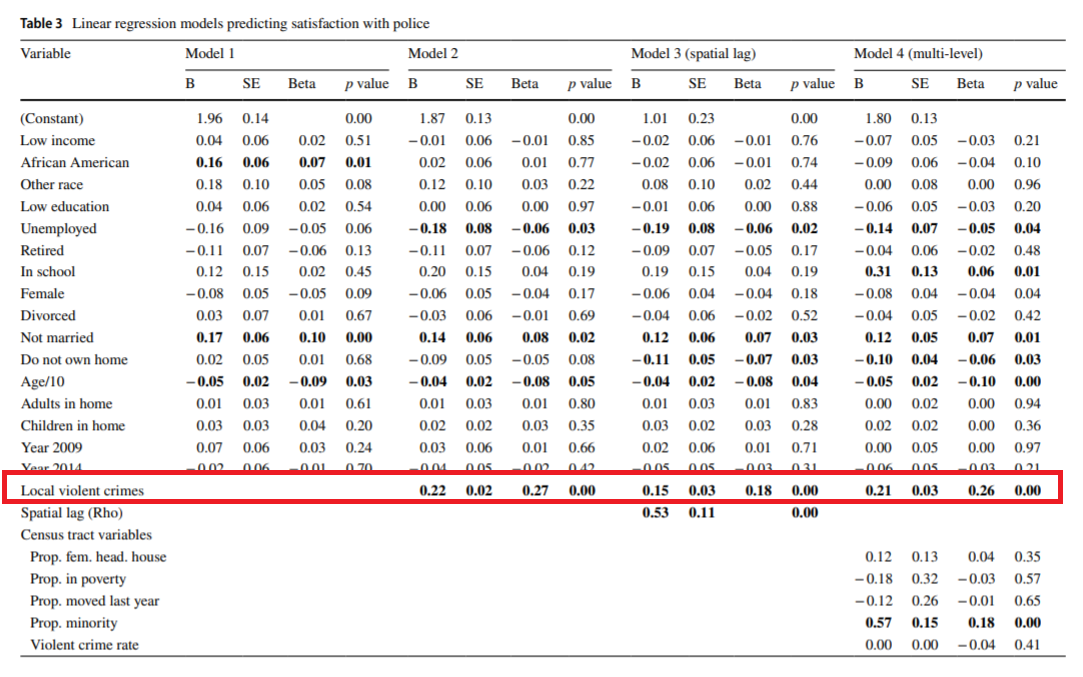
Methods: In each survey, respondents provided the nearest intersection to their address. Using that geocoded survey data, we use inverse distance weighting to map a smooth surface of satisfaction with police over the entire city and compare the micro-level pattern of policing attitudes to survey data aggregated to the census tract. We also use spatial and multi-level regression models to estimate the effect of local violent crimes on attitudes towards police, controlling for other individual and neighborhood level characteristics.

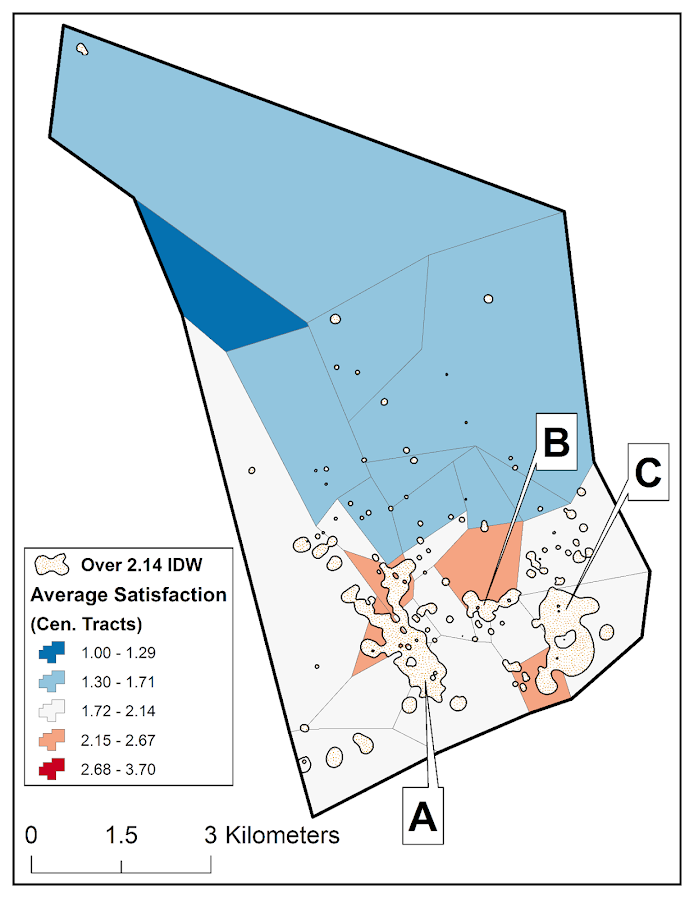
Results: We demonstrate that there are no systematic biases for respondents refusing to answer the nearest intersection question. We show that hot spots of dissatisfaction with police do not conform to census tract boundaries, but rather align closely with hot spots of crime. Models predicting satisfaction with police show that local counts of violent crime are a strong predictor of attitudes towards police, even above individual level predictors of race and age.

Conclusions: Asking survey respondents to provide the nearest intersection to where they live is a simple approach to mapping attitudes towards police at micro places. This approach provides advantages beyond those of using traditional neighborhood boundaries. Specifically, it provides more precise locations police may target interventions, as well as illuminates an important predictor (i.e., nearby violent crimes) of policing attitudes.

And this was one of my favorites to make maps. We show how to take surveys and create analogs of hot spot maps of negative sentiment towards police. We do this via asking individuals to list their closest intersection (to still give some anonymity), and then create inverse distance weighted maps of negative attitudes towards police.

We also find in this work that nearby crimes are the biggest factor in predicting negative sentiment towards police. This hints that past results aggregating attitudes to neighborhoods is inappropriate, and that police reducing crime is likely to have the best margin in terms of making people more happy with the police in general.

As always, feel free to reach out for a copy of the paper if you cannot access JQC. (Or you could go a view the pre-print.)

Conjoint Analysis of Crime Rankings

So part of my recent research mapping crime harm spots uses cost of crime estimates relevant to police departments (Wheeler & Reuter, 2020). But a limitation of this is that cost of crime estimates are always somewhat arbitrary.

For a simple example, those cost estimates are based mostly on people time by the PD to respond to crimes and devote investigative resources. Many big city PDs entirely triage crimes like breaking into vehicles though. So based on PD response the cost of those crimes are basically $0 (especially if PDs have an online reporting system).

But I don’t think the public would agree with that sentiment! So in an act of cognitive dissonance with my prior post, I think asking the public is likely necessary for police to be able to ultimately serve the publics interest when doing valuations. For some ethical trade-offs (like targeting hot spots vs increasing disproportionate minority contact, Wheeler, 2019) I am not sure there is any other reasonable approach than simply getting a bunch of peoples opinions.

But that being said, I suspected that these different metrics would provide pretty similar rankings for crime severity overall. So while it is criminology 101 that official crime and normative perceptions of deviance are not a perfect 1 to 1 mapping, most folks (across time and space) have largely similar agreement on the severity of different crimes, e.g. that assault is worse than theft.

So what I did was grab some survey ranking of crime data from the original source of crime ranking that I know of, Marvin Wolfgang’s supplement to the national crime victimization survey (Wolfgang et al., 2006). I have placed all the code in this github folder to replicate. And in particular check out this Jupyter notebook with the main analysis.

Conjoint Analysis of Crime Ranks

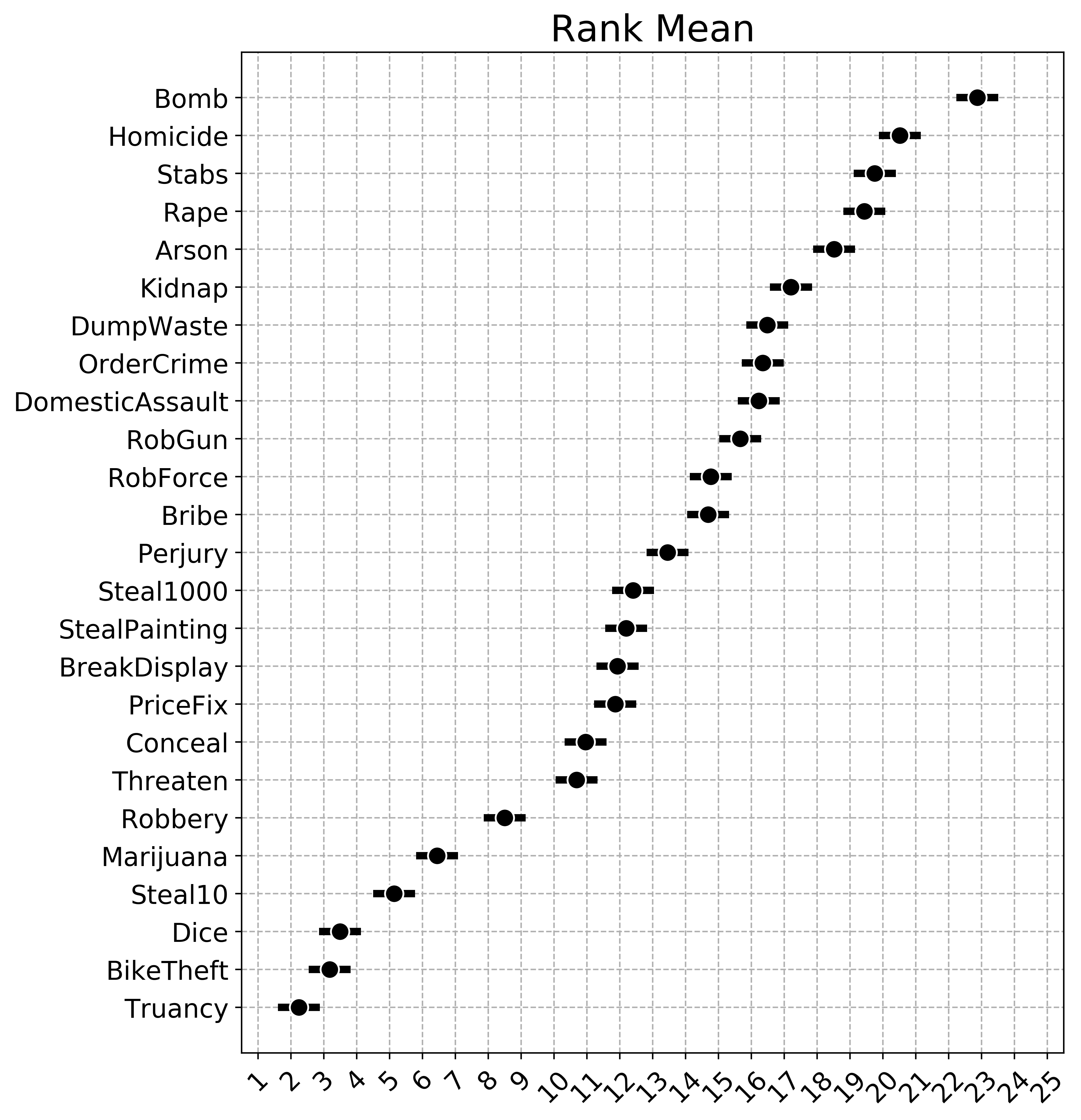
This analysis is often referred to as conjoint analysis. There are a bunch of different ways to conduct conjoint analysis – some ask folks to create a ranked list of items, others ask folks to choose between a list of a few items, and others ask folks to rank problems on a Likert item 1-5 scale. I would maybe guess Likert items are the most common in our field, see for example Spelman (2004) using surveys of asking people about disorder problems (and that data is available to, Taylor, 2008).

The Wolfgang survey I use here is crazy complicated, see the codebook, but in a nutshell they had an anchoring question where they assigned stealing a bike to a value of 10, and then asked folks to give a numeric score relative to that theft for a series of 24 other crime questions. Here I only analyze one version of the questionnaire, and after eliminating missing data there are still over 4,000 responses (in 1977!).

So you could do analyze those metric scores directly, but I am doing the lazy route and just doing a rank ordering (where ties are the average rank) within person. Then conjoint analysis is simply a regression predicting the rank. See the notebook for a more detailed walkthrough, so this just produces the same analysis as looking at the means of the ranks.

About the only thing I do different here than typical conjoint analysis is that I rescale the frequency weights (just changes the degrees of freedom for standard error estimates) to account for the repeated nature of the observations (e.g. I treat it like a sample of 4000 some observations, not 4000*25 observations). (I don’t worry about the survey weights here.)

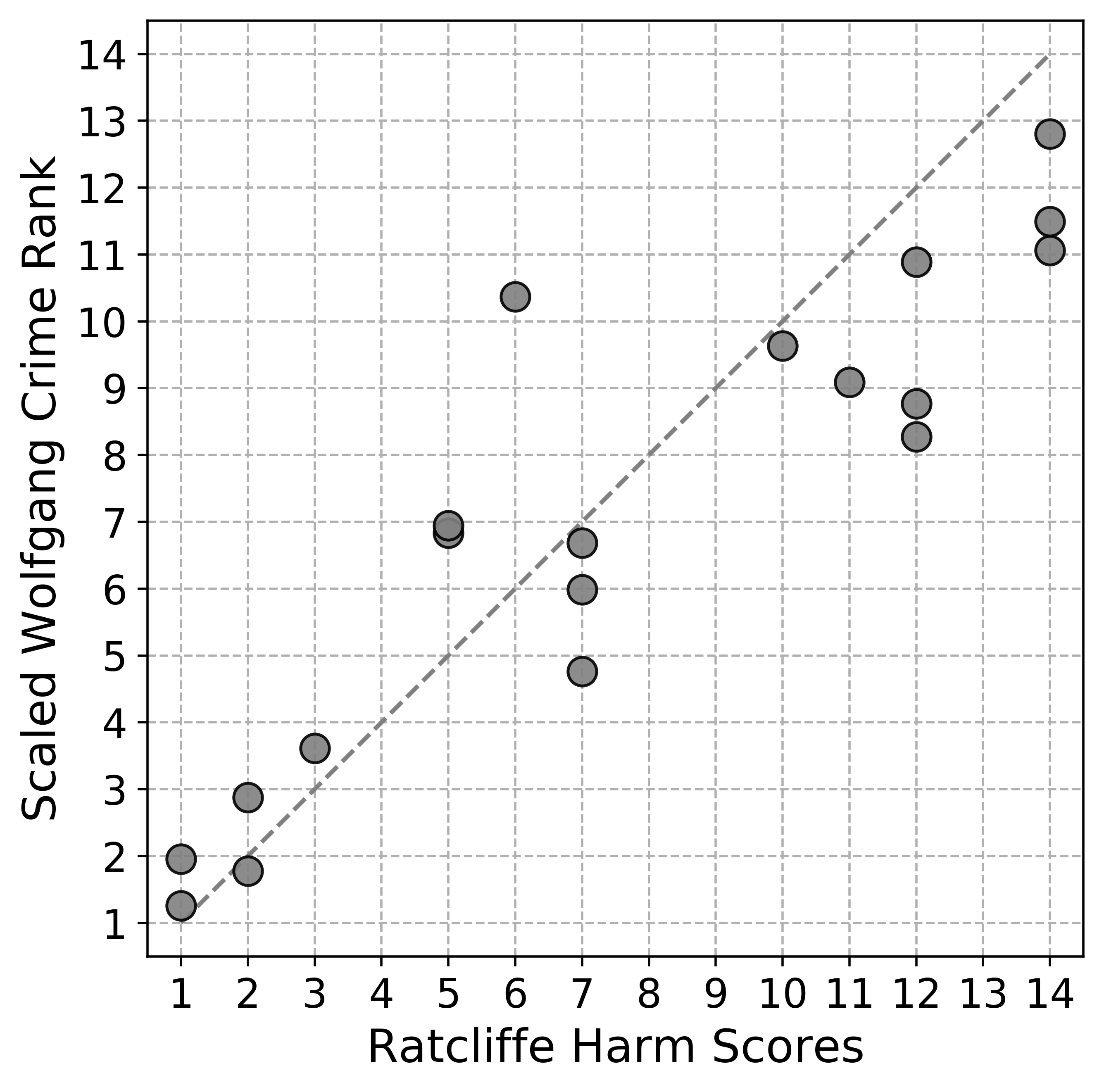
To test my assertion of whether these different ranking systems will be largely in agreement, I take Jerry’s crime harm paper (Ratcliffe, 2015), which is based on sentencing guidelines, and map them as best I could to the Wolfgang questions (you could argue with me some though on those assements – and some questions don’t have any analog, like a company dumping waste). I rescaled the Wolfgang rankings to be in a range of 1-14, same as Jerry’s, instead of 1-25.

Doing a more deep dive into the Wolfgang questions, there are definately different levels in the nature of the questions you can tease out. Folks clearly take into account both harm to the victim and total damages/theft amounts. But overall the two systems are fairly correlated. So if an analyst wants to make crime harm spots now, I think it is reasonable to use one of these ranking systems, and then worry about getting the public perspective later on down the line.

The Wolfgang survey is really incredible. In this regression framework you can either adjust for other characteristics (e.g. it asks about all the usual demographics) or look at interactions (do folks who were recently victimized up their scores). So this is really just scratching the surface. I imagine if someone redid it with current data many of the metrics would be similar as well, although if I needed to do this I don’t think I would devise something as complicated as this, and would ask people to rank a smaller set of items directly.

References

  • Ratcliffe, J.H. (2015). Towards an index for harm-focused policing. Policing: A Journal of Policy and Practice, 9(2), 164-182.
  • Spelman, W. (2004). Optimal targeting of incivility-reduction strategies. Journal of Quantitative Criminology, 20(1), 63-88.
  • Taylor, R.B. (2008). Impacts of Specific Incivilities on Responses to Crime and Local Commitment, 1979-1994: [Atlanta, Baltimore, Chicago, Minneapolis-St. Paul, and Seattle]. https://doi.org/10.3886/ICPSR02520.v1
  • Wheeler, A.P., & Reuter, S. (2020). Redrawing hot spots of crime in Dallas, Texas. https://doi.org/10.31235/osf.io/nmq8r
  • Wheeler, A.P. (2019). Allocating police resources while limiting racial inequality. Justice Quarterly, Online First.
  • Wolfgang, M.E., Figlio, R.M., Tracy, P.E., and Singer, S.I. (2006). National Crime Surveys: Index of Crime Severity, 1977. https://doi.org/10.3886/ICPSR08295.v1

New working paper: Mapping attitudes towards the police at micro places

I have a new preprint posted, Mapping attitudes towards the police at micro places. This is work with Jasmine Silver, as well as Rob Worden and Sarah McLean. See the abstract:

We demonstrate the utility of mapping community satisfaction with the police at micro places using data from citizen surveys conducted in 2001, 2009 and 2014 in one city. In each survey, respondents provided the nearest intersection to their address. We use inverse distance weighting to map a smooth surface of satisfaction with police over the entire city, which shows broader neighborhood patterns of satisfaction as well as small area hot spots of dissatisfaction. Our results show that hot spots of dissatisfaction with police do not conform to census tract boundaries, but rather align closely with hot spots of crime and police activity. Models predicting satisfaction with police show that local counts of violent crime are the strongest predictors of attitudes towards police, even above individual level predictors of race and age.

In this article we make what are analogs of hot spot maps of crime, but measure dissatisfaction with the police.


One of the interesting findings is that these hot spots do not align nicely with census tracts (the tracts are generalized, we cannot divulge the location of the city). So the areas identified by each procedure would be much different.


As always, feel free to comment or send me an email if you have feedback on the article.

Heatmaps in SPSS

Heatmap is a visualization term that gets used in a few different circumstances, but here I mean a regular grid in which you use color to indicate particular values. Here is an example from Nathan Yau via FlowingData:

They are often not the best visualization to use to evaluate general patterns, but they offer a mix of zooming into specific individuals, as well as to identify overall trends. In particular I like using them to look at missing data patterns in surveys in SPSS, which I will show an example of in this blog post. Here I am going to use a community survey for Dallas in 2016. The original data can be found here, and the original survey questions can be found here. I’ve saved that survey as an SPSS file you can access at this link. (The full code in one sps syntax file is here.)


So first I am going to open up the data file from online, and name the dataset DallasSurv16.

*Grab the data from online.
SPSSINC GETURI DATA
URI="https://dl.dropbox.com/s/5e07yi9hd0u5opk/Surv2016.sav?dl=0"
FILETYPE=SAV DATASET=DallasSurv16.

Here I am going to illustrate making a heatmap with the questions asking about fear of crime and victimization, the Q6 questions. First I am going to make a copy of the original dataset, as we will be making some changes to the data. I do this via the DATASET COPY function, and follow it up by activating that new dataset. Then I do a frequency to check out the set of Q6 items.

DATASET COPY HeatMap.
DATASET ACTIVATE HeatMap.
FREQ Q6_1Inyourneighborhoodduringthe TO Q69Fromfire.

From the survey instrument, the nine Q6 items have values of 1 through 5, and then a "Don’t Know" category labeled as 9. All of the items also have system missing values. First we are going to recode the system missing items to a value of 8, and then we are going to sort the dataset by those questions.

RECODE Q6_1Inyourneighborhoodduringthe TO Q69Fromfire (SYSMIS = 8)(ELSE = COPY).
SORT CASES BY Q6_1Inyourneighborhoodduringthe TO Q69Fromfire.

You will see the effect of the sorting the cases in a bit for our graph. But the idea about how to make the heatmap in the grammar of graphics is that in your data you have a variable that specifies the X axis, a variable for the Y axis, and then a variable for the color in your heatmap. To get that set up, we need to go from our nine separate Q6 variables to one variable. We do this in SPSS by using VARSTOCASES to reshape the data.

VARSTOCASES /MAKE Q6 FROM Q6_1Inyourneighborhoodduringthe TO Q69Fromfire /INDEX = QType.

So now every person who answered the survey has 9 different rows in the dataset instead of one. The original answers to the questions are placed in the new Q6 variable, and the QType variable is a number of 1 to 9. So now individual people will go on the Y axis, and each question will go on the X axis. But before we make the chart, we will add the meta-data in SPSS to our new Q6 and QType variables.

VALUE LABELS QType
  1 'In your neigh. During Day'
  2 'In your neigh. At Night'
  3 'Downtown during day'
  4 'Downtown at night'
  5 'Parks during day'
  6 'Parks at Night'
  7 'From violent crime'
  8 'From property crime'
  9 'From fire'
.
VALUE LABELS Q6
 8 "Missing" 
 9 "Don't Know"
 1 'Very Unsafe'
 2 'Unsafe'
 3 'Neither safe or unsafe'
 4 'Safe'
 5 'Very Safe'
.
FORMATS Q6 QType (F1.0).

Now we are ready for our GGRAPH statement. It is pretty gruesome but just bare with me for a second.

TEMPORARY.
SELECT IF DISTRICT = 1.
GGRAPH
  /GRAPHDATASET NAME="graphdataset" VARIABLES=QType ID Q6
  /GRAPHSPEC SOURCE=INLINE.
BEGIN GPL
  PAGE: begin(scale(800px,2000px))
  SOURCE: s=userSource(id("graphdataset"))
  DATA: QType=col(source(s), name("QType"), unit.category())
  DATA: ID=col(source(s), name("ID"), unit.category())
  DATA: Q6=col(source(s), name("Q6"), unit.category())
  GUIDE: axis(dim(1), opposite())
  GUIDE: axis(dim(2), null())
  SCALE: cat(aesthetic(aesthetic.color.interior), map(("1", color.darkred),("2", color.red),("3", color.lightgrey), 
            ("4", color.lightblue), ("5", color.darkblue), ("9", color.white), ("8", color.white)))
  SCALE: cat(dim(2), sort.data(), reverse())
  ELEMENT: polygon(position(QType*ID), color.interior(Q6), color.exterior(color.grey), transparency.exterior(transparency."0.7"))
  PAGE: end()
END GPL.
EXECUTE.

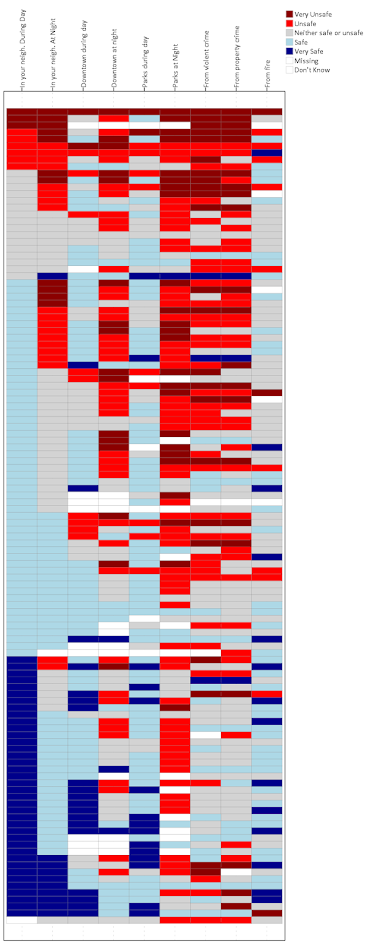
And this produces the chart,

So to start, normally I would use the chart builder dialog to make the skeleton for the GGRAPH code and update that. Here if you make a scatterplot in the chart dialog and assign the color it gets you most of the way there. But I will walk through some of the other steps.

  • TEMPORARY. and then SELECT IF – these two steps are to only draw a heatmap for survey responses for the around 100 individuals from council district 1. Subsequently the EXECUTE. command at the end makes it so the TEMPORARY command is over.
  • Then for in the inline GPL code, PAGE: begin(scale(800px,2000px)) changes the chart dimensions to taller and skinnier than the default chart size in SPSS. Also note you need a corresponding PAGE: end() command when you use a PAGE: begin() command.
  • GUIDE: axis(dim(1), opposite()) draws the labels for the X axis on the top of the graph, instead of the bottom.
  • GUIDE: axis(dim(2), null()) prevents drawing the Y axis, which just uses the survey id to displace survey responses
  • SCALE: cat(aesthetic maps different colors to each different survey response. Feeling safe are given blues, and not safe are given red colors. I gave neutral grey and missing white as well.
  • SCALE: cat(dim(2), sort.data(), reverse()), this tells SPSS to draw the Y axis in the order in which the data are already sorted. Because I sorted the Q6 variables before I did the VARSTOCASES this sorts the responses with the most fear to the top.
  • The ELEMENT: polygon( statement just draws the squares, and then specifies to color the interior of the squares according to the Q6 variable. I given the outline of the squares a grey color, but white works nice as well. (Black is a bit overpowering.)

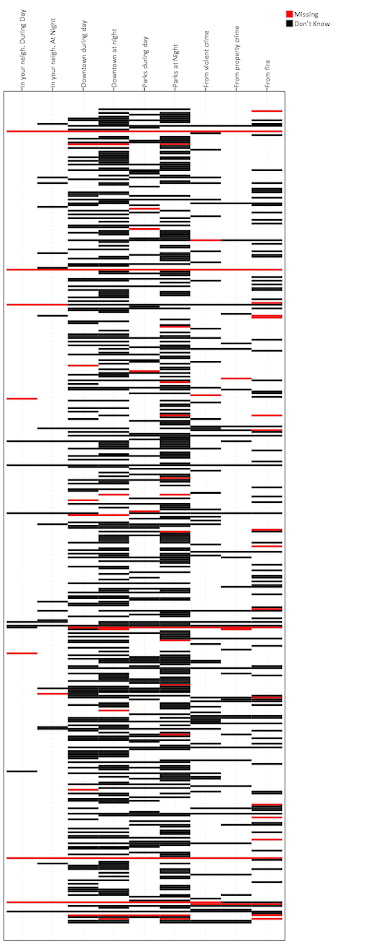
So now you have the idea. But like I said this can be hard to identify overall patterns sometimes. So sometimes I like to limit the responses in the graph. Here I make a heatmap of the full dataset (over 1,500 responses), but just look at the different types of missing data. Red is system missing in the original dataset, and Black is the survey filled in "Don’t Know".

*Missing data representation.
TEMPORARY.
SELECT IF (Q6 = 9 OR Q6 = 8).
GGRAPH
  /GRAPHDATASET NAME="graphdataset" VARIABLES=QType ID Q6 MISSING = VARIABLEWISE
  /GRAPHSPEC SOURCE=INLINE.
BEGIN GPL
  PAGE: begin(scale(800px,2000px))
  SOURCE: s=userSource(id("graphdataset"))
  DATA: QType=col(source(s), name("QType"), unit.category())
  DATA: ID=col(source(s), name("ID"), unit.category())
  DATA: Q6=col(source(s), name("Q6"), unit.category())
  GUIDE: axis(dim(1), opposite())
  GUIDE: axis(dim(2), null())
  SCALE: cat(aesthetic(aesthetic.color.interior), map(("1", color.darkred),("2", color.red),("3", color.lightgrey), 
            ("4", color.lightblue), ("5", color.darkblue), ("9", color.black), ("8", color.red)))
  ELEMENT: polygon(position(QType*ID), color.interior(Q6), color.exterior(color.grey), transparency.exterior(transparency."0.7"))
  PAGE: end()
END GPL.
EXECUTE.

You can see the system missing across all 6 questions happens very rarely, I only see three cases, but there are a ton of "Don’t Know" responses. Another way to simplify the data is to use small multiples for each type of response. Here is the first graph, but using a panel for each of the individual survey responses. See the COORD: rect(dim(1,2), wrap()) and then the ELEMENT statement for the updates. As well as making the size of the chart shorter and fatter, and not drawing the legend.

*Small multiple.
TEMPORARY.
SELECT IF DISTRICT = 1.
GGRAPH
  /GRAPHDATASET NAME="graphdataset" VARIABLES=QType ID Q6
  /GRAPHSPEC SOURCE=INLINE.
BEGIN GPL
  PAGE: begin(scale(1000px,1000px))
  SOURCE: s=userSource(id("graphdataset"))
  DATA: QType=col(source(s), name("QType"), unit.category())
  DATA: ID=col(source(s), name("ID"), unit.category())
  DATA: Q6=col(source(s), name("Q6"), unit.category())
  COORD: rect(dim(1,2), wrap())
  GUIDE: axis(dim(1), opposite())
  GUIDE: axis(dim(2), null())
  GUIDE: legend(aesthetic(aesthetic.color.interior), null())
  SCALE: cat(aesthetic(aesthetic.color.interior), map(("1", color.darkred),("2", color.red),("3", color.lightgrey), 
            ("4", color.lightblue), ("5", color.darkblue), ("9", color.white), ("8", color.white)))
  SCALE: cat(dim(2), sort.data(), reverse())
  ELEMENT: polygon(position(QType*ID*Q6), color.interior(Q6), color.exterior(color.grey), transparency.exterior(transparency."0.7"))
  PAGE: end()
END GPL.
EXECUTE.

You technically do not need to reshape the data using VARSTOCASES at first to make these heatmaps (there is an equivalent VARSTOCASES command within GGRAPH you could use), but this way is simpler in my opinion. (I could not figure out a way to use multiple response sets to make these non-aggregated charts, so if you can figure that out let me know!)


The idea of a heatmap can be extended to much larger grids — basically any raster graphic can be thought of as a heatmap. But for SPSS you probably do not want to make heatmaps that are very dense. The reason being SPSS always makes its charts in vector format, you cannot tell it to just make a certain chart a raster. So a very dense heatmap will take along time to render. But I like to use them in some situations as I have shown here with smaller N data in SPSS.

Also off-topic, but I may be working on a cook-book with examples for SPSS graphics. If I have not already made a blog post let me know what you would examples you would like to see!