Fitting a gamma distribution (with standard errors) in python

Over on Crime De-Coder, I have up a pre-release of my book, Data Science for Crime Analysis with Python.

I have gotten asked by so many people “where to learn python” over the past year I decided to write a book. Go check out my preface on why I am not happy with current resources in the market, especially for beginners.

I have the preface + first two chapters posted. If you want to sign up for early releases, send me an email and will let you know how to get an early copy of the first half of the book (and send updates as they are finished).

Also I have up the third installment of the AltAc newsletter. Notes about the different types of healthcare jobs, and StatQuest youtube videos are a great resource. Email me if you want to sign up for the newsletter.


So the other day I showed how to fit a beta-binomial model in python. Today, in a quick post, I am going to show how to estimate standard errors for such fitted models.

So in scipy, you have distribution.fit(data) to fit the distribution and return the estimates, but it does not have standard errors around those estimates. I recently had need for gamma fits to data, in R I would do something like:

# this is R code
library(fitdistrplus)
x <- c(24,13,11,11,11,13,9,10,8,9,6)
gamma_fit <- fitdist(x,"gamma")
summary(gamma_fit)

And this pipes out:

> Fitting of the distribution ' gamma ' by maximum likelihood
> Parameters :
>        estimate Std. Error
> shape 8.4364984  3.5284240
> rate  0.7423908  0.3199124
> Loglikelihood:  -30.16567   AIC:  64.33134   BIC:  65.12713
> Correlation matrix:
>           shape      rate
> shape 1.0000000 0.9705518
> rate  0.9705518 1.0000000

Now, for some equivalent in python.

# python code
from scipy.optimize import minimize
from scipy.stats import gamma

x = [24,13,11,11,11,13,9,10,8,9,6]

res = gamma.fit(x,floc=0)
print(res)

And this gives (8.437256958682587, 0, 1.3468401423927603). Note that python uses the scale version, so 1/scale = rate, e.g. 1/res[-1] results in 0.7424786123640676, which agrees pretty closely with R.

Now unfortunately, there is no simple way to get the standard errors in this framework. You can however minimize the parameters yourself and get the things you need – here the Hessian – to calculate the standard errors yourself.

Here to make it easier apples to apples with R, I estimate the rate parameter version.

# minimize negative log likelihood
def gll(parms,data):
    alpha, rate = parms
    ll = gamma.logpdf(data,alpha,loc=0,scale=1/rate)
    return -ll.sum()

result = minimize(gll,[8.,0.7],args=(x),method='BFGS')
se = np.sqrt(np.diag(result.hess_inv))
# printing results
np.stack([result.x,se],axis=1)

And this gives:

array([[8.43729465, 3.32538824],
       [0.74248193, 0.30255433]])

Pretty close, but not an exact match, to R. Here the standard errors are too low (maybe there is a sample correction factor?).

Some quick tests with this, using this scale version tends to be a bit more robust in fitting than the rate version.

The context of this, a gamma distribution with a shape parameter greater than 1 has a hump, and less than 1 is monotonically decreasing. This corresponds to the “buffer” hypothesis in criminology for journey to crime distributions. So hopefully some work related to that coming up soonish!


And doing alittle more digging, you can get “closed form” estimates of the parameters based on the Fisher Information matrix (via Wikipedia).

# Calculating closed form standard
# errors for gamma via Fisher Info
from scipy.special import polygamma
from numpy.linalg import inv
import numpy as np

def trigamma(x):
    return float(polygamma(1,x))

# These are the R estimates
shape = 8.4364984
rate = 0.7423908
n = 11 # 11 observations

fi = np.array([[trigamma(shape), -1/rate],
               [-1/rate, shape/rate**2]])

inv_fi = inv(n*fi)  # this is variance/covariance
np.sqrt(np.diagonal(inv_fi))

# R reports      3.5284240 0.3199124
# python reports 3.5284936 0.3199193

I do scare quotes around closed form, as it relies on the trigamma function, which itself needs to be calculated numerically I believe.

If you want to go through the annoying math (instead of using the inverse above), you can get a direct one liner for either.

# Closed for for standard error of shape
np.sqrt(shape / (n*(trigamma(shape)*shape - 1)))
# 3.528493591892887

# This works for the scale or the rate parameterization
np.sqrt((trigamma(shape))/ (n*rate**-2*(trigamma(shape)*shape - 1)))
# 0.31995664847081356

# This is the standard error for the scale version
scale = 1/rate
np.sqrt((trigamma(shape))/ (n*scale**-2*(trigamma(shape)*shape - 1)))
# 0.5803962127677769

Fitting beta binomial in python, Poisson scan stat in R

Sharing two pieces of code I worked on recently for various projects. First is fitting a beta binomial distribution in scipy. I had a need for this the other day, looking at the count of near duplicates in surveys. In that code I just used the method of moments estimator (which can often misbehave).

The top google results for this are all very bad (either code that does not work, or alternatives that are not good advice). One of the articles was even auto-generated content (ala ChatGPT type stuff), that had a few off the mark points (although was superficially what the python solution should look like, so the unwary would be led down a wrong path).

So here I show how to estimate the maximum likelihood estimate for the beta binomial distribution. First, because scipy already has a function for the pmf for the beta-binomial distribution it is pretty simple. For all of the discrete distributions, it should look like -dist.logpmf(..data..,...params...).sum(). In complicated stats speak this is “the negative of the sum of the log likelihood”. It is easier for me anyway to think in terms of the PDF/PMF though (the probability of observing your data given fixed parameters). And you find the parameters that maximize that probability over your entire sample. But to make the math easier we take the logs of the probabilities (so we can work with sums instead of multiplications), the log PMF here, and we take the negative so we find the minimum of the function.

Then you just pass the appropriate arguments to minimize and you are good to go.

import numpy as np
from scipy.optimize import minimize
from scipy.stats import betabinom
np.random.seed(10)

# simulating some random data
a = 0.8
b = 1.2

sim_size = 1000

n = 90
r = betabinom.rvs(n, a, b, size=sim_size)

# minimize negative log likelihood
def bbll(parms,k,n):
    alpha, beta = parms
    ll = betabinom.logpmf(k,n,alpha,beta)
    return -ll.sum()

result = minimize(bbll,[1,1],args=(r,90),method='Nelder-Mead')
print(result.x) # [alpha, beta]

And this returns for me:

>>> print(result.x)
[0.77065051 1.16323611]

Using simple simulations you can often get a feel for different estimators. Here n and sim_size make a decent difference for estimating beta, and beta I think tends to be biased downward in the smaller sample scenarios. (People don’t realize, for these non-normal distributions it is not un-common to need 1000+ observations to get decent un-biased estimates depending on the distribution.)

Note the nature of the data here, it is something like hits [5,8,9], and then a second either constant for every number (if the denominator is say 10 for all the observations, can just pass a constant 10). The denominator can however be variable in this set up, so you could have a set of different denominators like [6,8,10].

a = 1.5
b = 4.1

n = np.random.choice(range(30,90),size=sim_size)
r = betabinom.rvs(n, a, b, size=sim_size)

result = minimize(bbll,[1,1],args=(r,n),method='Nelder-Mead')
print(result.x)

Which returns:

>>> print(result.x)
[1.50563582 3.99837155]

I note here that some examples of beta-binomial use weighted data (the wikipedia page does this). These functions expect unweighted data. Functions that need to be repeatedly called (like the likelihood function here) I don’t like making them general with ifs and other junk, I would rewrite the bbll function for different forms of data and call that different function.

Also, as always, you need to check these to make sure the fitted parameters make sense and reasonably fit your data (plot the predicted PMF vs the observed histogram). The function here can converge, but could converge to non-sense (you probably don’t need to worry about constraints on the parameters, but better starting values are probably a good idea).

For future notes for myself, Guimaraes (2005) has examples of using fixed effects negative binomial and translating to beta-binomial (for fixed n). Also Young-Xu & Chan (2008) is a very nice reference (has Hessian, so if I wanted to estimate standard errors), as well as discussion of determining whether to use this model or a binomial with no extra dispersion.


The second thing I will post about is a scan statistic. The background is imagine someone comes to you and says “Hey, there were 10 robberies in the past week, is that normal or low?”. In the scenario where you have fixed time intervals, e.g. Monday through Sunday, and your data is approximately Poisson distributed, you can calculate the CDF. So say your mean per week over 2 years is 3.1, the probability of observing a count of 10 or more in a specific week is:

> # R code
> 1 - ppois(10-1,3.1)
> [1] 0.001400924

So alittle more than 1 in 1000. But if you ask the question “What is the probability of observing a single week of 10 or more, when I have been monitoring the series for 2 years”, with 52 weeks per year. You would adjust the probability for monitoring the trends for multiple weeks over time:

> p <- ppois(10-1,3.1)
> 1 - p^(52*2)
> [1] 0.1356679

So the probability of observing 10 or more in a single week over a 2 year period is closer to 14%. This multiple comparison issue is more extreme when you consider a sliding window – so can count events that occur in a span of a week, but not all necessarily in your pre-specified Monday to Sunday time period. So maybe you observed 10 in a week span that goes from Wednesday to Tuesday. What is the probability of observing 10 in that ad-hoc week time period over the 3 year monitoring period? This often comes up in news articles, see this post by David Spiegelhalter on pedestrian deaths for an example.

I have added in the Naus (1982) approximate statistic to calculate this in my ptools R package – scanw. If you install the latest version of ptools from github you can run for yourself:

> # R code
> library(devtools)
> install_github("apwheele/ptools") # get most recent
> library(ptools)
>
> # example given above
> scanw(52*2,1,3.1,10)

Which prints out [1] 0.5221948. So adding in the sliding window considerably ups the probability of observing a large clump of events.

I don’t think this is so useful from a crime analyst perspective, moreso from a journalistic perspective ‘oh we saw this number recently, is that anomalous’. If you are actively monitoring crime stats I would suggest you use the stats I describe in Wheeler (2016) to identify current outliers given fixed time intervals from the start. (And this approximation is for Poisson data. Overdispersed will have a higher probability.)

And for reference as well, Prieto-Curiel et al. (2023) have an approach that examines the cumulative sum. I’ve debated on doing that in a control chart style framework as well, but instead of just cumsum(counts), do cumsum(counts - expected). I don’t know how people effectively reset the cumulative charts though and effectively deal with seasonality.

I think my approach in Wheeler (2016) is better to identify anomalous trends right now, the Prieto-Curiel approach is still examining historical data and looking for breaks.

References

Survey duplicates and other stuff

So for various updates. First, I have started an AltAc newsletter, see the first email here. It will be examples of jobs, highlights of criminologists who are in the private sector, and random beginner tech advice (this week was getting started in NLP using simpletransformers, next week I will give a bit of SQL). Email me if you want to be added to the list (open to whomever).

Second, over on CRIME De-Coder I have a post on more common examples of NLP in crime analysis: named entity recognition, semantic similarity, and supervised learning. I have been on an NLP kick lately – everyone thinks genAI (e.g. ChatGPT) is all the rage, most applications though really don’t want genAI, they just think genAI is cool.

Third, Andrew Gelman blogged about the Hogan/Kaplan back and forth. I do like Gelman’s hot takes, even if he is not super in-the-know on current flavors of different micro-econ identification strategies.

Fourth, I have pushed mine and Gio’s whitepaper on using every door direct mail and web based push surveys + MRP to CrimRXiv. Using Every Door Direct Mail Web Push Surveys and Multi-level modelling with Post Stratification to estimate Perceptions of Police at Small Geographies (Circo & Wheeler, 2023). This is our solution to measuring spatially varying attitudes towards police with a reasonable budget (the NIJ community perceptions challenge). Check it out and get in touch if you want to deploy something like that to your jurisdiction.

For a bit of background, we (me and Gio) intentionally did not submit to the other categories in the competition. I don’t think you can reasonably measure micro place community attitudes using any of the other methods in the competition (with the exception of boots on the ground survey takers, which is cost prohibitive and a non-starter for most cities). So we could be like ‘uSiNG TwiTTeR aNd SenTimeNT aNalYSis tO mEasUre HoW mUCh PeoPLe hAtE pOLIcE’, but this is bad both from a measure perspective (sentiment analyses are not good, even ignoring selection biases in those public social media sources) and a tieing it to a particular spatial area perspective. The tieing it to a small spatial area also makes me very hesitant to suggest purely web based adverts to generate survey responses.

Analyzing Survey Duplicates

The last, and biggest thing I wanted to share. Jake Day and Jon Brauer’s blog, Reluctant Criminologists, has a series of posts on analyzing near survey duplicates (also with contribution by Maja Kotlaja). Apparently there was a group with SurveyMonkey/Princeton that gives a recommendation that matches over 85% are cause for concern – so if you take two survey responses, and those two responses have over 85% of the same survey responses, that is symptomatic of fraud in the SurveyMonkey advice.

This is theoretically caused by a malicious actor (such as a survey taker not wanting to do work). So they take an existing survey, duplicate it, but to be sneaky change a few responses to make it look less suspicious (this is not about making up responses whole cloth).

The 85% rule is bad advice and will result in chasing the noise. Many real world criminology surveys will have more random matches, so people will falsely assume surveys are fraudulent. RC do EDA on one of their own surveys and say why they don’t think the over 85% is likely to be fraudulent. (And sign up for their blog and other work while you go check out their post.)

So I give python code how I would analyze survey duplicates, taking into account the nature of the baseline data, Survey Forensics: Identifying Near Duplicate Responses. I show in simulations how you can get more than 85% duplicate matches, even in random data, depending on the marginal distribution of the survey responses.

I also show how to use statistics to identify outliers use false discovery rate corrections, and then cluster like responses together for easier analysis of the identified problem responses. Using data in Raleigh, I show a several groups of outlying survey near duplicates are people just doing run responses (all 5s, 4s, or missings). But I do identify 3 pairs that are somewhat suspicious.

While this is particular type of fraud is not so much a problem in web based surveys, it is not totally irrelevant – you can have people retake web based push surveys by accident. Urban talks about this in terms of analyzing IP addresses. Cell phones and WiFi though some of those could slip through, so this is idea is not totally irrelevant even for web surveys. And for shared WiFi (universities, or people in the same home/apt taking the survey) IP addresses won’t necessarily discriminate.

References

Synthetic control in python: Opioid death increases in Oregon and Washington

So Charles Fain Lehman has a recent post on how decriminalization of opioids in Oregon and Washington (in the name of harm reduction) appear to have resulted in increased overdose deaths. Two recent papers, both using synthetic controls, have come to different conclusions, with Joshi et al. (2023) having null results, and Spencer (2023) having significant results.

I have been doing synth analyses for several groups recently, have published some on micro-synth in the past (Piza et al., 2020). The more I do, the more I am concerned about the default methods. Three main points to discuss here:

  • I think the default synth fitting mechanism is not so great, so I have suggested using Lasso regression (if you want a “real” peer-reviewed citation, check out DeBiasi & Circo (2021) for an application of this technique). Also see this post on crime counts/rates and synth problems, which using an intercept in a Lasso regression avoids.
  • The fitting mechanism + placebo approach to generate inference can be very noisy, resulting in low powered state level designs. Hence I suggest a conformal inference approach to generate the null distribution
  • You should be looking at cumulative effects, not just instant effects in these designs.

I have posted code on Github, and you can see the notebook with the results. I will walk through here quickly. I initially mentioned this technique is a blog post a few years ago (with R code). Here I spent some time to script it up in python.

So first, we load in the data, and go on to conduct the Oregon analysis (you drop Washington as a potential control). Now, a difference in the Abadie estimator (just a stochastic gradient descent optimizer with hard constraints), vs a lasso estimator (soft constraints), is that you need to specify how much to penalize the coefficients. There is no good default for how much, it depends on the scale of your data (doing death rates per 1,000,000 vs per 100,000 will change the amount of penalization), how many rows of data you have, and have many predictor variables you have. So I use an approach to suggest the alpha coefficient for the penalization in a seperate step:

import LassoSynth
import pandas as pd

opioid = pd.read_csv('OpioidDeathRates.csv')
wide = LassoSynth.prep_longdata(opioid,'Period','Rate','State')

# Oregon Analysis
or_data = wide.drop('Washington', axis=1)
oregon = LassoSynth.Synth(or_data,'Oregon',38)

oregon.suggest_alpha() # default alpha is 1

This ends up suggesting an alpha value of 0.17 (instead of default 1). Now you can fit (I passed in the data already to prep it for synth on the init, so no need to re-submit the data):

oregon.fit()
oregon.weights_table()

The fit prints out some metrics, root mean square error and R-squared, {'RMSE': 0.11589514406988406, 'RSquare': 0.7555976595776881}, here for this data. Which offhand looks pretty similar to the other papers (including Charles). And for the weights table, Oregon ends up being very sparse, just DC and West Virginia for controls (plus the intercept):

Group                       Coef
Intercept               0.156239
West Virginia           0.122256
District of Columbia    0.027378

The Lasso model here does constrain the coefficients to be positive, but does not force them to sum to 1 (plus it has an intercept). I think these are all good things (based on personal experience fitting functions). We can graph the fit for the historical data, plus the standard error of the lasso counterfactual forecasts in the post period:

# Default alpha level is 95% prediction intervals for counterfactual
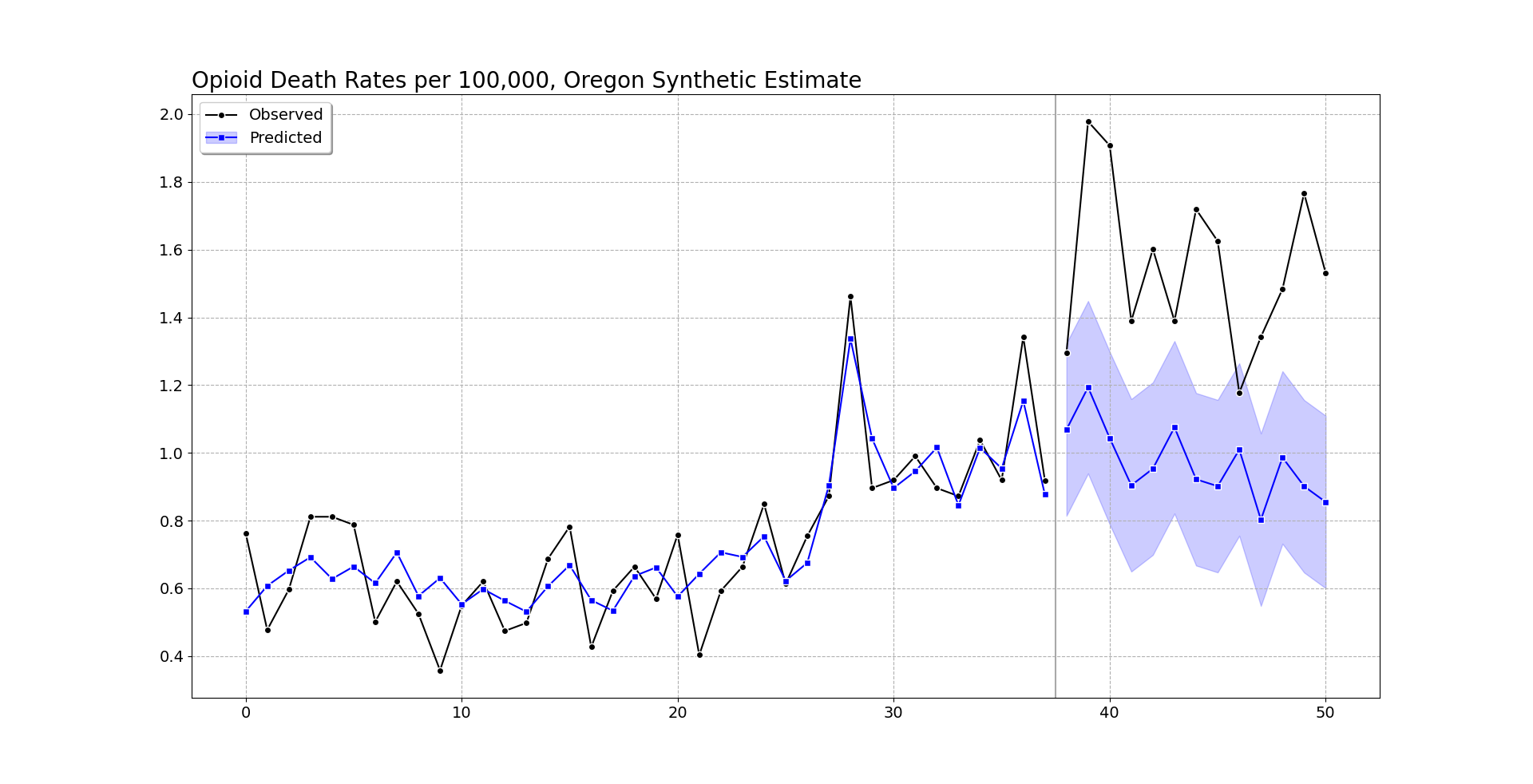
oregon.graph('Opioid Death Rates per 100,000, Oregon Synthetic Estimate')

So you can see the pre-intervention fit is smoother than the monthly data in Oregon, but by eye seems quite reasonable (matches the recent increase and spikes post period 20, starts in Jan-2018, so starting in August-2019). (Perfect fits are good evidence of over-fitting in machine learning.)

Post intervention, after period 37, I do my graph a bit differently. Sometimes people are confused when the intervention starts in the graph, so here I literally split pre/post data lines, so there should be no confusion. I use the conformal inference approach to generate 95% prediction intervals around the counterfactual trend. You can see the counterfactual trend has slightly decreased, whereas Oregon increased and is volatile. Some of the periods are covered by the upper most intervals, but the majority are clearly outside.

Now, besides the fitting function, one point I want to make is people should be looking at cumulative effects, not just instant effects. So Abadie has a global test, using placebos, that looks at the ratio of the pre-fit to post fit (squared errors), then does the placebo p-value based on that stat. This doesn’t have any consideration though for consistent above/below effects.

So pretend the Oregon observed was always within the 95% counterfactual error bar, but was always consistently at the top, around 0.1 increase in overdose deaths. Any single point-wise monthly inference fails to reject the null, but that overall always high pattern is not regular. You want to look at the entire curve, not just a single point. Random data won’t always be high or low, it should fluctuate around the counterfactual estimate.

To do this you look at the cumulative differences between the counterfactual and the observed (and take into account the error distribution for the counterfactuals).

# again default is 95% prediction intervals
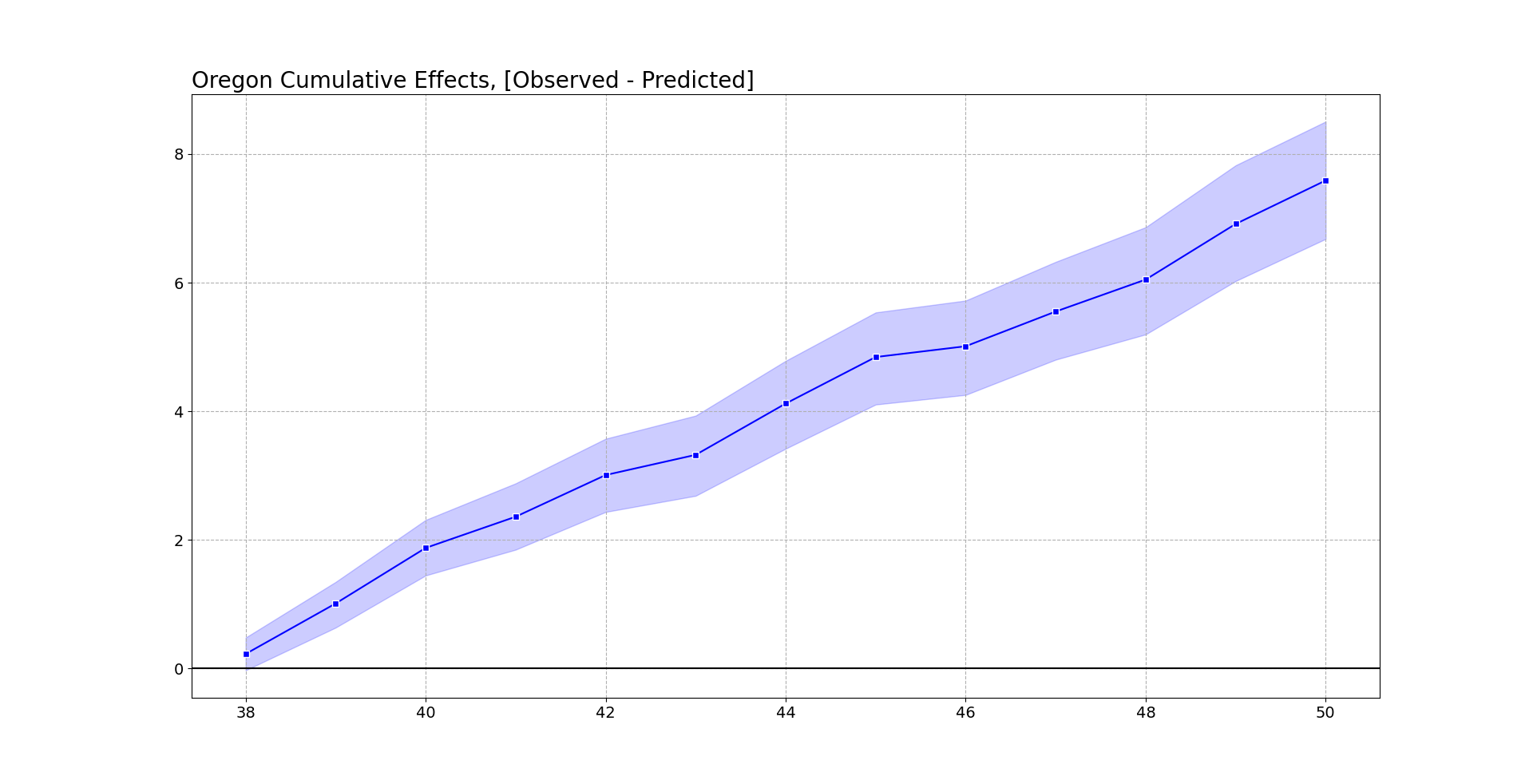
oregon.cumgraph('Oregon Cumulative Effects, [Observed - Predicted]')

Accumulated over time, this is a total of over 7 per 100,000. With Oregon having a population of around 4.1 million, I estimate that the cumulative increased number of overdose deaths is around 290 in Oregon. This is pretty consistent with the results in Spencer (2023) as well (182 increased deaths over fewer months).

To do a global test with this approach, you just look at the very final time period and whether it covers 0. This is what I suggest in-place of the Abadie permutation test, as this has a point estimate and standard error, not just a discrete p-value.

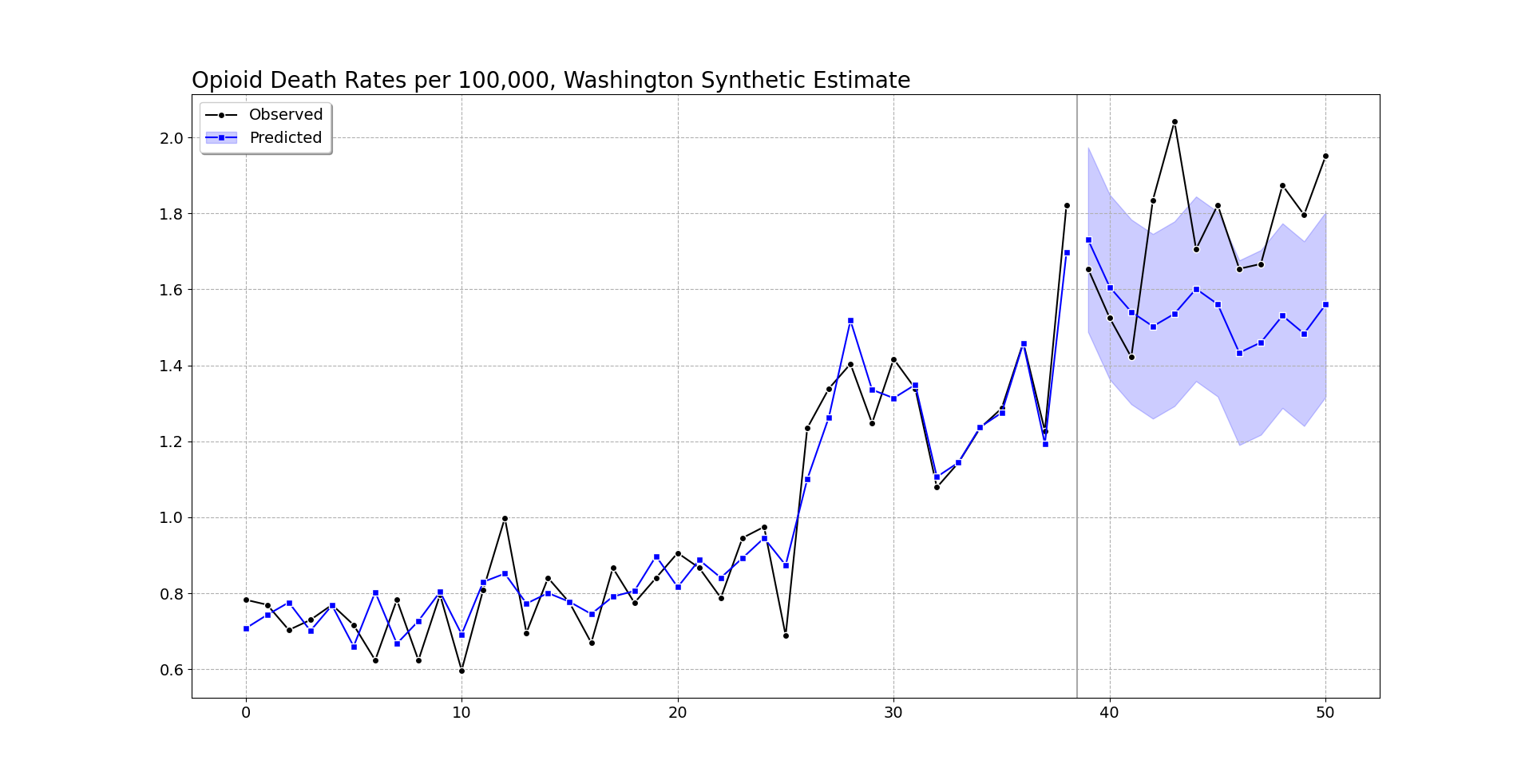
We can do the same analysis for Washington as we did for Oregon. It shows increases, but many of the time periods are covered by the counter-factual 95% prediction interval.

But like I mentioned before, they are consistently high. So when you do the cumulative effects for Washington, they more clearly show increases over time (this data last date is March 2022).

At an accumulated 2.5 per 100,000, with a state population of around 7.7 million, it is around 190 additional overdose deaths in Washington. You can check out the notebook for more stats, Washington has a smaller suggested alpha, so the matched weights have several more states. But the pre-fit is better, and so it has smaller counterfactual intervals. All again good things compared to the default (placebo approach Washington/Oregon will pretty much have the same error distribution, so Washington being less volatile does not matter using that technique).

I get that Abadie is an MIT professor, published a bunch in JASA and well known econ journals, and that his approach is standard in how people do synthetic control analyses. My experience though over time has made me think the default approaches here are not very good – and the placebo approach where you fit many alternative analyses just compounds the issue. (If the fit is bad, it makes the placebo results more variable, causing outlier placebos. People don’t go and do a deep dive of the 49 placebos though to make sure they are well behaved.)

The lasso + conformal approach is how I would approach the problem from my experience fitting machine learning models. I can’t give perfect proof this is a better technique than the SGD + placebo approach by Adadie, but I can release code to at least make it easier for folks to use this technique.

References

  • De Biasi, A., & Circo, G. (2021). Capturing crime at the micro-place: a spatial approach to inform buffer size. Journal of Quantitative Criminology, 37, 393-418.

  • Joshi, S., Rivera, B. D., Cerdá, M., Guy, G. P., Strahan, A., Wheelock, H., & Davis, C. S. (2023). One-year association of drug possession law change with fatal drug overdose in Oregon and Washington. JAMA Psychiatry Online First.

  • Piza, E. L., Wheeler, A. P., Connealy, N. T., & Feng, S. Q. (2020). Crime control effects of a police substation within a business improvement district: A quasi‐experimental synthetic control evaluation. Criminology & Public Policy, 19(2), 653-684.

  • Spencer, N. (2023). Does drug decriminalization increase unintentional drug overdose deaths?: Early evidence from Oregon Measure 110. Journal of Health Economics, 91, 102798.

GUI Tool to download Google Streetview Imagery

For some brief updates, check out the newest post on the CRIME De-Coder blog, PDs should share crime data. I discuss the types of crime data PDs typically share, the benefit to doing so, and how it can be very easy (just upload a static file to a website).

Also wanted to share a new tool I built, a GUI interface to download multiple Google Streetview images given a list of addresses. Here is a video of the tool in action:

I have been asked in the past to do this based on several blog posts I have written (1,2). I get around 200 views of those posts per month, so figured it was worth some time to build something general to share – it is often people in marketing interested in that data.

I am selling the tool for $300. Check out the CRIME De-Coder Store to purchase. It is currently built for Windows, I can build it for Mac if there is demand. (If you have a list and just want me to download the images for you, e.g. you don’t want to sign up for a google API key yourself, just get in touch and I will give a quote based on your total volume.)

If you are wondering where the $300 pricing came in, there is a simple rule that if you can estimate the maximum price someone is willing to buy, divide by half and that is reasonably close to optimal on typical sloping downward demand curves. I had an offer for $600 for this recently, hence I set the price of the tool for $300.

If there is other web-scraping data you are interested, always feel free to get in touch. I can often give quick feedback as to the feasibility and give a quote for the work (as well as detail if what you are asking is even feasible given the data available).

Querying OSM places data in python

For updates on other blogs, we have:

For a quick post here, Simon Willison has a recent post on using duckdb to query OSM data made available by the Overture foundation. I have written in the past scraping places data (gas stations, stores, etc., often used in spatial crime analysis) from Google (or other sources), so this is a potentially free source.

So I was interested to check out the data, it is quite easy to download given the ability to query parquet data files online. Simon in his post said it was taking awhile though, and this example downloading data from Raleigh took around 25 minutes. So no good for a live API, but fine for a batch job.

This python is simple enough to just embed in a blog post:

import duckdb
import pandas as pd
from datetime import datetime
import requests

# setting up in memory duckdb + extensions
db = duckdb.connect()
db.execute("INSTALL spatial")
db.execute("INSTALL httpfs")
db.execute("""LOAD spatial;
LOAD httpfs;
SET s3_region='us-west-2';""")

# Raleigh bound box from ESRI API
ral_esri = "https://maps.wakegov.com/arcgis/rest/services/Jurisdictions/Jurisdictions/MapServer/1/query?where=JURISDICTION+IN+%28%27RALEIGH%27%29&returnExtentOnly=true&outSR=4326&f=json"
bbox = requests.get(ral_esri).json()['extent']

# check out https://overturemaps.org/download/ for new releases
places_url = "s3://overturemaps-us-west-2/release/2023-07-26-alpha.0/theme=places/type=*/*"
query = f"""
SELECT
  *
FROM read_parquet('{places_url}')
WHERE
  bbox.minx > {bbox['xmin']}
  AND bbox.maxx < {bbox['xmax']} 
  AND bbox.miny > {bbox['ymin']} 
  AND bbox.maxy < {bbox['ymax']}
"""

# Took me around 25 minutes
print(datetime.now())
res = pd.read_sql(query,db)
print(datetime.now())

And this currently queries 29k places in Raleigh. Places can have multiple categories, so here I just slice out the main category and check it out:

def extract_main(x):
    return x['main']

res['main_cat'] = res['categories'].apply(extract_main)

res['main_cat'].value_counts().head(30)

And this returns

>>> res['main_cat'].value_counts().head(30)
beauty_salon                         1291
real_estate_agent                     657
landmark_and_historical_building      626
church_cathedral                      567
community_services_non_profits        538
professional_services                 502
real_estate                           452
hospital                              405
automotive_repair                     396
dentist                               350
lawyer                                316
park                                  308
insurance_agency                      298
public_and_government_association     288
spas                                  265
financial_service                     261
gym                                   260
counseling_and_mental_health          256
religious_organization                240
car_dealer                            214
college_university                    185
gas_station                           179
hotel                                 170
contractor                            169
pizza_restaurant                      167
barber                                161
shopping                              160
grocery_store                         160
fast_food_restaurant                  160
school                                158

I can’t say anything about the coverage of this data. Looking nearby my house it appears pretty well filled in. There are additional pieces of info in the OSM data as well, such as a confidence score.

So definately a ton of potential to use that as a nice source for reproducible crime analysis (it probably has the major types of places most people are interested in looking at). But I would do some local checks for your data before wholesale recommending using the open street map data over an official business directory (if available – but that may not include things like ATMs) or Google Places API data (but this is free!)

Downloading Police Employment Trends from the FBI Data Explorer

The other day on the IACA forums, an analyst asked about comparing her agencies per-capita rate for sworn/non-sworn compared to other agencies. This is data available via the FBI’s Crime Data Explorer. Specifically they have released a dataset of employment rates, broken down by various agencies, over time.

The Crime Data Explorer to me is a bit difficult to navigate, so this post is going to show using the API to query the data in python (maybe it is easier to get via direct downloads, I am not sure). So first, go to that link above and sign up for a free API key.

Now, in python, first the API works via asking for a specific agencies ORI, as well as date ranges. (You can do a query for national and overall state as well, but I would rarely want those levels of aggregation.) So first we are just going to grab all of the agencies across 50 states. This runs fairly fast, only takes a few minutes:

import pandas as pd
import requests

key = 'Insert your key here'

state_list = ("AL", "AK", "AZ", "AR", "CA", "CO", "CT", "DE", "FL", "GA",
              "HI", "ID", "IL", "IN", "IA", "KS", "KY", "LA", "ME", "MD",
              "MA", "MI", "MN", "MS", "MO", "MT", "NE", "NV", "NH", "NJ",
              "NM", "NY", "NC", "ND", "OH", "OK", "OR", "PA", "RI",
              "SC","SD","TN","TX","UT","VT","VA","WA","WV","WI","WY","DC")

# Looping over states, getting all of the ORIs
fin_data = []
for s in states:
    url = f'https://api.usa.gov/crime/fbi/cde/agency/byStateAbbr/{s}?API_KEY={key}'
    data = requests.get(url)
    fin_data.append(pd.DataFrame(data.json()))

agency = pd.concat(fin_data,axis=0).reset_index(drop=True)

And the agency dataframe has just a few shy of 19k ORI’s listed. Unfortunately this does not have much else associated with the agencies (such as the most recent population). It would be nice if this list had population counts (so if you just wanted to compare yourself to other similar size agencies), but alas it does not. So the second part here – scraping all 18,000+ agencies, takes a bit (let it run overnight).

# Now grabbing the full employment data
ystart = 1960   # some have data going back to 1960
yend = 2022
emp_data = []

# try/catch, as some of these can fail
for i,o in enumerate(agency['ori']):
    print(f'Getting agency {i+1} out of {agency.shape}')
    url = ('https://api.usa.gov/crime/fbi/cde/pe/agency/'
          f'{o}/byYearRange?from={ystart}&to={yend}&API_KEY={key}')
    try:
        data = requests.get(url)
        emp_data.append(pd.DataFrame(data.json()))
    except:
        print(f'Failed to query {o}')

emp_pd = pd.concat(emp_data).reset_index(drop=True)
emp_pd.to_csv('EmployeePoliceData.csv',index=False)

And that will get you 100% of the employee data on the FBI data explorer, including data for 2022.

To plug my consulting firm here, this is something that takes a bit of work. If you have longer running scraping jobs, I paired this code example down to be quite minimial, but you want to periodically save results and have the code be able to run from the last save point. So if you scrape 1000 agencies, your internet goes out, you don’t want to have to start from 0, you want to start from the last point you left off.

If that is something you need, it makes sense to send me an email to see if I can help. For that and more, check out my website, crimede-coder.com:

Too relaxed? Naive Bayes does not improve recidivism forecasting in the NIJ challenge

So the paper Improving Recidivism Forecasting With a Relaxed Naïve Bayes Classifier (Lee et al., 2023), recently published in Crime & Delinquency, has incorrect results. Note I am not sandbagging on the authors, I reviewed this paper for JQC and Journal of Criminal Justice, so I have given the authors this same feedback already (multiple times!). The authors however did not correct their results, and just journal shopped and published the wrong findings.

I have replication code here to review. (Note I initially made a mistake in my code replication, reversed calculating p(x|y), I calculated p(y|x) by accident, see this older code I shared in my prior reviews, but I was still correct in my assertion that Lee’s results were wrong.)

So the main thing that made me go to this effort, the authors report unbelieveable results. They report Brier Scores for Females (Round 1) of 0.104 and for males 0.159 – these scores blow the competition out of the water. The leaderboard was 0.15 for Females and 0.19 for males. Note how I don’t list to the third decimal – the difference between the teams you needed to go down that low. Lee also reports unbelievably low Brier scores for the alternative logit and random forest models – their results just on their face are not believable.

If the authors really believe their results this kind of sucks for them they did not participate in the NIJ challenge, they would have won more than $150,000! But I am pretty sure they are miscalculating their Brier scores somewhere. My replication code shows them in the same ballpark as everyone else, but they would not have made the leaderboard. Here are my estimates of what their Brier scores should be reported as (the Brier column below in the two tables):

Folks can go and look at their paper and their set of spreadsheets in the supplemental material – I have posted not many more than 50 lines of (non-comment) python code that replicates their regression model coefficients and shows their Brier scores are wrong though. (And subsequently any points Lee et al. 2023 make about fairness are thus wrong as well.)

NIJ probably released papers at some point, but if you want to see other folks discussion, there is Circo & Wheeler (2022) (for mine and Gio’s results for team MCHawks), and Mohler & Porter (2021) for team PASDA.

I may put in the slate sometime to discuss naive Bayes (and other categorical encoding schemes). It is not a bad idea for data with many categories, but for this NIJ data there just isn’t that much to squeeze out of the data. So any future work will be unlikely to dramatically improve upon the competition results (it is difficult to overfit this data). Again given my analysis here, I am pretty sure a valid data analysis (not peeking) at best will “beat” the competition results in the 3rd decimal place (if they can improve at all).

Now part of the authors argument is that this method (relaxed naive Bayes) results in simpler interpretations. Typically people interpret “simple” models in terms of the end results, e.g. having a simple checklist of integer weights. The more I deal with predictive models though, I think this is maybe misguided. You could also interpret “simple” in terms of the code used for how someone derived the weights (and evaluated the final metrics). This is important when auditing code that others have written, as you will ultimately take the code and apply it to your data.

I think this “simpler to estimate the same results” is probably more important for scientists and outside groups wanting to verify the integrity of any particular machine learning model than “simple end result weights”. Otherwise scientists can make up results and say my method is better. Which is simpler I suppose, but misses the boat a bit in terms of why we want simple models to begin with.

References

Some notes on synthetic control and Hogan/Kaplan

This will be a long one, but I have some notes on synthetic control and the back-and-forth between two groups. So first if you aren’t familiar, Tom Hogan published an article on how the progressive District Attorney (DA) in Philadelphia, Larry Krasner, in which Hogan estimates that Krasner’s time in office contributed to a large increase in the number of homicides. The control homicides are estimated using a statistical technique called synthetic control, in which you derive estimates of the trend in homicides to compare Philly to based on a weighted average of comparison cities.

Kaplan and colleagues (KNS from here on) then published a critique of various methods Hogan used to come up with his estimate. KNS provided estimates using different data and a different method to derive the weights, showing that Philadelphia did not have increased homicides post Krasner being elected. For reference:

Part of the reason I am writing this is if people care enough, you could probably make similar back and forths on every synth paper. There are many researcher degrees of freedom in the process, and in turn you can make reasonable choices that lead to different results.

I think it is worthwhile digging into those in more detail though. For a summary of the method notes I discuss for this particular back and forth:

  • Researchers determine the treatment estimate they want (counts vs rates) – solvers misbehaving is not a reason to change your treatment effect of interest
  • The default synth estimator when matching on counts and pop can have some likely unintended side-effects (NYC pretty much has to be one of the donor cities in this dataset)
  • Covariate balancing is probably a red-herring (so the data issues Hogan critiques in response to KNS are mostly immaterial)

In my original draft I had a note that this post would not be in favor of Hogan nor KNS, but in reviewing the sources more closely, nothing I say here conflicts with KNS (and I will bring a few more critiques of Hogan’s estimates that KNS do not mention). So I can’t argue much with KNS’s headline that Hogan’s estimates are fatally flawed.

An overview of synthetic control estimates

To back up and give an overview of what synth is for general readers, imagine we have a hypothetical city A with homicide counts 10 15 30, where the 30 is after a new DA has been elected. Is the 30 more homicides than you would have expected absent that new DA? To answer this, we need to estimate a counterfactual trend – what the homicide count would have been in a hypothetical world in which a new progressive DA was not elected. You can see the city homicides increased the prior two years, from 10 to 15, so you may say “ok, I expected it to continue to increase at the same linear trend”, in which case you would have expected it to increase to 20. So the counterfactual estimated increase in that scenario is observed - counterfactual, here 30 - 20 = 10, an estimated increase of 10 homicides that can be causally attributed to the progressive DA.

Social scientists tend to not prefer to just extrapolate prior trends from the same location into the future. There could be widespread changes that occur everywhere that caused the increase in city A. If homicide rates accelerated in every city in the country, even those without a new progressive DA, it is likely something else is causing those increases. So say we compare city A to city B, and city B had a homicide count trend during the same time period 10 15 35. Before the new DA in city A, cities A/B had the same pre-trend (both 10 15). The post time period City B increased to 35 homicides. So if using City B as the counterfactual estimate, we have the progressive DA reduced 5 homicides, again observed - counterfactual = 30 - 35 = -5. So even though city A increased, it increased less than we expected based on the comparison city B.

Note that this is not a hypothetical concern, it is pretty basic one that you should always be concerned about when examining macro level crime data. There has been national level homicide increases over the time period when Krasner has been in office (Yim et al, 2020, and see this blog post for updates. U.S. city homicide rates tend to be very correlated with each other (McDowall & Loftin, 2009).

So even though Philly has increased in homicide counts/rates when Krasner has been in office, the question is are those increases higher or lower than we would expect. That is where the synthetic control method comes in, we don’t have a perfect city B to compare to Philadelphia, so we create our own “synthetic” counter-factual, based on a weighted average of many different comparison cities.

To make the example simple, imagine we have two potential control cities and homicide trends, city C1 0 30 20, and city C2 20 0 30. Neither looks like a good comparison to city A that has trends 10 15 30. But if we do a weighted average of C1 and C2, with the weights 0.5 for each city, when combined they are a perfect match for the two pre-treatment periods:

C0  C1 Average cityA
 0  20   10     10
30   0   15     15
20  30   25     30

This is what the synthetic control estimator does, although instead of giving equal weights it determines the optimal weights to match the pre-treatment time period given many potential donors. In real data for example C0 and C1 may be given weights of 0.2 and 0.8 to give the correct balance based on the prior to treatment time periods.

The fundamental problem with synth

The rub with estimating the synth weights is that there is no one correct way to estimate the weights – you have more numbers to estimate than data points. In the Hogan paper, he has 5 pre time periods, 2010-2014, and he has 82 potential donors (99 other of the largest cities in the US minus 17 progressive prosecutors). So you need to learn 82 numbers (the weights) based on 5 data points.


Side note: you can also consider matching on covariates additional data points, although I will go into more detail on how matching on covariates is potentially a red-herring. Hogan I think uses an additional 5*3=15 time varying points (pop, cleared homicide, homicide clearance rates), and maybe 3 additional time invariant (median income, 1 prosecutor categorization, and homicides again!). So maybe has 5 + 15 + 3 = 23 data points to match on (so same fundamental problem, 23 numbers to learn 82 weights). I am just going to quote the full passage on Hogan (2022a) here where he discusses covariate matching:

The number of homicides per year is the dependent variable. The challenge with this synthetic control model is to use variables that both produce parallel trends in the pre-period and are sufficiently robust to power the post-period results. The model that ultimately delivered the best fit for the data has population, cleared homicide cases, and homicide clearance rates as regular predictors. Median household income is passed in as the first special predictor. The categorization of the prosecutors and the number of homicides are used as additional special predictors. For homicides, the raw values are passed into the model. Abadie (2021) notes that the underlying permutation distribution is designed to work with raw data; using log values, rates, or other scaling techniques may invalidate results.

This is the reason why replication code is necessary – it is very difficult for me to translate this to what Hogan actually did. “Special” predictors here are code words for the R synth package for time-invariant predictors. (I don’t know based on verbal descriptions how Hogan used time-invariant for the prosecutor categorization for example, just treats it as a dummy variable?) Also only using median income – was this the only covariate, or did he do a bunch of models and choose the one with the “best” fit (it seems maybe he did do a search, but doesn’t describe the search, only the end selected result).

I don’t know what Hogan did or did not do to fit his models. The solution isn’t to have people like me and KNS guess or have Hogan just do a better job verbally describing what he did, it is to release the code so it is transparent for everyone to see what he did.


So how do we estimate those 82 weights? Well, we typically have restrictions on the potential weights – such as the weights need to be positive numbers, and the weights should sum to 1. These are for a mix of technical and theoretical reasons (having the weights not be too large can reduce the variance of the estimator is a technical reason, we don’t want negative weights as we don’t think there are bizzaro comparison areas that have opposite world trends is a theoretical one).

These are reasonable but ultimately arbitrary – there are many different ways to accomplish this weight estimation. Hogan (2022a) uses the R synth package, KNS use a newer method also advocated by Abadie & L’Hour (2021) (very similar, but tries to match to the closest single city, instead of weights for multiple cities). Abadie (2021) lists probably over a dozen different procedures researchers have suggested over the past decade to estimate the synth weights.

The reason I bring this up is because when you have a problem with 82 parameters and 5 data points, the problem isn’t “what estimator provides good fit to in-sample data” – you should be able to figure out a estimator that accomplishes good in-sample fit. The issue is whether that estimator is any good out-of-sample.

Rates vs Counts

So besides the estimator used, you can break down 3 different arbitrary researcher data decisions that likely impact the final inferences:

  • outcome variable (homicide counts vs homicide per capita rates)
  • pre-intervention time periods (Hogan uses 2010-2014, KNS go back to 2000)
  • covariates used to match on

Lets start with the outcome variable question, counts vs rates. So first, as quoted above, Hogan cites Abadie (2021) for saying you should prefer counts to rates, “Abadie (2021) notes that the underlying permutation distribution is designed to work with raw data; using log values, rates, or other scaling techniques may invalidate results.”

This has it backwards though – the researcher chooses whether it makes sense to estimate treatment effects on the count scale vs rates. You don’t goal switch your outcome because you think the computer can’t give you a good estimate for one outcome. So imagine I show you a single city over time:

        Y0    Y1    Y2
Count   10    15    20
Pop   1000  1500  2000

You can see although the counts are increasing, the rate is consistent over the time period. There are times I think counts make more sense than rates (such as cost-benefit analysis), but probably in this scenario the researcher would want to look at rates (as the shifting denominator is a simple explanation causing the increase in the counts).

Hogan (2022b) is correct in saying that the population is not shifting over time in Philly very much, but this isn’t a reason to prefer counts. It suggests the estimator should not make a difference when using counts vs rates, which just points to the problematic findings in KNS (that making different decisions results in different inferences).

Now onto the point that Abadie (2021) says using rates is wrong for the permutation distribution – I don’t understand what Hogan is talking about here. You can read Abadie (2021) for yourself if you want. I don’t see anything about the permutation inferences and rates.

So maybe Hogan mis-cited and meant another Abadie paper – Abadie himself uses rates for various projects (he uses per-capita rates in the 2021 cited paper, Abadie et al., (2010) uses rates for another example), so I don’t think Abadie thinks rates are intrinsically problematic! Let me know if there is some other paper I am unaware of. I honestly can’t steelman any reasonable source where Hogan (2022a) came up with the idea that counts are good and rates are bad though.

Again, even if they were, it is not a reason to prefer counts vs rates, you would change your estimator to give you the treatment effect estimate you wanted.


Side note: Where I thought the idea with the problem with rates was going (before digging in and not finding any Abadie work actually saying there is issues with rates), was increased variance estimates with homicide data. So Hogan (2022a) estimates for the synth weights Detroit (0.468), New Orleans (NO) (0.334), and New York City (NYC) (0.198), here are those cities homicide rates graphed (spreadsheet with data + notes on sources).

You can see NO’s rate is very volatile, so is not a great choice for a matched estimator if using rates. (I have NO as an example in Wheeler & Kovandzic (2018), that much variance though is fairly normal for high crime not too large cities in the US, see Baltimore for example for even more volatility.) I could forsee someone wanting to make a weighted synth estimator for rates, either make the estimator a population weighted average, or penalize the variance for small rates. Maybe you can trick microsynth to do a pop weighted average out of the box (Robbins et al., 2017).


To discuss the Hogan results specifically, I suspect for example NYC being a control city with high weight in the Hogan paper, which superficially may seem good (both large cities on the east coast), actually isn’t a very good control area considering the differences in homicide trends (either rates or counts) over time. (I am also not so sure about describing NYC and New Orlean’s as “post-industrial” by Hogan (2022a) either. I mean this is true to the extent that all urban areas in the US are basically post-industrial, but they are not rust belt cities like Detroit.)

Here is for reference counts of homicides in Philly, Detroit, New Orleans, and NYC going back further in time:

NYC is such a crazy drop in the 90s, lets use the post 2000 data that KNS used to zoom in on the graph.

I think KNS are reasonable here to use 2000 as a cut point – it is more empirical based (post crime drop), in which you could argue the 90’s are a “structural break”, and that homicides settled down in most cities around 2000 (but still typically had a gradual decline). Given the strong national homicide trends though across cities (here is an example I use for class, superimposing Dallas/NYC/Chicago), I think using even back to the 60’s is easily defensible (moreso than limiting to post 2010).

It depends on how strict you want to be whether you consider these 3 cities “good” matches for the counts post 2010 in Hogan’s data. Detroit seems a good match on the levels and ok match on trends. NO is ok match on trends. NYC and NO balance each other in terms of matching levels, NYC has steeper declines though (even during the 2010-2014 period).

The last graph though shows where the estimated increases from Hogan (2022a) come from. Philly went up and those 3 other cities went down from 2015-2018 (and had small upward bumps in 2019).

Final point in this section, careful what you wish for with sparse weights and sum to 1 in the synth estimate. What this means in practice when using counts and matching on pop size, is that you need lines that are above and below Philly on those dimensions. So to get a good match on Pop, it needs to select at least one of NYC/LA/Houston (Chicago was eliminated due to having a progressive prosecutor). To get a good match on homicide counts, it also has to pick at least one city with more homicides per year as well, which limits the options to New York and Detroit (LA/Houston have lower overall homicide counts to Philly).

You can’t do the default Abadie approach for NYC for example (matching on counts and pop) – it will always have a bad fit when using comparison cities in the US as the donor pool. You either need to allow the weights to sum to larger than 1, or the lasso approach with an intercept is another option (so you only match on trend, not levels).

Because matching on trends is what matters for proper identification in this design, not levels, this is all sorts of problematic with the data at hand. (This is also a potential problem with the KNS estimator as well. KNS note though they don’t trust their estimate offhand, their reasonable point is that small changes in the design result in totally different inferences.)

Covariates and Out of Sample Estimates

For sake of argument, say I said Hogan (2022a) is bunk, because it did not match on “per-capita annual number of cheese-steaks consumed”. Even though on its face this covariate is non-sense, how do you know it is non-sense? In the synthetic control approach, there is no empirical, falsifiable way to know whether an covariate is a correct one to match on. There is no way to know that median income is better than cheese-steaks.

If you wish for more relevant examples, Philly has obviously more issues with street consumption of opioids than Detroit/NOLA/NYC, which others have shown relationships to homicide and has been getting worse over the time Krasner has been in office (Rosenfeld et al., 2023). (Or more simply social disorganization is the more common way that criminologists think about demographic trends and crime.)

This uncertainty in “what demographics to control for” is ok though, because matching on covariates is neither necessary nor sufficient to ensure you have estimated a good counter-factual trend. Abadie in his writings intended for covariates to be more like fuzzy guide-rails – they are qualitative things that you think the comparison areas should be similar on.

Because there are effectively an infinite pool of potential covariates to match on, I prefer the approach of simply limiting the donor pool apriori – Hogan limiting to large cities is on its face reasonable. Including other covariates is not necessary, and does not make the synth estimate more or less robust. Whether KNS used good or bad data for covariates is entirely a red-herring as to the quality of the final synth estimate.


Side note: I don’t doubt that Hogan got advice to not share data and code. It is certainly not normative in criminology to do this. It creates a bizarre situation though, in which someone can try to replicate Hogan by collating original sources, and then Hogan always comes back and says “no, the data you have are wrong” or “the approach you did is not exactly replicating my work”.

I get that collating data takes a long time, and people want to protect their ability to publish in the future. (Or maybe just limit their exposure to their work being criticized.) It is blatantly antithetical to verifying the scientific integrity of peoples work though.

Even if Hogan is correct though in the covariates that KNS used are wrong, it is mostly immaterial to the quality of the synth estimates. It is a waste of time for outside researchers to even bother to replicate Hogan’s covariates he used.


So I used the idea of empirical/falsifiable – can anything associated with synth be falsifiable? Why yes it can – the typical approach is to do some type of leave-one-out estimate. It may seem odd because synth estimates an underlying match to a temporal trend in the treated location, but there is nothing temporal about the synth estimate. You could jumble up the years in the pre-treatment sample and still would estimate the same weights.

Because of this, you can leave-a-year-out in the pre-treatment time period, run your synth algorithm, and then predict that left out year. A good synth estimator will be close to the observed value for the out of sample estimates in the pre-treated time period (and as a side bonus, you can use that variance estimate to estimate the error in the post-trend years).

That is a relatively simple way to determine if the Hogan 5 year vs KNS 15 year time periods are “better” synth controls (my money is on KNS for that one). Because Hogan has not released data/code, I am not going to go through that trouble. As I said in the side note earlier, I could try to do that, and Hogan could simply come back and say “you didn’t do it right”.

This also would settle the issue of “over-fit”. You actually cannot just look at the synth weights, and say that if they are sparse they are not over-fit and if not sparse are over-fit. So for reference, you have in Hogan essentially fitting 82 weights based on 5 datapoints, and he identified a fit with 3 non-zero weights. Flip this around, and say I had 5 data points and fit a model with 3 parameters, it is easily possible that the 3 parameter model in that scenario is overfit.

Simultaneously, it is not necessary to have a sparse weights matrix. Several alternative methods to estimate synth will not have sparse weights (I am pretty sure Xu (2017) will not have sparse weights, and microsynth estimates are not sparse either for just two examples). Because US cities have such clear national level trends, a good estimator in this scenario may have many tiny weights (where good here is low bias and variance out of sample). Abadie thinks sparse weights are good to make the model more interpretable (and prevent poor extrapolation), but that doesn’t mean by default a not sparse solution is bad.

To be clear, KNS admit that their alternative results are maybe not trustworthy due to not sparse weights, but this doesn’t imply Hogan’s original estimates are themselves “OK”. I think maybe a correct approach with city level homicide rate data will have non-sparse weights, due to the national level homicide trend that is common across many cities.

Wrapping Up

If Crim and Public Policy still did response pieces maybe I would go through that trouble of doing the cross validation and making a different estimator (although I would unlikely be an invited commenter). But wanted to at least do this write up, as like I said at the start I think you could do this type of critique with the majority of synth papers in criminology being published at the moment.

To just give my generic (hopefully practical) advice to future crim work:

  • don’t worry about matching on covariates, worry about having a long pre-period
  • the default methods you need to worry about if you have enough “comparable” units – this is in terms of levels, not just trends
  • the only way to know the quality of the modeling procedure in synth is to do out of sample estimates.

Bullet points 2/3 are perhaps not practical – most criminologists won’t have the capability to modify the optimization procedure to the situation at hand (I spent a few days trying without much luck to do my penalized variants suggested, sharing so others can try out themselves, I need to move onto other projects!) Also takes a bit of custom coding to do the out of sample estimates.

For many realistic situations though, I think criminologists need to go beyond just point and clicking in software, especially for this overdetermined system of equations synthetic control scenario. I did a prior blog post on how I think many state level synth designs are effectively underpowered (and suggested using lasso estimates with conformal intervals). I think that is a better default in this scenario as well compared to the typical synth estimators, although you have plenty of choices.

Again I had initially written this as trying to two side the argument, and not being for or against either set of researchers. But sitting down and really reading all the sources and arguments, KNS are correct in their critique. Hogan is essentially hiding behind not releasing data and code, and in that scenario can make an endless set of (ultimately trivial) responses of anyone who publishes a replication/critique.

Even if some of the the numbers KNS collated are wrong, it does not make Hogan’s estimates right.

References

Youtube interview with Manny San Pedro on Crime Analysis and Data Science

I recently did an interview with Manny San Pedro on his YouTube channel, All About Analysis. We discuss various data science projects I conducted while either working as an analyst, or in a researcher/collaborator capacity with different police departments:

Here is an annotated breakdown of the discussion, as well as links to various resources I discuss in the interview. This is not a replacement for listening to the video, but is an easier set of notes to link to more material on what particular item I am discussing.

0:00 – 1:40, Intro

For rundown of my career, went to do PhD in Albany (08-15). During that time period I worked as a crime analyst at Troy, NY, as well as a research analyst for my advisor (Rob Worden) at the Finn Institute. My research focused on quant projects with police departments (predictive modeling and operations research). In 2019 went to the private sector, and now work as an end-to-end data scientist in the healthcare sector working with insurance claims.

You can check out my academic and my data science CV on my about page.

I discuss the workshop I did at the IACA conference in 2017 on temporal analysis in Excel.

Long story short, don’t use percent change, use other metrics and line graphs.

7:30 – 13:10, Patrol Beat Optimization

I have the paper and code available to replicate my work with Carrollton PD on patrol beat optimization with workload equality constraints.

For analysts looking to teach themselves linear programming, I suggest Hillier’s book. I also give examples on linear programming on this blog.

It is different than statistical analysis, but I believe has as much applicability to crime analysis as your more typical statistical analysis.

13:10 – 14:15, Million Dollar Hotspots

There are hotspots of crime that are so concentrated, the expected labor cost reduction in having officers assigned full time likely offsets the position. E.g. if you spend a million dollars in labor addressing crime at that location, and having a full time officer reduces crime by 20%, the return on investment for hotspots breaks even with paying the officers salary.

I call these Million dollar hotspots.

14:15 – 28:25, Prioritizing individuals in a group violence intervention

Here I discuss my work on social network algorithms to prioritize individuals to spread the message in a focussed deterrence intervention. This is opposite how many people view “spreading” in a network, I identify something good I want to spread, and seed the network in a way to optimize that spread:

I also have a primer on SNA, which discusses how crime analysts typically define nodes and edges using administrative data.

Listen to the interview as I discuss more general advice – in SNA it matters what you want to accomplish in the end as to how you would define the network. So I discuss how you may want to define edges via victimization to prevent retaliatory violence (I think that would make sense for violence interupptors to be proactive for example).

I also give an example of how detective case allocation may make sense to base on SNA – detectives have background with an individuals network (e.g. have a rapport with a family based on prior cases worked).

28:25 – 33:15, Be proactive as an analyst and learn to code

Here Manny asked the question of how do analysts prevent their role being turned into more administrative role (just get requests and run simple reports). I think the solution to this (not just in crime analysis, but also being an analyst in the private sector) is to be proactive. You shouldn’t wait for someone to ask you for specific information, you need to be defining your own role and conducting analysis on your own.

He also asked about crime analysis being under-used in policing. I think being stronger at computer coding opens up so many opportunities that learning python, R, SQL, is the area I would like to see stronger skills across the industry. And this is a good career investment as it translates to private sector roles.

33:15 – 37:00, How ChatGPT can be used by crime analysts

I discuss how ChatGPT may be used by crime analysis to summarize qualitative incident data and help inform . (Check out this example by Andreas Varotsis for an example.)

To be clear, I think this is possible, but the tech I don’t think is quite up to that standard yet. Also do not submit LEO sensitive data to OpenAI!

Also always feel free to reach out if you want to nerd out on similar crime analysis questions!