New preprint: The accuracy of the violent offender identification directive (VOID) tool to predict future gun violence

I have a new preprint out, The accuracy of the violent offender identification directive (VOID) tool to predict future gun violence. This is work with Rob Worden and Jasmine Silver from our time at the Finn Institute. Below is the abstract:

We evaluate the Violent Offender Identification Directive (VOID) tool, a risk assessment instrument implemented within a police department to prospectively identify offenders likely to be involved with future gun violence. The tool uses a variety of static measures of prior criminal history that are readily available in police records management systems. The VOID tool is assessed for predictive accuracy by taking a historical sample and calculating scores for over 200,000 individuals known to the police at the end of 2012, and predicting 103 individuals involved with gun violence (either as a shooter or a victim) during 2013. Despite weights for the instrument being determined in an ad-hoc manner by crime analysts, the VOID tool does very well in predicting involvement with gun violence compared to an optimized logistic regression and generalized boosted models. We discuss theoretical reasons why such ad-hoc instruments are likely to perform well in identifying chronic offenders for all police departments.

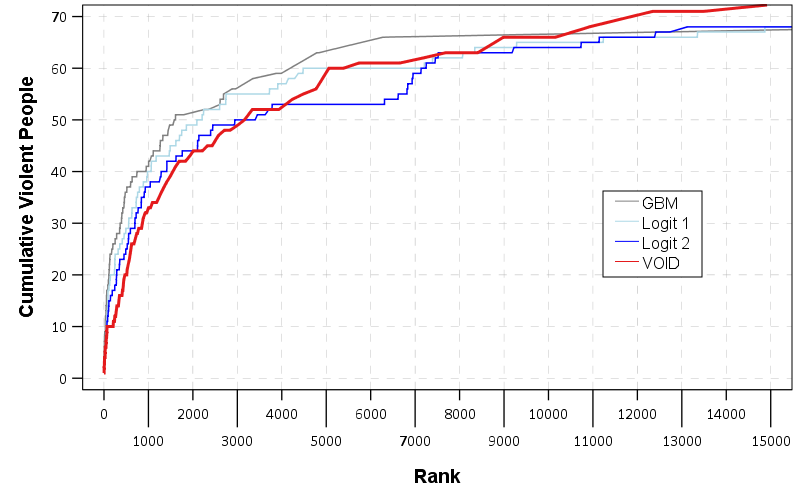
There were just slightly over 100 violent gun offenders we were trying to pick out of over 200,000. The VOID tool did really well! Here is a graph comparing how many of those offenders VOID captured compared to a generalized boosted model (GBM), and two different logistic regression equations.

I have some of my thoughts in this article as to why a simple tool does just as well as more complicated regression and machine learning techniques, which is a common finding in recidivism studies as well. My elevator pitch for why that is is because most offenders are generalists, and for example you can basically swap prior arrests for robbery with prior arrests for motor vehicle theft — they both provide essentially the same signal for future potential criminality. See also discussion of this on Dan Simpson’s post on the Stat Modeling, Causal Inference and Social Science blog, which in turn makes me think the idea behind simple models can be readily applied to many decision points in the criminal justice field.

The simple takeaway from this for crime analysts making chronic offender lists is that don’t let the perfect be the enemy of the good. Analysts can likely create an ad-hoc weighting to prioritize chronic offenders and it will do quite well compared to fancier models.

I will be presenting this work at the ACJS conference in New Orleans on Saturday 2/17/18. It is a great session, with YongJei Lee, Jerry Ratcliffe, Bryanna Fox, and Stacy Sechrist (see session 384 in the ACJS program), so stop on by. If you want to catch up with me in New Orleans just send me an email. And as always if you have feedback on the draft I am all ears.

New preprint: A Gentle Introduction to Creating Optimal Patrol Areas

I have a new preprint posted, A Gentle Introduction to Creating Optimal Patrol Areas. Below is the abstract:

Models to create optimal patrol areas have been in existence for over 45 years, but police departments still regularly construct patrol areas in an ad-hoc fashion. This essay walks the reader through formulating an integer linear program to create a set number of patrol areas that have near equal call load and that are contiguous using simple examples. Then the technique is illustrated using a case study in Carrollton, TX. Creating optimal patrol areas not only have the potential to improve efficiency in response times, but can also encourage hot spots policing. Applications of linear programming can additionally be applied to a wide variety of problems within criminal justice agencies, and this essay provides a gentle introduction to understanding the mathematical notation of linear programming.

In this paper I introduce a very simple integer linear program to create patrol beats, and then build up the complexity into the fuller p-median problem with additional constraints applicable to making patrol areas. The constraints on making the call load equal that I introduce in the paper are the only real novel aspect of the paper (although no doubt someone else has done something similar previously), but I was a bit frustrated reading other linear programs to create patrol areas. Most work was concentrated in operations research journals and in my opinion was totally inaccessible to a typical crime analyst. So I frame the paper as an introduction to integer linear programs, walk though some simplified examples, and then apply that full model in Carrollton. I also provide an extensive walkthrough using the python program PuLP so others can replicate the work with their own data in the supplementary materials.

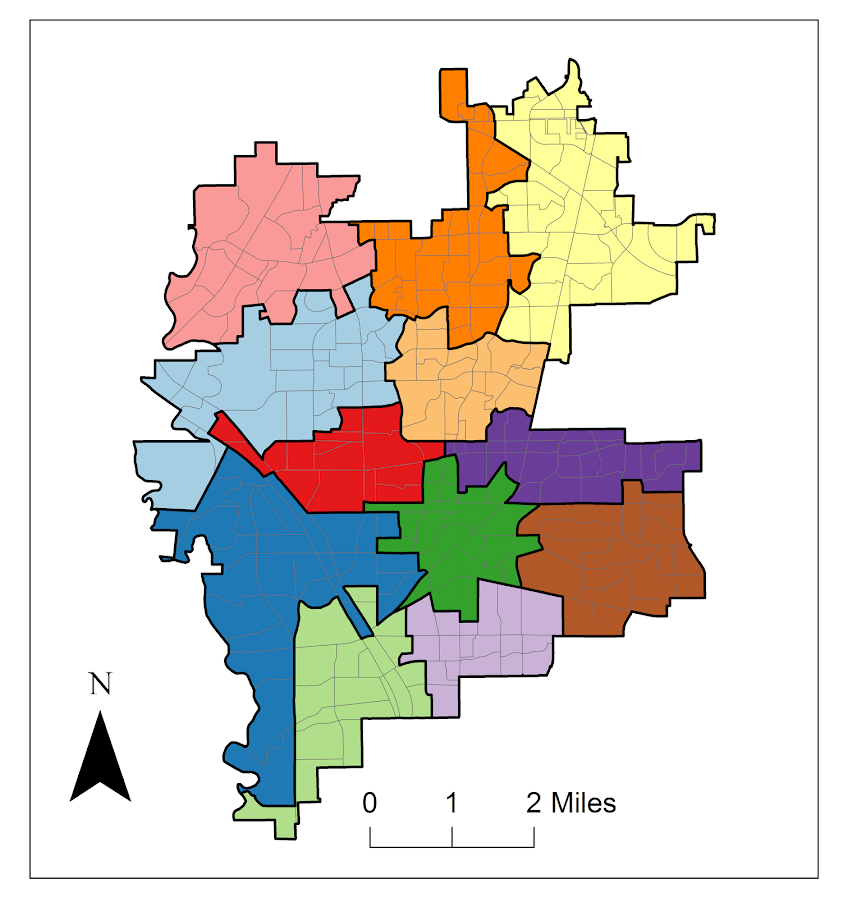
Here is my end example map of the optimal patrol areas in Carrollton.


You can see that my areas are not as nice and convex, although most applications of correcting for that introduce multiple objective functions and/or non-linear functions, making the problem much harder to estimate in practice (which was part of my pet-peeve with prior publications – none provided code to estimate the models described, with the exception of some of the work of Kevin Curtin).

Part of the reason I tackled this problem is that it comes up all the time on the IACA list-serve — how to make new patrol areas. If you are an analyst interested in applying this in your jurisdiction and would like help always feel free to contact me.

New course in the spring – Crime Science

This spring I will be teaching a new graduate level course, Crime Science. A better name for the course would be evidence based policing tactics to reduce crime — but that name is too long!

Here you can see the current syllabus. I also have a page for the course, which I will update with more material over the winter break.

Given my background it has a heavy focus on hot spots policing (different tactics at hot spots, time spent at hot spots, crackdowns vs long term). But the class covers other policing strategies; such as chronic offenders, the focused deterrence gang model, and CPTED. We also discuss the use of technology in policing (e.g. CCTV, license plate readers, body-worn-cameras).

I will weave in ethical discussions throughout the course, but I reserved the last class to specifically talk about predictive policing strategies. In particular the two main concerns are increasing disproportionate minority contact through prediction, and privacy concerns with police collecting various pieces of information.

So take my course!

Monitoring homicide trends paper published

My paper, Monitoring Volatile Homicide Trends Across U.S. Cities (with coauthor Tom Kovandzic) has just been published online in Homicide Studies. Unfortunately, Homicide Studies does not give me a link to share a free PDF like other publishers, but you can either grab the pre-print on SSRN or always just email me for a copy of the paper.

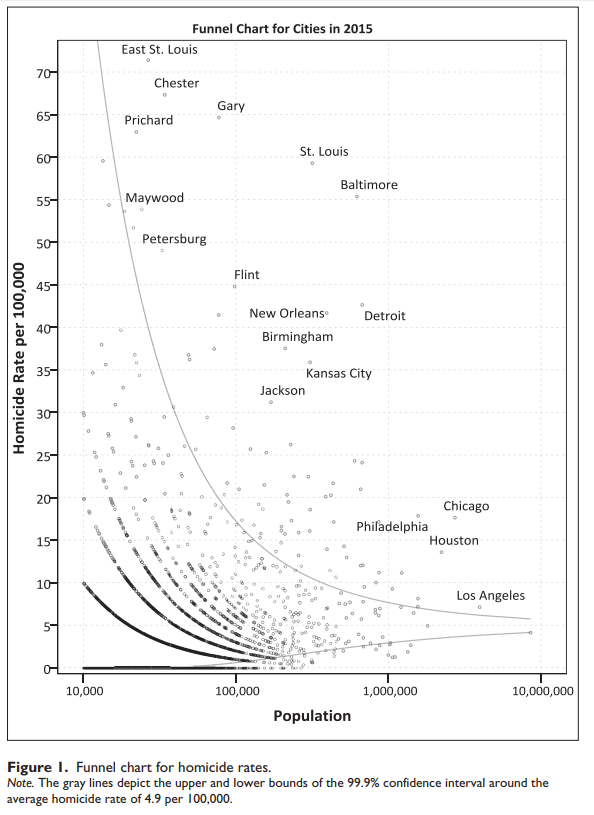
They made me convert all of the charts to grey scale :(. Here is an example of the funnel chart for homicide rates in 2015.

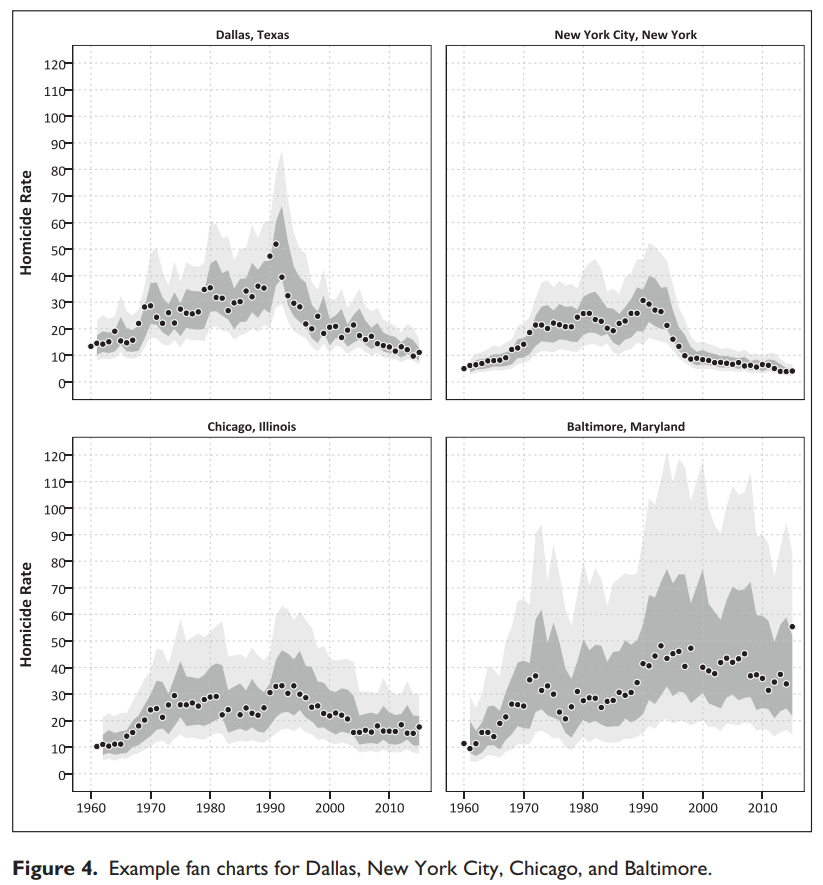
And here are example fan charts I generated for a few different cities.

As always if you have feedback or suggestions let me know! I posted all of the code to replicate the analysis at this link. The prediction intervals can definately be improved both in coverage and in making their length smaller, so I hope to see other researchers tackling this as well.

Graphs and interrupted time series analysis – trends in major crimes in Baltimore

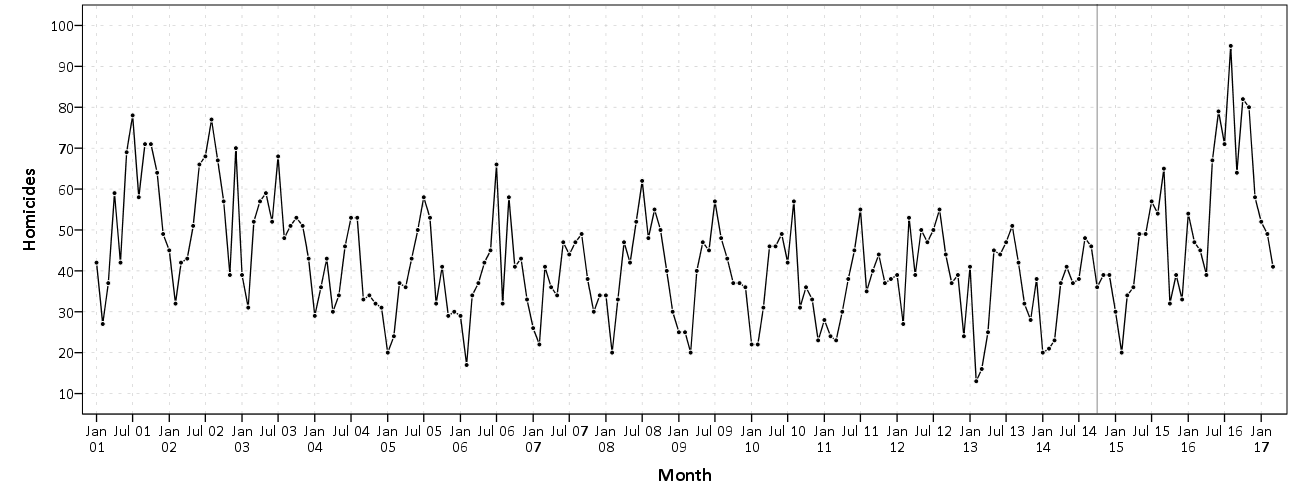
Pete Moskos’s blog is one I regularly read, and a recent post he pointed out how major crimes (aggravated assaults, robberies, homicides, and shootings) have been increasing in Baltimore post the riot on 4/27/15. He provides a series of different graphs using moving averages to illustrate the rise, see below for his initial attempt:

He also has an interrupted moving average plot that shows the break more clearly – but honestly I don’t understand his description, so I’m not sure how he created it.

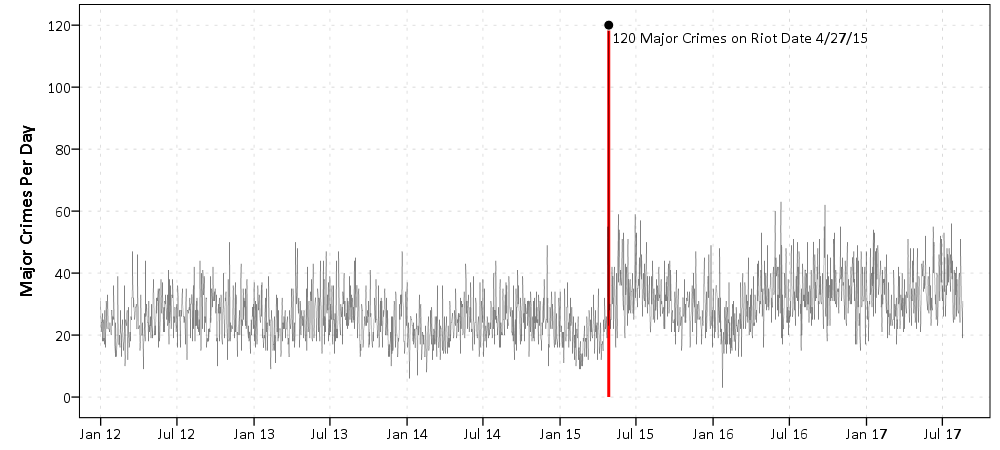
I recreated his initial line plot using SPSS, and I think a line plot with a guideline shows the bump post riot pretty clearly.

The bars in Pete’s graph are not the easiest way to visualize the trend. Here making the line thin and lighter grey also helps.

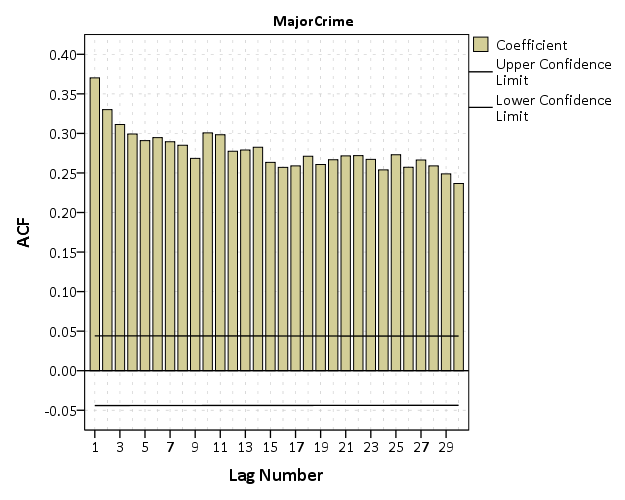
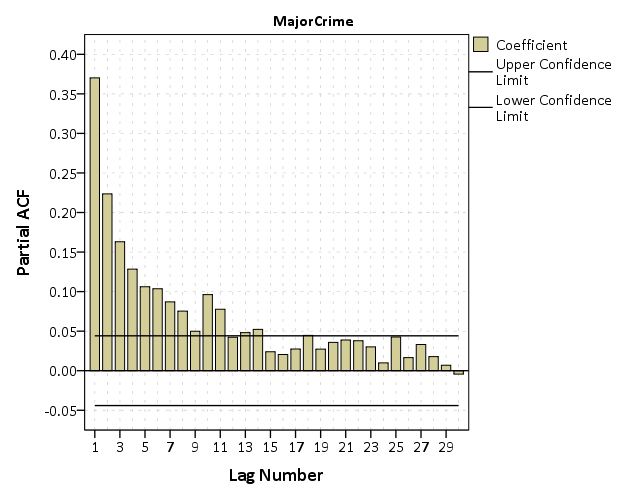
The way to analyze this data is using an interrupted time series analysis. I am not going to go through all of those details, but for those interested I would suggest picking up David McDowell’s little green book, Interrupted Time Series Analysis, for a walkthrough. One of the first steps though is to figure out the ARIMA structure, which you do by examining the auto-correlation function. Here is that ACF for this crime data.

You can see that it is positive and stays quite consistent. This is indicative of a moving average model. It does not show the geometric decay of an auto-regressive process, nor is the autocorrelation anywhere near 1, which you would expect for an integrated process. Also the partial autocorrelation plot shows the geometric decay, which is again consistent with a moving average model. See my note at the bottom, how this interpretation was wrong! (Via David Greenberg sent me a note.)

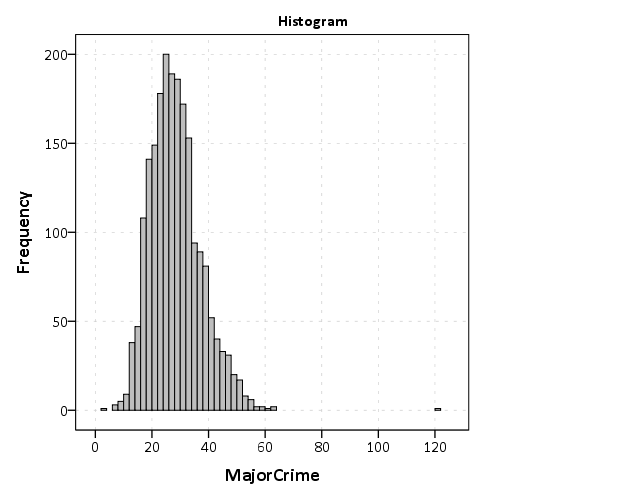
Although it is typical to analyze crime counts as a Poisson model, I often like to use linear models. Coefficients are much easier to interpret. Here the distribution of the counts is high enough I am ok using a linear interrupted ARIMA model.

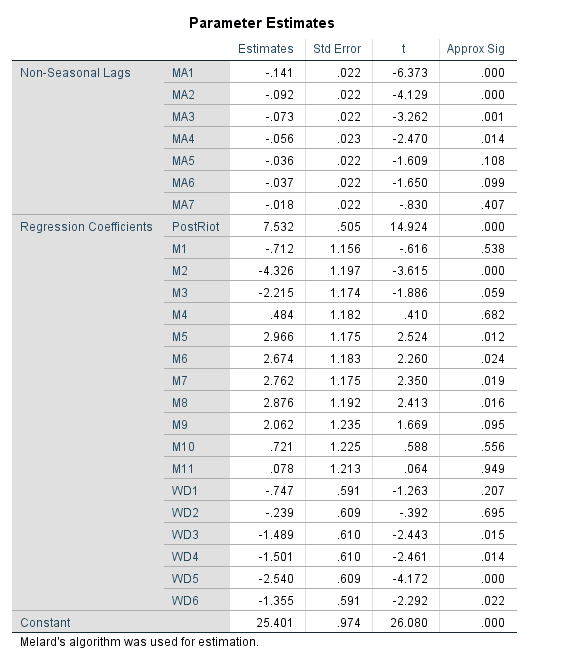
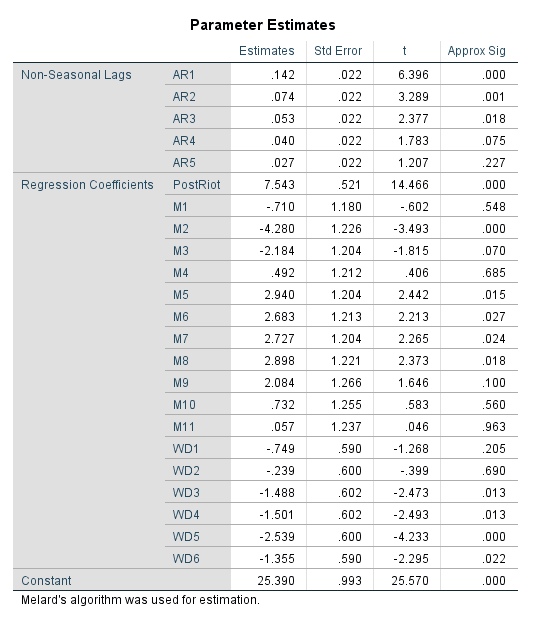
So I estimated an interrupted time series model. I include a dummy variable term that equals 1 as of 4/27/15 and after, and equals 0 before. That variable is labeled PostRiot. I then have dummy variables for each month of the year (M1, M2, …., M11) and days of the week (D1,D2,….D6). The ARIMA model I estimate then is (0,0,7), with a constant. Here is that estimate.

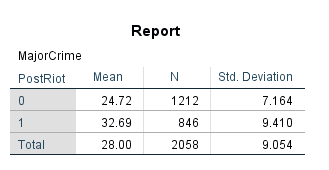
So we get an estimate that post riot, major crimes have increased by around 7.5 per day. This is pretty similar to what you get when you just look at the daily mean pre-post riot, so it isn’t really any weird artifact of my modeling strategy. Pre-riot it is under 25 per day, and post it is over 32 per day.

This result is pretty robust across different model specifications. Dropping the constant term results in a larger post riot estimate (over 10). Inclusion of fewer or more MA terms (as well as seasonal MA terms for 7 days) does not change the estimate. Inclusion of the monthly or day of week dummy variables does not make a difference in the estimate. Changing the outlier value on 4/27/15 to a lower value (here I used the pre-mean, 24) does reduce the estimate slightly, but only to 7.2.

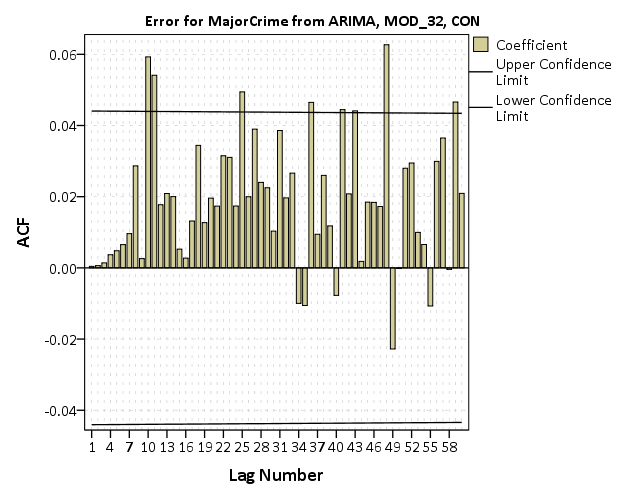
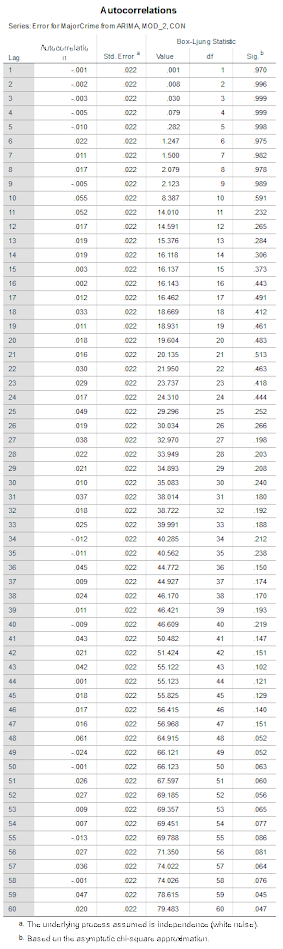
There is a bit of residual autocorrelation I was never able to get rid of, but it is fairly small, with the highest autocorrelation of only about 0.06.

Here is the SPSS code to reproduce the Baltimore graphs and ARIMA analysis.

As a note, while Pete believes this is a result of depolicing (i.e. Baltimore officers being less proactive) the evidence for that hypothesis is not necessarily confirmed by this analysis. See Stephen Morgan’s analysis on crime and arrests, although I think proactive street stops should likely also be included in such an analysis.


This Baltimore data just shows a bump up in the series, but investigating homicides in Chicago (here at the monthly level) it looks to me like an upward trend post the McDonald shooting. This graph is at the monthly level.

I have some other work on Chicago homicide geographic patterns going back quite a long time I can hopefully share soon!

I will need to update the Baltimore analysis to look at just homicides as well. Pete shows a similar bump in his charts when just examining homicides.

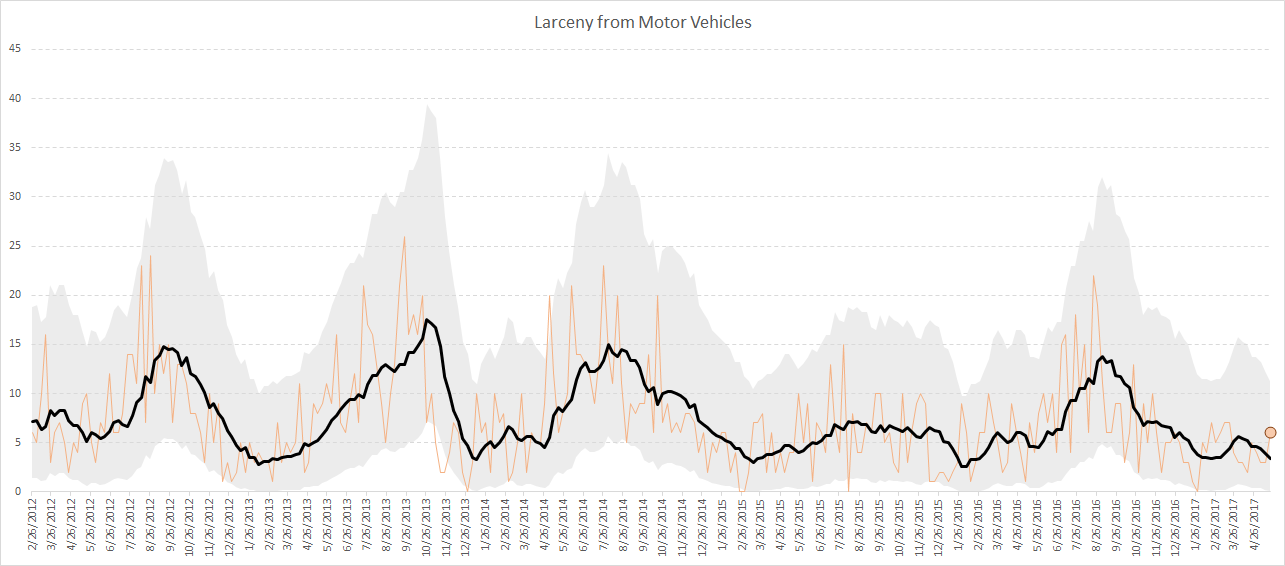
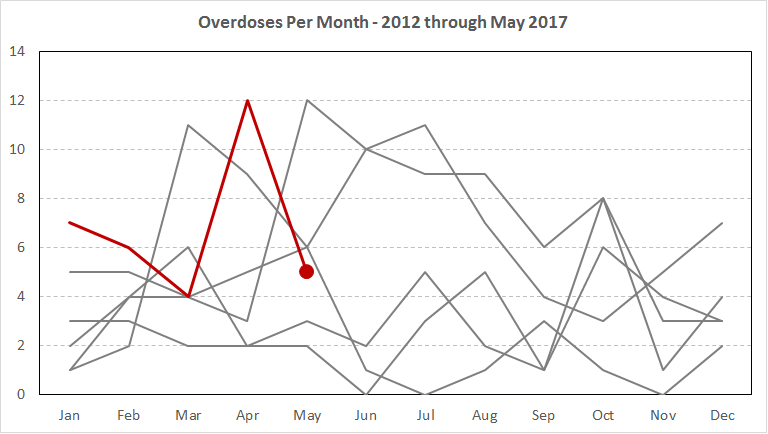
For additional resources for folks interested in examining crime over time, I would suggest checking out my article, Monitoring volatile homicide trends across U.S. cities, as well as Tables and Graphs for Monitoring Crime Patterns. I’m doing a workshop at the upcoming International Association for Crime Analysts conference on how to recreate such graphs in Excel.


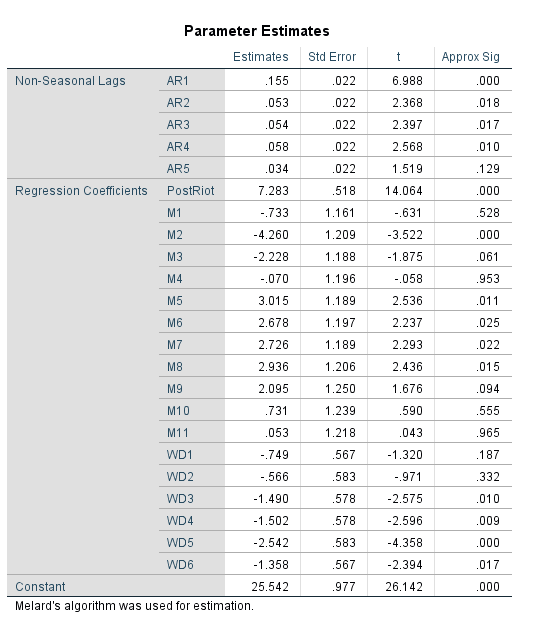
David Greenberg sent me an email  to note my interpretation of the ACF plots was wrong – and that a moving average process should only have a spike, and not show the slow decay. He is right, and so I updated the interrupted ARIMA models to include higher order AR terms instead of MA terms. The final model I settled on was (5,0,0) — I kept adding higher order AR terms until the AR coefficients were not statistically significant. For these models I still included a constant.

For the model that includes the outlier riot count, it results in an estimate that the riot increased these crimes by 7.5 per day, with a standard error of 0.5

This model has no residual auto-correlation until you get up to very high lags. Here is a table of the Box-Ljung stats for up to 60 lags.

Estimating the same ARIMA model with the outlier value changed to 24, the post riot estimate is still over 7.

Subsequently the post-riot increase estimate is pretty robust across these different ARIMA model settings. The lowest estimate I was able to get was a post mean increase of 5 when not including an intercept and not including the outlier crime counts on the riot date. So I think this result holds up pretty well to a bit of scrutiny.

IACA Conference 2017 workshop: Monitoring temporal crime trends for outliers (Excel)

This fall at the International Association of Crime Analysts conference I am doing a workshop, Monitoring temporal crime trends for outliers: A workshop using Excel. If you can’t wait (or are not going) I have all my materials already prepared, which you can download here. That includes a walkthrough of my talk/tutorial, as well as a finished Excel workbook. It is basically a workshop to go with my paper, Tables and graphs for monitoring temporal crime trends: Translating theory into practical crime analysis advice.

For some preview, I will show how to make a weekly smoothed chart with error bands:

As well as a monthly seasonal chart:

I use Excel not because I think it is the best tool, but mainly because I think it is the most popular among crime analysts. In the end I just care about getting the job done! (Although I’ve given reasons why I think Excel is more painful than any statistical program.) Even though it is harder to make small multiple charts in Excel, I show how to make these charts using pivot tables and filters, so watching them auto-update when you update the filter is pretty cool.

For those with SPSS I have already illustrated how to make similar charts in SPSS here. You could of course replicate that in R or Stata or whatever if you wanted.

I am on the preliminary schedule currently for Tuesday, September 12th at 13:30 to 14:45. I will be in New Orleans on the 11th, 12th and 13th, so if you want to meet always feel free to send an email to set up a time.

SPSS Statistics for Data Analysis and Visualization – book chapter on Geospatial Analytics

A book I made contributions to, SPSS Statistics for Data Analysis and Visualization, is currently out. Keith and Jesus are the main authors of the book, but I contributed one chapter and Jon Peck contributed a few.

The book is a guided tour through many of the advanced statistical procedures and data visualizations in SPSS. Jon also contributed a few chapters towards using syntax, python, and using extension commands. It is a very friendly walkthrough, and we have all contributed data files for you to be able to follow along through the chapters.

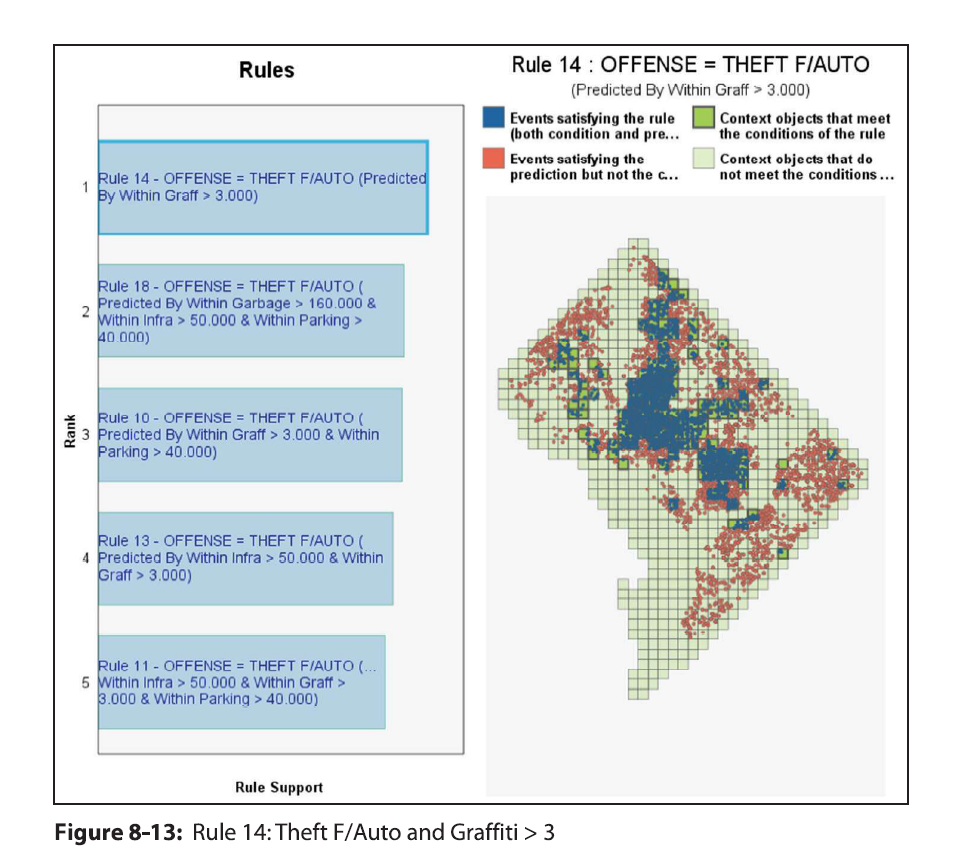
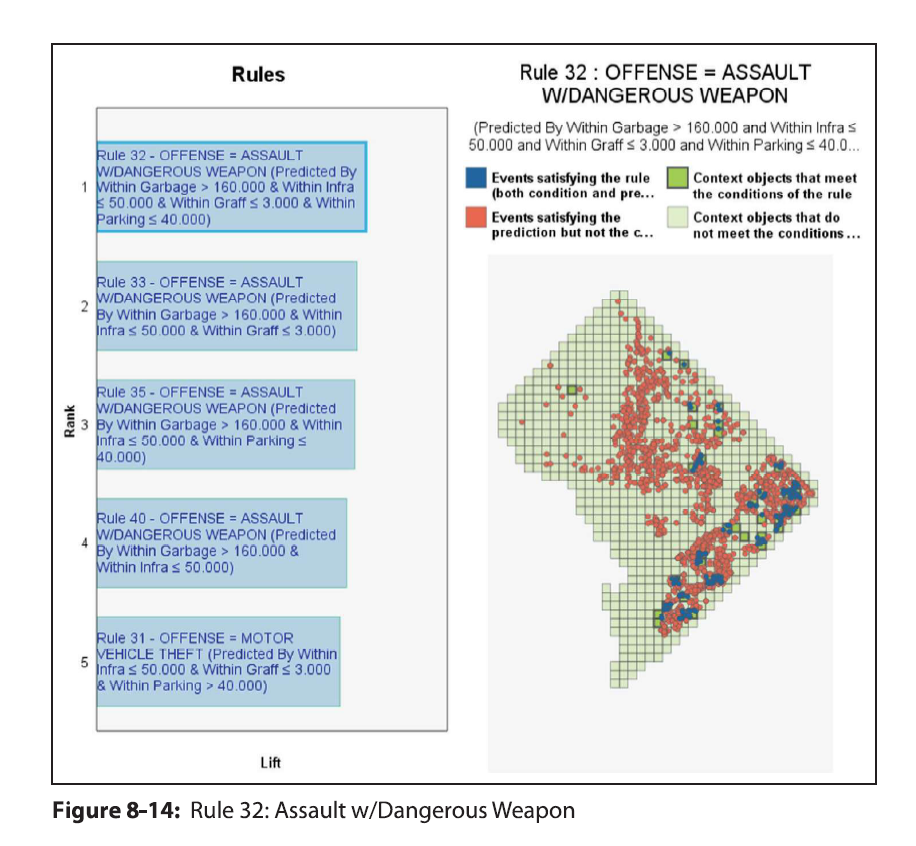
So there is alot of content, but I wanted to give a more specific details on my chapter, as I think they will be of greater interest to crime analysts and criminologists. I provide two case studies, one of using geospatial association rules to identify areas of high crime plus high 311 disorder complaints in DC (using data from my dissertation). The second I give an example of spatio-temporal forecasting of ShotSpotter data at the weekly level in DC using both prior shootings as well as other prior Part 1 crimes.

Geospatial Association Rules

The geospatial association rules is a technique for high dimensional contingency tables to find particular combinations among categories that are more prevalent. I show examples of finding that thefts from motor vehicles tend to be associated in places nearby graffiti incidents.

And that assaults tend to be around locations with more garbage complaints (and as you can see each has a very different spatial patterning).

I consider this to be a useful exploratory data analysis type technique. It is very similar in application to conjunctive analysis, that has prior very similar crime mapping applications in risk terrain modeling (see Caplan et al., 2017).

Spatio-Temporal Prediction

The second example case study is forecasting weekly shootings in fairly small areas (500 meter grid cells) using ShotSpotter data in DC. I also use the prior weeks reported Part 1 crime types (Assault, Burglary, Robbery, etc.), so it is similar to the leading indicators forecasting model advocated by Wilpen Gorr and colleagues. I show that prior shootings predict future shootings up to 5 lags prior (so over a month), and that the prior crimes do have an effect on future shootings (e.g. robberies in the prior week contribute to more shootings in the subsequent week).

If you have questions about the analyses, or are a crime analyst and want to apply similar techniques to your data always feel free to send me an email.

Identifying near repeat crime strings in R or Python

People in criminology should be familiar with repeats or near-repeats for crimes such as robbery, burglaries, or shootings. An additional neat application of this idea though is to pull out strings of incidents that are within particular distance and time thresholds. See this example analysis by Haberman and Ratcliffe, The Predictive Policing Challenges of Near Repeat Armed Street Robberies. This is particularly useful to an analyst interested in crime linkage — to see if those particular strings of incidents are likely to be committed by the same offender.

Here I will show how to pluck out those near-repeat strings in R or Python. The general idea is to transform the incidents into a network, where two incidents are connected only if they meet the distance and time requirements. Then you can identify the connected components of the graph, and those are your strings of near-repeat events.

To follow along, here is the data and the code used in the analysis. I will be showing this on an example set of thefts from motor vehicles (aka burglaries from motor vehicles) in Dallas in 2015. In the end I take two different approaches to this problem — in R the solution will only work for smaller datasets (say n~5000 or less), but the python code should scale to much larger datasets.

Near-repeat strings in R

The approach I take in R does the steps as follows:

  1. compute the distance matrix for the spatial coordinates
  2. convert this matrix to a set of 0’s and 1’s, 1’s correspond to if the distance is below the user specified distance threshold (call it S)
  3. compute the distance matrix for the times
  4. convert this matrix to a set of 0’1 and 1’s, 1’s correspond to if the distance is below the user specified time threshold (call it T)
  5. use element-wise multiplication on the S and T matrices, call the result A, then set the diagonal of A to zero
  6. A is now an adjacency matrix, which can be converted into a network
  7. extract the connected components of that network

So here is an example of reading in the thefts from motor vehicle data, and defining my function, NearStrings, to grab the strings of incidents. Note you need to have the igraph R library installed for this code to work.

library(igraph)

MyDir <- "C:\\Users\\axw161530\\Dropbox\\Documents\\BLOG\\SourceNearRepeats"
setwd(MyDir)

BMV <- read.csv(file="TheftFromMV.csv",header=TRUE)
summary(BMV)

#make a function
NearStrings <- function(data,id,x,y,time,DistThresh,TimeThresh){
    library(igraph) #need igraph to identify connected components
    MyData <- data
    SpatDist <- as.matrix(dist(MyData[,c(x,y)])) < DistThresh  #1's for if under distance
    TimeDist <-  as.matrix(dist(MyData[,time])) < TimeThresh #1's for if under time
    AdjMat <- SpatDist * TimeDist #checking for both under distance and under time
    diag(AdjMat) <- 0 #set the diagonal to zero
    row.names(AdjMat) <- MyData[,id] #these are used as labels in igraph
    colnames(AdjMat) <- MyData[,id] #ditto with row.names
    G <- graph_from_adjacency_matrix(AdjMat, mode="undirected") #mode should not matter
    CompInfo <- components(G) #assigning the connected components
    return(data.frame(CompId=CompInfo$membership,CompNum=CompInfo$csize[CompInfo$membership]))
}

So here is a quick example run on the first ten records. Note I have a field that is named DateInt in the csv, which is just the integer number of days since the first of the year. In R though if the dates are actual date objects you can submit them to the dist function though as well.

#Quick example with the first ten records
BMVSub <- BMV[1:10,]
ExpStrings <- NearStrings(data=BMVSub,id='incidentnu',x='xcoordinat',y='ycoordinat',time='DateInt',DistThresh=30000,TimeThresh=3)
ExpStrings

So here we can see this prints out:

> ExpStrings
            CompId CompNum
000036-2015      1       3
000113-2015      2       4
000192-2015      2       4
000251-2015      1       3
000360-2015      2       4
000367-2015      3       1
000373-2015      4       2
000378-2015      4       2
000463-2015      2       4
000488-2015      1       3

The CompId field is a unique Id for every string of events. The CompNum field states how many events are within the string. So we have one string of events that contains 4 records in this subset.

Now this R function comes with a big caveat, it will not work on large datasets. I’d say your pushing it with 10,000 incidents. The issue is holding the distance matrices in memory. But if you can hold the matrices in memory this will still run quite fast. For 5,000 incidents it takes around ~15 seconds on my machine.

#Second example alittle larger, with the first 5000 records
BMVSub2 <- BMV[1:5000,]
BigStrings <- NearStrings(data=BMVSub2,id='incidentnu',x='xcoordinat',y='ycoordinat',time='DateInt',DistThresh=1000,TimeThresh=3)

The elements in the returned matrix will line up with the original dataset, so you can simply add those fields in, and do subsequent analysis (such as exporting back into a mapping program and digging into the strings).

#Add them into the original dataset
BMVSub2$CompId <- BigStrings$CompId
BMVSub2$CompNum <- BigStrings$CompNum   

You can check out the number of chains of different sizes by using aggregate and table.

#Number of chains
table(aggregate(CompNum ~ CompId, data=BigStrings, FUN=max)$CompNum)

This prints out:

   1    2    3    4    5    6    7    9 
3814  405   77   27    3    1    1    1

So out of our first 1,000 incidents, using the distance threshold of 1,000 feet and the time threshold of 3 days, we have 3,814 isolates. Thefts from vehicles with no other incidents nearby. We have 405 chains of 2 incidents, 77 chains of 3 incidents, etc. You can pull out the 9 incident like this since there is only one chain that long:

#Look up the 9 incident
BMVSub2[BMVSub2$CompNum == 9,]  

Which prints out here:

> BMVSub2[BMVSub2$CompNum == 9,]
      incidentnu xcoordinat ycoordinat StartDate DateInt CompId CompNum
2094 043983-2015    2460500    7001459 2/25/2015      56   1842       9
2131 044632-2015    2460648    7000542 2/26/2015      57   1842       9
2156 045220-2015    2461162    7000079 2/27/2015      58   1842       9
2158 045382-2015    2460154    7000995 2/27/2015      58   1842       9
2210 046560-2015    2460985    7000089  3/1/2015      60   1842       9
2211 046566-2015    2460452    7001457  3/1/2015      60   1842       9
2260 047544-2015    2460154    7000995  3/2/2015      61   1842       9
2296 047904-2015    2460452    7001457  3/3/2015      62   1842       9
2337 048691-2015    2460794    7000298  3/4/2015      63   1842       9

Or you can look up a particular chain by its uniqueid. Here is an example of a 4-chain set.

> #Looking up a particular incident chains
> BMVSub2[BMVSub2$CompId == 4321,]
      incidentnu xcoordinat ycoordinat StartDate DateInt CompId CompNum
4987 108182-2015    2510037    6969603 5/14/2015     134   4321       4
4988 108183-2015    2510037    6969603 5/14/2015     134   4321       4
4989 108184-2015    2510037    6969603 5/14/2015     134   4321       4
4993 108249-2015    2510037    6969603 5/14/2015     134   4321       4

Again, only use this function on smaller crime datasets.

Near-repeat strings in Python

Here I show how to go about a similar process in Python, but the algorithm does not calculate the whole distance matrix at once, so can handle much larger datasets. An additional note is that I exploit the fact that this list is sorted by dates. This makes it so I do not have to calculate all pair-wise distances – I will basically only compare distances within a moving window under the time threshold – this makes it easily scale to much larger datasets.

So first I use the csv python library to read in the data and assign it to a list with a set of nested tuples. Also you will need the networkx library to extract the connected components later on.

import networkx as nx
import csv
import math

dir = r'C:\Users\axw161530\Dropbox\Documents\BLOG\SourceNearRepeats'

BMV_tup = []
with open(dir + r'\TheftFromMV.csv') as f:
    z = csv.reader(f)
    for row in z:
        BMV_tup.append(tuple(row))

The BMV_tup list has the column headers, so I extract that row and then figure out where all the elements I need, such as the XY coordinates, the unique Id’s, and the time column are located in the nested tuples.

colnames = BMV_tup.pop(0)
print colnames
print BMV_tup[0:10]

xInd = colnames.index('xcoordinat')
yInd = colnames.index('ycoordinat')
dInd = colnames.index('DateInt')
IdInd = colnames.index('incidentnu')

Now the magic — here is my function to extract those near-repeat strings. Again, the list needs to be sorted by dates for this to work.

def NearStrings(CrimeData,idCol,xCol,yCol,tCol,DistThresh,TimeThresh):
    G = nx.Graph()
    n = len(CrimeData)
    for i in range(n):
        for j in range(i+1,n):
            if (float(CrimeData[j][tCol]) - float(CrimeData[i][tCol])) > TimeThresh:
                break
            else:
                xD = math.pow(float(CrimeData[j][xCol]) - float(CrimeData[i][xCol]),2)
                yD = math.pow(float(CrimeData[j][yCol]) - float(CrimeData[i][yCol]),2)
                d = math.sqrt(xD + yD)
                if d < DistThresh:
                    G.add_edge(CrimeData[j][idCol],CrimeData[i][idCol])
    comp = nx.connected_components(G)
    finList = []
    compId = 0
    for i in comp:
        compId += 1
        for j in i:
            finList.append((j,compId))
    return finList

We can then do the same test on the first ten records that we did in R.

print NearStrings(CrimeData=BMV_tup[0:10],idCol=IdInd,xCol=xInd,yCol=yInd,tCol=dInd,DistThresh=30000,TimeThresh=3)

And this subsequently prints out:

[('000378-2015', 1), ('000373-2015', 1), ('000113-2015', 2), ('000463-2015', 2), ('000192-2015', 2), ('000360-2015', 2), 
('000251-2015', 3), ('000488-2015', 3), ('000036-2015', 3)]

The component Id’s wont be in the same order as in R, but you can see we have the same results. E.g. the string with three incidents contains the Id’s 000251, 000488, and 000036. Note that this approach does not return isolates — incidents which have no nearby space-time examples.

Running this on the full dataset of over 14,000 incidents takes around 20 seconds on my machine.

BigResults = NearStrings(CrimeData=BMV_tup,idCol=IdInd,xCol=xInd,yCol=yInd,tCol=dInd,DistThresh=1000,TimeThresh=3)

And that should scale pretty well for really big cities and really big datasets. I will let someone who knows R better than me figure out workarounds to scale to bigger datasets in that language.

Using the exact reference distribution for small sample Benford tests

I recently came across another potential application related to my testing small samples for randomness in day-of-week patterns. Testing digit frequencies for Benford’s law basically works on the same principles as my day-of-week bins. So here I will show an example in R.

First, download my functions here and save them to your local machine. The only library dependency for this code to work is the partitions library, so install that. Now for the code, you can source my functions and load the partitions library. The second part of the code shows how to generate the null distribution for Benford’s digits — the idea is that lower digits will have a higher probability of occurring.

#Example using small sample tests for Benfords law
library(partitions)
#switch to wherever you downloaded the functions to your local machine
source("C:\\Users\\axw161530\\Dropbox\\PublicCode_Git\\ExactDist\\Exact_Dist.R")

f <- 1:9
p_fd <- log10(1 + (1/f)) #first digit probabilities

And so if you do cbind(f,p_fd) at the console it prints out:

      f       p_fd
 [1,] 1 0.30103000
 [2,] 2 0.17609126
 [3,] 3 0.12493874
 [4,] 4 0.09691001
 [5,] 5 0.07918125
 [6,] 6 0.06694679
 [7,] 7 0.05799195
 [8,] 8 0.05115252
 [9,] 9 0.04575749

So we expect over 30% of the first digits to be 1’s, just under 18% to be 2’s, etc. To show how we can use this for small samples, I take an example of fraudulent checks from Mark Nigrini’s book, Digital Analysis using Benford’s law (I can’t find a google books link to this older one — it is the 2000 one published by Global Audit Press I took the numbers from).

#check data from Nigrini page 84
checks <- c(1927.48,
           27902.31,
           86241.90,
           72117.46,
           81321.75,
           97473.96,
           93249.11,
           89658.17,
           87776.89,
           92105.83,
           79949.16,
           87602.93,
           96879.27,
           91806.47,
           84991.67,
           90831.83,
           93766.67,
           88338.72,
           94639.49,
           83709.28,
           96412.21,
           88432.86,
           71552.16)

#extracting the first digits
fd <- substr(format(checks,trim=TRUE),1,1)
tot <- table(factor(fd, levels=paste(f)))

Now Nigrini says this is too small of a sample to perform actual statistical tests, so he just looks at it at face value. If you print out the tot object you will see that we have mostly upper values in the series, three 7’s, nine 8’s, and nine 9’s.

> tot

1 2 3 4 5 6 7 8 9 
1 1 0 0 0 0 3 9 9 

Now, my work on small samples for day-of-week crime sprees showed that given reasonably expected offender behavior, you only needed as few as 8 crimes to have pretty good power to test for randomness in the series. So given that I would expect the check series of 23 is not totally impossible to detect significant deviations from the null Benford’s distribution. But first we need to figure out if I can actually generate the exact distribution for 23 digits in 9 bins in memory.

m <- length(tot)
n <- sum(tot)
choose(m+n-1,m-1)

Which prints out just under 8 million, [1] 7888725. So we should be able to hold that in memory.

So now comes the actual test, and as my comment says this takes a few minutes for R to figure out — so feel free to go get a coffee.

#Takes a few minutes
resG <- SmallSampTest(d=tot,p=p_fd,type="G")
resG

Here I use the likelihood ratio G test instead of the more usual Chi-Square test, as I found that always had more power in the day-of-the-week paper. From our print out of resG we subsequently get:

> resG
Small Sample Test Object 
Test Type is G 
Statistic is 73.4505062784174 
p-value is:  2.319579e-14  
Data are:  1 1 0 0 0 0 3 9 9 
Null probabilities are:  0.3 0.18 0.12 0.097 0.079 0.067 0.058 0.051 0.046 
Total permutations are:  7888725 

So since the p-value is incredibly small, we would reject the null that the first digit distribution of these checks follows Benford’s law. So on its face we can reject the null with this dataset, but it would take more investigation in general to give recommendations of how many observations in practice you would need before you can reasonably even use the small sample distribution. I have code that allows you to test the power given an alternative distribution in those functions, so for a quick and quite conservative test I see the power if the alternative distribution were uniform instead of Benford’s with our 23 observations. The idea is if people make up numbers uniformly instead of according to Benford’s law, what is the probability we would catch them with 23 observations. I label this as conservative, because I doubt people even do a good job of making them uniform — most number fudging cases will be much more egregious I imagine.

#power under null of equal probability
p_alt <- rep(1/9,9)
PowUni <- PowAlt(SST=resG,p_alt=p_alt) #again takes a few minutes
PowUni

So based on that we get a power estimate of:

> PowUni
Power for Small Sample Test 
Test statistic is: G  
Power is: 0.5276224  
Null is: 0.3 0.18 0.12 0.097 0.079 0.067 0.058 0.051 0.046  
Alt is: 0.11 0.11 0.11 0.11 0.11 0.11 0.11 0.11 0.11  
Alpha is: 0.05  
Number of Bins: 9  
Number of Observations: 23 

So the power is only 0.5 in this example. Since you want to aim for power of ~0.80 or higher, this shows that you are not likely to uncover more subtle patterns of manipulation with this few of observations. The power would go up for more realistic deviations though — so I don’t think this idea is totally dead in the water.

If you are like me and find it annoying to wait for a few minutes to get the results, a quick and dirty way to make the test go faster is to collapse bins that have zero observations. So our first digits have zero observations in the 3,4,5 and 6 bins. So I collapse those and do the test with only 6 bins, which makes the results return in around ~10 seconds instead of a few minutes. Note that collapsing bins is better suited for the G or the Chi-Square test, because the KS test or Kuiper’s test the order of the observations matter.

#Smaller subset
UpProb <- c(p_fd[c(1,2,7,8,9)],sum(p_fd[c(3,4,5,6)]))
ZeroAdd <- c(table(fd),0)

resSmall <- SmallSampTest(d=ZeroAdd,p=UpProb,type="G")
resSmall

When you do this for the G and the Chi-square test you will get the same test statistics, but in this example the p-value is larger (but is still quite small).

> resSmall
Small Sample Test Object 
Test Type is G 
Statistic is 73.4505062784174 
p-value is:  1.527991e-15  
Data are:  1 1 3 9 9 0 
Null probabilities are:  0.3 0.18 0.058 0.051 0.046 0.37 
Total permutations are:  98280  

I can’t say for sure the behavior of the tests when collapsing categories, but I think it is reasonable offhand, especially if you have some substantive reason to collapse them before looking at the data.

In practice, they way I expect this would work is not just for testing one individual, but as a way to prioritize audits of many individuals. Say you had a large company, and you wanted to check the invoices for 1,000’s of managers, but each manager may only have 20 some invoices. You would compute this test for each manager then, and then subsequently rank them by the p-values (or do some correction like the false-discovery-rate) for further scrutiny. That takes a bit more work to code that up efficiently than what I have here though. Like I may pre-compute the exact CDF’s for each test statistic, aggregate them alittle so they fit in memory, and then check the test against the relevant CDF.

But feel free to bug me if you want to use this idea in your own work and want some help implementing it.


For some additional examples, here is some code to get the second digit expected probabilities:

#second digit probabilities
s <- 0:9
x <- expand.grid(f*10,s)
x$end <- log10(1 + (1/(x[,1]+x[,2])))
p_sd <- aggregate(end ~ Var2, data=x, sum)
p_sd

which are expected to be much more uniform than the first digits:

> p_sd
   Var2        end
1     0 0.11967927
2     1 0.11389010
3     2 0.10882150
4     3 0.10432956
5     4 0.10030820
6     5 0.09667724
7     6 0.09337474
8     7 0.09035199
9     8 0.08757005
10    9 0.08499735

And we can subsequently also test the check sample for deviation from Benford’s law in the second digits. Here I show an example of using the exact distribution for the Kolmogorov-Smirnov test. (There may be reasonable arguments for using Kuiper’s test with digits as well, but for both the KS and the Kuiper’s V you need to make sure the bins are in the correct order to conduct those tests.) To speed up the computation I only test the first 18 checks.

#second digits test for sample checks, but with smaller subset
sd <- substr(format(checks[1:18],trim=TRUE),2,2)
tot_sd <- table(factor(sd, levels=paste(s)))
resK_2 <- SmallSampTest(d=tot_sd,p=p_sd,type="KS")
resK_2

And the test results are:

> resK_2
Small Sample Test Object 
Test Type is KS 
Statistic is 0.222222222222222 
p-value is:  0.7603276  
Data are:  1 2 2 2 1 0 2 4 1 3 
Null probabilities are:  0.12 0.11 0.11 0.1 0.1 0.097 0.093 0.09 0.088 0.085 
Total permutations are:  4686825 

So for the second digits of our checks we would fail to reject the null that the data follow Benford’s distribution. To test the full 23 checks would generate over 28 million permutations – will update based on how long that takes.

The final example I will give is with another small example dataset — the last 12 purchases on my credit card.

#My last 12 purchases on credit card
purch <- c( 72.00,
           328.36,
            11.57,
            90.80,
            21.47,
             7.31,
             9.99,
             2.78,
            10.17,
             2.96,
            27.92,
            14.49)
#artificial numbers, 72.00 is parking at DFW, 9.99 is Netflix   

In reality, digits can deviate from Benford’s law for reasons that do not have to do with fraud — such as artificial constraints to the system. But, when I test this set of values, I fail to reject the null that they follow Benford’s distribution,

fdP <- substr(format(purch,trim=TRUE),1,1)
totP <- table(factor(fdP, levels=paste(f)))

resG_P <- SmallSampTest(d=totP,p=p_fd,type="G")
resG_P

So for a quick test the first digits of my credit card purchases do approximately follow Benford’s law.

> resG_P
Small Sample Test Object 
Test Type is G 
Statistic is 12.5740089945434 
p-value is:  0.1469451  
Data are:  3 4 1 0 0 0 2 0 2 
Null probabilities are:  0.3 0.18 0.12 0.097 0.079 0.067 0.058 0.051 0.046 
Total permutations are:  125970  

New working paper: Choosing Representatives to Deliver the Message in a Group Violence Intervention

I have a new preprint up on SSRN, Choosing Representatives to Deliver the Message in a Group Violence Intervention. This is what I will be presenting at ACJS next Friday the 24th. Here is the abstract:

Objectives: The group based violence intervention model is predicated on the assumption that individuals who are delivered the deterrence message spread the message to the remaining group members. We focus on the problem of who should be given the initial message to maximize the reach of the message within the group.

Methods: We use social network analysis to create an algorithm to prioritize individuals to deliver the message. Using a sample of twelve gangs in four different cities, we identify the number of members in the dominant set. The edges in the gang networks are defined by being arrested or stopped together in the prior three years. In eight of the gangs we calculate the reach of observed call-ins, and compare these with the sets defined by our algorithm. In four of the gangs we calculate the reach for a strategy that only calls-in members under supervision.

Results: The message only needs to be delivered to around 1/3 of the members to reach 100% of the group. Using simulations we show our algorithm identifies the minimal dominant set in the majority of networks. The observed call-ins were often inefficient, and those under supervision could be prioritized more effectively.

Conclusions: Group based strategies should monitor their potential reach based on who has been given the message. While only calling-in those under supervision can reach a large proportion of the gang, delivering the message to those not under supervision will likely be needed to reach 100% of the group.

And here is an image of the observed reach for one of the gang networks using both call-ins and custom notifications.

The paper has the gang networks available at this link, and uses Python to do the network analysis and SPSS to draw the graphs.

If you are interested in applying this to your work let me know! Not only do I think this is a good idea for focused deterrence initiatives for criminal justice agencies, but I think the idea can be more widely applied to other fields in social sciences, such as public health (needle clean/dirty exchange programs) or organizational studies (finding good leaders in an organization to spread a message).