CrimCon Roundtable: Flipping a Criminal Justice PhD to an alt-academic Data Science Career

This Thursday 11/19/2020 at 1 PM Eastern, I will be participating in a roundtable for the online CrimCon event. This is free for everyone to zoom in, and here is the link to the program, I am on Stream 3!

The title is above — I have been a private sector data scientist at HMS for not quite a year now. I wanted to organize a panel to help upcoming PhD’s in criminal justice get some more exposure to potential data science positions, outside the traditional tenure track. Here is the abstract:

Tenure-track positions in academia are becoming more challenging to obtain, and only a small portion of junior faculty continue in academia to the rank of full professor. Therefore, students may opt to explore alternate options to obtain employment after their PhD is finished. These alternatives to the tenure track are often called “alt-academic” jobs. This roundtable will be focused on discussing various opportunities that exist for PhD’s in criminal justice and behavioral sciences spanning the public sector, the private sector, and non-profits/think tanks. Panelists will also discuss gaps in the typical PhD curriculum, with the goal of aiding current students to identify steps they can take to make themselves more competitive for alt-academic roles.

And here are each of the panelists bios:

Dr. Andrew Wheeler is currently a Data Scientist at HMS working on problems related to predictive modeling and optimization in relation to health insurance claims. Before joining HMS, he received a PhD degree in Criminal Justice from SUNY Albany. While in academia his research focused on collaborating with police departments for various problems including; evaluating crime reduction initiatives, place based and person based predictive modeling, data analytics for crime analysis, and developing models for the efficient and fair delivery of police resources.

Dr. Jennifer Gonzalez is the Senior Director of Population Health at the Meadows Mental Health Policy Institute, where she manages the Institute’s research and data portfolio. She earned her doctoral degree in epidemiology and a M.S. degree in criminal justice. Before joining MMHPI, Dr. Gonzalez was a tenured associate professor at the University of Texas School of Public Health, where she maintained a portfolio of more than $10 million in research funding and published more than one hundred interdisciplinary articles focused on the health of those who come into contact with—and work within—the criminal justice system.

Dr. Kyleigh Clark-Moorman is a Senior Research Associate for the Public Safety Performance Project at The Pew Charitable Trusts, a non-profit public policy organization. Kyleigh began working at Pew in 2019 and completed her PhD in Criminology and Criminal Justice at the University of Massachusetts, Lowell in May 2020. As an early career researcher, Dr. Clark-Moorman’s work has been published in Criminal Justice and Behavior, Criminal Justice Studies, and the Journal of Criminal Justice. In her role at Pew, Kyleigh is responsible for research design and data analysis focused on various criminal justice topics while also working with external partners to produce high-impact reports and analyses to raise awareness and drive public policy.

Matt Vogel is Associate Professor in the School of Criminal Justice at the University at Albany, SUNY and the Director of the Laboratory for Decision Making in Criminology and Criminal Justice. Matt regularly assists local agencies with data and evaluation needs. Some of his ongoing collaborations include assessments of racial representation on capital juries in Missouri, a longitudinal evaluation of a school-based violence reduction program, and the implementation of a police-hospital collaboration to help address retaliatory violence in St. Louis. Prior to joining the faculty at UAlbany, Matt worked in the Department of Criminology and Criminal Justice at the University of Missouri – St. Louis and held a long-term visiting appointment with the Faculty of Architecture at TU Delft (the Netherlands).

If you have any upfront questions you would like addressed by the panel, always feel free to send me a pre-emptive email (or comment below).


Update: The final roundtable is now posted on Youtube. See below for the panels thoughts on pursuing non-tenure track jobs with your social science Phd.

Regression with Simple Weights

I was reminded of this paper by Jung et al. on constructing simple rules via regression recently. So in the past few posts I have talked about how RTM (1,2) is aimed at making simple models. This is via variable selection and/or simplying the inputs to be binary yes/no. But in the end the final equation could be something like:

log(Crime) = -0.56 + 0.6923*NearbyBars + 0.329*HighDensity311

The paper linked above is about making the regression weights simple, so instead of a regression weight of 0.89728, you may just round the regression weight to 1. The Jung paper does a procedure where they use lasso regression and then round the weights. But there is a simpler approach IMO I will illustrate, just amend the lasso weights to push the coefficients to simple integers. (Also reminded by this example of using an iterative linear program to push weights to binary 0/1.)

So in lasso, you estimate your normal regression equation, but put a penalty on the weights that is typically something like lambda*(sum(abs(reg_weights)) - 1)**2. So if you have reg weights that add to more than 1, they are penalized by a particular amount (the lambda is a tuner to make the penalty higher/lower). And in the iterative algorithm to minimize your loss function plus this added penalty, it will converge to regression weights that meet the criteria of in total summing to around 1. Not exactly 1 but close.

You can however swap out that penalty term with whatever you want (or add to it additional penalties). I will show an example of using a penalty term to push regression coefficients towards integer values, creating simple regression weights.

Why Simple Models?

Dan Simpson has a good blog post of the Jung paper and why simple models are sometimes preferable (and I also have a comment why simple models like this tend to work out well for CJ datasets). But here are few quick examples why you might want a simple model results.

Example 1: If you have people in the field who are tabulating data and making quick decisions, it may be they need to use pen/paper and make a quick decision. No time to input results into a computer and pop out a prediction. Imagine a nurse in the ER, or even your general practitioner. There may be quite a bit of utility in making a simple check list that says if +4 on this scale, do a more intensive treatment.

Example 2: You have a complicated, large database. It is easier to create a simple predictive model in SQL to serve up predictions (either because of latency or because of the complexity of the data pipeline). Instead of a complicated random forest, a linear regression with simple weights will be much easier to implement.

Example 3: Transparency. Complicated models are more difficult to understand and monitor. If you have a vested interest in presenting the model to outside parties, it may make sense to sacrifice some accuracy to make the model more interpretable. Also similar to lasso, I suspect these simple weights will reduce the variance of predictions.

The reason that these simple weights work well in practice for many social science examples you could interpret either in a good light or a bad one. For the half-empty interpretation, our models are not well identified – we can literally swap out various weights in our regression equation and get near similar predictions. So it is fools errand to try to find the regression equation that describes the underlying system. But you can flip that around as well, we don’t even need to find the perfect equation, we can identify quite a few good predictive equations. And why not pick a good equation that is easier to interpret?

Pytorch Example

The example set of code here is very simple, so I will just put the python code entirely in this post. First I import my libraries I am using and change my directory.

############################################
import os
import torch
import statsmodels.api as sm
import statsmodels.formula.api as smf
import pandas as pd
import numpy as np

my_dir = r'D:\Dropbox\Dropbox\Documents\BLOG\regression_simpleweights\analysis'
os.chdir(my_dir)
############################################

Next I read in the data, which I have previously used as an example in prior blog posts on doctor visits for medicare patients. One thing to note here, is that I rescale the independent variables I am using to min/max. So the age variable instead of going from 65-90 like in the original data, now is scaled to be between 0/1. This is a problem intrinsic to lasso as well, in that you can change the scale of the input variables and it changes the weights. Here with the original data, the education variable has a tiny regression coefficient (0.2), but is highly stat significant. So without rescaling that variable, the model said to hell with your penalty and still converged to a solution of that regression weight is 0.2. If you divide the education variable by 5 though, the corresponding regression weight would change to around 1.

###########################################
#Data from Stata, https://www.stata-press.com/data/r16/gsem_mixture.dta
#see pg 501 https://www.stata.com/manuals/sem.pdf

visit_dat = pd.read_stata('gsem_mixture.dta')
y_dat = visit_dat[['drvisits']]
x_vars = ['private','medicaid','age','educ','actlim','chronic']
#rescaling variables to 0/1
x_dat = visit_dat[x_vars]
visit_dat[x_vars] = (x_dat - x_dat.min(axis=0)) / ( x_dat.max(axis=0)  - x_dat.min(axis=0) )
x_dat = visit_dat[x_vars] #intentional not a copy
###########################################

Now in the next part, I estimate the default linear regression model using statsmodels for reference. Then I stuff the results into pytorch tensors (which I will use later as default starting points for the pytorch estimates). Below is a pic of the resulting summary for the regression model (with the scaled variables, so is slightly different than my prior post).

###########################################
#Estimating the same model in statsmodel
#for confirmation of the result

stats_mod = smf.ols(formula='drvisits ~ private + medicaid + age + educ + actlim + chronic',
                    data=visit_dat)
sm_results = stats_mod.fit()
print(sm_results.summary())

#What is the mean squared error
pred = sm_results.get_prediction().summary_frame()
print( ((y_dat['drvisits'] - pred['mean'])**2).mean() )
#169513.0122252265 for sum
#46.10 for mean

#for setting default initial weights
coef_table = sm_results.params
int_ten = torch.tensor([coef_table[0]], dtype=torch.float, requires_grad=True)
coef_ten = torch.tensor(pd.DataFrame(coef_table[1:]).T.to_numpy(), dtype=torch.float, requires_grad=True)
###########################################

Now creating the pytorch model is quite simple. For linear regression it is just one linear layer, and then setting the loss function to mean squared error. Then I create my own simple weight penalization factor in the simp_loss function. This takes the regression weights (not including the bias/intercept term), takes the difference between the observed weight and the rounded weight, takes the absolute value and sums those absolute values up. Then in the loop when I am fitting the model, you can see the loss = criterion(y_pred, y_ten) + 0.4*simp_loss(model) line. For the usual linear regression, it would just be the first criterion term. Here to add in the penalty term is super simple in pytorch, you just add it to the loss. (And you can incorporate additional penalities, the same way ala elastic-net. The Jung paper they put a penalty on the sum of coefficients as per the original lasso as well.)

Then the final part of the code after the loop is just putting the coefficients in a nicer data frame to print. And below the code snippet are the results.

###########################################
#Now estimating OLS model with simple coefficient
#Penalities in Pytorch

torch.manual_seed(10)

model = torch.nn.Sequential( 
  torch.nn.Linear(len(x_vars),1,bias=True)
)

##Initializing weights
#with torch.no_grad():
#    model[0].weight = torch.nn.Parameter(coef_ten)
#    model[0].bias = torch.nn.Parameter(int_ten)

x_ten = torch.tensor( x_dat.to_numpy(), dtype=torch.float)
y_ten = torch.tensor( y_dat.to_numpy(), dtype=torch.float)

criterion = torch.nn.MSELoss(reduction='mean')
optimizer = torch.optim.Adam(model.parameters(), lr=1e-4)

def simp_loss(mod):
    dif = mod[0].weight - torch.round(mod[0].weight)
    return dif.abs().sum()

for t in range(100000):
    #Forward pass
    y_pred = model(x_ten)
    #Loss
    loss = criterion(y_pred, y_ten) + 0.4*simp_loss(model)
    if t % 1000 == 99:
        print(f'iter: {t}, loss: {loss.item()}') 
    #Zero gradients
    optimizer.zero_grad()
    loss.backward()
    optimizer.step()

#Making a nice dataframe of coefficients

coef_vars = ['Inter'] + x_vars
vals = list(model[0].bias.detach().numpy()) + list(model[0].weight.detach().numpy()[0,:])
res = pd.DataFrame(zip(coef_vars, vals), columns=['Var','Coef'])
print( res )
###########################################

Here I did not round the coefficients, so you can see that they are not exactly integer values, but are very close. So this will result in a lower loss than taking the usual linear regression coefficients and rounding them like in the noted Jung paper. It is a more direct approach. Also note that the intercept is not close to an integer value. I did not include the intercept in my penalty term. You could if you wanted to, but for most examples I don’t think it makes much sense to do that.

But one of the things that I have noticed playing around with pytorch more is that it is very difficult to get random initialized weights to converge to the same solution. That identification problem I mentioned earlier. One way is instead of using random initialized weights, is to initialize them to some reasonable values. If you uncomment the lines with torch.no_grad(): in the above code and initialize the weights to start from the unregularized OLS solution, it converges much faster, has a slightly smaller mean square error term, and results in these effects:

So you can see in that solution it is exactly the same as rounding the initial OLS solution (ignoring the intercept again). But that may not always be the case. For example if actlim (activity limitations) and educ (education) had a very high correlation, it may be rounding both down is too big a hit to the fit of the equation, so one may go down and one go up. (You need to estimate the equation to know if things like that will occur.)

And that is all folks! While if I were sharing this more broadly, I would likely make a statsmodel like interface (and it appears they use cvxopt under the hood) instead of pytorch, it is very simple to amend pytorch to return simple weights, just add in the penalty to the loss function. Works the same way for lasso/ridge as it does for the simple weights example I give here.

Next up I want to try to figure out autograd in pytorch good enough to give standard errors for these various regression models I am estimating. While I don’t think hypothesis testing makes sense for these various models I am sharing, seeing a standard error that is very high may have prognostic value. In this case, if you had a very high standard error relative to the simple coefficient, it might suggest you should rescale the variable a different way or drop it entirely.

Also for this example, to be simple in the field it would not only need simple coefficients, but simple inputs as well. Wondering if there is a way to add in threshold layers in deep learning to automatically figure out the best way to make the inputs binary (e.g. above 70, educ below 10, etc.) instead of doing min/max scaling of the inputs.

A latent variable approach to RTM using hidden layers in deep learning

Sorry about the long title! Previously I have blogged about how to use Deep Learning to generate an RTM like model variable selection and positive constraints. Deep learning frameworks often do not rely on variable selection like that though, they more often leverage hidden layers. For social scientists familiar with structural equation modelling, these hidden layers are very much akin to formative latent variables. (More traditionally folks use reflective latent variables in factor analysis, so the latent variable causes the observed measures. This is the obverse, the observed measures cause/define the latent variable, and we find the loadings that best predict some outcome further down the stream.)

In a nutshell, instead of the typical RTM way of picking the best variable to use, e.g. Alcohol Density < 100 meters OR Alcohol Density < 500 meters, it allows both to contribute to a latent variable, call it AlcoholDens, but allows those weights to vary. Then I see how well the AlcoholDens latent variable predicts crime. I will show later in the results that the loadings are often spread out among different density/distance measures in this sample, suggesting the approach just pick one is perhaps misguided.

I’ve posted the data and code to follow along here. There are two py files, 00_RTMHidden.py runs the main analysis, but dl_rtm_funcs.py has various functions used to build the deep learning model in pytorch. I am just going to hit some of the highlights instead of walking through bit by bit.

Some helper functions

First, last blog post I simply relied on using Poisson loss. This time, I took some effort to figure out my own loss function for the negative binomial model. Here I am using the NB2 form, and you can see I took the likelihood function from the Stata docs (they are a really great reference for various regression model info). To incorporate this into your deep learning model, you need to add a single parameter in your model, here I call it disp.

#Log likelihood taken from Stata docs, pg 11 
#https://www.stata.com/manuals13/rnbreg.pdf
def nb2_loss(actual, log_pred, disp):
    m = 1/disp.exp()
    mu = log_pred.exp()
    p = 1/(1 + disp.exp()*mu)
    nll = torch.lgamma(m + actual) - torch.lgamma(actual+1) - torch.lgamma(m)
    nll += m*torch.log(p) + actual*torch.log(1-p)
    return -nll.mean()

A second set of helper functions I will illustrate at the end of the post is evaluating the fit for Poisson/Negative Binomial models. I’ve discussed these metrics before, they are just a python rewrite of older SPSS code I made.

def pred_nb(mu, disp, int_y):
    inv_disp = 1/disp
    p1 = gamma(int_y + inv_disp) / ( factorial(int_y)*gamma(inv_disp) )
    p2 = ( inv_disp / (inv_disp + mu) ) ** inv_disp
    p3 = ( mu / (inv_disp + mu) ) ** int_y
    pfin = p1*p2*p3
    return pfin
    
def nb_fit(mu, obs, disp, max_y):
    res = []
    cum_fit = mu - mu
    for i in range(max_y+1):
        pred_fit = pred_nb(mu=mu, disp=disp, int_y=i)
        pred_obs = (obs == i)
        res.append( (str(i), pred_obs.mean(), pred_fit.mean(), pred_obs.sum(), pred_fit.sum()) )
        cum_fit += pred_fit
    fin_fit = 1 - cum_fit
    fin_obs = (obs > max_y)
    res.append( (str(max_y+1)+'+', fin_obs.mean(), fin_fit.mean(),
                  fin_obs.sum(), fin_fit.sum()) )
    dat = pd.DataFrame(res, columns=['Int','Obs','Pred','ObsN','PredN'])
    return dat

Main Analysis

Now onto the main analysis. Skipping the data loading (it is near copy-paste from my prior RTM Deep Learning post), here are the main guts to building and fitting the RTM model.

model = dl_rtm_funcs.RTM_hidden(gen_list=[alc_set,metro_set,c311_set], 
                                gen_names=['AlcOutlets','MetroEntr','Dens311'])
optimizer = torch.optim.Adam(model.parameters(), lr=0.001) #1e-4

for t in range(5001):
    #Forward pass
    y_pred = model(comb_ten)
    #Loss 
    loss_insample = dl_rtm_funcs.nb2_loss(y_ten, y_pred, model.dispersion)
    optimizer.zero_grad()
    loss_insample.backward() #retain_graph=True
    optimizer.step()
    if t % 100 == 0:
        loss_out = dl_rtm_funcs.nb2_loss(out_ten, y_pred, model.dispersion)
        print(f'iter {t}: loss in = {loss_insample.item():.5f}, loss out = {loss_out.item():.5f}')

And in terms of iterations, on my machine this takes less than 20 seconds to do the 5000 iterations, and it has clearly peaked out by then (both in sample 2011 and out of sample 2012).

I’ve loading the RTM model object with a few helper functions, so if you then run print( model.coef_table() ), you get out the final regression coefficients, including the dispersion term. For my negative binomial models for my dissertation, the dispersion term tended to be around ~4 for many models, so this corresponds pretty closely with my prior work.

These have interpretations as latent variables representing the effect of nearby alcohol outlets (both distance and density), metro entrances (just distance), and 311 calls for service (just density). Similar to original RTM, I have restricted the crime generator effects to be positive.

I also have another helper function, model.loadings(), that gives you a nice table. Here this shows how the original variables contribute to the latent variable. So here are the loadings for the distance to the nearest metro.

You can see that the dummy variables for met_dis_300 (meters) and smaller all contribute to the latent variable. So instead of picking one variable in the end, it allows multiple variables to contribute to the latent risk score. It may make more sense in this set up to encode variables as not cumulative, e.g. < 50 meters, < 100 meters, but orthogonal, e.g. [0,50),[50,100), etc.), but just stuck with the prior data in the same format for now. I force the loadings to sum to 1 and be positive, so the latent variables still have a very apples-to-apples comparison in terms of effect sizes.

Here are the loadings for alcohol outlets, so we have both some distance and density effects in the end.

And here are the loadings for 311 density variables:

So you can see for the last one, only the furthest away had an effect at all. Which is contra to the broken windows theory! But also shows that this is more general than the original RTM approach. If it only should be one variable the model will learn that, but if it should be more it will incorporate a wider array of weights.

Next is to check out how well the model does overall. For calibration for Poisson/Negative Binomial models, I just detach my pytorch tensors, and feed them into my functions to do the evaluations.

#Calibration for Negative Binomial predictions
pred_pd = pd.Series( y_pred.exp().detach().numpy() )
disp_val = model.dispersion.exp().item()

nb_fit = dl_rtm_funcs.nb_fit(mu=pred_pd, obs=crime_data['Viol_2011'], 
                             disp=disp_val, max_y=10)
print( nb_fit )

So this shows that the model is pretty well calibrated in terms of overall predictions. Both samples predict 83% zeroes. I predict a few more 3/4 crime areas than observed, and my tails are somewhat thinner than they should be, but only by a tiny bit. (No doubt this would improve if I incorporated more covariates, kept it simple to debug on purpose.)

We can ignore the negative binomial dispersion term and see what our model would predict in the usual Poisson case (the mean functions are the same, it is just changing the variance). To do this, just pass in a dispersion term of 1.

pois_fit = dl_rtm_funcs.nb_fit(mu=pred_pd, obs=crime_data['Viol_2011'], 
                               disp=1, max_y=10)
print( pois_fit )

You can see that the Poisson model is a much worse fit. Underpredicting zero crime areas by 6%, and areas with over 10 crimes should pretty much never happen according to the Poisson model.

We should be assessing these metrics out of sample as well, and you can see that given crime is very historically stable, the out of sample 2012 violent crime counts are similarly well calibrated.

Finally, I have suggested in the past to use a weighted ROC curve as a metric for crime counts. Here is a simple example of doing that in python.

crime_data['Weights'] = crime_data['Viol_2012'].clip(1)
crime_data['Outcome'] = crime_data['Viol_2012'].clip(0,1)

fpr, tpr, thresh = roc_curve(crime_data['Outcome'], pred_pd, sample_weight=crime_data['Weights'])
weighted_auc = auc(fpr, tpr)
print( weighted_auc ) 

So you can see the AUC is nothing to brag about here, 0.61 (it is only 0.63 in the 2011 sample). But again I am sure I could get that up by quite a bit by incorporating more covariates into the model.

A bunch of random shout outs

Busy, busy, busy! Hopefully I will have some time in the near future to write up some more data science posts. But for now, here is a small python snippet to help you build interaction variables between two sets of numpy arrays/dataframes.

import numpy as np
def np_int(a,b):
    rows = a.shape[0]
    cols = a.shape[1]*b.shape[1]
    return np.einsum('ij,ik->ijk', a, b).reshape((rows,cols))

This works for pytorch as well (just replace np.einsum with torch.einsum). So coming up (eventually) I will illustrate encoding interaction between hidden layers in a deep learning model. But for now some quicker updates.

Shout out #1: Scott Jacques has continued to push the charge for open access to criminology journals. He has two recent posts about post-prints, and how our main journal (Criminology) has an excessive policy of not allowing authors to post post prints for over two years (whereas the majority of criminology journals allow you to post immediately).

Several aspects of open science are tricky – posting pre-prints/post-prints is not. If we can come together as a group this is an easy, no cost way to greatly improve the accessibility of our work to the greater public.

Shout out #2: The folks at Police Rewired have hosted a hackathon intended to Hack Hate. It is too late to participate, but they will be displaying the results this Sunday. I have not had the chance to participate in any code hackathons, I will need to make a concerted effort in the future to give at least one a shot. (It seems hard, how can you do any work in only a day or a week or two!? But the proof is in the pudding so to speak, I’ve have seen some pretty cool things come out of various hackathons in the past.)

Shout out #3: My workplace, HMS, is involved in a data sharing collaborative called the Digital Health DRC. They also have a hackathon coming up, but this is related to Telehealth use. The Digital Health DRC is pretty cool though, it is basically a way for HMS (and several other private sector entities) to share various datasets with researchers over the globe.

The scope of HMS’s data is somewhat outside the realm of my old stomping grounds of criminology (but not entirely, a big part of my job is identifying potentially fraudulent patterns in claims data). But for folks who have a research question that could be answered using health insurance claims data, this is a good resource to look into. (HMS has pretty good coverage of Medicare claims across the US.)

Finally, I experimented a few days on the site with hosting ads. I managed to serve up a few thousand and make 10 cents. So I will turn that off for now. I debated on putting the button for folks to donate a coffee, but even that is not necessary. (I can afford the few bucks for the domain, and I use dropbox to back up my files anyway, so hosting extra materials is not a big deal.) I rather folks just take my nerdy notes and make your own cool stuff (and share them with me!) I may need to figure out a better hosting solution for images though — google photos is continuing to give me troubles I see (so if you see an image is not coming through feel free to let me know in the comments or send me an email).

Overview of DataViz books

Keith McCormick the other day on LinkedIn the other day made a post/poll on his favorite data viz books. (I know Keith because I contributed a chapter on geospatial data analysis in SPSS in Keith and Jesus Salcedo’s book, SPSS Statistics for Data Analysis and Visualization, and Jon Peck contributed a chapter as well.)

One thing about this topical area is that there isn’t a standard Data Viz 101 curriculum. So if you pick up Statistics 101 books, they will cover pretty much all the same material (normal distribution, central limit theorem, t-tests, regression). It isn’t 100% overlap (some may spend more time on elementary probability, and others may cover ANOVA), but for someone learning the material there isn’t much point in reading multiple introductory stats books.

This is not so with the Data Viz books in Keith’s picture – they are very different in content. As I have read quite a few different books on the topic over the years I figured I would give my breakdown of the various books.

Albert Cairo’s The Functional Art

While my list is not in rank order, I am putting Cairo’s book first for a reason. Although there is not a Data Viz 101 curriculum, this book is the closest thing to it. Cairo goes through in short order various cognitive aspects on how we view the world that are fundamental to building good data visualizations. This includes things like it is easier to compare lengths along a common axis, and that we can perceive rank order to color saturation, but not to a color’s hue.

It is also enjoyable to read because of all the great journalistic examples. I did not care so much for the interviews at the back, and I don’t like the cover. But if I did a data viz course for undergrads in social sciences (Cairo developed this for journalism students), I would likely assign this book. But despite being very accessible, he covers a broad spectrum of both simple graphs and complicated scientific diagrams.

For this review many of these authors have other books. So I haven’t read Cairo’s The Truthful Art, so I cannot comment on it.

Edward Tufte’s The Visual Display of Quantitative Information

Tufte’s book was the first data viz book I bought in grad school. I initially invested in it as he had a chapter on a critique of powerpoint presentations, which is very straightforward and provides practical advice on what not to do. Most of the critiques of this book are that it is mostly just a collection of Tufte’s opinions about creating minimalist, dense, scientific graphs. So while Cairo dives into the science of perception, Tufte is just riffing his opinions. His opinions are based on his experience though, and they are good!

I believe I have read all of Tufte’s other books as well, but this is the only one that made much of an impression on me (some of his others go beyond graphs, and talk about UI design). I gobbled it up in only two days when I first started reading it, and so if I were stuck on an island with one book scenario I would choose this one over the others I list here (although again think Cairo’s book is the best to start with for most folks). So for scientists I think it is a good investment and an enjoyable read overall.

Nathan Yau’s Visualize This

Of all the books I review, Yau’s is the only how-to actually make graphs in software. Unfortunately, much of Yau’s programmatic advice was outdated already when it was published (e.g. flash was already going by the wayside). So while he has many great examples of creating complicated and beautiful data visualizations, the process he outlines to make them are overly complicated IMO (such as using python to edit parts of a pre-made SVG map). It is a good book for examples no doubt, and maybe you can pick up a few tricks in terms of post editing charts in a vector graphics program, such as Illustrator or Inkscape (most examples are making graphs in base R and then exporting to edit finishing touches).

In terms of making a how-to book it is really hard. Yau I am sure has updates on his Flowing Data website to make charts (and maybe his newer book is better). But I don’t think I would recommend investing in this book for anything beyond looking at pretty examples of data viz.

Stephen Kosslyn’s Graph Design for the Eye and Mind

The prior books all contained complicated, dense, scientific graphs. Kosslyn’s book is specifically oriented to making corporate slide decks/powerpoints, in which the audience is not academic. But his advice is mostly backed on his understanding of the psychology (he relegates extensive endnotes to point to scientific lit, to avoid cluttering up the basic book). He has as few gems of advice I admit, such as it isn’t the number of lines in a graph that make it complicated, but really the number of unique profiles. But then he has some pieces I find bizarre, such as saying pie charts are OK because they are so popular (so have survived a Darwinian survival process in terms of being presented to business people).

I would stick with Tufte’s powerpoint advice (and later will mention a few other books related to giving presentations), as opposed to recommending this book.

Alan MacEachren How maps work: Representation, visualization, and design

MacEachren’s book is encyclopedic in terms of scientific literature on design aspects of both cartography, as well as the psychological literature. So it is like reading an encyclopedia (not 100% sure if I ever finished it front to back to be honest). I would start here if you are interested in designing cognitive experiments to test certain graphs/maps. I think MacEachren pooling from cartography and psychology ends up being a better place to start than say Colin Ware’s Information Visualization (but it is close). They are both very academically oriented though.

Leland Wilkinson’s The Grammar of Graphics

I used SPSS for along time when I read this book, so I was already quite familiar with the grammar of graphics in terms of creating graphs in SPSS. That pre-knowledge helped me digest Wilkinson’s material I believe. Nick Cox has a review of this book, and for this one he notes that the audience for this book is hard to pin down. I agree, in that you need to be pretty far along already in terms of making graphs to be able to really understand the material, and as such it is not clear what the benefit is. Even for power users of SPSS, much of the things Wilkinson talks about are not implemented in SPSS’s GGRAPH language, so they are mostly just on paper.

(Note Nick has a ton of great reviews on Amazon as well for various data viz books. He is a good place to start to decide if you want to purchase a book. For example the worst copy-edited book I have ever seen is Andy Kirk’s via Packt publishing, and Nick notes how poorly it is copy-edited in his review.)

Here is an analogy I think is apt for Wilkinson’s book – if we are talking about cars, you may have a book on the engineering of the car, and another on how to actually drive the car. Knowing how pistons work in a combustible engine does not help you drive a car, but helps you build one. Wilkinson’s book is more about the engineering of a graph from an algebraic perspective. At the fringes it helps in thinking about the components of graphs, but doesn’t really give any advice about what graph to make in-and-of itself, nor what is a good graph or a bad graph.

Note that the R library ggplot2, is actually quite a bit different than Leland’s vision. It is simpler, in that Wickham essentially drops the graph algebra part, so you specify the axes directly, whereas in Wilkinson’s you just say X*Y*Z, and depending on other aspects of the grammer this may produce a 3d scatterplot, a facet gridded scatterplot, a clustered bar chart, etc. I think Wickham was right to make that design choice, but in doing so it really isn’t an implementation of what Wilkinson was talking about in this book.

Jacques Bertin’s Semiology of Graphics: Diagrams, Networks, Maps

Bertin’s book is an attempt to make a dictionary of terms for different aspects of graphs. So it is a bit in the weeds. One unique aspect of Bertin is that he discusses titles and labels for graphs, although I wouldn’t go as far as saying that his discussion leads to straightforward advice. I find Wilkinson’s grammer of graphics a more useful way to overall think about the components of a graph, although Bertin is more encyclopedic in coverage of different types of graphs and maps in the wild.

Short notes on various other books

Most of these books (with the exception of Nathan Yau’s) are not how-to actually write code to make graphs. For those that use R, there are two good options though. Hadley Wickham’s ggplot2: Elegant Graphics for Data Analysis (Use R!) was really good at the time (I am not sure if the newer version is more up to date though, like any software it changes over time so the older one I know is out of date for many different code examples). And though I’ve only skimmed it, Kieran Healy’s Data Visualization: A practical introduction is free and online and looks good (and also for those interested in criminal justice examples Jacob Kaplan has examples in R as well, Crime by the Numbers). So those later two I know are good in terms of being up to date.

For python I just suggest using google (Jake VanderPlas has a book that looks good, and his website is really good). For excel I really like Jorge Camões work (his book is Data at Work, which I don’t think I’ve read, but have followed his website for along time).

In terms of scientific presentations (which covers both graphs and text), I’ve highly suggested in the past Trees, maps, and theorems. This is similar in spirit to Tufte’s minimalist style, but gives practical advice on slides, writing, and presentations. Jon Schwabish’s book, Better Presentations: A Guide for Scholars, Researchers, and Wonks, is very good as well in terms of direct advice. I think for folks in academia I would say go for Doumont’s book, and for those in corporate environment go for Schwabish’s.

Stephen Few’s books deserve a mention here as well, such as Show me the numbers. Stephen is the only one to do a deep dive into the concept of dashboards. Stephen’s advice is very straightforward and more oriented towards a corporate type environment, not so much a scientific one (although it isn’t bad advice for scientists, ditto for Schwabish, just stating more so for an understanding of the intended audience).

I could go on forever, Tukey’s EDA, Calvin Schmid’s book on how to draw graphs with actual splines! How to lie with statistics and how to lie with maps. So many to choose from. But I think if you are starting out in a data oriented role in which you need to make graphs, I would suggest starting with Cairo’s book, then get Tufte to really get some artistic motivation and a good review of bad powerpoint practices. The rest are more advanced material for study though.

From a criminologist, we should restore voting rights

I have donated to the Southern Poverty Law Center in the past (recently my workplace, HMS, matched contributions). I no doubt do not 100% agree with their positions on every little detail (as is probably true for every organization in the criminal justice sphere) , but I believe they do good work. In particular I’ve always though that their identifying hate groups is a valuable public service, see the SPLC’s Hate Map.

They do more work than just the hate group map though. Recently they have been sending information on voter disenfranchisement. It is not uniform across states, but in many places if you have a felony conviction you have your rights to vote stripped entirely. It is even more severe in some places, in that you cannot vote if you simply owe fines or fees to the state.

I figured this would be a good blog post, as I have always had a more extreme view on this than most people. While most argue simply that individuals voting rights should be restored after an individuals imprisonment has ended, I don’t believe they should ever be stripped to begin with. Or more specifically, I believe people who are even currently incarcerated should be allowed to vote.

The reasons I have this opinion are relatively simple. First, there is no evidence that voter disenfranchisement acts as a deterrent to prevent someone from committing a crime. No one thinks, hey, I shouldn’t commit this robbery because I need to cast my ballot this fall. Restoring voting rights, even to those imprisoned, poses no threat to public safety.

The second reason I support restoring voting rights is because an important part of offender reintegration into society is to participate in civil matters. We don’t lock people up and throw away the keys, so we should take steps to help those former offenders come back and have a positive contribution to our society. What simpler way than to allow those individuals to engage in the voting process? (The foremost authority on this subject is Vesla Weaver.)

You may ask how would voting in prison work? For voting in prison the location of the vote should not count where the jail is located, but wherever the last address of the offender was before they were incarcerated. This brings up another issue, that certain state census counting procedures count individuals incarcerated at the location of the prison. This results in gerrymandering, where typically rural areas with prisons get more electoral representation, even though for the most part those individuals have no voting rights.

I believe we would be better off as a nation if not only everyone was allowed to vote, but that everyone did vote.

Open Source Criminology Related Network Datasets

So I am a big proponent of open source data analysis. There is a problem with using criminal justice data sources though – they often have private information that prevents us from sharing the data. For example, I have posted quite a few of my projects here (mostly spatial data analysis), but there are a few I cannot share. For example, I worked on a paper with chronic offender predictions, and I cannot share that data (Wheeler et al., 2019). The outcome, being a victim or perpetrator of gun violence, is so rare that by itself basically makes it impossible to publicly share the data without exposing the individuals under study.

One good resource all criminologists should be aware of is ICPSR, in particular NACJD. Many datasets on there though anymore are restricted, in that you need to get IRB permission and ICPSR permision to download the dataset to use. (Which typically takes like 2~3 months in my experience doing it a few times, which includes both your local Uni IRB and the ICPSR process.) For example here is one I went through the motions to get to (in the end) validate different survival prediction methods.

ICPSR is a great resource to be able to handle sharing potentially sensitive data. But this falls short in two areas. One is in teaching – you cannot go through the IRB ritual in a timely enough fashion to be able to use those datasets in a course environment. The other is in terms of methods, so for example if you wanted to say your model provides better predictions than some other model, they should be established on the same datasets. Current state of affairs in criminology in this regard is pretty bad to be curt – most everybody uses their own data they have access to. So much of the research on different risk assessment instruments for bail/probation/parole are pretty much impossible to say one is better than another.

One example type of data source that is almost entirely missing from NACJD (that I am aware of) is social network datasets relevant for criminology/criminal justice. So I have started a spreadsheet to collate different open source network datasets relevant for criminologists. So I have some from my work and a few other random examples I have come across on the internet.

SPREADSHEET OF NETWORK DATASETS

I have made that spreadsheet open, so anyone should be able to edit in more sources. (Feel free to include links to ICPSR as well, but if you do edit a note to say whether it is restricted access or not.) For here I would be interested in really large networks, for example would love to try to replicate Marie’s work on gang network transitions (Oullet et al., 2019a).

And also while I am here, Jacob Young has created a very nice introductory course to social network analysis. I have a brief lecture in my advanced research design class, but Jacob’s is much more thorough (and he is more of an expert in this area than I am for sure).

I will add to that spreadsheet over time as well. I have made a separate sheet for survival analysis datasets. I would be particularly keen for example criminal justice examples. So for network analysis we have examples of looking at use-of-force networks (Oullet et al., 2019b), and for survival analysis I would be interested in a time to solve example dataset. Unfortunately for the solved cases, NIBRS is a good resource but has a large confound in they don’t measure whether a case was ever assigned to a detective.

Feel free to add whatever in that spreadsheet, but what I was thinking was oriented towards different methods (again as a main motivation is for teaching). So for example if you knew of datasets for age-period-cohort modelling, or for estimating group-based-trajectory models, I think those would be good examples to start new sheets and collate different data sources.

References

  • Ouellet, M., Bouchard, M., & Charette, Y. (2019a). One gang dies, another gains? The network dynamics of criminal group persistence. Criminology, 57(1), 5-33.
  • Ouellet, M., Hashimi, S., Gravel, J., & Papachristos, A. V. (2019b). Network exposure and excessive use of force: Investigating the social transmission of police misconduct. Criminology & Public Policy, 18(3), 675-704.
  • Wheeler, A. P., Worden, R. E., & Silver, J. R. (2019). The accuracy of the violent offender identification directive tool to predict future gun violence. Criminal Justice and Behavior, 46(5), 770-788.

Using the Google Vision and Streetview API to Explore Hotspots

So previously I have shown how to automate the process of downloading google street view imagery (for individual addresses & running down a street). One interesting application is to then code those streetview images. There are many applications in criminology of coding these images for disorder. So Rob Sampson initially had the idea of ecometrics, in which he used systematic social observations via taking a video going down various streets to code physical disorder, such as garbage on the street (Raudenbush & Sampson, 1999). Others than leveraged Google streetview imagery to do those same audits instead of collecting their own footage (Bader et al., 2017).

Those are all someone looks at the images and a human says, there is XYZ in this photo and ABC in this photo. I was interested in testing out the Google Vision API to automate identifying parts of the images. So instead of a human manually reviewing, you build a score automatically. See for example work on identifying the percieved safety of streets (Naik et al., 2014).

Here I was motivated by some recent work of a colleague, Nate Connealy, in which he used this imagery to identify the differences in hot spots vs not hot spots (Connealy, 2020). Also I am pretty sure I saw George Mohler present on this at some ASC before I had the idea (it was similar to this paper, Khorshidi et al., 2019, not 100% sure it was the same one though). For an overview of crim applications using streetview and google maps, which also span CPTED type analyses, check out Vandeviver (2014).

So with Google’s automated vision API, if I submit this photo of a parking garage (this is actually the image I get if I submit the address Bad Address, Dallas, TX to the streetview API, so take in mind errors like that in my subsequent analysis).

You get back these labels, where the first item is the description and the second is the ‘score’ for whether the item is in the image:

('Architecture', 0.817379355430603),
('Floor', 0.7577666640281677),
('Room', 0.7444316148757935),
('Building', 0.7440816164016724),
('Parking', 0.7051371335983276),
('Ceiling', 0.6624311208724976),
('Flooring', 0.6004095673561096),
('Wood', 0.5958532094955444),
('House', 0.5928719639778137),
('Metal', 0.5114516019821167)

So I don’t tell Google what to look for, it just gives me back a ton of different labels depending on what it detects in the image. So what I do here is based on my hotspot work (Wheeler & Reuter, 2020), I grab a sample of 300 addresses inside my Dallas based hot spot areas, and 300 addresses outside of hot spots. (These addresses are based on crime data themselves, so similar to Nate’s work I only sample locations that at least have 1 crime).

So this isn’t a way to do predictions, but I think it is potentially interesting application of exploratory data analysis for hot spots or high crime areas.

Python Code Snippet

I am just going to paste the python code-snippet in its entirety.

'''
Grabbing streetview images and detecting
labels using the google vision API
'''

from google.cloud import vision
import pandas as pd
import io
import os
import urllib
import time

os.chdir(r'D:\Dropbox\Dropbox\Documents\BLOG\GoogleLabels_hotspots\analysis')

add_dat = pd.read_csv('Sampled_Adds.csv')
add_dat['FullAdd'] = add_dat['IncidentAddress'] + ", DALLAS, TX"

# Code to download image based on address 
# https://andrewpwheeler.com/2015/12/28/using-python-to-grab-google-street-view-imagery/

myloc = r"./Images" #replace with your own location
key = "&key=????YourKeyHere????" 

def GetStreet(Add,SaveLoc,Name):
  base = "https://maps.googleapis.com/maps/api/streetview?size=1200x800&location="
  MyUrl = base + urllib.parse.quote_plus(Add) + key #added url encoding
  fi = Name + ".jpg"
  loc_tosav = os.path.join(SaveLoc,fi)
  urllib.request.urlretrieve(MyUrl, loc_tosav)

# Code to get the google vision API labels
# for the image

client = vision.ImageAnnotatorClient.from_service_account_json('Geo Dallas-b5543ff0bb6d.json')

def LabelImage(ImageLoc):
    # Loads the image into memory
    with io.open(ImageLoc, 'rb') as image_file:
        content = image_file.read()
    image = vision.types.Image(content=content)
    response = client.label_detection(image=image)
    labels = response.label_annotations
    res = []
    if response.error.message:
        print(f'Error for image {ImageLoc}')
        print(f'Error Message {response.error.message}')
        res.append( ('Error', 1.0 ) )
    else:
        res = []
        for l in labels:
            res.append( (l.description , l.score) )
    return res

#A random parking garage!
GetStreet('Bad Address, Dallas, TX',myloc,'Bad_Address')    
LabelImage(os.path.join(myloc,'Bad_Address.jpg'))
            
long_tup = []
for index, row in add_dat.iterrows():
    #Name of the image
    nm = str(index) + "_" + str(row['Inside'])
    #Download the image    
    GetStreet(row['FullAdd'],myloc,nm)
    #Get the labels
    labs = LabelImage(os.path.join(myloc,nm + '.jpg'))
    #Build the new data tuples
    for l in labs:
        long_dat = (index, nm +'.jpg', row['Inside'], row['FullAdd'], l[0], l[1])
        long_tup.append(long_dat)
    #Sleep for a second to not spam the servers
    time.sleep(1)
    print(f'Done with index {index}')

long_dat = pd.DataFrame(long_tup, 
                        columns=['Index','Image','Inside','Address','Description','Score'])
            
long_dat.to_csv('LabeledData.csv',index=False)

To get this to work you need a few things. First, you need to enable both the Vision API and the Streetview API in your Google API console. The streetview API has a key you can get directly from the API console (as described in my prior posts). But the vision API is different, and you can download a json file with all the necessary info and feed it into the client call. Once that is all done, you have it set up to query both API’s to get the images and then get the labels. But this is quick and dirty, it does not check for errors in either.

Here is a screenshot of some of the images downloaded, you can see that the streetview API doesn’t fail when their is no image available, it just does a mostly blank gray screenshot.

Analyzing the Results

I am not above just piping the results into an Excel document and doing some quick pivot tables. (I like doing that when there are many categories I want to explore quickly.) So here is a pivot table of the sum of the scores across the 300 outside hotspot (column 0) and 300 inside (column 1) images. So you can see the label of property is in more than half of the images for each (since the score value is never above 1). But property is more common outside hot spots than it is inside hot spots.

Here are contrast coded sums, so these identify the different labels that are more common in either hotspots or outside of hotspots. So outside of hotspots trees and plants appear more common (see Kondo et al., 2017 and Kondo’s other work on the topic). Inside hotspots we have more cars & asphault for examples.

This is just a quick and dirty analysis though. I do not take into account here missing images. The Screenshot label shows missing images are more common inside hotspots. And here since I use the addresses sometimes it gives me a shot of the street instead of the view perpendicular to the street. (I am not 100% sure the best way to do it, if you geocode and then use the lat/lon, you may not have the right view of the property either depending on the geocoding engine, so maybe going with the address directly is better?)

Future Work

In terms of predictive applications, I think using the streetview imagery is not likely to improve crime forecasts, that it is really only worthwhile for EDA or theory testing. In terms of predictive analysis, I actually think using the satellite imagery has more potential (see Jay, 2020 for an example, although that isn’t predictive but causal analysis).

So prior work has used 311 calls for service to identify high disorder areas (Magee, 2020; O’Brien & Winship, 2017; Wheeler, 2018), so I wonder if you can specifically build an image detector to identify particular disorder aspects that are not redundant with 311 calls. And also perhaps scales directly relevant to CPTED. The Google Vision labels are a bit superficial to really use for many theory crim applications I am afraid, but is an interesting exploratory data analysis to check them out.

References

Incorporating treatment non-compliance into call-ins

I have previously published work on identifying optimal individuals to prioritize for call-ins in Focused Deterrence interventions. The idea is we want to identify optimal people to spread the message, so you call in a small number of individuals and they should spread the message to the remaining group. There are better people than others to seed the message to to make sure it spreads throughout the network.

I knew of a direct improvement on that algorithm I published (very similar to the TURF problem I described the other day). But the bigger issue was that even when you call in individuals they do not always come to the meeting – treatment non-compliance. When working with state parole and/or local probation, the police department can ask those agencies to essentially make people come in, but otherwise it is voluntary.

The TURF problem I did the other day gave me a bit of inspiration on how to tackle that treatment non-compliance problem though. In a nutshell when you calculate whether someone is reached (via being directly connected to someone called-in), they can be partially reached based on the probability of the selected nodes treatment compliance. I have posted the code to follow along on dropbox here. I won’t go through the whole thing, but just some highlights.

The Model

First, in some quick and dirty text math, the model is:

Maximize Sum( R_i )

Subject to:

  • R_i <= Sum( S_j*p_j ) for each i
  • Sum( S_j ) = k
  • S_i element of [0,1]
  • R_i <= 1 for each i

Here i refers to an individual node in the gang/group network.

The first constraint R_i <= Sum( S_j*p_j ), the j’s are the nodes that are connected to i (and i itself). The p_j are the estimates that an individual will comply with coming into the call-in. For one agency we worked with for that project, they guessed that those who don’t need to come in comply about 1/6th of the time, so I use that estimate here in my examples, and give people who are on probation/parole a 1 for the probability of compliance.

Second constraint is we can only call in so many people, here k. The model solves very fast, so you can generate results for various k until you get the reach you want to in the end. (You could do the model the other way, minimize S_i while constraining the minimized acceptable reach, e.g. Sum( R_i ) >= threshold, I don’t suggest this in practice though, as when dealing with compliance there may be no feasible solution that gets you the amount of reach in the network you want.)

For the third constraint, the decision variables S_i are binary 0/1’s, but the R_i are continuous. But the trick here is that the last constraint, R_i <= 1, means that the expected reach is capped at 1. Here is a way to think about this, imagine you want to know the chance that person A is reached, and they are connected to two called-in individuals, who each have a 40% chance at complying with the treatment (coming to the call-in). The expected times person A would be reached then is additive in the probabilities, 0.4 + 0.4 = 0.8. If we had 3 people connected to A again at 40% apiece, the expected number of times A would be reached is then 0.4 + 0.4 + 0.4 = 1.2. So a person can be reached multiple times. (Note this is not the probability a person is reached at least once! It is a non-linear problem to model that.)

But if we took away the last constraint, what would happen is that the algorithm would just pick the nodes that had the highest number of neighbors. Since we are maximizing expected reach, if we had a sample of two people, the expected reach values of [2.5, 0] would be preferable to [1, 1], although clearly we rather have the reach spread out. So to prevent that, I cap the expected reach variable at 1, R_i <= 1 for each i, so this spreads out the selected individuals. So in the end the expected number of times people are reached are a lower bound estimate, but those are only people who are expected to receive the message multiple times.

This is a bit of a hack, but in my tests works quite well. I attempted to model the non-linear problem of estimating the probabilities at the person level and still maximizing the expected reach (in the code I have an example of using the CVXR R package). But it was quite fickle in when it would return a solution. So I am focusing on the linear program here, which is not perfect, but is an improvement over my prior published work.

Some Python Snippets

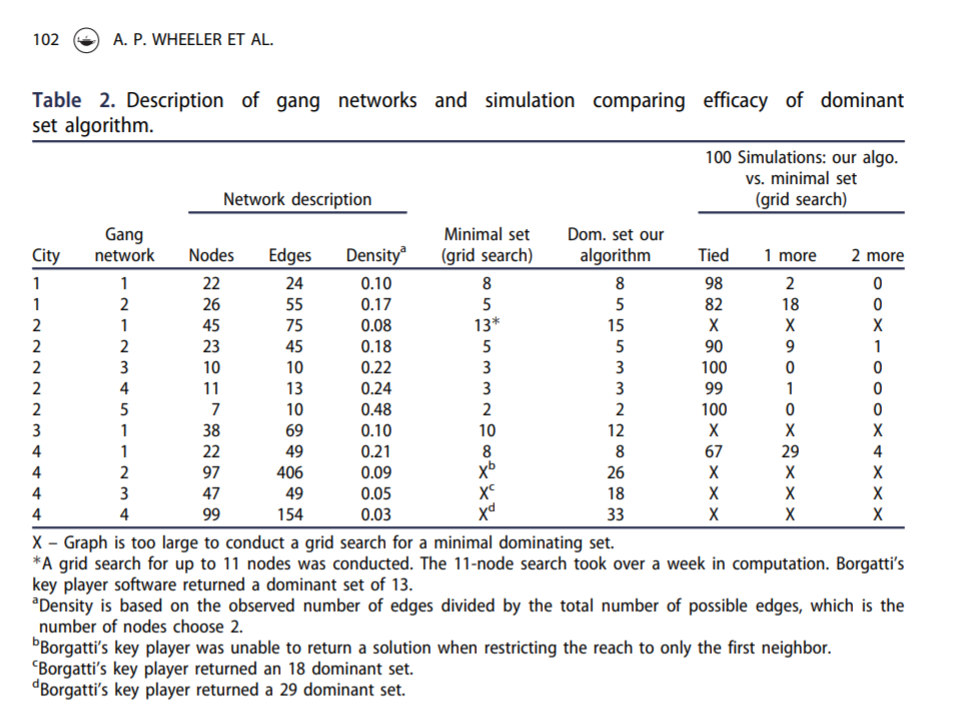
So for my example code, I am using City 4 Gang 4 from my paper. The reason is this was the largest network, and my original algorithm performed the worst. 99 nodes, and my original algorithm identified a 33 person dominant set, but Borgotti’s tool (that uses a genetic algorithm) identified a 29 dominant set.

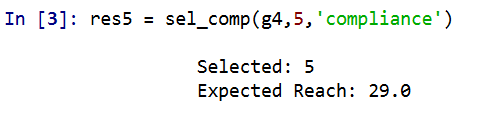
Here is an example of calling my function to select the individuals for a call-in based on the non-compliance estimates. (g4 is the networkx graph object, the second arg is the number of individuals, and compliance is the node attribute that has the probability of treated compliance.) If we call in only 5 people, we still expect a reach of 29 individuals. Here there ends up being some highly connected people on parole/probation, so they have a 1 probability of complying with the treatment.

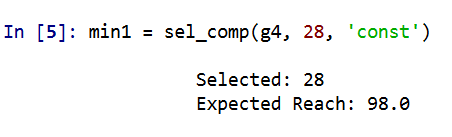
A consequence of this algorithm is that if you pipe in 1’s for the treatment compliance, you basically get an improvement to my original algorithm. So for a test we can see if I get the same minimal dominating set as Borgotti did for his algorithm here, where const is just everybody complies 100% of the time.

And yep we get a dominating set (all 99 people are reached). What happens if we go down one, and only select 28 people?

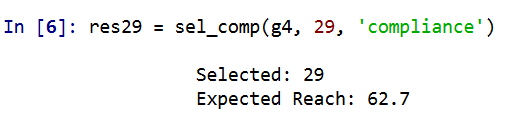
We only reach 98 out of the 99. So it appears a 29 set is the minimal dominating set here. But like I said the treatment non-compliance is a big deal in this setting. What is our expected reach if we take that into account, but still call-in 29 people?

It is still pretty high, around 2/3s of the network, but is still much smaller. Also if you look at the overlap between the constant versus non-compliance model, they select quite a few different individuals. It makes a big difference.

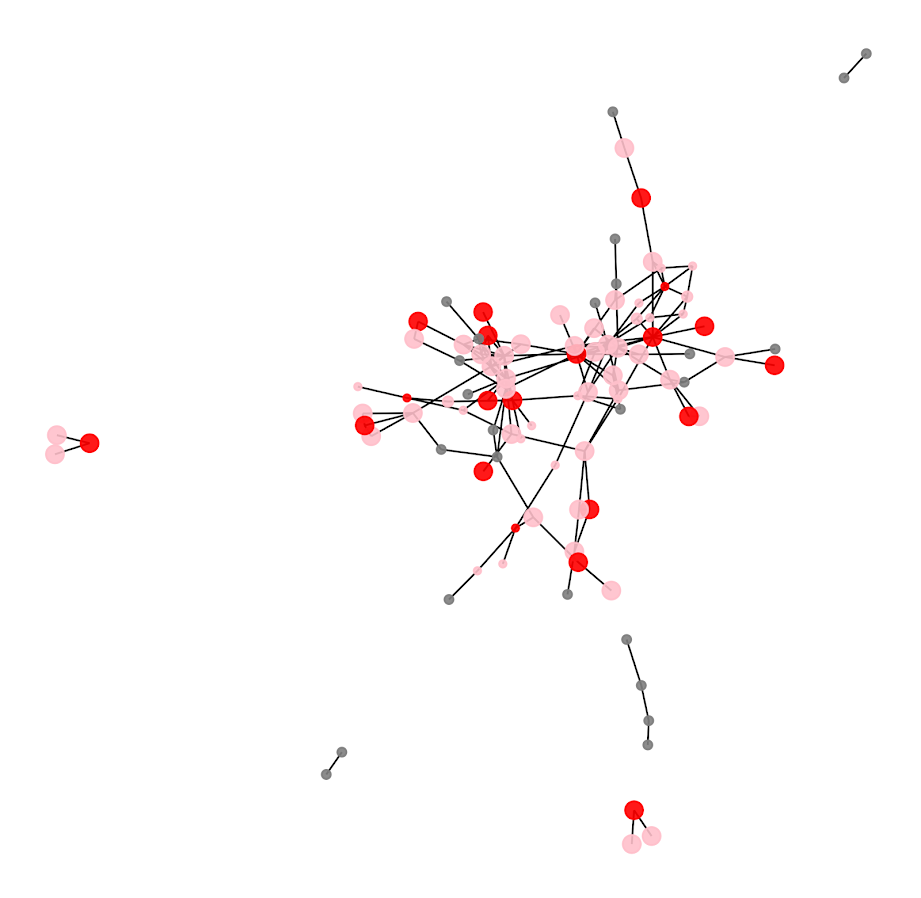
Here is a graph I made of selecting 20 individuals. Red means I selected that person, pink means they are reached at least some, and the size of the reach is proportion to the node. Then grey folks I wouldn’t expect to be reached by the message (at least by first degree connections).

So you can see that most of the people selected have that full 1 expected reach, so the algorithm does prioritize individuals on probation/parole who have a 100% expected compliance. But you can see a few folks who have a lower compliance who are selected as they are in places in the network not covered by those on probation/parole.

I have a tough time getting network layouts to look nice in python (even with the same layout algorithms, I feel like igraph in R just looks much better out of the box).

Future Work

Out of the box, this algorithm could incorporate several different pieces of information. So here I use the non-compliance estimate as a constant, but you could have varying estimates for that based on some other model no problem (e.g. older individuals comply more often than younger, etc.). Also another interesting extension (if you could get estimates) would be the probability a called-in individual spreads the message. In the part Sum( S_j*p_j ) it would just be something like Sum( S_j*p_cj*p_sj ), where p_cj is the compliance probability for attending, and p_sj is the probability to spread the message to those they are connected to.

Getting worthwhile estimates for either of those things will be tough though. Only way I can see it is via some shoe leather qualitative or survey approach.

Simulating runs of events

I still lurk on the Cross Validated statistics site every now and then. There was a kind of common question about the probability of a run of events occurring, and the poster provided a nice analytic solution to the problem using Markov Chains and absorbing states I was not familiar with.

I was familiar with a way to approximate the answer though using a simple simulation, and encoding data via run length encoding. Run length encoding works like this, if you have an original sequence that is AABBBABBBB, then the run length encoded version of this sequence is:

A,2
B,2
A,1
B,4

This is a quite convenient sparse data format to be familiar with. E.g. if you are using tensors in various deep learning libraries, you can encode the data like this and then stack the tensor. But the stacked tensor is just a view, so it doesn’t take up as much memory as the initial full tensor.

Using this encoding also makes a simulation to answer the question, how often do runs of 5+ occur in this hypothetical experiment quite easy to estimate. You just calculate the run length encoded version of the data, and see if any of the lengths are equal to or greater than 5. Below are code snippets in R and Python.

While the analytic solution is of course preferable when you can figure it out, simulations are nice to test whether the solution is correct, as well as to provide an answer when you are not familiar with how to analytically derive a solution.

R Code

R has a native run-length encoding command, rle. The reason is that runs tests are a common time series technique for looking at randomness. Encourage you to run the code yourself to see how my simulated answer lines up with the analytic answer provided on the stats site!

##########################################
# R Code
set.seed(10)
die <- 1:6
run_sim <- function(rolls=1000, conseq=5){
    test <- sample(die,rolls,TRUE)
    res <- max(rle(test)$lengths) >= conseq
    return(res)
}

sims <- 1000000
results <- replicate(sims, run_sim(), TRUE)
print( mean(results) )
##########################################

Python Code

The python code is very similar to the R code. Main difference is there is no native run length encoding command in numpy or scipy I am aware of (although there should be)! So I edited a function I found from Stackoverflow to accomplish the rle.

##########################################
# Python code

import numpy as np
np.random.seed(10)

# Edited from https://stackoverflow.com/a/32681075/604456
# input numpy arrary, return tuple (lengths, vals)
def rle(ia):
    y = np.array(ia[1:] != ia[:-1])         # pairwise unequal (string safe)
    i = np.append(np.where(y), len(ia) - 1) # must include last element
    z = np.diff(np.append(-1, i))           # run lengths
    return (z, ia[i])

die = list(range(6))

def run_sim(rolls=1000, conseq=5):
    rlen, vals = rle(np.random.choice(a=die,size=rolls,replace=True))
    return rlen.max() >= conseq

sims = 1000000
results = [run_sim() for i in range(sims)]
print( sum(results)/len(results) )
##########################################

I debated on expanding this post to show how to do these simulations in parallel, this is a bit of a cheesy experiment to show though. To do 1 million simulations on my machine still only takes like 10~20 seconds for each of these code snippets. So that will have to wait until another post!

You may be thinking why do I care about runs of dice rolls? Well, it can be extended to many different types of time series monitoring problems. For example, when I worked as a crime analyst at Troy I thought about this in terms of analyzing domestic violent reports. They were too numerous for me to read through every report, so I needed to devise a system to identify if there were anomalous patterns in the recent number of reports. You could devise a test here, say how many days of 10+ reports in a row, and see how frequently you would expect that occur in say a year of monitoring. The simulations above could easily be amended to do that, via doing simulations of the Poisson distribution instead of dice rolls, or assigning weights to particular outcomes.