My Blogging in Review in 2013

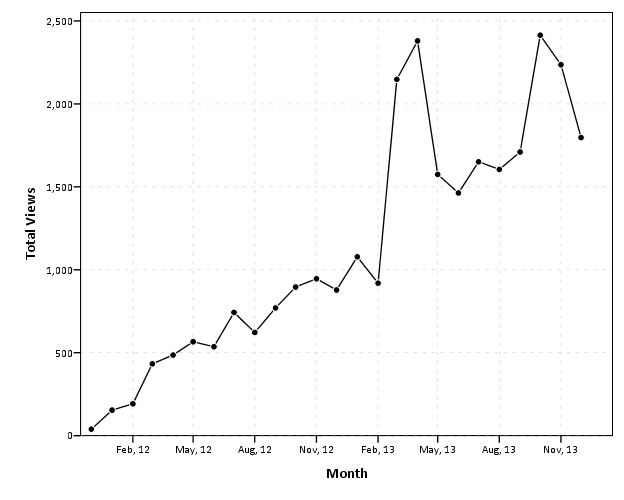
2013 was my second year in blogging. I published 40 posts in 2013 (for a total of 72), and my cumulative site views were just a few shy of a 21,000 for the year. I only recieved 7,200 site views in 2012, so the blog has seen a fair bit of growth. The below chart aggregates the site views per month since the beginning (in December 2011) until December 2013. December has been a bit of a dip with only around an average of 60 views per day, but I was up to an average of 78 and 75 views per day in October and November respectively.

The large uptick in March was due to the Junk Charts Challenge being mentioned by Kaiser Fung. I got over 500 site views that day, and have totalled 765 referrals from the JunkCharts domain. This is pretty similar to the bursty behavior I noted on the CV blog, and that one good tweet or mention by a prominent figure will boost visibility by a large margin.

Most of the regular traffic though comes from generic internet searches, mainly for SPSS related material. A few of my earlier posts of Comparing continuous distributions of unequal size groups in SPSS (2,468 total views), Hacking the default SPSS chart template (2,237), and Avoid Dynamite Plots! Visualizing dot plots with super-imposed confidence intervals in SPSS and R (1,542) are some of my most popular posts. The Junk Charts Challenge post has a total of 1,804 views, but it seems to me that it was more of a flood initially and then a trickle as oppossed to the steady views the other posts bring.

Last year I said I would blog about a few topics and failed to write a post about any of them, so I won’t do that again this year. I will however state that I am currently on the job market, as I recently defended my prospectus. If you are aware of a job opportunity you think I would be interested in, or would like to talk to me about a consulting project feel free to send me an email (you can see my CV for my qualifications and brief discussion of past and current consulting services I have provided).

Some sites give advice about maintaining a blog and attracting visitors (such as writing posts so often). My advice is to write quality material, and the rest is just icing on the cake. Hopefully I have more cake for you in the near future.

Network Xmas Tree in SPSS

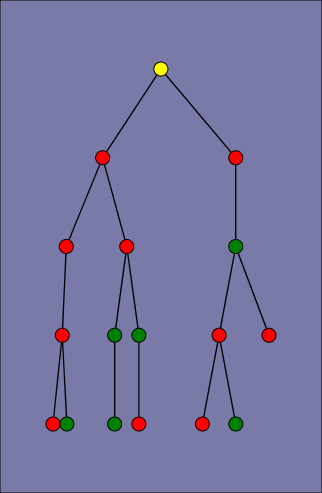
Motivated by Rick Wicklin’s raster based Christmas Tree in SAS, here I will show how to lay out a network Xmas tree in SPSS – XKCD network style.

SPSS’s GPL language has the ability to lay out different network diagrams given a list of edges and vertices. One of the layouts is a tree layout, and is intended for hierarchical data. Dendrograms created from hierarchical clustering are some of the most popular uses for this type of layout.

So to create the data for our Xmas tree, what I first did was just drew the XKCD tree on a piece of paper, and then replaced the ornaments with an integer value used to represent a node. Below is my best ASCII art representation of that tree.


              1
          ____|______
         |           |
         2           3
     ____|      _____|_____
    |          |           |
    4          5           6
 ___|____      |       ____|____
|        |     |      |         |
7        8     9     10        11
|_____      ___|___   |         |         
|     |    |       |  |         |
12   13    14      15 16       17

From here we can make an edge dataset that consists of the form of all the directed connections in the above graph. So 1 is connected to 2, 2 is connected to 4 etc. That dataset will look like below.


data list free / XFrom XTo.
begin data
1 2
1 3
2 4
3 5
3 6
4 7
4 8
5 9
6 10
6 11
7 12
7 13
9 14
9 15
10 16
11 17
end data.
dataset name edges.

If all I wanted to do was to draw the edges this would be sufficient for the graph. But I also want to style the nodes, so I create a dataset listing the nodes and a color which I will draw them with.


data list free / Node (F2.0) Type (A15).
begin data
1 Yellow
2 Red
3 Red
4 Green
5 Red
6 Red
7 Red
8 Red
9 Red
10 Green
11 Green
12 Green
13 Red
14 Green
15 Red
16 Green
17 Red
end data.
dataset name nodes.

Now here is the magic of GPL to draw our Xmas tree.


GGRAPH
  /GRAPHDATASET NAME="edges" DATASET = "edges" VARIABLES=XFrom XTo
  /GRAPHDATASET NAME="nodes" DATASET = "nodes" VARIABLES=Node Type
  /GRAPHSPEC SOURCE=INLINE.
BEGIN GPL
 SOURCE: e=userSource(id("edges"))
 DATA: XFrom=col(source(e), name("XFrom"), unit.category())
 DATA: XTo=col(source(e), name("XTo"), unit.category())
 SOURCE: n=userSource(id("nodes"))
 DATA: Node=col(source(n), name("Node"), unit.category())
 DATA: Type=col(source(n), name("Type"), unit.category())
 GUIDE: axis(dim(1), null())
 GUIDE: legend(aesthetic(aesthetic.color.interior), null())
 COORD: rect(dim(1,2), reflect(dim(2)))
 SCALE: cat(aesthetic(aesthetic.color.interior), map(("Yellow", color.yellow), ("Red", color.red), ("Green", color.green)))
 ELEMENT: edge(position(layout.tree(node(Node),from(XFrom), to(XTo), root("1"))))
 ELEMENT: point(position(layout.tree(node(Node),from(XFrom), to(XTo), root("1"))), color.interior(Type), size(size."14"))
END GPL.

I ended up drawing the Y axis (and reflecting it) because my chart template did not have enough padding for the root node and the yellow circle was partially cut off in the plot. I then post-hoc deleted the Y axis, changed the aspect ratio and the background color of the plot. And Voila – Happy Holidays!

A Festschrift (blog post) for Lord, his paradox and Novick’s prediction

Lord’s paradox is a situation in which analyzing change scores between two time points results in different treatment effect estimates than analyzing the treatment effect of the second time point conditional on the first time point. In terms of regression equations we have the following as the change score model:

Y_2 - Y_1 = \beta_a \cdot T

And the following as the conditional model:

Y_2 = \beta_b \cdot T + \gamma \cdot Y_1

Lord’s paradox is the fact that \beta_a and \beta_b won’t always be the same. I won’t go into too many details on why that is the case, and I would suggest the reader to review Allison (1990) and Holland and Rubin (1983) for some treatments of the problem. The traditional motivation for the change score model (which is pretty similar to fixed effects in panel regressions) is to account for any time invariant omitted variables that may be correlated with a unit being exposed to the treatment.

So lets say that we have an equation predicting Y_2

Y_2 = \beta \cdot T + \delta \cdot X

Lets also say that we cannot observe X, we know that it is correlated with T, but that X does not vary in time. For an example lets say that the treatment is a diet regimen for freshman college students and the outcome of interest is body fat content, and if they sign up they get discounts on specific cafeteria meals. Students voluntarily sign up to take the treatment though, so one may think that certain student characteristics (like being in better shape or have more self control with eating) are correlated with selecting to sign up for the diet. So how can we account for those pre-treatment characteristics that are likely correlated with selection into the treatment?

If we happen to have pre-treatment measures of Y, we can see that:

Y_1 = \delta \cdot X

And so we can subtract the latter equation from the former to cancel out the omitted variable effect:

Y_2 - Y_1 = \beta \cdot T + \delta \cdot X - \delta \cdot X = \beta \cdot T

Now, a frequent critique of the change score model is that it assumes that the autoregressive effect of the baseline score on the post score is 1. See Frank Harrell’s comment on this answer on the Cross Validated site (also see my answer to that question as to why change scores that include the baseline on the right hand side don’t make sense). Holland and Rubin (1983) make the same assertion. To make it clear, these critiques say that change scores are only justified when in the below equation \rho is equal to 1.

Y_2 = \beta \cdot T + \delta \cdot X + \rho \cdot Y_1

This caused me some angst though. As you can see in my original formulation there is no \rho \cdot Y_1 term at all, so it would seem that if anything I assume it is 0. But it seems that my description of time constant ommitted variables is making the same presumption. To show this lets go back one further step in time:

Y_0 = \delta \cdot X

We can see that we could just replace \delta \cdot X with the lagged value. Substituting this into the equation predicting Y_1 we would then have.

Y_1 = \rho \cdot Y_0 = Y_0

Which is the same as saying \rho=1. So my angst is resolved and Frank Harrell, Don Rubin and Paul Holland are correct in their assertions and doubting such a group of individuals surely makes me crazy! This does bring other questions though as to when the change score model is appropriate. Obviously our models are never entirely correct, and the presumption of \rho = 1 is on its face ridiculous in most situations. It is akin to saying the outcome is a random walk that is only guided by various exogenous shocks.

As always, the model one chooses should be balanced against alternatives in an attempt to reduce bias in the effect estimates we are interested in. When the unobserved and omitted X is potentially very large and have a strong correlation with being given the treatment, it seems the change score model should be preferred. I presume someone smarter than me can give better quantitative estimates as to when the bias of assuming \rho=1 is a better choice than making the assumption of no other unobserved time invariant omitted variables.


I end this post on a tangent. I recently revisited the material as I wanted to read Holland and Rubin (1983) which is a chapter in the reader Principals of moderns Psychological Measurement: A Festschrift for Frederic M. Lord. I also saw in that same reader a chapter by Melvin Novick, The centrality of Lord’s paradox and exchangeability for all statistical inference. At the end he was pretty daring in making some predictions for the state of statistics as of November 12, 2012 – so I am a year late with my Festschrift but they are still interesting fodder none-the-less. I’ll leave the reader to judge the extent Novick was correct in his following predictions:

  1. be less dependent on constricting models such as the normal and will primarily use more general classes of distributions, for example, the exponential power distribution;
  2. be fully Bayesian with full emphasis on the psychometric assessment of proper prior distributions;
  3. be fully decision theoretic with emphasis on the pyschometric assessment of individual and institutional utilities;
  4. use robust classes of prior distributions and utility functions as well as robust model distributions;
  5. rely completely on full-rank Bayesian univariate and multivariate analyses of variance and covariance using fully exchangeable, informative prior distributions as appropriate;
  6. emphasize exchangeability through careful modeling, blocking, and covariation with randomization playing a residual role;
  7. emphasize the use of posterior predictive distributions using the lessons of Lord’s paradox, exchangeability, and appropriate conditional probabilities;
  8. place great emphasis on numerical solutions when exact Bayesian solutions prove intractable;
  9. still use some pseudo Bayesian methods when both theoretical and computational fully Bayesian solutions remain intractable. (This prevision is subject to modification if I can convince Rubin, Holland and their associates to devote their impressive skills to the quest for fully Bayesian solutions. Should this happen, there may be no need for any pseudo Bayesian methods.)

Citations

  • Allison, Paul. 1990. Change scores as dependent variables in regression analysis. Sociological methodology 20: 93-114.
  • Holland, Paul & Donald Rubin. 1983. On Lord’s Paradox. In Principles of modern psychological measurement: A festchrift for Frederic M. Lord edited by Wainer, Howard & Samuel Messick pgs:3-25. Lawrence Erlbaum Associates. Hillsdale, NJ.
  • Novick, Melvin. 1983. The centrality of Lord’s paradox and exchangeability for all statistical inference. In Principles of modern psychological measurement: A festchrift for Frederic M. Lord edited by Wainer, Howard & Samuel Messick pgs:3-25. Lawrence Erlbaum Associates. Hillsdale, NJ.
  • Wainer, Howard & Samuel Messick. 1983. Principles of modern psychological measurement: A festchrift for Frederic M. Lord. Lawrence Erlbaum Associates. Hillsdale, NJ.

A Comment on Data visualization in Sociology

Kieran Healy and James Moody recently posted a pre-print, Data visualization in sociology that is to appear in a forthcoming issue of the Annual Review of Sociology. I saw awhile ago on Kieran’s blog that he was planning on releasing a paper on data viz. in sociology and was looking forward to it. As I’m interested in data visualization as well, I’m glad to see the topic gain exposure in such a venue. After going through the paper I have several comments and critiques (all purely of my own opinion). Take it with a grain of salt, I’m neither a sociologist nor a tenured professor at Duke! (I will refer to the paper as HM from here on.)

Sociological Lags

The first section, Sociological Lags, is intended to set the stage for the contemporary use of graphics in sociology. I find both the historical review lacking in defining what is included, and the segway into contemporary use uncompelling. I break the comment in this section into three sections of my own making, the historical review, the current state of affairs & reasoning for the current state of affairs.

Historical Review of What Exactly?

It is difficult to define the scope when reviewing historical applications of visualization on sociology; both because sociology can be immensely broad (near anything to do with human behavior) and defining what counts as a visual graph is difficult. As such it ends up being a bit of a fools errand to go back to the first uses of graphics in sociology. Often Playfair is considered the first champion of graphing numeric summaries (although he has an obvious focus on macro-economics), but if one considers maps as graphics people have made those before we had words and numbers. Tufte often makes little distinction between any form of writing or diagram that communicates information, e.g. in-text sparklines, Hobbe’s visual table of contents to Leviathan on the frontpiece, or Galileo’s diagrams of the rings of Saturn. Paul Lewi in Speaking of Graphics describes the quipu as a visual tool used for accounting by the Incas. If one considers ISOTYPE counting picture diagrams as actual graphs, the Mayan hieroglphys for counting values would seemingly count (forgive my ingorance of anthropology, as I’m sure other examples that fit these seemingly simple criteria exist in other and older societies). Tufte gives an example of using mono-spaced type font, which in our base 10 counting system approximates a logarithmic chart if the numbers are right aligned in a column.

10000
 1000
  100
   10
    1

So here we come to a bit of a contradiction, in that one of the main premises of the article is to advocate the use of graphics over tables, but a table can be a statistical graphic under certain definitions. The word semi-graphic is sometimes used to describe these hybrid tables and graphics (Feinberg, 1979).

So this still leaves us the problem of defining the scope for a historical review. Ignoring the fuzzy definition of graphics laid out prior, we may consider the historical review to contain examples of visualizations from sociologists or applications of visualization to sociological inquiry in general. HM cite 6 examples at the top of page 4, which are a few examples of visualizations from sociologists (pictures please of the examples!) I would have liked to seen the work of Aldophe Quetelet mentioned as a popular historical figure in sociology, and his maps of reported crimes would be considered an example of earlier precedence for data visualization. (I distinctly remember a map at the end of Quetelet (1984) and it appears he used graphs in other works, so I suspect he has other examples I am not familiar with.)

Other popular historical figures that aren’t sociologists but analyzed sociological relevant data were geographers such as Booth’s poverty maps, Minard’s migration flows (Friendly, 2002a), and Guerry/Balbi & Fletcher’s maps of moral statistics (Cook & Wainer, 2012; Friendly, 2007). Other popular champions in public health are John Snow and Florence Nightingale (Brasseur, 2005). I would have liked HM to either had a broader review of historical visualization work pertinent to sociologists, or (IMO even better) more clearly defined the scope of the historical examples they talk about. Friendly (2008) is one of the more recent reviews that I know of talking about the historical examples, so I’d prefer just referring the reader there and then having a more pertinent review of applications within sociology. Although no bright line exists for who is a sociologist, this seems to me to be an easier way to limit the scope of a historical review. Perhaps restrict the discussion to its use in major journals or well known texts (especially methodology oriented ones). The lack of graphs in certain influential works is perhaps more telling than their inclusion. I don’t think Weber or Durkheim used any graphs or maps that I remember.

The Current State of Affairs

The historical discussion is pertinent as a build up to the current state of affairs, but the segway between examples in the early 1900’s and contemporary research is difficult. The fact that the work of Calvin Schmid isn’t mentioned anywhere in the paper is remarkable (or perhaps just indicative of his lack of influence – he still should be mentioned though!) Uses of mapping crime seems to be a strong counter-example of the lack of graphs in either olden or modern sociology; Shaw and McKay’s Juvenile Delinquency in Urban Areas has many exemplary maps and statistical graphics. Sampson’s Great American City follows suit with a great many scatterplots and maps. (Given my background I am prejudiced to be more familiar with applications in criminology.)

So currently in the article we go from a few examples of work in sociology around the turn of the 20th century to the lack of use of graphics in sociology compared to the hard sciences. This is well known, and Cleveland (1984) should have been cited in addition to the anecdotal examples of comparison to articles in Science. (And is noted later on that this in and of itself is a poor motivation for the use of more graphs.) What is potentially more interesting (and pertinent to sociologists) is the variation within sociology itself over time or between different journals in sociology. For instance; is more page space devoted to figures now that one does not need to draw your own graphs by hand compared to say in the 1980s? Do journals such as Sociological Methodology and Sociological Methods & Research have clearly more examples of using graphics compared to ASR or AJS? Has the use of graphics laggard behind the adoption of quantitative analysis in the field? Answering these questions IMO provides a better sense of the context of the contemporary use of graphs in sociology than simply repeating old hat comparing to other fields. It also provides a segway between the historical and contemporary use of graphics within sociology. Indeed it is "easy to find" examples of graphs in contemporary journal articles in sociology, and I would prefer to have some sort of quantitative estimate of the prevalence of graphics within sociological articles over time. This also allows investigation of the cultural impediment hypothesis in this section versus the technical impediment discussions later on. HM also present some hypotheses about the adoption of quantitative modelling in sociology in reference to other social science fields that would lend itself to empirical verification of this kind.

Reasoning For The Current State of Affairs

I find the sentences by HM peculiar:

But, somewhere along the line, sociology became a field where sophisticated statistical models were almost invariably represented by dense tables of variables along rows and model numbers along columns. Though they may signal scientific rigor, such tables can easily be substantively indecipherable to most readers, and perhaps even at times to authors. The reasons for this are beyond the scope of this review, although several possibly complementary hypotheses suggest themselves.

And can be interpreted in two different ways given the context. It can be interpreted as posing the question why are graphics preferable to tables, or why are graphics in relative disuse in sociology. For either I disagree it is outside the scope of the article!

If interpreted in the latter (why disuse of graphics in sociology) HM don’t follow their own advice, and give an excellent discussion of the warnings of graphics provided by Keynes. This section is my favorite in the paper, and I would have liked to see discussion on either training curricula in sociology or discussion of the role in graphs of popular sociological methodology text books. Again, I don’t believe Durkheim or Weber use graphs at all (although I provide other examples of prior scholars they have been exposed to did). Fisher has a chapter on graphs, so the concept isn’t foreign, and obviously the use of ANOVA and regression was adopted within sociology with open arms – why not graphical methods? Why is Schmid (1954) seemingly ignored? The discussion of Keynes is fascinating, but did Keynes really have that much influence on the behavior of sociologists? (I’m reminded of this great quote on the CV site on Wooldrige, 776 pages without a single graph!) This still doesn’t satisfactorily (to me) explain the current state of affairs. For instance a great counter example is Yule (1926); which was a pretty popular paper that used (22!) graphs to explain the behavior of time series. We are left to speculation about historical inertia of an economist as the reasoning for lack of discourse and use of graphics in contemporary sociological publications. I enjoyed the speculation, but I am unconvinced. Again having estimates of the proportion of page space devoted to graphs in sociology over time (and/or in comparison to the other social science fields mentioned) would lend credence to the hypotheses about cultural and technological impediments.

If you interpret the quoted sentence as posing the question why are graphics preferable to tables, then that seems to be crucial discussion to motivate the article to begin with, and I will argue is on topic in the authors next section, visualization in principle. HM miss a good opportunity to relate the quote of Keynes to when we want to use graphs (making relative comparisons) versus tables (which are best when we are just looking up one value, but we are not often interested in just looking up one value!)

Visualization in Principle

The latter sections of the paper, visualization in principle and practice, I find much more reasonable as reviews and well organized into sections (albeit the scope of the sections are still ill-defined). Most of my dissapointments from here on are ommissions that I feel are important to the discussion.

I was disappointed in this particular section of the article, as I believed it would have been a great opportunity to introduce concepts of graphical perception (e.g. Cleveland’s hierarchy), connect the piece to more contemporary work examining graphical perception, and even potentially provide more actionable advice about improving graphics for publication.

This section begins with a hod-podge list of popular viz. books. I was surprised to see Wilkinson’s Grammar of Graphics mentioned, and I was surprised to see Stephen Kosslyn’s books (which are more how to cook book like) and Calvin Schmid ommitted. IMO MacEachren’s How Maps Work should also be included on the shelf, but I’m not sure if that or any of those listed can be objectively defined as influential. Influential is a seemingly ill-defined criteria, and I would have liked to seen citation counts for any of these in sociology journals (I would bet they are all minimal). I presume this is possible as Neal Caren’s posts on scatterplot or Kieran’s philosophy citation network are examples using synonmous data. I find the list strange in that the books are very different in content (see Kosslyn (1985) for a review of several of them), and a reader may be misled in that they cover redundant material. The next part then discusses Tufte and his walkthrough of the famous March of Napoleon graphic by Minard and tries to give useful tidbits of advice along the way.

Use of Example Minard Graphic

While I don’t deny that the Minard example is a wonderful, classical example of a great graph, I would prefer to not perpetuate Tufte’s hyperbole as it beeing the best statistical graphic ever drawn. It is certainly an interesting application, but does time-stamped data of the the number of troops exemplify any type of data sociologists work with now? I doubt it. Part of why I’m excited by field specific interest in visualization is because in sociology (and criminology) we deal with data that isn’t satisfactorily discussed in many general treatments of visualization.

A much better example, in this context IMO, would have been Kieran Healy’s blog post on finding Paul Revere. It is as great an example as the Minard march, has direct relevance to sociologists, and doesn’t cover ground previously covered by other authors. It also is a great example of the use of graphical tools for direct analysis of sociological data. It isn’t a graph to present the results of the model, it is a graph to show us the structure of the network in ways that a model never could! Of course not everyone works with social network data either, but if the goal is to simply have a wow thats really cool example to promote the use of graphics, it would have sufficed and been more clearly on topic for sociology.

The use of an exemplar graphic can provide interest to the readers, but it isn’t clear from the onset of this section that this is the reasoning behind presenting the graphic. Napoleon’s March (nor any single graphic) can not be substantive enough fodder for description of guides to making better graphics. The discussion of topics like layering and small multiples are too superficial to constitute actionable advice (layering needs to be shown examples really to show what you are talking about).

If someone were asking me for the simple introduction to the topic, I would introduce Cleveland’s hierarchy JASA paper (Cleveland & McGill, 1984). For making prettier graphs, I would just suggest to The Visual Display of Quantitative Information and Stephen Few’s short papers. Cleveland’s hierarchy should really be mentioned somewhere in the paper.

This section ends with a mix of advice and more generic discussion on graphical methods, framing the discussion in terms of reproducible research.

Reproducible Research

While I totally endorse the encouragement of reproducible research, and I agree the technical programming skills for producing graphs are the same, I’m not sure I see as strong a connection to data visualization. In much of the paper the connections of direct pertinence to sociologists are not explicit, but HM miss a golden opportunity here to make one; data we often use is confidential in nature, providing problems of both sharing code and displaying graphics in publications. Were not graphing scatterplots of biological assays, but of peoples behavior and sensitive information.

IMO a list of criteria to improve the aesthetics of most graphs that are disseminated in social science articles are; print the graph as a high resolution PNG file or a vector file format (much software defaults to JPEG unfortunately), sensible color choices (how is ColorBrewer not mentioned in the article!) or sensible choices for line formats, and understanding how to make elements of interest come to the foreground in the plot (e.g. not too heavy of gridlines, use color selectively to highlight areas of interest – discussed under the guise of layering earlier in the Minard graphic section). This list of simple advice though for aesthetics can be accomplished in any modern statistical software (and has been possible for years now). The section ends up being a mix of advice about aesthetics of plots with advice about how to make complicated plots more understandable (e.g. talk about small multiples). Discussing these concepts is best kept seperated. Although good advice extends to both, a quick and dirty scatterplot doesn’t have the same expectations as a plot in a publication. (The model of clarity residual plots from R would not be so clear if they had 10,000 points although it still may be sufficient for most purposes.)

Visualization in Practice

This section is organized into exploratory data analysis and presenting the results of models. HM touch on pertinent examples to sociologists (mainly large datasets with high variance to signals that are too complicated for bivariate scatterplots to tell the whole story). I enjoyed this section, but will mention additional examples and discussion that IMO should have been included.

EDA

HM make the great point that EDA and confirmatory analysis are never seperate, and that we can use thoughts from EDA to evaluate regression models. This IMO isn’t anything different than what Tukey talks about when he takes out row and column effects, it is just the scale of the number of data points and ability to fit models is far beyond any examples in Tukey’s EDA.

For the EDA section on categorical variables notable omissions are mosaic plots (Friendly, 1994) – which are mentioned but not shown in the pairs plot example and later on page 23 – and techniques for assessing residuals in logistic regression models (Greenhill et al., 2011; Esarey & Pierce, 2012). When discussing parallel coordinate plots mention should also be made of extensions to categorical data (Bendix et al. 2005; Dang et al. 2010; Hofmann & Vendettuoli, 2013). Later on mention is made that mosaic plots one needs to develop gestalt to interpret them (which I guess we are born with the ability to interpret bar graphs and scatterplots?) The same is oft mentioned for interpreting parallel coordinate plots, and anything that is novel will take some training to be able to interpret.

For continous models partial residual plots should be mentioned (Fox, 1991), and ellipses and caterpillar plots should be mentioned in relation to multi-level modelling (Afshartous & Wolf, 2007; Friendly et al. 2013; Loy & Hofmann 2013) as well as corrgrams for simple data reduction in SPLOMS (Friendly, 2002b). From the generic discussion of Bourdieu it sounds like they are discussing bi-plots or some sort of similar data reduction technique.

I should note that this is just my list of things I think deserve mention for application to sociologists, and the task of what to include is essentially an impossible one. Of course what to include is arbitrary, but I base it mainly on tasks I believe are more common for quantitative sociologists. This is mainly regression analysis and evaluating causal relationships between variables. So although parallel coordinate plots are a great visualization tool for anyone to be familiar with, I doubt it will be as interesting as tools to evaluate the fit or failure of regression models. HM mention that PCP plots are good for identifying clusters and outliers (they aren’t so good for evaluating correlations). Another example (that HM don’t mention) would be treemaps. It is an interesting tool to visualize hierarchical data, but I agree that it shouldn’t be included in this paper as such hierarchical data in sociology is rare (or at least many applications of interest aren’t immediately obvious to me). The Buja et al. paper on using graphs for inference is really neat idea, (and I’m glad to see it mentioned) but I’m more on the fence as to whether it should have taken precedence to some of the other visualizations ideas I mention.

EDA for examining the original data and for examining model residuals are perhaps different enough that it should have its own specific section (although HM did have a nice discussion of this distinction). Examining model residuals is always preached but is seemingly rarely performed. More examples for the parade of horribles I would enjoy (Figure 1 presents a great one – maybe find one for a more complicated model would be good – I know of a few using UCR county data in criminology but none off-hand in sociology). The quote from Gelman (2004) is strange. Gelman’s suggestions for posterior simulations to check the model fit can be done with frequentist models, see King et al. (2000) for basically the same advice (although the citation is at an appropriate place). Also King promotes these as effective displays to understand models, so they are not just EDA then but reasonable tools to summarize models in publications (similar to effect plots later shown).

Presenting model results

The first two examples in this section (Figure 7 histogram and Figure 8 which I’m not sure what it is displaying) seem to me that they should be in the EDA section (or are not cleary defined as presenting results versus EDA graphics). Turning tables into graphs (Cook & Teo, 2011; Gelman et al. 2002; Feinberg & Wainer, 2011; Friendly & Kwan, 2011; Kastellec & Leoni, 2007) is a large omission in this section. Since HM think that tables are used sufficiently, this would have been a great opportunity to show how some tables in an article are better presented as graphs and make more explicit how graphs are better at displaying regression results in some circumstances (Soyer & Hogarth, 2012). It also would have presented an opportunity to make the connection that data visualization can even help guide how to make tables (see my blog post Some notes on making effective tables and Feinberg & Wainer (2011)).

Examples of effects graphs are great. I would have liked mentions of standardizing coefficients to be on similar or more interpretable scales (Gelman & Pardoe, 2007; Gelman, 2008) and effectively displaying uncertainty in the estimates (see my blog post and citations Viz. weighted regression in SPSS and some discussion).

Handcock & Morris (1999) author names are listed in the obverse order in the bibliography in case anyone is looking for it like I was!

In Summary and Moving Forward

As oppossed to ending with a critique of the discussion, I will simply use this as a platform to discuss things I feel are important for moving forward the field of data visualization within sociology (and more broadly the social sciences). First, things I would like to see in the social sciences moving forward are;

  • More emphasis on the technical programming skills necessary to make quality graphs.
  • Encourage journals to use appropriate graphical methods to convey results.
  • Application of the study of data viz. methods as a study worthy in sociology unto itself.

The first suggestion, emphasis on technical programming skills, is in line with the push towards reproducible research. I would hope programs are teaching the statistical computing skills necessary to be an applied quantitative sociologist, and teaching graphical methods should be part and parcel. The second suggestion, encourage journals to use appropriate graphical methods, I doubt is objectionable to most contemporary journals. But I doubt reviewers regularly request graphs instead of tables even where appropriate. It is both necessary for people to submit graphs in their articles and for reviewers to suggest graphs (and journals to implement and enforce guidelines) to increase usage in the field.

When use of graphs becomes more regular and widespread in journal articles, I presume the actual discussion and novel applications will become more regular within sociological journals as well. James Moody is a notable exception with some of his work on networks, and I hope more sociologists are motivated to develop tools unique to their situation and test the efficacy of particular displays. Sociologists have some unique circumstances (spatial and network data, mostly categorical dimensions, low signal/high variance) that call for not just transporting ideas from other fields, but attention and development within sociology itself.


Citations

  • Afshartous, D. and Wolf, M. (2007). Avoiding ‘data snooping’ in multilevel and mixed effects models. Journal of the Royal Statistical Society: Series A (Statistics in Society), 170(4):1035-1059.
  • Bendix, F., Kosara, R., and Hauser, H. (2005). Parallel sets: visual analysis of categorical data. In IEEE Symposium on Information Visualization, 2005. INFOVIS 2005., pages 133-140. IEEE.
  • Brasseur, L. (2005). Florence nightingale’s visual rhetoric in the rose diagrams. Technical Communication Quarterly, 14(2):161-182.
  • Cleveland, W. S. and McGill, R. (1984). Graphical perception: Theory, experimentation, and application to the development of graphical methods. Journal of the American Statistical Association, 79(387):531-554.
  • Cleveland, W. S. (1984). Graphs in scientific publications. The American Statistician, 38(4):261-269.
  • Cook, Alex R. & Shanice W. Teo. (2011) The communicability of graphical alternatives to tabular displays of statistical simulation studies. PLoS ONE 6(11): e27974.
  • Cook, R. and Wainer, H. (2012). A century and a half of moral statistics in the united kingdom: Variations on joseph fletcher’s thematic maps. Significance, 9(3):31-36.
  • Dang, T. N., Wilkinson, L., and Anand, A. (2010). Stacking graphic elements to avoid Over-Plotting. IEEE Transactions on Visualization and Computer Graphics, 16(6):1044-1052.
  • Esarey, Justin & Andrew Pierce. 2012. Assessing fit quality and testing for misspecification in binary-dependent variable models. Political Analysis 20(4): 480-500. Preprint PDF Here
  • Feinberg, R. A. and Wainer, H. (2011). Extracting sunbeams from cucumbers. Journal of Computational and Graphical Statistics, 20(4):793-810.
  • Fienberg, S. E. (1979). Graphical methods in statistics. The American Statistician, 33(4):165-178.
  • Fox, J. (1991). Regression diagnostics. Number no. 79 in Quantitative applications in the social sciences. Sage.
  • Friendly, M. (1994). Mosaic displays for Multi-Way contingency tables. Journal of the American Statistical Association, 89(425):190-200.
  • Friendly, M. (2002a). Visions and Re-Visions of charles joseph minard. Journal of Educational and Behavioral Statistics, 27(1):31-51.
  • Friendly, M. (2002b). Corrgrams: Exploratory displays for correlation matrices. The American Statistician, 56(4):316-324.
  • Friendly, M. (2007). A.-M. guerry’s moral statistics of france: Challenges for multivariable spatial analysis. Statistical Science, 22(3):368-399.
  • Friendly, M. (2008). The golden age of statistical graphics. Statistical Science, 23(4):502-535.
  • Friendly, M., Monette, G., and Fox, J. (2013). Elliptical insights: Understanding statistical methods through elliptical geometry. Statistical Science, 28(1):1-39.
  • Friendly, Michael & Ernest Kwan. 2011. Comment on Why tables are really much better than graphs. Journal of Computational and Graphical Statistics 20(1): 18-27.
  • Gelman, A. (2008). Scaling regression inputs by dividing by two standard deviations. Statistics in medicine, 27(15):2865-2873.
  • Gelman, A. and Pardoe, I. (2007). Average predictive comparisons for models with nonlinearity, interactions, and variance components. Sociological Methodology, 37(1):23-51.
  • Gelman, Andrew, Cristian Pasarica & Rahul Dodhia (2002). Let’s practice what we preach. The American Statistician 56(2):121-130.
  • Greenhill, Brian, Michael D. Ward & Audrey Sacks. 2011. The separation plot: A new visual method for evaluating the fit of binary models. American Journal of Political Science 55(4):991-1002.
  • Hofmann, H. and Vendettuoli, M. (2013). Common angle plots as Perception-True visualizations of categorical associations. Visualization and Computer Graphics, IEEE Transactions on, 19(12):2297-2305.
  • Kastellec, Jonathan P. & Eduardo Leoni. (2007). Using graphs instead of tables in political science. Perspectives on Politics 5(4):755-771.
  • King, G., Tomz, M., and Wittenberg, J. (2000). Making the most of statistical analyses: Improving interpretation and presentation. American Journal of Political Science, 44(2):347-361.
  • Kosslyn, S. M. (1985). Graphics and human information processing: A review of five books. Journal of the American Statistical Association, 80(391):499-512.
  • Kosslyn, S. M. (1994). Elements of graph design. WH Freeman New York.
  • Lewi, P. J. (2006). Speaking of graphics. http://www.datascope.be/sog.htm
  • Loy, A. and Hofmann, H. (2013). Diagnostic tools for hierarchical linear models. Wiley Interdisciplinary Reviews: Computational Statistics, 5(1):48-61.
  • MacEachren, A. M. (2004). How maps work: representation, visualization, and design. Guilford Press.
  • Sampson, R. J. (2012). Great American city: Chicago and the enduring neighborhood effect. University of Chicago Press.
  • Schmid, C. F. (1954). Handbook of graphic presentation. Ronald Press Company. http://archive.org/details/HandbookOfGraphicPresentation
  • Shaw, C. R. and McKay, H. D. (1972). Juvenile delinquency and urban areas: a study of rates of delinquency in relation to differential characteristics of local communities in American cities. A Phoenix Book. University of Chicago Press.
  • Soyer, E. and Hogarth, R. M. (2012). The illusion of predictability: How regression statistics mislead experts. International Journal of Forecasting, 28(3):695-711.
  • Tufte, E. R. (1983). The visual display of quantitative information. Graphics Press.
  • Quetelet, A. (1984). Adolphe Quetelet’s Research on the propensity for crime at different ages. Criminal justice studies. Anderson Pub. Co.
  • Yule, G. U. (1926). Why do we sometimes get Nonsense-Correlations between Time-Series?-a study in sampling and the nature of Time-Series. Journal of the Royal Statistical Society, 89(1):1-63.

Odds Ratios NEED To Be Graphed On Log Scales

Andrew Gelman blogged the other day about an example of Odds Ratios being plotted on a linear scale. I have seen this mistake a couple of times, so I figured it would be worth the time to further elaborate on.

Reported odds ratios are almost invariably from the output of a generalized linear regression model (e.g. logistic, poisson). Graphing the associated exponentiated coefficients and their standard errors (or confidence intervals) is certainly a reasonable thing to want to do – but unless someone wants to be misleading they need to be on a log scale. When the coefficients (and the associated intervals) are exponeniated they are no longer symmetric on a linear scale.

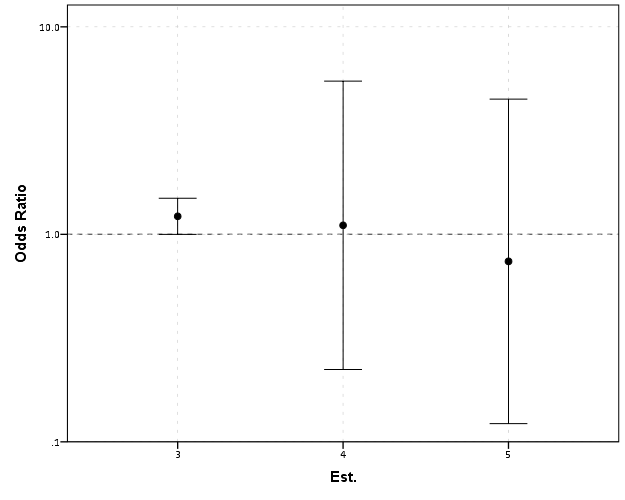
To illustrate a few nefarious examples, lets pretend our software spit out a series of regression coefficients. The table shows the original coefficients on the log odds scale, and the subsequent exponentiated coefficients +- 2 Standard Errors.

Est.  Point  S.E. Exp(Point) Exp(-2*S.E.) Exp(+2*S.E.)
  1   -0.7   0.1    0.5        0.4            0.6
  2    0.7   0.1    2.0        1.6            2.5
  3    0.2   0.1    1.2        1.0            1.5
  4    0.1   0.8    1.1        0.2            5.5
  5   -0.3   0.9    0.7        0.1            4.5

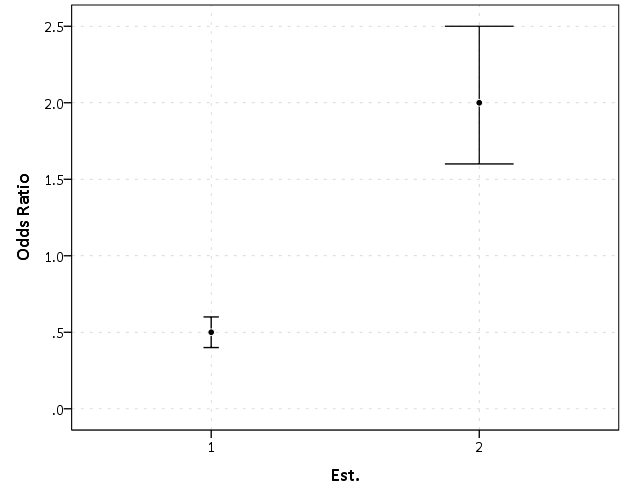
Now, to start lets graph the exponentiated estimates (the odds ratios) for estimates 1 and 2 and their standard errors on an arithmetic scale, and see what happens.

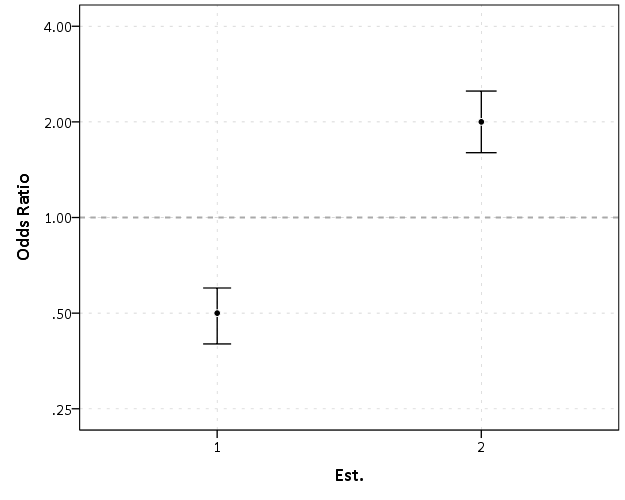
This graph would give the impression that 2 is both a larger effect and has a wider variance than effect 1. Now lets look at the same chart on a log scale.

By construction effects 1 and 2 are exactly the same (this is clear on the original log odds scale before the coefficients were exponentiated). Changes in the ratio of the odds can not go below zero, and a change from an odds ratio between 0.5 and 0.4 is the same relative change as that between 2.0 and 2.5. On the linear scale though the former is a difference of 0.1, and the latter a difference of 0.5.

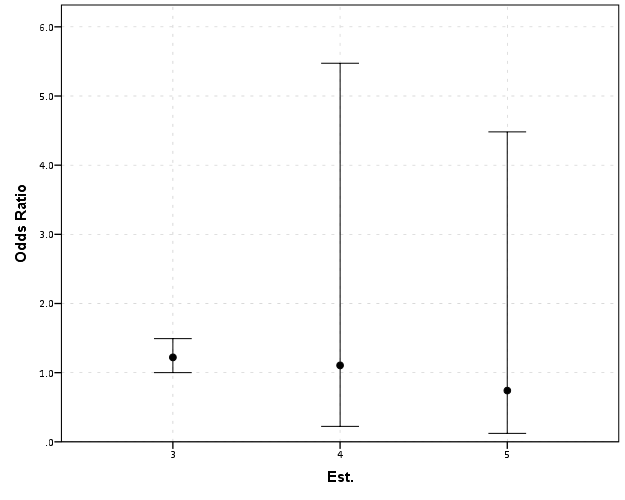
Such visual discrepancies get larger the further towards zero you go, and as what goes in the denominator and what goes in the numerator is arbitrary, displaying these values on a linear scale is very misleading. Consider a different example:

Well, what would we gather from this? Estimates 4 and 5 both have a wide variance, and the majority of their error bars are both above 1. This is an incorrect interpretation though, as the point estimate of 5 is below 1, and more of its error bar is on the below 1 side.

Looking up some more examples online this may be a problem more often than I thought (doing a google image search for “plot odds ratios” turns up plenty of examples to support my position). I even see some examples of forest plots of odds ratios fail to do this. An oft critique of log scales is that they are harder to understand. Even if I acquiesce that this is true, plotting odds ratios on a linear scale is misleading and should never be done.


To make a set of charts in SPSS with log scales for your particular data you can simply enter in the model estimates using DATA LIST and then use GGRAPH to make the plot. In particular for GGRAPH see the SCALE lines to set the base of the logarithms. Example below:

*Can input your own data.
DATA LIST FREE / Id  (A10) PointEst  SEPoint Exp_Point CIExp_L CIExp_H.
BEGIN DATA
  1   -0.7   0.1    0.5        0.4            0.6
  2    0.7   0.1    2.0        1.6            2.5
  3    0.2   0.1    1.2        1.0            1.5
  4    0.1   0.8    1.1        0.2            5.5
  5   -0.3   0.9    0.7        0.1            4.5
END DATA.
DATASET NAME OddsRat.

*Graph of Confidence intervals on log scale.
FORMATS Exp_Point CIExp_L CIExp_H (F2.1).
GGRAPH
  /GRAPHDATASET NAME="graphdataset" VARIABLES=Id Exp_Point CIExp_L CIExp_H
  /GRAPHSPEC SOURCE=INLINE.
BEGIN GPL
  SOURCE: s=userSource(id("graphdataset"))
  DATA: Id=col(source(s), name("Id"), unit.category())
  DATA: Exp_Point=col(source(s), name("Exp_Point"))
  DATA: CIExp_L=col(source(s), name("CIExp_L"))
  DATA: CIExp_H=col(source(s), name("CIExp_H"))
  GUIDE: axis(dim(1), label("Point Estimate and 95% Confidence Interval"))
  GUIDE: axis(dim(2))
  GUIDE: form.line(position(1,*), size(size."2"), color(color.darkgrey))
  SCALE: log(dim(1), base(2), min(0.1), max(6))
  ELEMENT: edge(position((CIExp_L+CIExp_H)*Id))
  ELEMENT: point(position(Exp_Point*Id), color.interior(color.black), 
           color.exterior(color.white))
END GPL.

Equal Probability Histograms in SPSS

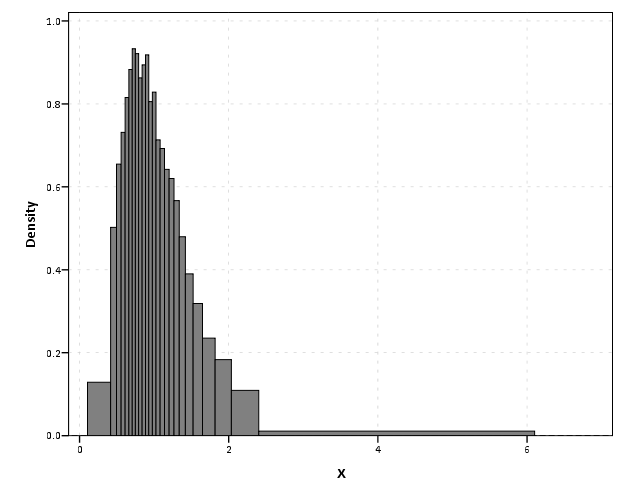
The other day on NABBLE an individual asked for displaying histograms with unequal bar widths. I showed there if you have the fences (and the height of the bar) you can draw the polygons in inline GPL using a polygon element and the link.hull option for edges. I used a similar trick for spineplots.

On researching when someone would use unequal bar widths a common use is to make the fences at specified quantiles and plot the density of the distribution. That is the area of the bars in the plot is equal, but the width varies giving the bars unequal height. Nick Cox has an awesome article about graphing univariate distributions in Stata with equally awesome discussion of said equal probability histograms.

The full code is at the end of the post, but in a nutshell you can call the !EqProbHist MACRO by specifying the Var and how many quantiles to slice it, NTiles. The macro just uses OMS to capture the table of NTiles produced by FREQUENCIES along with the min and max, and returns a dataset named FreqPoly with the lower and upper fences plus the height of the bar. This dataset can then be plotted with a seperate GGRAPH command.

!EqProbHist Var = X NTiles = 25.
GGRAPH
  /GRAPHDATASET DATASET = 'FreqPoly' NAME="graphdataset" VARIABLES=FenceL FenceU Height
  /GRAPHSPEC SOURCE=INLINE.
BEGIN GPL
 SOURCE: s=userSource(id("graphdataset"))
 DATA: FenceL=col(source(s), name("FenceL"))
 DATA: FenceU=col(source(s), name("FenceU"))
 DATA: Height=col(source(s), name("Height"))
 TRANS: base=eval(0)
 TRANS: casenum = index() 
 GUIDE: axis(dim(1), label("X"))
 GUIDE: axis(dim(2), label("Density"))
 SCALE: linear(dim(2), include(0))
 ELEMENT: polygon(position(link.hull((FenceL + FenceU)*(base + Height))), color.interior(color.grey), split(casenum)) 
END GPL.

An example histogram is below.

Note if you have quantiles that are tied (e.g you have categorical or low count data) you will get division by zero errors. So this type of chart is only reasonable with continuous data.

*********************************************************************************************.
*Defining Equal Probability Macro - only takes variable and number of tiles to slice the data.
DEFINE !EqProbHist (Var = !TOKENS(1)
                   /NTiles = !TOKENS(1) )
DATASET DECLARE FreqPoly.
OMS
/SELECT TABLES
/IF SUBTYPES = 'Statistics'
/DESITINATION FORMAT = SAV OUTFILE = 'FreqPoly' VIEWER = NO.
FREQUENCIES VARIABLES=!Var
  /NTILES = !NTiles
  /FORMAT = NOTABLE
  /STATISTICS = MIN MAX.
OMSEND.
DATASET ACTIVATE FreqPoly.
SELECT IF Var1 <> "N".
SORT CASES BY Var4.
COMPUTE FenceL = LAG(Var4).
RENAME VARIABLES (Var4 = FenceU).
COMPUTE Height = (1/!NTiles)/(FenceU - FenceL).
MATCH FILES FILE = *
/KEEP FenceL FenceU Height.
SELECT IF MISSING(FenceL) = 0.
!ENDDEFINE.
*Example Using the MACRO and then making the graph.
dataset close all.
output close all.
set seed 10.
input program.
loop #i = 1 to 10000.
  compute X = RV.LNORMAL(1,0.5).
  compute X2 = RV.POISSON(3).
  end case.
end loop.
end file.
end input program.
dataset name sim.
PRESERVE.
SET MPRINT OFF.
!EqProbHist Var = X NTiles = 25.
GGRAPH
  /GRAPHDATASET DATASET = 'FreqPoly' NAME="graphdataset" VARIABLES=FenceL FenceU Height
  /GRAPHSPEC SOURCE=INLINE.
BEGIN GPL
 SOURCE: s=userSource(id("graphdataset"))
 DATA: FenceL=col(source(s), name("FenceL"))
 DATA: FenceU=col(source(s), name("FenceU"))
 DATA: Height=col(source(s), name("Height"))
 TRANS: base=eval(0)
 TRANS: casenum = index() 
 GUIDE: axis(dim(1), label("X"))
 GUIDE: axis(dim(2), label("Density"))
 SCALE: linear(dim(2), include(0))
 ELEMENT: polygon(position(link.hull((FenceL + FenceU)*(base + Height))), color.interior(color.grey), split(casenum)) 
END GPL.
RESTORE.
*********************************************************************************************.

Stacked (pyramid) bar charts for Likert Data

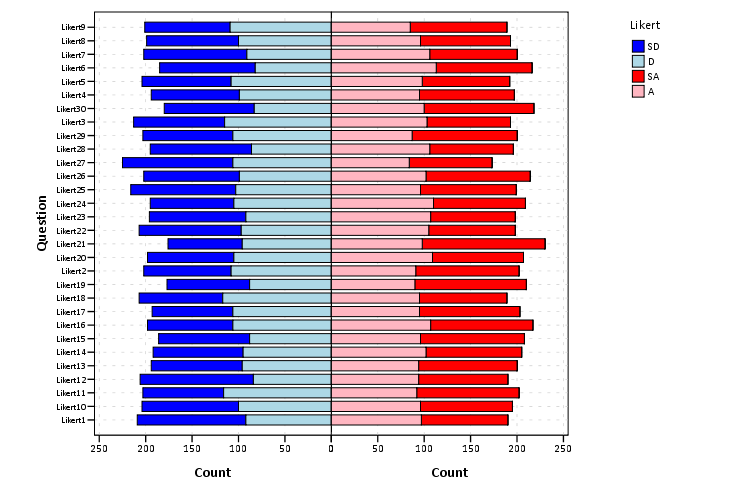
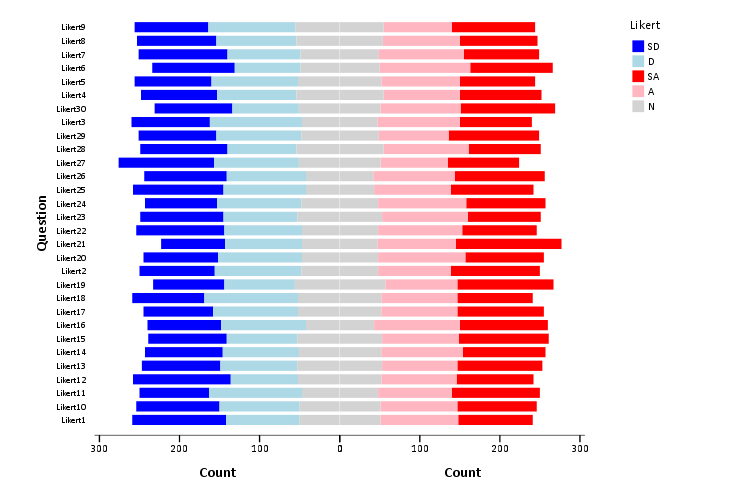
A while ago this question on Cross Validated showed off some R libraries to plot Likert data. Here is a quick post on replicating the stacked pyramid chart in SPSS.

This is one of the (few) examples where stacked bar charts are defensible. One task that is easier with stacked bars (and Pie charts – which can be interpreted as a stacked bar wrapped in a circle) is to combine the lengths of adjacent categories. Likert items present an opportunity with their ordinal nature to stack the bars in a way that allows one to more easily migrate between evaluating positive vs. negative responses or individually evaluating particular anchors.

First to start out lets make some fake Likert data.

**************************************.
*Making Fake Data.
set seed = 10.
input program.
loop #i = 1 to 500.
compute case = #i.
end case.
end loop.
end file.
end input program.
dataset name sim.
execute.
*making 30 likert scale variables.
vector Likert(30, F1.0).
do repeat Likert = Likert1 to Likert30.
compute Likert = TRUNC(RV.UNIFORM(1,6)).
end repeat.
execute.
value labels Likert1 to Likert30 
1 'SD'
2 'D'
3 'N'
4 'A'
5 'SA'.
**************************************.

To make a similar chart to the one posted earlier, you need to reshape the data so all of the Likert items are in one column.

**************************************.
varstocases
/make Likert From Likert1 to Likert30
/index Question (Likert).
**************************************.

Now to make the population pyramid Likert chart we will use SPSS’s ability to reflect panels, and so we assign an indicator variable to delineate the positive and negative responses.

***************************************
*I need to make a variable to panel by.
compute panel = 0.
if Likert > 3 panel = 1.
***************************************.

From here we can produce the chart without displaying the neutral central category. Here I use a temporary statement to not plot the neutral category, and after the code is the generated chart.

***************************************.
temporary.
select if Likert <> 3.
GGRAPH
  /GRAPHDATASET NAME="graphdataset" VARIABLES=Question COUNT()[name="COUNT"] Likert panel
    MISSING=LISTWISE REPORTMISSING=NO
  /GRAPHSPEC SOURCE=INLINE.
BEGIN GPL
  SOURCE: s=userSource(id("graphdataset"))
  COORD: transpose(mirror(rect(dim(1,2))))
  DATA: Question=col(source(s), name("Question"), unit.category())
  DATA: COUNT=col(source(s), name("COUNT"))
  DATA: Likert=col(source(s), name("Likert"), unit.category())
  DATA: panel=col(source(s), name("panel"), unit.category())
  GUIDE: axis(dim(1), label("Question"))
  GUIDE: axis(dim(2), label("Count"))
  GUIDE: axis(dim(3), null(), gap(0px))
  GUIDE: legend(aesthetic(aesthetic.color.interior), label("Likert"))
  SCALE: linear(dim(2), include(0))
  SCALE: cat(aesthetic(aesthetic.color.interior), sort.values("1","2","5","4"), map(("1", color.blue), ("2", color.lightblue), ("4", color.lightpink), ("5", color.red)))
  ELEMENT: interval.stack(position(Question*COUNT*panel), color.interior(Likert), shape.interior(shape.square))
END GPL.
***************************************.

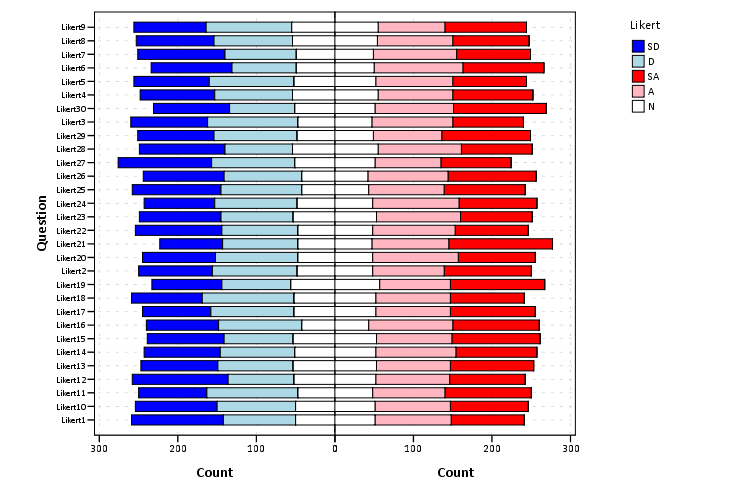
These charts when displaying the Likert responses typically allocate the neutral category half to one panel and half to the other. To accomplish this task I made a continuous random variable and then use the RANK command to assign half of the cases to the positive panel.

***************************************.
compute rand = RV.NORMAL(0,1).
AUTORECODE  VARIABLES=Question  /INTO QuestionN.
RANK
  VARIABLES=rand  (A) BY QuestionN Likert /NTILES (2)  INTO RankT /PRINT=NO
  /TIES=CONDENSE .
if Likert = 3 and RankT = 2 panel = 1.
***************************************.

From here it is the same chart as before, just with the neutral category mapped to white.

***************************************.
GGRAPH
  /GRAPHDATASET NAME="graphdataset" VARIABLES=Question COUNT()[name="COUNT"] Likert panel
    MISSING=LISTWISE REPORTMISSING=NO
  /GRAPHSPEC SOURCE=INLINE.
BEGIN GPL
  SOURCE: s=userSource(id("graphdataset"))
  COORD: transpose(mirror(rect(dim(1,2))))
  DATA: Question=col(source(s), name("Question"), unit.category())
  DATA: COUNT=col(source(s), name("COUNT"))
  DATA: Likert=col(source(s), name("Likert"), unit.category())
  DATA: panel=col(source(s), name("panel"), unit.category())
  GUIDE: axis(dim(1), label("Question"))
  GUIDE: axis(dim(2), label("Count"))
  GUIDE: axis(dim(3), null(), gap(0px))
  GUIDE: legend(aesthetic(aesthetic.color.interior), label("Likert"))
  SCALE: linear(dim(2), include(0))
  SCALE: cat(aesthetic(aesthetic.color.interior), sort.values("1","2","5","4", "3"), map(("1", color.blue), ("2", color.lightblue), ("3", color.white), ("4", color.lightpink), ("5", color.red)))
  ELEMENT: interval.stack(position(Question*COUNT*panel), color.interior(Likert),shape.interior(shape.square))
END GPL.
***************************************.

The colors are chosen to illustrate the ordinal nature of the data, with the anchors having a more saturated color. To end I map the neutral category to a light grey and then omit the outlines of the bars in the plot. They don’t really add anything (except possible moire patterns), and space is precious with so many items.

***************************************.
GGRAPH
  /GRAPHDATASET NAME="graphdataset" VARIABLES=Question COUNT()[name="COUNT"] Likert panel
    MISSING=LISTWISE REPORTMISSING=NO
  /GRAPHSPEC SOURCE=INLINE.
BEGIN GPL
  SOURCE: s=userSource(id("graphdataset"))
  COORD: transpose(mirror(rect(dim(1,2))))
  DATA: Question=col(source(s), name("Question"), unit.category())
  DATA: COUNT=col(source(s), name("COUNT"))
  DATA: Likert=col(source(s), name("Likert"), unit.category())
  DATA: panel=col(source(s), name("panel"), unit.category())
  GUIDE: axis(dim(1), label("Question"))
  GUIDE: axis(dim(2), label("Count"))
  GUIDE: axis(dim(3), null(), gap(0px))
  GUIDE: legend(aesthetic(aesthetic.color.interior), label("Likert"))
  SCALE: linear(dim(2), include(0))
  SCALE: cat(aesthetic(aesthetic.color.interior), sort.values("1","2","5","4", "3"), map(("1", color.blue), ("2", color.lightblue), ("3", color.lightgrey), ("4", color.lightpink), ("5", color.red)))
  ELEMENT: interval.stack(position(Question*COUNT*panel), color.interior(Likert),shape.interior(shape.square),transparency.exterior(transparency."1"))
END GPL.
***************************************.

Sparklines for Time Interval Crime Data

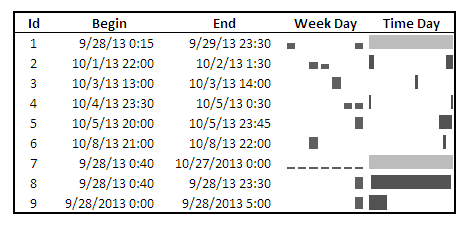
I developed some example sparklines for tables when visualizing crime data that occurs in an uncertain window. The use case is small tables that list the begin and end date-times, and the sparklines provide a quick visual assessment of the day of week and time of day. Examining for overlaps in two intervals is one of the hardest things to do when examining a table, and deciphering days of week when looking at dates is just impossible.

Here is an example table of what they look like.

The day of week sparklines are a small bar chart, with Sunday as the first bar and Saturday as the last bar. The height of the bar represents the aoristic estimate for that day of week. An interval over a week long (entirely uncertain what day of week the crime took place) ends up looking like a dashed line over the week. This example uses the sparkline bar chart built into Excel 2010, but the Sparklines for Excel add-on provides synonymous functionality. The time of day sparkline is a stacked bar chart in disguise; it represents the time interval with a dark grey bar, and the remaining stack is white. This allows you to have crimes that occur overnight and are split in the middle of the day. Complete ignorance of when the crime occurred during the day I represent with a lighter grey bar.

The spreadsheet can be downloaded from my drop box account here.

A few notes the use of the formulas within the sheet:

  • The spreadsheet does have formulas to auto-calculate the example sparklines (how they exactly work is worth another blog post all by itself) but it should be pretty clear to replicate the example bar chart for the day of week and time of day in case you just want to hand edit (or have another program return the needed estimates).
  • For the auto-calculations to work for the Day of Week aoristic estimates the crime interval needs to have a positive value. That is, if the exact same time is listed in the begin and end date column you will get a division by zero error.
  • For the day of week aoristic estimates it calculates the proportion as 1/7 if the date range is over one week. Ditto for the time range it is considered the full range if it goes over 24 hours.

A few notes on the aesthetics of sparklines:

  • For the time of day sparkline if you have zero (or near zero) length for the interval it won’t show up in the graph. Some experimentation suggests the interval needs around 15 to 45 minutes for typical cell sizes to be visible in the sheet (and for printing).
  • For the time of day sparkline the empty time color is set to white. This will make the plot look strange if you use zebra stripes for the table. You could modify it to make the empty color whatever the background color of the cell is, but I suspect this might make it confusing looking.
  • A time of day bar chart could be made just the same as the day of week bar chart. It would require the full expansion for times of day, which I might do in the future anyway to provide a conveniant spreadsheet to calculate aoristic estimates. (I typically do them with my SPSS MACRO – but it won’t be too arduous to expand what I have done here to an excel template).
  • If the Sparklines for Excel add-on allowed pie charts with at least two categories or allowed the angle of the pie slice to be rotated, you could make a time of day pie chart sparkline. This is currently not possible though.

I have not thoroughly tested the spreadsheet calculations (missing values will surely return errors, and if you have the begin-end backwards it may return some numbers, but I doubt they will be correct) so caveat emptor. I think the sparklines are a pretty good idea though. I suspect some more ingenious uses of color could be used to cross-reference the days of week and the time of day, but this does pretty much what I hoped for when looking at the table.

Cyclical color ramps for time series line plots

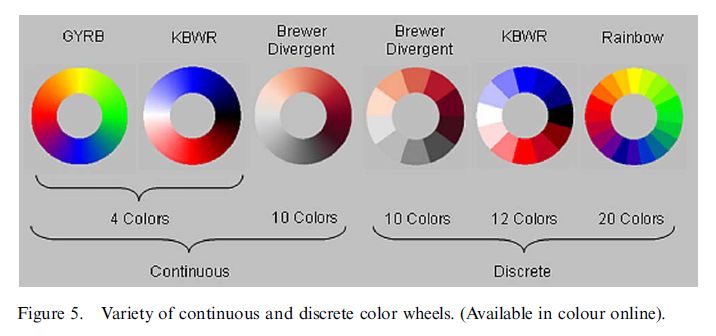
Morphet & Symanzik (2010) propose different novel cyclical color ramps by taking ColorBrewer ramps and wrapping them on the circle. All other previous continuous circle ramps I had seen prior were always rainbow scales, and there is plenty discussion about why rainbow color scales are bad so we needn’t rehash that here (see Kosara, Drew Skau, and my favorite Why Should Engineers and Scientists Be Worried About Color? for a sampling of critiques).

Below is a picture of the wrapped cyclical ramps from Morphet & Symanzik (2010). Although how they "average" the end points is not real clear to me from reading the paper, they basically use a diverging ramp and have one end merge at a fully saturated end of the sprectrum (e.g. nearly black) and the other merge at the fully light end of the spectrum (e.g. nearly white).

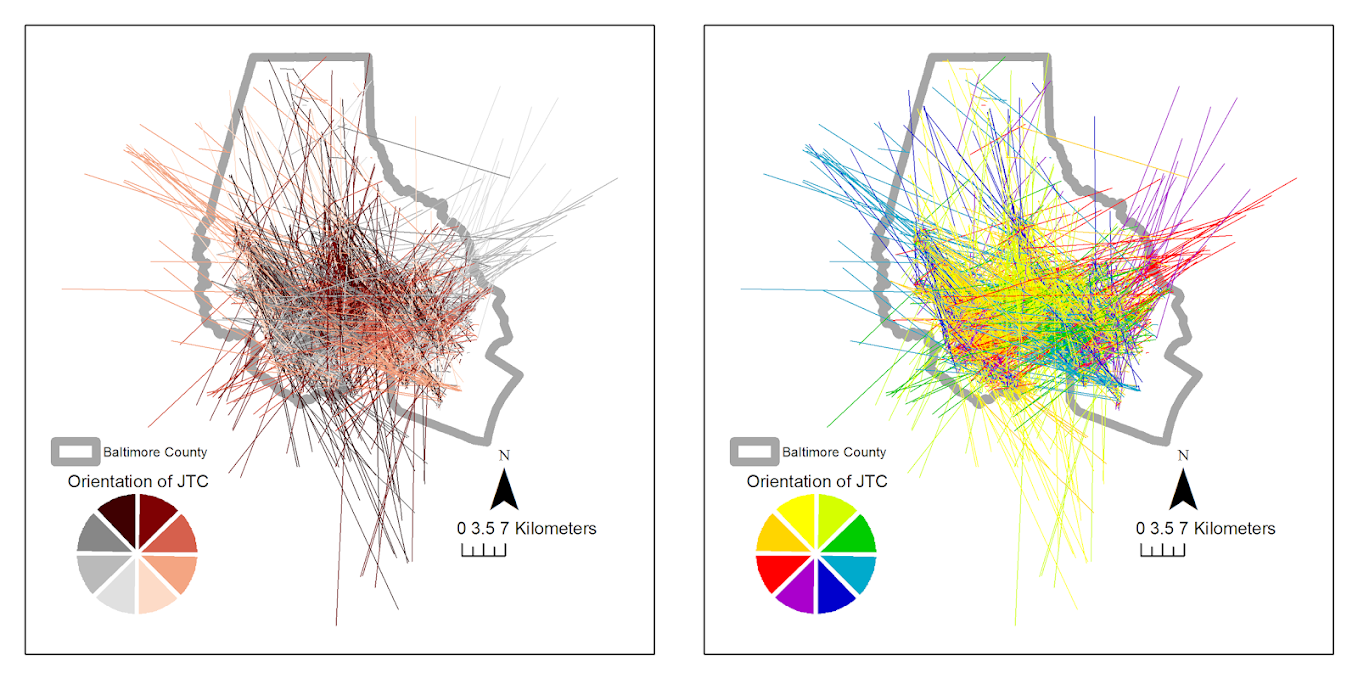
The original motivation is for directional data, and here is a figure from my paper Viz. JTC lines comparing the original rainbow color ramp I chose (on the right) and an updated red-grey cyclical scale on the left. The map is still quite complicated, as part of the motivation of that map was to show how plotting the JTC the longer lines dominate the graphic.

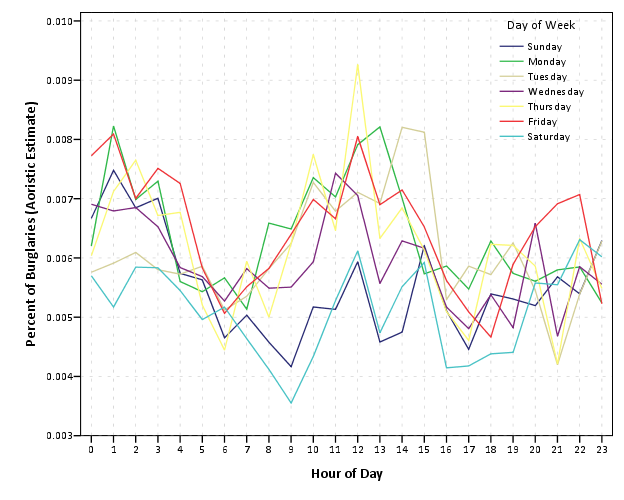
But I was interested in applying this logic to showing cyclical line plots, e.g. aoristic crime estimates by hour of day and day of week. Using the same Arlington data I used before, here are the aoristic estimates for hour of day plotted seperately for each day of the week. The colors for the day of the week use SPSS’s default color scheme for nominal categories. SPSS does not have anything as far as color defaults to distinguish between ordinal data, so if you use a categorical coloring scheme this is what you get.

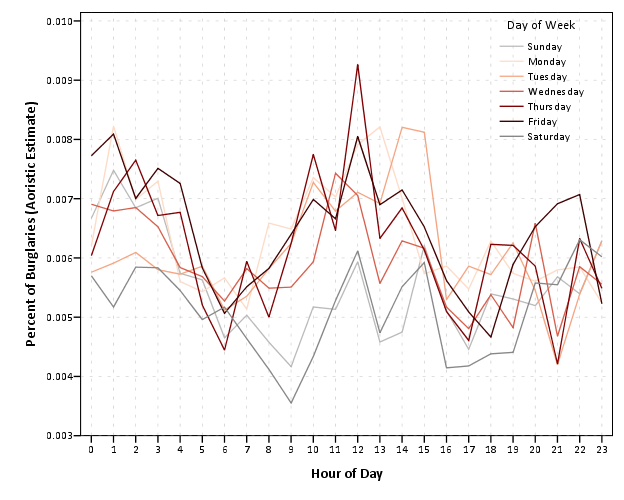
The default is very good to distinguish between nominal categories, but here I want to take advantage of the cyclical nature of the data, so I employ a cyclical color ramp.

From this it is immediately apparent that the percentage of crimes dips down during the daytime for the grey Saturday and Sunday aoristic estimates. Most burglaries happen during the day, and so you can see that when homeowners are more likely to be in the house (as oppossed to at work) burglaries are less likely to occur. Besides this, day of week seems largely irrelevant to the percentage of burglaries that are occurring in Arlington.

I chose to make during the week shades of red, the dark color split between Friday-Saturday, and the light color split between Sunday-Monday. This trades one problem for another, in that the more fully saturated colors draw more attention in the plot, but I believe it is a worthwhile sacrifice in this instance. Below are the Hexidecimal RGB codes I used for each day of the week.

Sun - BABABA
Mon - FDDBC7
Tue - F4A582
Wed - D6604D
Thu - 7F0103
Fri - 3F0001
Sat - 878787

Online Crime Mapping for Troy PD

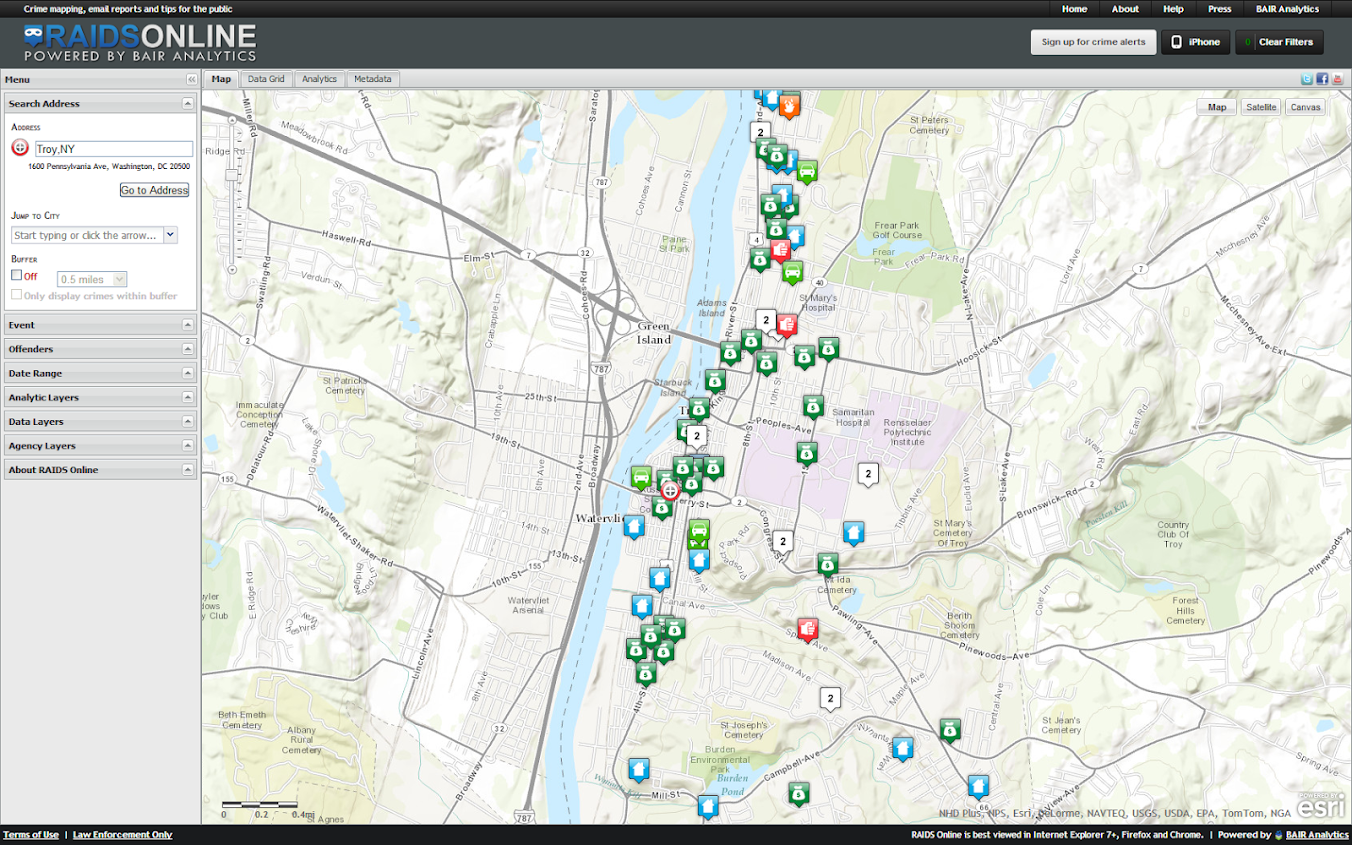
One of the big projects I have been working on since joining the Troy Police Department as a crime analyst last fall is producing timely geocoded data. I am happy to say that a fruit of this labor is the public crime map, via RAIDS Online, that has finally gone public (and can be viewed here). The credit for the online map mainly goes to BAIR Analytics and their free online mapping platform. I merely serve up the data for them to put on the map.

I’ve come to believe that more open data is the way of the future, and in particular an online crime map is a way to engage and enlighten the public to the realities of crime statistics. Although this comes with some potential negative externalities for the police department, such as complaints about innacurracy, decreasing home prices, and misleading symbology and offset geocoding. I firmly believe though that providing this information empowers the public to be more engaged in matters of crime and safety within their communities.

I thank the Troy Police Department for supporting the project in spite of these potential negative consequences, and Chief Tedesco for his continual support of the project. I also thank Capt. Cooney for arranging for all of the media releases. Below is the current online news stories (will update with CW15 if they post a story).

Here I end with a list of reading materials I consider necessary for any other crime analyst pondering the decision whether to public crime statistics online. And I end by again thanking Troy PD for allowing me to publish this data, and BAIR for providing the online service that makes it possible with a zero dollar budget.


Let me know if I should add any papers to the list! Privacy implications (such as this work by Michael Leitner and colleagues) might be worth a read as well for those interested. See my geomasking tag at CiteUlike for various other references.